
Amazon affiliate links - we earn a commission.Affiliate disclosure

Buying guide · 12 min read · Updated 2026-11-07

Best Electric Tillers for Clay Soil (2026)

Which electric tillers have the amperage and tine steel to work clay? Five machines compared on motor headroom, tine layout and the moisture window.

James MillerBy James MillerLead Machine Editor5 machines comparedSpec-sheet verified
Best Electric Tillers for Clay Soil

At a glance

Our top picks

Side by side

Spec comparison

Clay is the hardest test for a small electric tiller. The soil particles are tiny and pack tightly, so the same motor that sails through loam can stall or skip across the surface.

The right machine for clay is chosen by sustained torque and tine steel, not marketing claims. Moisture matters as much as the motor, so this guide also covers the working window where clay breaks apart instead of smearing.

Before you buy

6 Criteria to Look For Before Buying an Electric Tiller for Clay Soil

  1. 01

    Motor headroom for clay

    Clay loads a motor harder than loam because the particles pack tightly and resist the tines. A 13.5 amp unit such as the RYOBI or Earthwise draws about 1,600 watts, while a 10.5 amp unit like the MZK draws about 1,260 watts. For clay beds above a few hundred square feet, choose 13.5 amps or more and consider the 15A BILT HARD.

  2. 02

    Tine steel and fastening

    Hardened steel tines resist bending when they strike stones or hardpan. The Greenworks 60V lists hardened steel tines, and the Earthwise uses fixed steel tines for rigidity. Check that fasteners are bolted, not stamped, and tighten them regularly since clay vibration loosens them.

  3. 03

    The clay moisture window

    Clay is only workable within a narrow moisture range. Squeeze a handful: if it forms a ball that crumbles when poked, it is ready. If it smears like putty, it is too wet and tilling will create hard clods. Dry clay is almost impossible to penetrate, so water the bed the day before if needed.

  4. 04

    Width versus torque

    A wider head spreads the same motor power across more soil. The 18 inch BILT HARD has 15 amps to cover that width, while the 12.5 inch MZK has 10.5 amps for a narrower path. In clay, a narrower head can feel stronger, so do not assume wide is better.

  5. 05

    Corded versus battery

    Corded machines hold power as long as you have an outlet, which suits clay. The Greenworks 60V offers a brushless motor and no cord but a limited runtime. Cordless is a fit only for small beds. If you do go cordless, a second battery is worth more than a bigger charger, because clay work drains a 4.0Ah pack quickly and charging takes much longer than the job.

  6. 06

    Depth expectations

    Rated depths of 8 inches on the RYOBI, Earthwise and MZK assume loose soil. In clay expect 3 to 5 inches on the first pass and add passes at lower depth. Never force the machine to dig deeper by leaning forward; let the tines work.

Detailed reviews

The 5 best electric tillers for clay soil, explained

01
RYOBI 16 inch 13.5A corded cultivator, 6 tines
13.5A corded16 in wide8 in deep6 steel tines
Check price on Amazon
Best for: Gardeners with previously worked clay who want a proven corded machine.

The RYOBI pairs a 13.5 amp motor, about 1,600 watts at 120 volts, with six steel tines that cultivate 16 inches wide and 8 inches deep. In clay the limiting factor is torque at the tines, and a gear-reduced 13.5 amp motor holds speed in firm soil better than any cordless unit in this guide.

The tradeoff is the usual front-tine behavior. The tines pull the machine forward, so in dry clay you make shallow passes, about 3 to 4 inches at a time, instead of one deep cut. It is a lighter design, which helps maneuvering but means you provide the downward pressure by leaning back on the handle. Compared with the Earthwise 16 inch with fixed tines, it offers the same amp rating and width, so the choice comes down to brand support and handle comfort. In practice the RYOBI is the machine most owners would reach for first when the bed is workable but firm, because its lighter frame is easier to turn at the end of a row. Its six tines also leave a finer tilth than the four-tine heads sold at lower price tiers, which saves a second raking pass.

For ownership, clean the clay from between the tines before it dries, because dried clay becomes concrete-like and adds load next season. Use a heavy-gauge extension cord and store the machine dry.

What works

  • 13.5A holds speed in firm clay
  • Six tines break clods finely
  • Lightweight for a 16 inch machine
  • Widely supported brand

Watch out for

  • Front tines ride up in dry clay
  • Needs a heavy-gauge extension cord

Spec sheet

Power
13.5A corded
Width
16 inches
Depth
Up to 8 inches
Tines
6 steel
Design
Lightweight front-tine
02
Earthwise TC70016EW 16 inch 13.5A tiller, fixed tines
13.5A corded16 in wide8 in deepFixed tines
Check price on Amazon
Best for: Gardeners who prefer a simple start switch and a rigid fixed-tine head.

The Earthwise uses a 13.5 amp motor with fixed steel tines, a 16 inch width and 8 inch depth. Fixed tines are permanently mounted rather than adjustable or removable, which gives a rigid head that transmits torque directly into clay without play.

The tradeoff is flexibility. You cannot remove tines to narrow the path in a tight row, and a bent tine means replacing the assembly rather than a single piece. The push-button start with a single operating lever is easier on cold, stiff hands than a two-hand bail. Against the RYOBI it has the same headline specs, so the Earthwise is the one to choose for the control layout and the fixed-tine rigidity.

Check bolts regularly, because vibration in clay loosens fasteners. Rinse tines after use and dry the machine. Store the cord loosely coiled to avoid kinks. Over a few seasons the main wear points are the tine edges and the switch, so rotate the work direction between passes and keep the switch free of dirt. Fixed tines mean you should inspect them for bends after any stone strike, since a bent set throws the machine off balance and loads the bearings unevenly.

What works

  • 13.5A motor matches the RYOBI
  • Rigid fixed-tine head
  • Single lever, push-button start
  • Padded grip

Watch out for

  • Width cannot be narrowed
  • Fixed tines are harder to service

Spec sheet

Power
13.5A corded
Width
16 inches
Depth
8 inches
Tines
Fixed steel
Controls
Push-button, single lever
03
BILT HARD 18 inch 15A corded tiller, 6 tines
15A corded18 in wide6 tines380 RPM
Check price on Amazon
Best for: Larger clay plots where you want the most motor headroom.

The BILT HARD has a 15 amp, 120 volt motor and six steel blades at about 380 RPM across an 18 inch path. It has the most motor headroom in this guide, about 1,800 watts, which is exactly what firm clay demands.

The tradeoff is that 18 inches is a wide head, and in clay it wants a firm grip. If the tines catch a hardpan edge, the machine can twist the handles. At 15 amps it also leaves little margin on a shared household circuit, so run it on its own outlet. Compared with the 16 inch RYOBI, it adds two inches of width and 1.5 amps of motor capacity.

Being a newer-brand listing, its parts support is an unknown. Clean the clay off the tines after use and check the cord insulation each season.

What works

  • 15A motor has the most headroom
  • 18 inch path covers ground fast
  • Six tines give a fine tilth
  • Foldable handle

Watch out for

  • Wide head can twist on hardpan
  • Newer brand with unknown parts supply

Spec sheet

Power
15A, 120V
Width
18 inches
Tines
6 steel
Tine speed
380 RPM
Handle
Foldable
04
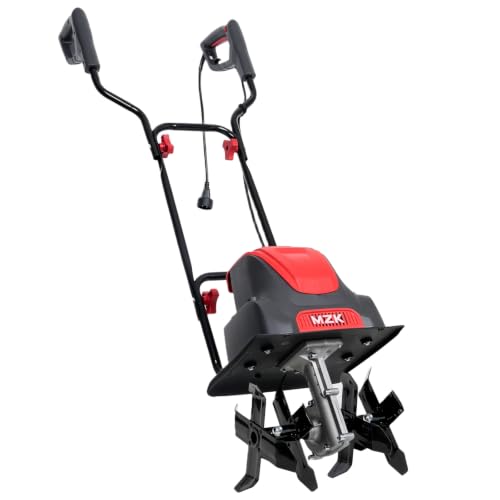
MZK 12.5 inch 10.5A electric tiller, 8 inch depth
10.5A corded12.5 in wide8 in deep430 RPM
Check price on Amazon
Best for: Small clay beds and a lower-cost corded option.

The MZK uses a 10.5 amp motor, about 1,260 watts, with a narrower 12.5 inch path and a quoted 430 RPM tine speed, which is faster than the 360 to 400 RPM of most rivals. A narrower head concentrates the motor power on less soil, so in clay it behaves better than its amp rating suggests.

The tradeoff is that it needs more passes and has less margin than the 15 amp BILT HARD. It will work well on a clay raised bed or small vegetable patch, but it is not the tool for a big plot. A higher RPM can also pulverize clay into dust if overworked, so keep the soil moist.

It is a lesser-known brand, so keep expectations modest on lifespan. Clean it after use and avoid running it in wet clay. A practical trick is to pair it with the Earthwise or RYOBI in a two-machine plan: the narrow MZK handles tight spots between plants while the bigger unit does the open ground. Its copper-wound motor should be allowed to cool if the housing gets hot after a long session in dense soil.

What works

  • Narrow head focuses the motor on less soil
  • Faster tine speed of 430 RPM
  • Reasonable 8 inch depth
  • Light to carry

Watch out for

  • Needs more passes in large plots
  • Lower headroom than 13.5A machines

Spec sheet

Power
10.5A corded
Width
12.5 inches
Depth
8 inches
Tine speed
430 RPM
Motor
Copper winding
05
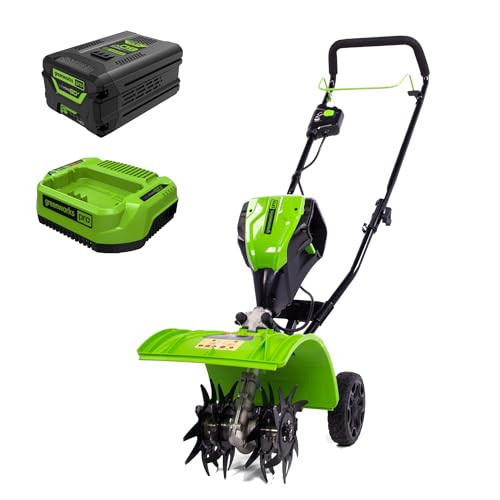
Greenworks 60V 8 inch brushless cordless tiller kit
60V brushless8 in path4.0Ah packHardened tines
Check price on Amazon
Best for: Clay beds with no outlet nearby or an existing 60V battery system.

The Greenworks 60V Pro uses a brushless motor with a 60 volt UltraPower battery and hardened steel tines on an 8 inch path. Brushless motors give more torque per watt, less heat and longer life than brushed ones.

The tradeoff is that cordless power is capacity-limited and 8 inches is narrow. In firm clay it will manage small beds, but it will not match a 13.5 amp corded unit on sustained work. It is the right pick if you cannot run a cord or already own 60V tools.

Store the battery indoors and keep tine clay clean. Remove the battery before clearing jams. Compared with the corded 13.5 amp machines it is quieter and has no cord to drag over freshly tilled soil, which is a real advantage when you are working a small bed you do not want to walk on. Expect to charge between beds, and avoid forcing it through dry clay, where brushless motors will thermally limit to protect the cells.

What works

  • Brushless motor gives better torque per watt
  • No cord to manage
  • Hardened steel tines
  • Includes 4.0Ah battery and charger

Watch out for

  • 8 inch path is narrow
  • Runtime limits large jobs

Spec sheet

Power
60V brushless
Width
8 inches
Battery
4.0Ah included
Tines
Hardened steel
Use
Beds and borders

Spec sheet decoder

What the numbers on the box really mean

The specs manufacturers lead with, translated into what they tell you about real-world performance.

Amps

Current draw at 120 volts. Watts equal amps times volts, so 13.5A is roughly 1,600 watts.

Watch forThe RYOBI and Earthwise both list 13.5A, the BILT HARD 15A.

Tine RPM

How fast the tines rotate after the gear reduction. Faster tines pulverize soil, slower ones bite harder.

Watch forMZK lists 430 RPM while BILT HARD lists 380 RPM.

Brushless motor

A motor without carbon brushes that is more efficient and needs less service.

Watch forThe Greenworks 60V is brushless; most corded units here are brushed.

Fixed versus removable tines

Fixed tines are rigid and cannot be narrowed. Removable tines let you change width.

Watch forEarthwise uses fixed tines.

Tilling depth

Maximum depth in loose soil. Clay reduces it significantly.

Watch for8 inch claims on the RYOBI mean 3 to 5 inches in firm clay.

Methodology

How We Evaluated These Electric Tillers for Clay Soil

Torque and motor headroom

We compared amp ratings and motor types because clay stalls weak motors. The 15A BILT HARD leads, the 13.5A RYOBI and Earthwise follow, and the 10.5A MZK sits below. Brushless cordless was judged separately.

Tine strength

We looked at tine steel, whether tines are fixed or removable and how they are fastened. Hardened steel on the Greenworks was noted. Fixed tines on the Earthwise were judged for rigidity.

Control in firm soil

We considered handle design, start controls and machine weight. Lighter units like the RYOBI are easy to steer but need you to lean on the handle. Wider heads were assessed for twisting risk.

Power source practicality

Corded and cordless were weighed for sustained clay work. Corded wins for torque and runtime, cordless wins for convenience. We flagged runtime limits on the Greenworks.

Ownership

Based on the spec sheet and owner feedback patterns, we weighed cleaning, brush wear, bolt tightness and parts support. Established brands scored better on support than newer listings.

Decision guide

How to Choose the Right Electric Tillers for Clay Soil

By Clay Condition

SituationPickWhy
Previously worked clay bedRYOBI 16 inch 13.5AProven torque for moist clay
Compacted, rarely worked clayBILT HARD 18 inch 15AMost motor headroom
Small clay raised bedMZK 12.5 inch 10.5ANarrow head concentrates power
Clay with no outlet nearbyGreenworks 60V 8 inchBrushless cordless torque
Clay with occasional stonesEarthwise 16 inch fixed tinesRigid head resists bending

By Budget

TierPickWhy
Lowest costMZK 12.5 inch 10.5ACheapest corded option
Mid tierBILT HARD 18 inch 15AHigh output for the price tier
Mid-high tierEarthwise 16 inchFixed tines and simple controls
Brand-backedRYOBI 16 inchEstablished support
Highest costGreenworks 60V kitBattery and charger included

Corded vs Cordless on Clay

Corded

The RYOBI, Earthwise, BILT HARD and MZK hold power as long as they are plugged in. They are better for clay because torque does not fade. You manage a cord.

Cordless

The Greenworks 60V runs without a cord and has a brushless motor. It is limited by battery capacity and an 8 inch width, so it suits small clay beds.

Choose corded for any clay plot beyond a few beds.

Tine Layout

PreferencePickWhy
Fine tilthRYOBI 16 inchSix tines give a fine finish
Rigid headEarthwise 16 inchFixed tines
Fastest tine speedMZK 12.5 inch430 RPM
Widest passBILT HARD 18 inch18 inches
Narrowest rowsGreenworks 60V8 inch path

For Breaking Hardpan Specifically

Look for

Look for the highest amp rating available, hardened tines and a heavy handle that you can lean back on. Hardpan below 4 inches needs a spade fork first.

In this comparison

The BILT HARD 18 inch 15A has the most headroom, followed by the RYOBI 13.5A. None of these machines replaces a gas rear-tine tiller for virgin hardpan.

When to Spend More

Spend more if

Spend more if the clay plot is large or you want a brand-supported motor. The RYOBI 13.5A and BILT HARD 15A give extra torque.

Save if

Save if you only work a bed or two. The MZK 10.5A is enough for small clay beds.

Ownership

Maintenance schedule

The upkeep that decides whether this machine lasts two seasons or ten.

TaskIntervalWhy it matters
Remove clay from tinesEvery sessionDried clay hardens and adds load. Use a stick or hose before it sets.
Tighten tine boltsMonthly in seasonClay vibration loosens fasteners. Loose tines wobble and wear the shaft.
Inspect the cordBefore each seasonDamaged insulation is a shock risk. Replace or repair promptly.
Check motor brushesEvery 2 to 3 seasonsBrushed motors lose power when brushes wear. Replace them before sparking starts.
Battery careWinter storageStore the Greenworks pack indoors and part-charged to protect cell life.

FAQ

Frequently Asked Questions

Can an electric tiller handle clay?

Yes, if the clay has been worked before and is at the right moisture. A 13.5A or 15A corded unit works best. For virgin clay, break it with a spade fork or a gas machine first.

How wet should clay be?

Squeeze a handful: it should hold a ball but crumble when poked. If it smears, wait. If it is rock hard, water it lightly the day before.

Do I need 15 amps?

Not always. 13.5A is enough for most clay beds. 15A gives extra headroom for larger or firmer areas.

Are cordless tillers any good in clay?

They work in small, loosened clay beds. The Greenworks 60V brushless is the best here, but runtime and width limit it.

Why does the tiller bounce on the surface?

Front tines ride up in hard clay. Lean back to put pressure on the tines, take shallow passes and moisten the soil.

Should I add compost?

Yes. Organic matter improves clay structure over time. Till it in once the clay is workable, and avoid adding sand, which can make clay set harder.

Bottom line

The short version

Browse more electric tillers for clay soilon Amazon →
James Miller, Lead Machine Editor

About the author

James Miller

Lead Machine Editor, MachineFanatic

James Miller leads MachineFanatic's buying guides, turning spec sheets, manuals and owner feedback into clear verdicts on power tools, outdoor power equipment, shop machines and kitchen machines.

More from James →

Keep reading

Related guides