


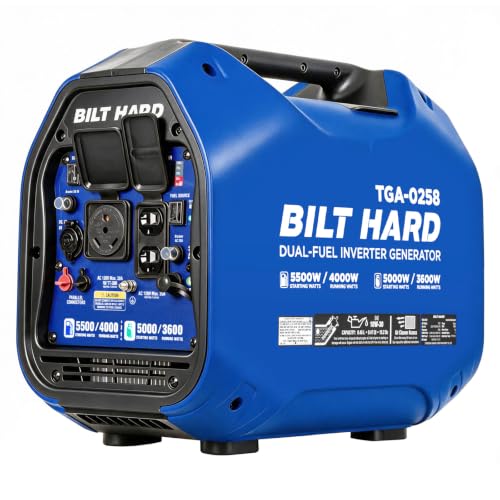
The key camping number here is not the wattage but the runtime: eight hours at a quarter load on a small 1.3 gallon tank, or a full day on a standard 20 pound grill cylinder. That propane option is a real convenience, because you can use the same bottle that feeds the camp stove or swap it at any gas station, and the output only drops by about 200 watts to 3,100 running.
The 59 dBA noise rating at 23 feet is the figure that matters in a crowded campground, where hosts listen for bark. It reaches that level in Eco mode, so with a larger load the engine speeds up and gets louder, but at night with only lights it stays out of the conversation.
Like all lightweight inverters, it hides electronics inside a compact case, so keep it in the shade and clear of dirt. Run the carburetor dry on gasoline before winter, and keep the propane hose out of direct sun between trips. Compared with the WEN 4800 you give up a few hundred rated watts, but you also carry a lighter and cheaper machine.
What works
- Day-long runtime on a 20 pound propane tank
- 59 dBA rating at 23 feet suits busy campgrounds
- Only about 200 watts lost on propane
- Small 1.3 gallon tank keeps the frame compact
Watch out for
- The quiet rating applies at light Eco mode load
- Small gas tank needs refueling in a full day of use
Spec sheet
- Gas output
- 3,800 start, 3,300 running
- Propane output
- 3,500 start, 3,100 running
- Gas runtime
- 8 hours at 25% load, 1.3 gallons
- Propane runtime
- 24 hours, 20 lb tank
- Noise
- 59 dBA at 23 feet