
Amazon affiliate links - we earn a commission.Affiliate disclosure

Buying guide · 15 min read · Updated 2026-11-06

Best Inverter Generators for Camping (2026)

Six camping inverter generators compared on running watts, weight, noise, fuel type and campground rules, from 26 lb carry units to 3,600 W dual fuel.

James MillerBy James MillerLead Machine Editor6 machines comparedSpec-sheet verified
Best Inverter Generators for Camping

At a glance

Our top picks

Side by side

Spec comparison

MachineOutputNoiseWeightFuel tankWarranty
Honda EU2200i 2200W Inverter GeneratorBest OverallHonda EU2200i 2200W Inverter Generator2,200 W peak, 1,800 W running48 to 57 dBAJust over 47 lb0.95 gal, 3.2 to 8.1 h3 years residential
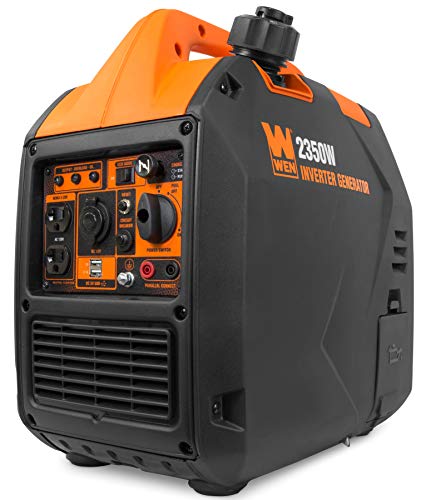
WEN 56235i 2350W Super Quiet Inverter GeneratorBest Value Gas PickWEN 56235i 2350W Super Quiet Inverter Generator2,350 W surge, 1,900 W runningn/a39 lbn/a2 years
Generac GP3300i 3300W Inverter GeneratorBest for Camper ACGenerac GP3300i 3300W Inverter Generator3,300 W starting, 2,500 W runningn/a59.5 lb1.06 gal3 years
WEN DF360iX 3600W Dual Fuel Inverter GeneratorBest Dual FuelWEN DF360iX 3600W Dual Fuel Inverter Generatorn/an/an/an/a3 years
AIVOLT 1750W 26.5 lb Inverter GeneratorBest LightweightAIVOLT 1750W 26.5 lb Inverter Generator1,750 W peak, 1,350 W running52 dBA26.5 lb0.66 gal, 7 h at 25% load2 years
GK 1600W 26 lb Portable Inverter GeneratorBest Budget UltralightGK 1600W 26 lb Portable Inverter Generator1,600 W peak, 1,200 W rated58 dB at 23 ft26 lbn/an/a

An inverter generator is a small gasoline or propane engine that turns a high frequency alternator into clean, stable electricity. Campers choose them over open frame generators because they are lighter, quieter and safe for phones, laptops and medical devices. The buying problem is that listing numbers mix peak and running watts, and weight and noise often matter more at a campsite than raw output.

This guide explains how to size a camping generator from your actual loads, how noise and campground rules change the decision, and what fuel and safety features are worth paying for. Start with the picks above for a fast shortlist, then read the reviews below to match a machine to your camper, your carry distance and your tolerance for maintenance.

Before you buy

6 Criteria to Look For Before Buying an Inverter Generator for Camping

  1. 01

    Running watts versus peak watts

    Peak watts are a brief burst for starting motors, while running watts are the load a generator can carry for hours. A 2,200 watt Honda EU2200i headline hides about 1,800 running watts, and the AIVOLT's 1,750 peak figure covers 1,350 running watts. Add the running watts of everything you plan to use together, then check the biggest motor's starting surge against the peak rating. Buying on the headline number is the most common reason a camping generator trips when the coffee maker and the microwave run together. For electronics-only camping, the 1,200 watt GK 1600W is enough, while a rooftop AC needs the 2,500 running watts of the Generac GP3300i.

  2. 02

    Weight and carry distance

    A generator that is too heavy to move gets left at home or placed too close to the camper. The AIVOLT 1750 at 26.5 pounds and the GK 1600W at about 26 pounds carry one handed, the WEN 56235i at 39 pounds is a two-handed lift, the Honda EU2200i weighs just over 47 pounds and the Generac GP3300i weighs 59.5 pounds. Add the weight of a full tank and a fuel can when you plan the carry. If you load and unload from a truck bed or a trailer hitch carrier every trip, aim for 50 pounds or less.

  3. 03

    Noise at the campsite

    Most campgrounds enforce quiet hours, commonly in the evening and overnight, and many restrict generator hours entirely. Inverter engines slow down at light load, so a decibel figure measured at 25 percent load is the best case. The Honda EU2200i quotes 48 to 57 dBA, the AIVOLT quotes 52 dBA and the GK 1600W quotes 58 dB at 23 feet. A difference of 6 to 10 dBA is noticeable at the next campsite, and sound rises under load, so pad the figure when you plan to run an air conditioner.

  4. 04

    Fuel type and storage

    Gasoline stored for weeks loses potency, absorbs water and leaves varnish in the carburetor, which is the leading cause of a generator that will not start in spring. Propane keeps indefinitely and burns cleaner, which is why the dual fuel WEN DF360iX is useful for occasional campers, though its output falls from 2,900 to 2,600 rated watts on propane. For gasoline machines such as the Honda or the WEN 56235i, use stabilizer and either run the carburetor dry or use the fuel shutoff before storage. Buy ethanol-free fuel if it is available near you.

  5. 05

    CO protection and placement

    Every gasoline or propane engine produces carbon monoxide, and campers die each year from running generators too close to tents or campers. A CO shutdown sensor, as fitted to the Honda CO-Minder, the Generac COsense, the WEN DF360iX Watchdog and the AIVOLT, is a safety net rather than a license to place the generator carelessly. Keep the exhaust pointed away from sleeping areas and at least 20 feet from the camper, and run a battery CO alarm inside. The WEN 56235i has no sensor, so the separate alarm matters even more with that one.

  6. 06

    Spark arrestor and local rules

    Many national forests and dry-season campgrounds require a USDA qualified spark arrestor on any engine, and some jurisdictions restrict generator use during fire danger. The Generac GP3300i states a USDA qualified arrestor, which is a real advantage at western sites. Check the rules for each destination before you leave, and keep the exhaust area clear of dry grass and leaves. Buying a machine without the correct arrestor can mean paying to add one or being told to shut it off.

Detailed reviews

The 6 best inverter generators for camping, explained

01
Honda EU2200i 2200W Inverter Generator
1,800 W running48 to 57 dBA47 lb0.95 gal tank
Check price on Amazon
Best for: Campers who want the quietest, most dependable 2,000 watt class machine and will pay a premium for it.

The EU2200i earns the top spot because it does the camping job better than anything else here at the weight a person can carry from a tailgate to a site. The inverter design lets the engine slow down when the load drops, and Honda quotes 48 to 57 dBA, which is the range where a neighbor two sites over hears a hum instead of an engine. Run time stretches from about 3.2 hours at full load to as much as 8.1 hours on its 0.95 gallon tank when the load is light, so a phone, a CPAP and a few lights can run all night on one fill.

The tradeoff is output. At 1,800 running watts it will start a small camper air conditioner only if you pair it with a soft start, and it cannot run a 13,500 BTU unit with anything else on. Against the Generac GP3300i, which delivers 2,500 running watts, you give up about 700 watts in exchange for roughly 12 pounds less weight and a noticeably quieter engine note. Against the AIVOLT 1750, which weighs 26.5 pounds, the Honda is the heavier lift but carries more than 450 extra running watts.

Ownership is where a Honda separates itself. The CO-Minder sensor shuts the engine down if carbon monoxide builds near the unit, the Bluetooth app reminds you of service intervals, and the three year residential warranty is the longest in this roundup alongside Generac and WEN's dual fuel unit. Parts and dealer support are easy to find, which matters in year five when a carburetor needs cleaning after a winter of storage. Add fuel stabilizer before you park it, and run the carburetor dry or use the fuel valve as the manual describes.

What works

  • Quoted 48 to 57 dBA is among the quietest in this class
  • Eco Throttle stretches one tank to as much as 8.1 hours
  • CO-Minder shuts the engine off if carbon monoxide builds up
  • Dealer network and parts supply are the best of any pick here

Watch out for

  • Premium price compared with the other picks in this roundup
  • 1,800 running watts is not enough for a camper AC plus extras
  • Not sold in California, where Honda points buyers to other models

Spec sheet

Output
2,200 W peak, 1,800 W running
Noise
48 to 57 dBA
Weight
Just over 47 lb
Fuel tank
0.95 gal, 3.2 to 8.1 h
CO protection
CO-Minder shutdown
Connectivity
Bluetooth service app
Warranty
3 years residential
02
WEN 56235i 2350W Super Quiet Inverter Generator
1,900 W running2,350 W surge39 lbFuel shut-off
Check price on Amazon
Best for: Weekend campers who want a lightweight 1,900 watt machine and a lower entry price than Honda.

WEN's 56235i is the sensible budget answer to the Honda. It gives you 1,900 rated watts and 2,350 surge watts, which is actually 100 watts more running capacity than the EU2200i quotes, and it comes in lighter at 39 pounds. That makes it the easiest of the true 2,000 watt class machines to load into a trunk, and it is the one to look at if you camp a few weekends a year and want a clean sine wave for phones, laptops and a small TV without spending premium money.

Where it gives ground is refinement. WEN describes the noise as comparable to a normal conversation, but it does not publish a decibel range as low as Honda's 48 dBA at idle, so expect a louder neighbor-annoyance factor under load. There is also no carbon monoxide shutdown on this model, unlike the DF360iX in the same lineup, the Generac GP3300i or the Honda. If you camp in a trailer or near a tent, a separate battery CO alarm is not optional.

The fuel shutoff is the feature that helps in year three. Closing the valve and letting the carburetor run dry before storage keeps ethanol varnish from clogging the jets, which is the number one reason small generators refuse to start in spring. The warranty is two years, one year shorter than Honda, Generac or the dual fuel WEN, so keep your receipt. Parts are common and the machine is simple enough that a patient owner can service it.

What works

  • Rated at 1,900 watts, more running power than the Honda EU2200i
  • Weighs only 39 pounds so one person can load it alone
  • Fuel shutoff lets the carburetor run dry before storage
  • Two 120 V outlets plus 12 V DC and USB cover typical campsite loads

Watch out for

  • No CO shutdown sensor, so a separate CO alarm is required
  • Two year warranty is shorter than the three year picks
  • Noise is quoted only as conversation level, with no dBA range

Spec sheet

Output
2,350 W surge, 1,900 W running
Weight
39 lb
Outlets
Two 120 V, one 12 V DC, two USB
Fuel system
Fuel shutoff valve
Fuel
Gasoline only
Warranty
2 years
03
Generac GP3300i 3300W Inverter Generator
2,500 W running3,300 W starting59.5 lbCOsense shutdown
Check price on Amazon
Best for: Campers with a rooftop AC who need around 2,500 running watts without moving to a heavy open frame machine.

The GP3300i is the pick for a camper with a rooftop air conditioner. Its PowerRush feature pushes the starting capacity to 3,300 watts, about 50 percent over the running rating, which is the kind of reserve a compressor needs on startup. At 2,500 running watts it clears the typical 1,300 to 1,500 watt run draw of a 13,500 BTU rooftop unit with a little room left for a converter and lights, which none of the sub 2,000 watt machines here can do.

The cost is weight and fuel appetite. At 59.5 pounds it is the heaviest generator in this roundup that one person can still lift, roughly 12 pounds more than the Honda EU2200i. The 1.06 gallon tank gives up to 7 hours at 25 percent load but only about 4.5 hours at 50 percent, so running an AC overnight means a refill before morning. Against the WEN DF360iX, which has 2,900 running watts on gasoline and a propane option, the Generac gives up some output and fuel flexibility but gains a quieter Economy Mode and a 30 amp twist lock outlet.

It includes a USDA qualified spark arrestor, which is the detail many campers overlook until a ranger asks about it in dry national forest country. COsense monitors carbon monoxide and shuts the engine down. The warranty is three years and Generac's service network is broad, but check oil level before every run because the engine has a low oil shutdown rather than a gauge. A parallel kit, sold separately, lets you pair two for a larger rig.

What works

  • PowerRush lifts starting capacity to 3,300 watts for compressors
  • COsense shuts the engine down when carbon monoxide builds
  • USDA qualified spark arrestor suits national forest camping
  • Thirty amp twist lock outlet connects straight to an RV cord

Watch out for

  • At 59.5 pounds it is a real lift compared with 26 pound units
  • Tank gives only about 4.5 hours at 50 percent load
  • A 1.06 gallon tank means a refill during an overnight AC run

Spec sheet

Output
3,300 W starting, 2,500 W running
Weight
59.5 lb
Fuel tank
1.06 gal
Run time
7 h at 25% load, 4.5 h at 50%
Outlets
Two 120 V 20 A, one 120 V 30 A twist lock, USB-A
THD
Under 3%
Spark arrestor
USDA qualified
Warranty
3 years
04
WEN DF360iX 3600W Dual Fuel Inverter Generator
2,900 W gas running2,600 W propaneCO WatchdogTT-30R outlet
Check price on Amazon
Best for: Campers who want to run off a propane cylinder and need a TT-30R outlet for a travel trailer.

The DF360iX is the only machine in this camping lineup that can run on propane, and that matters more than it sounds. Gasoline sitting in a small tank for a season goes stale and gums up a carburetor, while propane stores indefinitely in a sealed cylinder and burns cleaner. Gasoline output is 2,900 rated watts and 3,600 surge, and propane drops to 2,600 rated and 3,500 surge, a derate of about 10 percent that you should plan around.

It also has the most useful RV outlet in the group, a TT-30R receptacle that accepts a standard 30 amp RV shore power cord without an adapter. That is better than the Generac's twist lock only if your camper uses a TT-30 plug, and most travel trailers do. WEN gives it a CO Watchdog shutdown sensor and a three year warranty, a step up from the two year coverage on the single fuel WEN 56235i. The tradeoff is size: it is considerably heavier than the 39 pound 56235i and fits in a trunk only with room to spare.

For ownership, the propane connection is a tool-free quick connector, so you can attach a standard 20 pound grill cylinder without a regulator kit. Keep the cylinder upright and secured, and inspect the hose for cracks each season. Running on propane also lets you leave the gasoline tank empty and the carburetor dry during storage, which solves the most common failure on camping generators.

What works

  • Runs on gasoline or propane for flexible fuel at the campsite
  • TT-30R outlet takes a standard 30 amp RV cord directly
  • CO Watchdog shuts down on dangerous carbon monoxide
  • Propane keeps well in storage, avoiding stale gasoline problems

Watch out for

  • Propane output drops to 2,600 rated watts from 2,900 on gasoline
  • Heavier and bulkier than the single fuel WEN 56235i
  • Dual fuel conversion adds components that need a periodic check

Spec sheet

Gasoline
3,600 W surge, 2,900 W rated
Propane
3,500 W surge, 2,600 W rated
RV outlet
TT-30R 30 A
Safety
CO Watchdog shutdown
Other outlets
Two 120 V, 12 V DC, two USB
Warranty
3 years
05
AIVOLT 1750W 26.5 lb Inverter Generator
1,350 W running1,750 W peak26.5 lb52 dBA
Check price on Amazon
Best for: Backpack and hike-in campers who need clean power for electronics at the lowest possible carry weight.

The AIVOLT is for the camper who counts pounds. At 26.5 pounds it can be carried one handed, which makes it practical for hike-in sites, kayak camps and tailgates where a 47 pound Honda is a chore. It delivers 1,350 running watts and 1,750 peak watts, enough for a CPAP, laptop, string lights, a coffee maker on its own or a 12 volt battery charger, and it quotes 52 dBA with a CO shutoff and under 3 percent harmonic distortion.

Its limit is the small engine and tank. The 0.66 gallon tank delivers up to 7 hours at 25 percent load, about the same as the Generac GP3300i's 1.06 gallons, but at light load only. Compared with the GK 1600W, which quotes 1,200 running watts, the AIVOLT adds 150 watts and a similar weight. Against the WEN 56235i's 1,900 running watts it gives up about 550 watts, which is the difference between running a microwave and not running one.

The warranty is two years, and this is a newer brand without the dealer network of Honda or Generac, so price it as a lightweight convenience rather than a long-term workhorse. Engine oil is not included, so add it before first start. As with every small generator, use fresh fuel and stabilizer, and keep the carburetor from sitting full over the winter.

What works

  • At 26.5 pounds it carries with one hand to remote sites
  • Quoted 52 dBA keeps campground noise complaints unlikely
  • Built in CO detection shuts the engine down automatically
  • ECO mode gives up to 7 hours at 25 percent load

Watch out for

  • 1,350 running watts rules out any camper air conditioner
  • Newer brand with a thinner parts and dealer network
  • Engine oil is not included, so add it before first use

Spec sheet

Output
1,750 W peak, 1,350 W running
Weight
26.5 lb
Noise
52 dBA
Fuel tank
0.66 gal, 7 h at 25% load
THD
Under 3%
Safety
CO auto shutoff
Warranty
2 years
06
GK 1600W 26 lb Portable Inverter Generator
1,200 W running1,600 W peak26 lb58 dB at 23 ft
Check price on Amazon
Best for: Budget campers who only need to charge electronics and run a few small appliances.

The GK 1600W is the lightest and smallest of the lot, built around a 60cc engine that quotes 1,200 rated watts and 1,600 peak. The pitch is the same as the AIVOLT: carry it anywhere and charge phones, tablets and a laptop with clean power, with a quoted total harmonic distortion below 2 percent. Its 58 dB at 23 feet measurement is useful because it is quoted at a stated distance, which makes it easier to compare than a bare decibel number.

Against the AIVOLT it has slightly less output, 1,200 versus 1,350 running watts, but quotes a longer run time of up to 8 hours at 25 percent load. Both are in the same 26 pound class and both are far below the 1,900 watts of the WEN 56235i. The practical limit is one appliance at a time: a 700 watt microwave is workable, but a coffee maker plus a space heater plus a TV will overload it. Parallel capability, using a kit sold separately, is a nice path to double the output if you decide you need more.

Ownership tradeoffs are about support. It carries low-oil and overload shutdowns plus CO protection, but it comes from a less established seller than Honda, Generac or WEN, so confirm warranty terms and parts availability at purchase. Treat it as a lightweight second generator rather than a primary one, and keep fuel fresh.

What works

  • Quoted total harmonic distortion under 2 percent is clean
  • Weighs about 26 pounds and fits easily in a compact car
  • Parallel capable so two units can share a larger load
  • Eight hour quoted run time at 25 percent load is the longest here

Watch out for

  • 1,200 running watts handles only one small appliance at a time
  • Smaller brand with limited dealer or parts network
  • Not strong enough to start any camper air conditioner

Spec sheet

Output
1,600 W peak, 1,200 W rated
Engine
60cc gasoline
Weight
26 lb
Noise
58 dB at 23 ft
THD
Under 2%
Run time
Up to 8 h at 25% load
Parallel
Capable, kit sold separately

Spec sheet decoder

What the numbers on the box really mean

The specs manufacturers lead with, translated into what they tell you about real-world performance.

Running watts

The power an inverter generator can deliver continuously without overheating or tripping. This is the number to compare against the total of your loads.

Watch forListings often lead with peak watts, such as 1,750 for the AIVOLT or 1,600 for the GK, while the 1,350 and 1,200 running watts sit lower in the text.

Starting watts

A short burst of extra power, usually held for a few seconds, that lets a motor or compressor spin up. It is higher than the running rating because a motor draws several times its running current at startup.

Watch forThe Generac GP3300i quotes 3,300 starting watts against 2,500 running, so the starting figure only helps if the load is a single compressor and not several loads at once.

THD

Total harmonic distortion measures how far the output waveform strays from a perfect sine wave. Under 3 percent is the usual mark for electronics-safe power.

Watch forThe GK quotes under 2 percent and the AIVOLT and Generac quote under 3 percent. Check the figure applies across the load range, not only at light load.

dBA at 25% load

A sound pressure measurement taken at a fixed distance with the generator at a light load, where an inverter engine runs slowly. It is the best case, not the typical case.

Watch forHonda's 48 to 57 dBA range spans idle to rated load. A bare figure such as 52 dBA for the AIVOLT says nothing about heavier loads.

Run time at 25% load

How long a full tank lasts when the machine carries one quarter of its rated output. Higher load means shorter run time.

Watch forThe Generac GP3300i's 7 hours at 25 percent falls to 4.5 hours at 50 percent, and the Honda's 8.1 hour best case falls to 3.2 hours at full load.

Methodology

How We Evaluated These Inverter Generators for Camping

Real running output

We compared running watts, not marketing peaks. The Honda EU2200i at 1,800 W, the WEN 56235i at 1,900 W, the Generac GP3300i at 2,500 W and the WEN DF360iX at 2,900 W on gasoline were set against the AIVOLT at 1,350 W and the GK at 1,200 W. Machines that publish only a peak figure were treated with caution.

Carry weight and footprint

Camping machines are carried, so weight was a primary measure, from the 26 pound GK and AIVOLT up to the 59.5 pound Generac. We looked at handle design and compact dimensions, and we noted when a spec sheet did not state weight. A heavy machine cost points unless its output justified it.

Noise and campground fit

We compared the quoted noise figures and the conditions behind them, such as the 58 dB at 23 feet on the GK and the 48 to 57 dBA range on the Honda. Quoted figures come from manufacturers, so we treated them as directional rather than exact.

Safety and compliance features

We looked for CO shutdown, low oil shutdown, spark arrestors and the quality of the outlet layout. The Honda, Generac, WEN DF360iX and AIVOLT list CO protection, and the Generac lists a USDA qualified spark arrestor. Missing CO protection, as on the WEN 56235i, counted against a pick.

Ownership and support

We compared warranties, with three years on the Honda, Generac and DF360iX and two years on the WEN 56235i and AIVOLT, plus fuel shutoff features and parts availability. Small brands with thin dealer networks were treated as a lower confidence choice for long-term use.

Decision guide

How to Choose the Right Inverter Generators for Camping

By Camping Style

Start from how you camp, because carry weight and output pull in opposite directions.

Camping styleRecommended pickWhy
Hike-in or kayak campsAIVOLT 1750W26.5 lb carry with 1,350 W running
Tent camping with electronicsHonda EU2200i48 to 57 dBA and 1,800 W running
Weekend trailer camping, no ACWEN 56235i1,900 W running at 39 lb
Camper with rooftop ACGenerac GP3300i2,500 W running, 3,300 W starting
Propane at the siteWEN DF360iX2,600 W on propane, TT-30R outlet
Lowest carry weight on a budgetGK 1600WAbout 26 lb with 1,200 W running

By Budget

Relative tiers only, since prices move.

Budget tierRecommended pickWhy
Lowest cost to ownGK 1600WCheapest way to get clean power
Low cost, lightweightAIVOLT 1750WAdds 150 W over the GK at similar weight
Mid tier valueWEN 56235iHighest running watts per dollar of the small units
Mid tier, more outputWEN DF360iXDual fuel and RV outlet
Upper mid tierGenerac GP3300iBest bet for AC with a three year warranty
PremiumHonda EU2200iQuietest and best supported

Light and Quiet vs Powerful and Heavy

The core tradeoff is that each extra 500 watts adds weight and noise.

Light and quiet

Smaller engines run slower, quieter and on less fuel. The AIVOLT 1750W at 26.5 pounds and the GK 1600W at 26 pounds, plus the Honda EU2200i at about 47 pounds, fit this group. They run phones, CPAPs, lights and a laptop, but not a camper air conditioner.

Powerful and heavy

Bigger engines carry a rooftop AC and a microwave together. The Generac GP3300i at 59.5 pounds and 2,500 running watts, and the WEN DF360iX at 2,900 running watts on gasoline, belong here. They cost you weight, fuel and noise.

Pick the light group if you camp with tents or a small trailer. Pick the powerful group only if you need to cool a camper.

By Fuel

Fuel choice drives storage and output.

Fuel preferenceRecommended pickWhy
Gasoline only, simpleHonda EU2200iEasy to service with a fuel shutoff routine
Gasoline with a fuel shutoffWEN 56235iLets the carburetor run dry
Propane to avoid stale fuelWEN DF360iXPropane quick connector, 2,600 W rated
Small tank, light useAIVOLT 1750W0.66 gal tank
Larger tankGenerac GP3300i1.06 gal, 7 h at 25% load

For Running a Camper Air Conditioner Specifically

Look for

A rooftop 13,500 BTU unit draws roughly 1,300 to 1,500 watts while running and several times that at startup. Look for at least 2,500 running watts, a 30 amp outlet, and ideally a soft start device. Anything under 2,000 running watts will struggle even with soft start.

In this comparison

The Generac GP3300i is the better pick for most trailers, with 2,500 running watts and 3,300 starting watts. The WEN DF360iX at 2,900 running watts on gasoline and a TT-30R outlet is the stronger electrical match if you can accept its extra weight.

When to Spend More

Spend more if

You camp in quiet-hours-only parks, store the machine for long periods, or want service nearby. The Honda EU2200i justifies a premium with its 48 to 57 dBA range and a three year warranty, and the Generac GP3300i is the upgrade for AC.

Save if

You camp a handful of weekends a year and only charge electronics. The WEN 56235i gives 1,900 running watts at a modest price, and the GK 1600W or AIVOLT 1750W cover phones and lights at the lowest weight.

Ownership

Maintenance schedule

The upkeep that decides whether this machine lasts two seasons or ten.

TaskIntervalWhy it matters
Check and change engine oilBefore every run, change after the first 20 hours, then every 100 hours or yearlySmall inverter engines hold under a pint of oil and rely on a low oil shutdown, so a low level can stop the machine or damage it. Fresh oil also protects the bearings during long camping weekends.
Treat or drain fuel for storageBefore any storage longer than 30 daysEthanol blends absorb moisture and leave varnish in the carburetor jets. Stabilizer or running the fuel line dry before storage is the cheapest insurance against a no-start in spring.
Clean the air filterEvery 50 hours, more often in dustA dirty filter starves the engine of air and raises fuel use. Camping in dry or sandy areas can clog the element faster than the manual interval suggests.
Inspect and clean the spark arrestorEvery 100 hours or each seasonCarbon buildup chokes exhaust flow and raises engine temperature. A clean arrestor also keeps you compliant in fire-restricted areas.
Replace the spark plugEvery 100 to 200 hoursA worn plug causes hard starts and rough running under load. The part is inexpensive and a quick swap restores smooth starting.
Test CO sensor and safety shutdownsAt the start of each camping seasonSensors fail silently if they are never checked. Follow the manual's test procedure and replace any unit that does not shut down as described.

FAQ

Frequently Asked Questions

How do I choose between a small inverter generator and a power station for camping?

A power station is silent, has no fuel and can charge from solar, so it suits phones, lights and a CPAP at a site with sun. An inverter generator keeps running as long as you have fuel, so it suits multi-day camps, cold weather and air conditioners. If your daily need is under about 1,000 watt-hours, consider a battery unit first. If you need an AC or cook with electric appliances, choose a generator like the Generac GP3300i.

How many watts do I need for camping?

Add the running watts of each appliance you want on at once: phone chargers use under 20 watts, a CPAP about 30 to 60 watts, a laptop under 100 watts, a coffee maker about 800 to 1,000 watts and a microwave about 1,000 watts. Then add the biggest motor's starting surge. Most tent campers are comfortable with 1,200 to 1,800 running watts, which covers the GK, the AIVOLT and the Honda EU2200i. A rooftop air conditioner pushes you to 2,500 or more.

Do cheaper inverter generators last as long as a Honda?

Not usually, but the gap depends on use. Honda's engines and dealer network have a long record, and the EU2200i carries a three year warranty. WEN and Generac offer lower prices with two or three year warranties and widely available parts. Smaller brands such as AIVOLT and GK should be treated as lighter-duty options until they build a service record.

Is peak wattage the same as the number on the generator name?

No. The number in a model name or listing is often the starting or peak figure, not what the generator sustains. The AIVOLT 1750W runs at 1,350 watts, and the Honda EU2200i is rated for about 1,800 running watts. Always read the running watts line on the spec sheet before you size a generator to your camper.

Where should I place a generator at a campsite?

Place it outdoors on a level, dry surface with the exhaust pointing away from tents, camper windows and neighbors. A common guideline is at least 20 feet from the camper or tent, and never inside a vehicle, garage or awning. Even with a CO shutdown sensor, run a battery-powered CO alarm inside the camper.

Can I run a camper air conditioner on a 2,000 watt inverter generator?

Usually not reliably. A 13,500 BTU rooftop unit draws about 1,300 to 1,500 watts running, but its compressor can pull around twice that on startup. With a soft start device, a 2,000 watt unit like the Honda EU2200i can sometimes run a smaller AC alone, but a 2,500 watt machine like the Generac GP3300i has a safer margin.

Bottom line

The short version

Browse more inverter generators for campingon Amazon →
James Miller, Lead Machine Editor

About the author

James Miller

Lead Machine Editor, MachineFanatic

James Miller leads MachineFanatic's buying guides, turning spec sheets, manuals and owner feedback into clear verdicts on power tools, outdoor power equipment, shop machines and kitchen machines.

More from James →

Keep reading

Related guides