
Amazon affiliate links - we earn a commission.Affiliate disclosure

Buying guide · 14 min read · Updated 2026-11-07

Best Electrical Label Printers (2026)

Handheld label printers for wires, panels and cables compared: cable wrap tools, heat shrink labels, cartridge systems and app printers for electricians.

James MillerBy James MillerLead Machine Editor7 machines comparedSpec-sheet verified
Best Electrical Label Printers

At a glance

Our top picks

An electrical label printer prints identification for wire, cable, patch panels and breaker directories. The job is harsher than a home label maker: tape must wrap around a cable, survive heat and abrasion and stay readable after years in a cabinet. The printer is a handheld thermal transfer tool built for that work.

The buying question is about format and media. Some units use laminated tape, others use heat shrink tube or cartridge systems, and each has its own cost per label and durability. Typing speed, cable-specific templates and wiring layout shortcuts also decide how fast a job goes.

Before you buy

6 Criteria to Look For Before Buying an Electrical Label Printer

  1. 01

    Media: laminated tape, tube or cartridge

    The media decides whether a label survives. Laminated TZe tape, as on the Brother PT-E110BP, seals print between films and resists abrasion. Heat shrink tubing, as on the VolenGo E1000, slides over a conductor and shrinks tight with a heat gun. Cartridge systems like the Brady M410 offer vinyl, polyester and specialty materials. Match the media to heat, chemicals and cable diameter before you buy the printer.

  2. 02

    Quick-layout keys

    Cable wrap, cable flag and faceplate layouts differ in how the text is oriented and repeated. The PT-E110BP and PTH111 have dedicated one-touch keys, which saves several menu presses per label. Over a hundred labels that is a real time saving. The Brady M210 relies on a manual keypad, so verify that the layouts you need are supported before you commit.

  3. 03

    Print resolution and small codes

    Most industrial handhelds print at 203 dpi, which is fine for text. The MakeID P31S reaches 300 dpi, which sharpens tiny text and small QR codes. If you use barcodes or QR labels on small cables, the higher resolution reduces scan failures. For plain names and numbers, the extra resolution is nice to have, not required.

  4. 04

    Connectivity and bulk printing

    Typing a hundred labels on a small keypad is slow, and a phone or PC import changes that. The Brady M211 and MakeID P31S accept lists via Bluetooth and bulk import, which suits patch panels. The keypad-only Brady M210 does not. Weigh whether you will import spreadsheets, and remember a dead phone can stall an app-only unit.

  5. 05

    Label width and size range

    Narrow tape of 3.5 to 12 millimeters, as on the PT-E110BP, handles most cables and faceplates. A wider 1 inch cartridge, as on the Brady M410, handles larger panel labels and equipment tags. If you mix both, plan two printers or accept a compromise. Width also sets text height, so check that your smallest cable fits the label height.

  6. 06

    Ownership cost and supply

    Printer price is a small part of the lifetime cost. Brother TZe cassettes cost less per label than Brady cartridges, while newer brands save money upfront but depend on tape availability. A contractor kit such as the PT-E110BP bundle includes three tapes, a case and a strap, which reduces first-week costs. Keep spare tape of each width in the truck.

Detailed reviews

The 7 best electrical label printers, explained

01
Brother PT-E110BP handheld industrial label printer kit
3.5 to 12 mm tape3 application keysContractor kitLaminated TZe
Check price on Amazon
Best for: Electricians who label cables and faceplates every day.

The PT-E110BP is a handheld industrial printer that prints laminated TZe tape in widths from 3.5 to 12 millimeters. Three quick application keys make cable wrap, cable flag and faceplate labels in a few presses, which is the exact work an electrician repeats all day. The contractor kit adds three tapes, a carrying case and a wrist strap, so it is usable out of the box.

The tradeoff is width. At a 12 millimeter maximum, it cannot print the larger labels that some panels and signs call for, and the Brother PT-H111 family covers a similar range. Against the Brady M410, which prints up to one inch wide with cartridge media, the Brother is cheaper to run but narrower.

In ownership, the thermal transfer ribbon is built into the tape cassette, so there is nothing to refill. The cutter and the print head are the wear points, and cleaning the head with isopropyl alcohol when text smudges keeps results sharp. Laminated tape resists moisture and abrasion better than plain thermal paper, which is why most contractors choose it.

What works

  • One-touch cable wrap and flag keys save time
  • Laminated TZe tape resists abrasion and water
  • Contractor kit includes case and strap
  • Wide tape catalog from 3.5 to 12 mm

Watch out for

  • Maximum 12 mm width limits big labels
  • Cassette cost per label is higher than rolls
  • No Bluetooth app in this model

Spec sheet

Tape width
3.5 to 12 mm
Quick keys
Cable wrap, flag, faceplate
Kit
3 tapes, case, wrist strap
Tape type
Laminated TZe
Print method
Thermal transfer
02
Brother P-touch Pro PTH111 handheld label maker
Cable wrap keyCable flag keyFaceplate keyWrist strap
Check price on Amazon
Best for: Panel and patch cable labeling with serial numbers.

The P-touch Pro PTH111 is a lightweight handheld that prints durable laminated labels for electrical and workspace use. Its one-touch keys for cable wrap, cable flag, faceplate and serialize make repetitive numbering fast, which matters when you label a hundred patch ports. The design is light and carries a detachable wrist strap, so it hangs from a belt.

The limit is capability. It is a simpler tool than the PT-E110BP kit and lacks the contractor bundle, so you buy tapes and a case separately. Compared with the VolenGo E1000, it does not make heat shrink tube labels, so wire labeling that must survive high heat needs another machine.

In use, the serialize key is the standout feature for panel work. Expect to buy tape in several widths and keep a spare cassette in the kit. Clean the head occasionally and keep the cutter edge free of adhesive buildup.

What works

  • Serialize key speeds numbered patch labels
  • Laminated tape resists wear and moisture
  • Lightweight body with wrist strap
  • One-touch wrap, flag and faceplate keys

Watch out for

  • No contractor kit with tapes included
  • No heat shrink tube support
  • Basic keypad and small display

Spec sheet

Tape type
Laminated TZe
Quick keys
Wrap, flag, faceplate, serialize
Carry
Detachable wrist strap
Design
Lightweight and durable
Focus
Workspace labeling
03
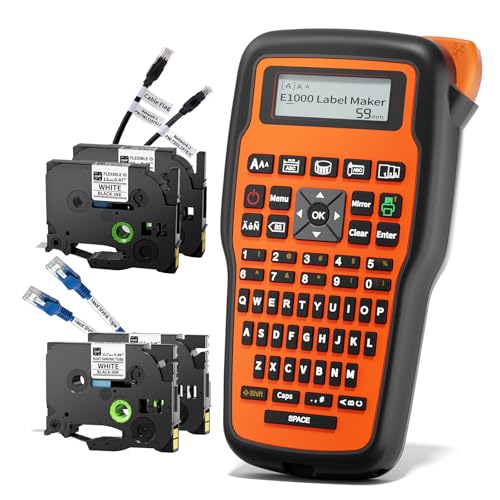
VolenGo E1000 heat shrink wire label maker, 12 mm
12 mm tapesHeat shrink 2:1Three cable modesFlexible ID tape
Check price on Amazon
Best for: Electricians marking wires with heat shrink sleeves on a budget.

The E1000 prints on 12 millimeter heat shrink tube tapes with a 2 to 1 shrink ratio, which is the way to mark individual conductors so a label cannot slip off. It also prints flexible ID wire tapes, and three cable modes cover wrap, flag and tube-style layouts. The kit includes two packs of tape, so it starts working immediately.

The tradeoff is brand maturity. The maker is newer than Brother or Brady, so confirm that replacement tape is easy to find before you commit. The tape width is also fixed at 12 millimeters, which excludes large signage labels.

Ownership is about tape supply and heat. Heat shrink tubing needs a heat gun at the right temperature and a steady hand, and over-shrinking can distort the print. Keep a few spare cassettes and clean the head regularly to avoid streaks across the text.

What works

  • Heat shrink tube tapes keep labels on wires
  • Flexible ID tape for cable wrap jobs
  • Three cable modes speed layouts
  • Starter tapes included in the kit

Watch out for

  • Newer brand with less tape supply history
  • Fixed 12 mm width
  • Heat shrink needs a heat gun step

Spec sheet

Tape width
12 mm
Heat shrink ratio
2:1
Modes
Three cable modes
Tapes included
Heat shrink and flexible ID
Use
Wire and cable marking
04
Brady M210 portable label printer kit with keypad
6 to 40 point textBacklit LCDA to Z keypadMulti-line labels
Check price on Amazon
Best for: Technicians who prefer a rugged keypad printer with cartridge media.

The Brady M210 is a compact handheld for identifying wires, panels and circuit boards. Its keypad has letters A to Z and numbers 0 to 9, and a backlit LCD graphics display makes editing easier in a dark cabinet. It prints multi-line labels in six text sizes from 6 to 40 point, which covers fine small tags and larger panel text.

The tradeoff is cost. Brady cartridges are designed for industrial materials and cost more per label than Brother TZe tape. Against the Brother PT-E110BP, the M210 offers fewer quick-key shortcuts but a more rugged material range.

As a keypad-only tool, it has no Bluetooth app or bulk import, so large jobs mean typing each label. Treat the cartridge door as a part to keep clean, and note that the single-color output is fine for most electrical needs.

What works

  • Backlit LCD helps in dim cabinets
  • Six text sizes from 6 to 40 point
  • Cartridge system suits industrial materials
  • Compact handheld size

Watch out for

  • Cartridges cost more per label
  • No app or bulk import
  • Fewer quick-layout keys than Brother

Spec sheet

Text sizes
6 to 40 point
Display
Backlit LCD graphics
Keypad
A to Z and 0 to 9
Color
Single color
Use
Wires, panels, circuit boards
05
Brady M211 portable Bluetooth monochrome label printer
BluetoothMonochromePortableBrady cartridges
Check price on Amazon
Best for: Teams that import long cable lists from a phone or tablet.

The M211 is the Bluetooth member of Brady's compact M2 line, which lets you design and send labels from a phone or tablet instead of typing on a small keypad. That matters on jobs with long lists of cable names, because the app can import data and print many labels in sequence. It uses the same family of cartridges as the M210, so you can share media between units.

The cost is dependence on the app. If the phone is dead or the app changes, the workflow slows, and the M211 has no keypad to fall back on. Compared with the M210, you gain workflow speed and lose the instant typing option.

Care is simple: keep the cartridge door clean, wipe the head if text streaks and keep the firmware current. Treat the wireless link as part of the tool and test pairing before a job site visit.

What works

  • Bluetooth lets you import label lists
  • Shares cartridges with the M210
  • Compact portable body
  • Faster for sequences than typing

Watch out for

  • No keypad, needs a phone to print
  • Cartridge cost per label is higher
  • App dependence is a risk

Spec sheet

Connectivity
Bluetooth
Color
Single color
Series
M2 portable
Media
Brady M21 cartridges
Use
Phone-driven labeling
06
MakeID P31S portable industrial label maker, 300 dpi
300 dpi0.75 in labelsBluetoothBulk data import
Check price on Amazon
Best for: Network and equipment labeling with QR codes and imported lists.

The P31S prints at 300 dpi, which gives sharper small text and tiny QR codes than the usual 203 dpi label makers. You can edit labels in an app or on PC software, and bulk data import lets you print a spreadsheet of cable or equipment names. The maker lists uses from network ports to tool bins, and QR code stickers help identify similar-looking parts.

The tradeoff is that it is a lighter-duty tool than the Brother and Brady industrial lines. It suits wiring tasks around the home and small shops, but harsh outdoor or high heat jobs call for laminated or specialty media. Against the Brady M211, it offers higher resolution but a less proven media range.

Ownership centers on tape supply and the companion software. Check that your preferred tape types are available and keep the app updated. A dirty print head shows up as faint lines, so a quick alcohol wipe helps.

What works

  • 300 dpi gives sharp small text and codes
  • Bulk data import speeds long label lists
  • App and PC software both supported
  • QR code labels identify look-alike parts

Watch out for

  • Lighter duty than industrial cartridge units
  • Newer tape ecosystem
  • Needs app or PC to edit

Spec sheet

Resolution
300 dpi
Label width
About 0.75 in
Connection
Bluetooth app and PC software
Bulk import
Yes
QR codes
Supported
07
Brady M410 handheld industrial label printer, 1 inch
Up to 1 in labels110+ cartridgesEdge-to-edgeLocking cartridge door
Check price on Amazon
Best for: Technicians who need wider, material-specific labels.

The M410 prints labels up to one inch wide, either pre-sized or continuous, with edge-to-edge printing that wastes less media. More than 110 drop-in cartridges across at least 12 purpose-built materials let you match vinyl, polyester or heat shrink to the job. The locking cartridge door with a viewing window makes changes quick and shows how much media is left.

The tradeoff is that it is the most capable and most expensive-to-run machine here. The cartridge system costs more per label than the Brother TZe tape and the unit is heavier. For small cable flags, the PT-E110BP is quicker, while the M410 earns its place when you need wide, durable labels.

Care means keeping cartridges in their packaging until use, cleaning the head and cutter and storing the tool in its case. Plan a tape inventory by material, since using the wrong cartridge can ruin a cabinet label after a year.

What works

  • Prints up to 1 inch wide
  • 110+ cartridges across many materials
  • Edge-to-edge printing saves media
  • Locking cartridge door with window

Watch out for

  • Highest running cost per label
  • Heavier than the Brother units
  • Cartridge inventory is complex

Spec sheet

Max width
1 in
Cartridges
110+ options
Materials
12+ purpose-built types
Print
Edge to edge
Door
Locking with window

Spec sheet decoder

What the numbers on the box really mean

The specs manufacturers lead with, translated into what they tell you about real-world performance.

Thermal transfer

A heated head transfers ink from a ribbon to the label. It gives durable, smudge-resistant prints.

Watch forThe Brother and Brady cassettes include the ribbon, so there is nothing to refill.

Heat shrink ratio

The amount a tube shrinks when heated, such as 2:1 for half its diameter. It sets how snugly the tube grips a wire.

Watch forThe E1000 uses 2:1 tube, so match it to your conductor diameter.

DPI

Dots per inch of the print head. Higher gives sharper small text and codes.

Watch forThe P31S prints at 300 dpi while most units are around 203.

Tape width

The label height available for text. It limits label size and the smallest cable you can wrap.

Watch forThe PT-E110BP runs 3.5 to 12 mm while the M410 reaches 1 inch.

Quick keys

Dedicated buttons for common layouts like cable wrap or flag. They save menu navigation.

Watch forThe PT-E110BP and PTH111 include wrap, flag and faceplate keys.

Methodology

How We Evaluated These Electrical Label Printers

Durability of the label

We looked at the media each printer uses and how it holds up to heat, abrasion and moisture. Laminated TZe tape and heat shrink tube scored high, while plain thermal media scored low. The Brady M410's material range was a strong point.

Speed on a real job

We evaluated how quickly a technician can produce a series of labels using quick keys, serialization and bulk import. The PTH111 and PT-E110BP stood out for keys, while the M211 and P31S stood out for import. Keypad-only units scored lower on long lists.

Print quality

We compared resolution and the sharpness of small text and codes. The 300 dpi P31S led, while the 203 dpi class was good enough for most cable names. Scan-critical work favors the higher resolution.

Ergonomics and kit

We considered weight, wrist straps, cases and included tapes. The PT-E110BP contractor kit and the lightweight PTH111 earned credit for carry. Heavier cartridge machines lost points for fatigue on long jobs.

Cost and supply

We weighed printer price, cost per label and tape availability across the lineup. TZe cassettes are widely stocked, while newer brands need checking. The Brady M410 scored lowest on running cost and highest on material choice.

Decision guide

How to Choose the Right Electrical Label Printers

By Job Type

SituationPickWhy
Daily cable and faceplate workBrother PT-E110BPQuick keys and contractor kit
Numbered patch panel portsBrother PTH111Serialize key
Marking single conductorsVolenGo E1000Heat shrink tube tapes
Dim cabinets, keypad workBrady M210Backlit LCD and keypad
Long imported cable listsBrady M211Bluetooth data import
Tiny QR code labelsMakeID P31S300 dpi print head
Wide equipment tagsBrady M410Up to 1 inch labels

By Budget

Budget tierPickWhy
Lowest costVolenGo E1000Starter tapes included
Low to midMakeID P31SHigh resolution at modest cost
Mid rangeBrother PTH111Laminated TZe tape and keys
Mid to upperBrother PT-E110BPKit with tapes and case
UpperBrady M210Industrial cartridge system
UpperBrady M211Bluetooth cartridge printer
HighestBrady M410Widest label and material range

Laminated Tape vs Cartridge Systems

Laminated TZe tape

The Brother PT-E110BP and PTH111 use cassettes with a built-in ribbon. Tape is cheap, widely stocked and well sealed against abrasion. Width tops out at 12 millimeters, so large labels are not possible.

Cartridge systems

The Brady M210, M211 and M410 use proprietary cartridges built for industrial materials. They offer vinyl, polyester and specialty media, with the M410 reaching 1 inch. Cost per label is higher and you must track many cartridge types.

Pick Brother tape for everyday wiring and Brady cartridges for specialty materials.

Keypad vs App Workflow

PreferencePickWhy
Type on the unitBrady M210Full keypad and LCD
Phone drivenBrady M211Bluetooth only
Phone plus PC softwareMakeID P31SApp, PC and bulk import
Keys for common layoutsBrother PT-E110BPWrap, flag, faceplate keys
Serial number runsBrother PTH111Serialize key

For Panel and Breaker Work Specifically

Look for

Serialization, quick layout keys, laminated media that resists abrasion and a width that fits breaker labels and faceplates. A backlit display helps in dark panels. Confirm the cutter produces clean edges so labels do not peel.

In this comparison

The Brother PTH111 is the panel specialist because of its serialize key, while the PT-E110BP adds the contractor kit. The Brady M210 suits panel work where a rugged keypad is preferred.

When to Spend More

Spend more if

You need wide labels, special materials or a rugged job-site tool. The Brady M410 and M210 justify their cartridge cost with material choice and durability.

Save if

You label cables and faceplates on routine installs. The Brother PT-E110BP and VolenGo E1000 handle that work with cheaper media.

Ownership

Maintenance schedule

The upkeep that decides whether this machine lasts two seasons or ten.

TaskIntervalWhy it matters
Swab the thermal headEvery few cassettesAdhesive and dust cause light streaks across the text. Wipe the head with isopropyl alcohol on a swab and let it dry.
Clean the cutter edgeMonthlyAdhesive builds on the blade and leaves ragged label edges. Wipe the blade with alcohol and keep fingers clear.
Store cassettes in packagingAlwaysHeat and dust shorten media life and can jam feed. Keep spares in a cool, closed case.
Charge or replace batteriesPer job cycleWeak batteries cause faint prints and resets. Recharge or swap cells before a long job.
Update the app and firmwareQuarterlyBluetooth units need current software to pair reliably. Updates also add media support.

FAQ

Frequently Asked Questions

Should I choose Brother tape or Brady cartridges?

Brother TZe tape is cheaper per label and widely stocked, which suits daily cable and faceplate work. Brady cartridges offer specialty industrial materials and wider labels, with a higher cost. Pick by the materials your jobs require.

How much should I budget for an electrical label printer?

The printer is only part of the spend. A contractor kit such as the Brother PT-E110BP bundles tapes and a case, which lowers first-week costs. Cartridge systems like the Brady M410 cost more to run over time.

How long do the labels last in a panel?

Laminated and cartridge media typically stay readable for years in a normal panel. Plain thermal paper fades faster in heat. Choose laminated or industrial media for anything that must outlast the install.

Are heat shrink labels better than wrap labels?

Heat shrink tubing grips a conductor and cannot slip off, which suits single wires. Wrap or flag labels are quicker and fit bundled cables. The VolenGo E1000 handles both, so you can mix methods.

Does a higher dpi matter for electrical labels?

Only for small QR codes or tiny text. The MakeID P31S at 300 dpi prints sharper small codes than the 203 dpi class. For plain names and numbers, the lower resolution is fine.

Do these printers work without a phone?

The Brother PT-E110BP, PTH111 and Brady M210 have built-in keypads, so they work without an app. The Brady M211 and MakeID P31S rely on Bluetooth or PC software. Keep a phone charged if you use those.

Bottom line

The short version

Browse more electrical label printerson Amazon →
James Miller, Lead Machine Editor

About the author

James Miller

Lead Machine Editor, MachineFanatic

James Miller leads MachineFanatic's buying guides, turning spec sheets, manuals and owner feedback into clear verdicts on power tools, outdoor power equipment, shop machines and kitchen machines.

More from James →

Keep reading

Related guides