
Amazon affiliate links - we earn a commission.Affiliate disclosure

Buying guide · 12 min read · Updated 2026-11-19

Best Energy Efficient RV Air Conditioners (2026)

Five efficient cooling options for RVs compared by inverter compressors, 12V versus 115V power, installation style and the real draw on your batteries.

James MillerBy James MillerLead Machine Editor5 machines comparedSpec-sheet verified
Best Energy Efficient RV Air Conditioners

At a glance

Our top picks

Side by side

Spec comparison

Efficiency in an RV air conditioner is mostly about how the compressor behaves. A fixed-speed machine runs flat out until the thermostat is satisfied, then stops, and the startup surge is where generators and batteries suffer. A machine that can modulate its speed spends more of its life at a gentle pace.

The other half of the story is the power source. A household-voltage unit pulled through an inverter from a battery bank wastes energy in the conversion, while a true battery-voltage design skips that step. We sort the field by how it makes cold and what it asks of your electrical system, not by sticker claims.

Before you buy

6 Criteria to Look For Before Buying an Energy Efficient RV Air Conditioner

  1. 01

    Compressor type and startup load

    An inverter or variable-speed compressor changes speed with the load, which is the single biggest efficiency lever in an RV air conditioner. A fixed-speed unit starts hard and cycles, and that surge is what overloads a 30 amp pedestal or a small generator. The TURBRO, Mountman, Gidrox and Midea here all use inverter designs, while a typical 13.5K rooftop unit does not. Buy an inverter if you generator-camp, because startup watts decide whether the machine runs at all.

  2. 02

    Power source and conversion loss

    A 115V unit running from a battery bank must pass through an inverter, losing a meaningful share of energy to conversion heat before it cools a single degree. The Gidrox and Xenjum run on 12V DC and avoid that loss. A traditional 115V unit powered through an inverter is where forum owners report very large battery draws. Decide whether you live on shore power or batteries before comparing BTU numbers.

  3. 03

    Installation style

    A rooftop unit opens a hole in the roof, a mini split like the Mountman needs an outdoor bracket and an indoor head, and the TURBRO hides under a bench. Each has a different leak risk, weight distribution and installation effort. The roof-friendly TURBRO preserves solar space, while the window-style Midea is only suited to parked rigs. Match the installation to how often your rig moves.

  4. 04

    Realistic capacity

    Efficiency numbers mean little if the machine cannot cool your coach. The 12,000 BTU Gidrox and 11,000 BTU Xenjum are small-rig tools, and the 8,000 BTU Midea cools a small space. Insulation, window covers and sun exposure change the load more than the badge does. Undersizing leads to continuous running and a drained battery. A reflective window cover, a shaded parking spot and a closed vent fan can do as much for your electric bill as a more expensive compressor, so fix the cabin before upgrading the machine.

  5. 05

    Heat pump behavior

    Heat pumps move heat instead of making it, which makes them efficient in mild weather but weak near freezing. The Gidrox quotes 9,000 BTU of heat, the TURBRO and Mountman also heat, and the Xenjum adds only 4,500 BTU. Plan a real heater for cold camps, and use the heat pump for shoulder-season mornings.

  6. 06

    Wiring and protection

    A 12V unit pulling tens of amps needs heavy cable, a correct fuse and a low-voltage cutoff or battery management system so it cannot drain a bank flat. Undersized wire wastes energy as heat and creates a fire risk. A 115V unit needs a breaker and an outlet that match its running current, and a small generator needs a soft start. Efficiency begins with the wiring. A voltage drop of even half a volt on a long 12V run costs real capacity, so keep cable runs short and use the gauge the maker specifies rather than whatever is already in the van.

Detailed reviews

The 5 best energy efficient rv air conditioners, explained

01
TURBRO inverter under-bench RV AC with heat pump, 115V
InverterHeat pumpUnder bench115V
Check price on Amazon
Best for: Vans and small coaches that want efficiency and a clear roof.

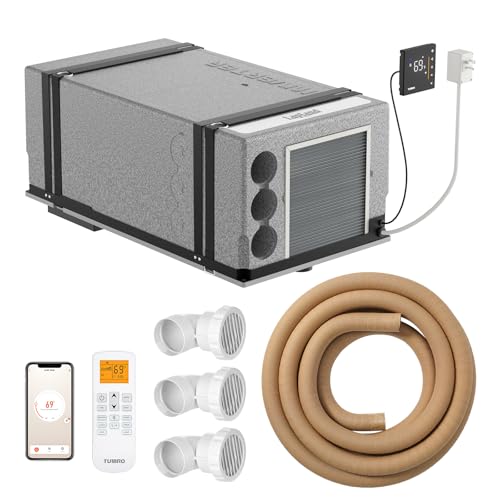
Most efficiency talk revolves around the compressor, and this TURBRO uses an inverter compressor that varies its speed to hold a setpoint. What makes it unusual is where it lives: inside the coach, under a bench, instead of on the roof. That frees the roof for solar panels and removes the aerodynamic drag and roof penetration of a rooftop shroud.

That layout has consequences. It is a better fit for a van, a Class B or a small trailer than for a big coach with an existing rooftop opening, and it needs a place to exhaust and a drain route. The heat pump gives shoulder-season warmth, but like every heat pump it loses output as outside temperature approaches freezing.

For ownership, the inverter electronics deserve a clean power source, so a proper shore connection beats a marginal generator. Keep the intake grille clear of pet hair and wipe the coil access panel annually. It is the cleverest answer here for rigs where rooftop space is precious.

What works

  • Inverter compressor modulates instead of cycling hard
  • Under-bench placement keeps the roof free for panels
  • Heat pump adds mild-weather heating
  • Cuts roof leak points and wind drag

Watch out for

  • Needs interior space, an exhaust path and drainage
  • Not a drop-in replacement for a rooftop opening

Spec sheet

Compressor
Inverter
Mounting
Hidden under-bench
Heating
Heat pump
Voltage
115V
Roof impact
Frees roof space
02
Mountman 12,000 BTU mini split, 19 SEER2, 115V
12,000 BTU19 SEER2InverterHeat pump
Check price on Amazon
Best for: Stationary or long-stay rigs where efficiency outranks mobility.

A mini split separates the loud, hot half from the cool half: an outdoor compressor unit and an indoor wall head joined by refrigerant lines. This Mountman lists a 19 SEER2 efficiency number, which is the highest formal efficiency figure in this group, and an inverter compressor that tracks the load.

The catch for RV use is that it was designed for a house wall, not for a road-going rig. You are looking at a custom installation with a bracket for the outdoor unit, a place for the indoor head and a routed condensate line, and you need to secure everything against vibration. In a stationary park model or a long-term camp it can be superb; in a rig that moves weekly, a rooftop unit is easier to trust.

Watch for the startup surge being gentle, a real benefit on a 30 amp pedestal. Clean the indoor washable filter every few weeks and keep the outdoor coil clear.

What works

  • 19 SEER2 rating is the best formal efficiency number here
  • Inverter compressor ramps instead of surging
  • Cooling and heating from one machine
  • Quiet indoor head compared with a roof unit

Watch out for

  • Built for a house wall, so RV mounting is custom work
  • Outdoor unit needs a secure travel mount

Spec sheet

Capacity
12,000 BTU
Efficiency
19 SEER2
Compressor
Inverter
Heating
Heat pump
Voltage
115V
03
Gidrox 12V 12,000 BTU inverter heat pump RV AC
12,000 BTU12V DCHeat pump43 dB claim
Check price on Amazon
Best for: Battery-powered vans and small rigs where watt-hours rule.

Running on 12V DC directly from the house bank removes the inverter loss that makes 115V units such expensive battery loads. Gidrox pairs that with an inverter compressor and quotes an average draw around 350W, a maker figure that will rise on a hot afternoon but shows the design priority is modulation, not brute force.

A 12,000 BTU DC unit is a van, small trailer or truck camper tool. It will not cool a 35 foot trailer on a 100 degree day, and it needs heavy cable and a correctly sized fuse, since 12V current is large. The reverse-cycle heat pump quoted at 9,000 BTU adds modest heat, again fading in real cold.

It rewards a lithium bank with solid battery protection and a low-voltage cutoff. Check terminal torque each season, because high-current DC connections loosen with vibration, and wipe the evaporator filter when airflow drops.

What works

  • True 12V operation skips inverter conversion losses
  • Inverter compressor with a modest quoted average draw
  • Reverse-cycle heat quoted at 9,000 BTU
  • 43 dB claim suits sleeping quarters

Watch out for

  • Heavy 12V cable and fusing are non-negotiable
  • Capacity suits small rigs, not full-size trailers

Spec sheet

Capacity
12,000 BTU
Voltage
12V DC
Heating
9,000 BTU heat pump
Noise claim
43 dB
Draw claim
About 350W average
04
Midea 8,000 BTU smart inverter window AC with heat
8,000 BTUInverterWindowHeat and cool
Check price on Amazon
Best for: Small campers parked for a season that want inverter efficiency cheaply.

This Midea is not an RV-specific machine, but its inverter compressor, Energy Star certification and heating function make it the cheapest way to get genuine variable-speed cooling in a small rig. It cools by modulating speed, then runs close to continuously at low output instead of cycling hard.

It is a window or sill unit, so the practical RV application is a camper van with a side window, a small trailer with a removable panel or a toy hauler garage. A window-style unit pulls moisture off the coil into a drain pan you will need to manage on a moving rig, and the cabinet protrudes outside by a good margin.

Think of it as a stationary summer solution and a serious option for a seasonal site. Remove it for travel, wash the filter monthly and watch the drain path to avoid condensation dripping where you do not want it.

What works

  • Inverter compressor with Energy Star certification
  • Heating function extends the season
  • Mid-priced compared with RV-specific units
  • Smart controls and a dehumidify mode

Watch out for

  • Not designed for roof or travel mounting
  • Window install takes a panel and a drain plan

Spec sheet

Capacity
8,000 BTU
Compressor
Inverter
Type
Window unit with heat
Coverage claim
350 sq ft
Certification
Energy Star
05
Xenjum 12V 11,000 BTU RV AC with heater, 43 lb
11,000 BTU12V DC43 lb35 dB claim
Check price on Amazon
Best for: Light camper vans where payload and battery draw both count.

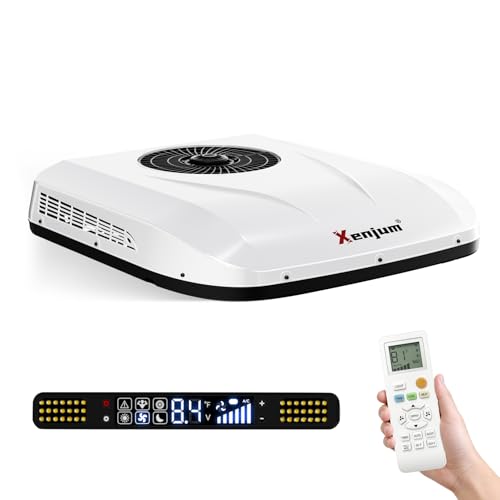
The standout number on the Xenjum is its weight: about 43 pounds, a fraction of a traditional 115V rooftop unit that can run well over 70. In a van or small camper that weight saving matters for payload and roof structure, and the 12V inverter scroll compressor keeps the electrical load modest.

The heating side is a 4,500 BTU supplement, so think of it as taking the edge off a cool morning rather than heating a winter camp. A claimed 35 dB sound level is a maker figure, and fan noise in a small cabin will usually be louder than the compressor.

Compared with the Gidrox it is lighter but offers less heating output. A DC unit demands a proper battery cutoff and solid fusing, and the roof needs a sound cut-out and sealant. Inspect the seal after the first rainy trip and again every spring.

What works

  • Roughly 43 lb is easy on the roof and payload
  • 12V inverter scroll compressor limits battery draw
  • Heater adds cool-morning comfort
  • Very low noise claim for sleeping

Watch out for

  • Heater is only a 4,500 BTU supplement
  • Small capacity limits it to compact rigs

Spec sheet

Cooling
11,000 BTU
Heating
4,500 BTU
Voltage
12V DC
Weight
43 lb
Noise claim
35 dB

Spec sheet decoder

What the numbers on the box really mean

The specs manufacturers lead with, translated into what they tell you about real-world performance.

SEER2

SEER2 is a seasonal efficiency rating for cooling, with higher numbers meaning less electricity per unit of cooling. It comes from a house-style test, not from road conditions.

Watch forOnly the Mountman lists a 19 SEER2 figure; do not compare it directly with a roof unit's marketing.

Inverter compressor

An inverter drive lets the compressor run at variable speed. It avoids hard on-off cycling and trims startup surge.

Watch forThe TURBRO, Gidrox, Mountman and Midea use it, so check that your power supply can feed clean electricity.

12V DC versus 115V

A 12V unit runs from the house bank directly, whereas a 115V unit needs shore power or an inverter. The inverter step wastes energy.

Watch forThe Gidrox and Xenjum are DC units, so size cable for tens of amps.

Heating BTU

Heat pump heating is quoted at mild outdoor temperatures. Output drops as it gets colder.

Watch forThe Gidrox quotes 9,000 BTU of heat against the Xenjum's 4,500 BTU supplement.

Noise claim in dB

Decibel claims describe the quietest mode under maker conditions. Real cabins add fan and compressor noise.

Watch forThe Xenjum claims 35 dB and the Gidrox 43 dB; expect real-world sound to sit above those.

Methodology

How We Evaluated These Energy Efficient RV Air Conditioners

Compressor design

We read each spec sheet for inverter or variable-speed compressors, since those drive both efficiency and gentle startup. The TURBRO, Gidrox and Mountman earned top marks. Fixed-speed designs were not considered for this guide.

Power path

We compared 12V DC and 115V power, noting where an inverter step would waste energy. The Gidrox and Xenjum avoid it entirely. For 115V units we looked at how clean the supply must be.

Installation realism

We judged whether the unit mounts on a roof, under a bench, on a wall or in a window. The 12,000 BTU Mountman was marked down for RV travel. The TURBRO scored well for roof-space preservation.

Capacity versus claims

We looked at the quoted BTU, from 8,000 on the Midea to 12,000 on the Gidrox and Mountman, and what size of rig each can realistically cool. We discounted maker claims that did not specify conditions. Weight, such as the Xenjum's 43 lb, also counted.

Year-three ownership

We considered filter access, DC connection upkeep and heat pump servicing, since sealed refrigerant work needs a certified technician. Simpler window units score for easy cleaning. DC units score for demanding but straightforward wiring.

Decision guide

How to Choose the Right Energy Efficient RV Air Conditioners

By Rig Type

SituationPickWhy
Camper van on batteriesGidrox 12V inverterTrue DC with modulation
Lightweight van roofXenjum 12V 43 lbLowest weight on the roof
Small trailer wanting roof spaceTURBRO under benchFrees roof for solar
Long-term park modelMountman mini splitHighest SEER2 rating

By Budget

SituationPickWhy
Lowest outlay for inverter coolingMidea 8,000 BTU windowMass-market inverter unit
Mid-range DCXenjum 12V 11,000 BTULightweight and efficient
Mid-range heat pump DCGidrox 12V 12,000 BTUHeat pump and inverter
Highest cost, best layoutTURBRO under-benchInverter with a hidden install

12V DC vs 115V Inverter

12V DC

The Gidrox and Xenjum run straight from the house battery and avoid conversion loss. They need heavy cable and protection and are limited to smaller rigs.

115V

The TURBRO, Mountman and Midea use shore or generator power. They cool larger spaces but are poor candidates for battery-only camping.

Choose DC for boondocking vans; choose 115V when you live on a pedestal. A hybrid rig with a big lithium bank and a large inverter can run either, but only the DC machines treat every watt-hour with respect.

Mounting Style

SituationPickWhy
Roof already fullTURBRO under benchNo roof cut-out needed
Stationary wall installationMountman mini splitSplit design with an indoor head
Seasonal window installMidea 8,000 BTURemovable for travel
Standard roof openingGidrox 12VRooftop DC design

For Off-Grid Camping Specifically

Look for

True 12V operation, a quoted average draw, a heat pump and a low-voltage cutoff. Check your battery bank capacity against the maker's draw figure.

In this comparison

The Gidrox pairs 12V DC with an inverter compressor and quotes about 350W average. The Xenjum saves weight but supplies less heat.

When to Spend More

Spend more if

You boondock or want a clear roof. The TURBRO and Gidrox cost more because of their layout and DC design.

Save if

You park seasonally on shore power. The Midea gives genuine inverter efficiency for much less.

Ownership

Maintenance schedule

The upkeep that decides whether this machine lasts two seasons or ten.

TaskIntervalWhy it matters
Wash filtersEvery 3 to 4 weeksDust chokes airflow and makes inverter units work harder. A clean filter keeps efficiency near the claimed figure, and a camp with dirt roads or pet hair may need it washed weekly.
Check DC terminalsEach springHigh-current 12V connections loosen with vibration. Heat at a loose lug wastes energy and risks damage.
Clear drain pathMonthly in humid weatherWindow and mini split units drain condensate. A blocked line overflows into the coach.
Inspect roof sealEach springRooftop DC units sit on a gasket and sealant. Cracks let water into the ceiling, and a slow leak behind a headliner is expensive to chase once the insulation is wet.
Clean condenser coilTwice a yearDirt on the coil reduces heat rejection. Use a soft brush and low-pressure water.

FAQ

Frequently Asked Questions

Is a 12V RV air conditioner really more efficient?

On a battery bank, yes, because it skips inverter conversion loss. The cooling effect per watt depends on the compressor, so a DC inverter unit is the most efficient pairing.

Do inverter RV air conditioners need a soft start?

Usually not, since modulating compressors start gently. A fixed-speed unit on a small generator is where a soft start earns its keep.

Can a mini split really live in an RV?

It can in a stationary or long-stay rig with a secure outdoor mount. For a rig that travels weekly, a rooftop or under-bench unit is more practical.

How much battery does a 12V RV air conditioner need?

Makers quote averages as low as about 350W, but a hot afternoon draws more. Size the bank generously and use a low-voltage cutoff.

Does a bigger BTU number mean better efficiency?

No. Efficiency comes from the compressor and the power path, while BTU only describes capacity. An oversized unit can waste energy by short cycling. The better question is how much sun and insulation loss your particular rig has, because a poorly insulated van with a big window needs more capacity than its length suggests.

Will a heat pump replace my furnace?

Not in cold weather. Heat pump output falls as it nears freezing, so keep a furnace for cold nights. Treat the heat pump as the efficient way to cover spring and fall mornings, not as a winter strategy.

Bottom line

The short version

Browse more energy efficient rv air conditionerson Amazon →
James Miller, Lead Machine Editor

About the author

James Miller

Lead Machine Editor, MachineFanatic

James Miller leads MachineFanatic's buying guides, turning spec sheets, manuals and owner feedback into clear verdicts on power tools, outdoor power equipment, shop machines and kitchen machines.

More from James →

Keep reading

Related guides