

Amazon affiliate links - we earn a commission.Affiliate disclosure

Buying guide · 12 min read · Updated 2026-11-13

Best Foldable Solar Panels (2026)

Six foldable solar panels from pocket size to 450W, compared on weight, connectors, cell type and which power stations they suit best.

James MillerBy James MillerLead Machine Editor6 machines comparedSpec-sheet verified
Best Foldable Solar Panels

At a glance

Our top picks

Side by side

Spec comparison

A foldable panel is a set of thin photovoltaic sections hinged into a briefcase-style bundle, built to feed a portable power station or charge small electronics. The whole value proposition is carrying a bigger collector than your pack could hold in rigid form.

The trap is that the label wattage, the connector and the input limit of your station all have to line up. A powerful panel with the wrong plug or too much voltage is wasted money, so the decision starts with the station, not the panel.

Before you buy

6 Criteria to Look For Before Buying a Foldable Solar Panel

  1. 01

    Match panel to station input

    Every power station lists a maximum input voltage and wattage, and the panel open-circuit voltage must stay under it even in cold weather, when voltage rises. The ZOUPW 450W lists 45.9V, which many 28V and 30V stations cannot take, while the Ecosonique 200W at 20V suits nearly everything. Check the station manual before looking at the panel, not after.

  2. 02

    Rated watts versus real harvest

    Panel ratings come from standard test conditions, and field output is commonly 60 to 80 percent of the label. A 200W Renogy in good sun therefore delivers about 120 to 160W, and a 100W FlexSolar closer to 60 to 80W. Size the panel to what you need after that haircut.

  3. 03

    Connector compatibility

    Foldables use MC4, DC5521, XT60 and Anderson plugs, and the wrong one forces an adapter that adds resistance. The CTOLITY 400W and Ecosonique 200W ship with MC4 output, while the SinKeu 40W bundles ten DC adapters. Count the adapters in the box against your station before ordering.

  4. 04

    Weight and folded size

    A panel you will not carry is useless, so measure the folded bundle against your trunk or pack. The FlexSolar at 4.1 lb is easy to carry on foot, while the ZOUPW at 29.5 lb is a vehicle-only item. For car camping, aim for under 15 lb so one person can handle it without strain.

  5. 05

    Cell type and heat tolerance

    N-type TOPCon cells degrade slower and cope with heat better than older P-type PERC, which matters on dark ground where panel temperature can run 30 degrees above air. The Renogy 200W and ZOUPW 450W use N-type, while the CTOLITY relies on older monocrystalline cells. Cell type matters more than the busbar count printed on the listing.

  6. 06

    Stand design and tilt

    A panel lying flat loses a large share of potential output when the sun is low, so a kickstand with several angles recovers real power. The Ecosonique has four adjustable kickstands and the FlexSolar uses a lighter support. Tilt the panel at the sun, and move it every couple of hours.

Detailed reviews

The 6 best foldable solar panels, explained

01
Renogy 200W N-Type Foldable Portable Solar Panel
200WN-Type 16BB13.89 lbUSB-C PD 45W
Check price on Amazon
Best for: First-time buyers pairing a mid-size power station with a panel that also charges small gear.

This panel pairs N-type 16-busbar cells with a four-panel folding frame. N-type silicon tolerates heat better and fades more slowly than the older P-type PERC cells many budget panels still use, which matters because a panel lying on hot ground runs well above lab temperature. The folded slab measures about 24 by 23 inches and closes with a magnetic latch.

At 13.89 lb it weighs a little more than the 11 lb Ecosonique 200W, but it adds a USB-C 45W port and two USB-A ports that the Ecosonique does not offer. That means a laptop or phone can charge straight from the panel without a power station in the chain. The honest tradeoff is price per watt, since the 400W CTOLITY gives double the output for less carrying penalty than two of these.

Expect the hinges and the magnet seam to be the wear points after a few seasons, so fold it flat and avoid stuffing it into a crowded trunk. Wipe the surface with a damp cloth rather than a stiff brush, because scratches in the laminate scatter light. It is the pick we would hand a first-time buyer with a mid-size station.

What works

  • N-type 16BB cells hold up better in heat
  • USB-C PD 45W port charges laptops directly
  • Folds to about 24 inches square
  • Magnetic latch keeps the bundle closed

Watch out for

  • Heavier than the Ecosonique at the same 200W
  • Costs more per watt than the 400W options

Spec sheet

Rated power
200W
Cell type
N-Type 16BB
Weight
13.89 lb
Folded size
23.72 x 22.99 x 1.97 in
Extra ports
USB-C PD 45W plus 2 USB-A
02
FlexSolar 100W Foldable Panel with PD USB-C
100W4.1 lbIP67PD 45W USB-C
Check price on Amazon
Best for: Backpackers and kayakers who want a phone, camera and small station charger under five pounds.

The FlexSolar is the pack-friendly choice, weighing only 4.1 lb and folding to roughly a half inch thick. Its surface uses monocrystalline cells under an ETFE film, a laminate that sheds dirt better than the glass-fibre surfaces on cheaper panels. The three-way output covers USB-C PD at 45W, USB-A at 18W and a 100W DC port for a station.

Having a USB-C port that can deliver 45W means a phone or small laptop charges directly while the sun is up. Where it falls behind is raw capacity: a 100W panel feeds a 500Wh station in two full sunny days at best, so the 200W Renogy or Ecosonique is better for a weekend cabin. The IP67 rating on the junctions means a rain shower will not kill it, though you should still keep the DC plug out of puddles.

Carry it flat against a pack frame and keep the cable coiled loosely, since tight bends at the connector are where small panels fail first. Because the weight is so low, a stiff gust can tip it over when propped, so weigh the kickstand down with a boot or a water bottle.

What works

  • Weighs just 4.1 lb for a 100W rating
  • PD 3.0 USB-C delivers 45W to laptops
  • IP67 rating tolerates rain splashes
  • Folds to about half an inch thick

Watch out for

  • 100W is slow for stations above 500Wh
  • Low weight lets wind tip it over

Spec sheet

Rated power
100W
Weight
4.1 lb
Thickness folded
0.59 in
Outputs
USB-C 45W, USB-A 18W, DC 100W
Water rating
IP67
03
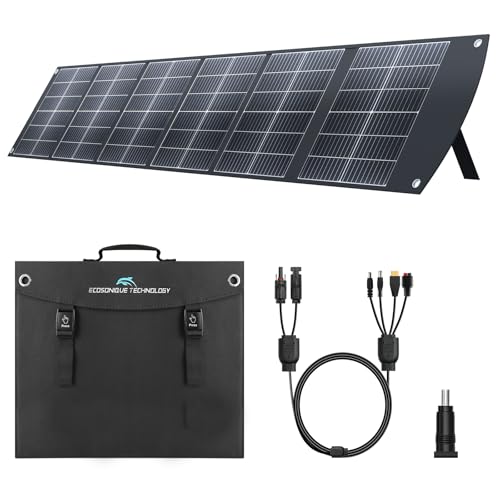
Ecosonique 200W Foldable Panel with MC4 Output
200W11 lbMC4 20V6-fold
Check price on Amazon
Best for: Campers whose station takes an MC4 or XT60 input and who need the smallest 200W bundle.

The Ecosonique folds six times down to a package of about 18 by 16.3 inches, which is noticeably smaller than the 23 inch bundle of the Renogy. Its main output is a 20V MC4 lead with a 3 metre cable, plus a 0.5 metre MC4 to other-connector adapter and assorted station plugs such as XT60. The cable length is useful because you can park the panel in sun while the station sits in shade.

Four adjustable kickstands let you set a steeper tilt than the single support legs on many rivals, which helps in winter when the sun sits low. At 11 lb it is the lightest 200W panel in this comparison, though it lacks the USB ports of the Renogy so it feeds a station only. Buyers with a station that wants a high-voltage series input should check the 20V rating first, because this panel is tuned for stations that accept roughly 12 to 30V.

The six-fold seams make it compact but add six hinge lines that collect grit, so brush them out before folding. Store it flat in its carry sleeve and keep the connector caps on, which stops sand and moisture from coating the MC4 contacts.

What works

  • Folds smallest of the 200W panels here
  • Four kickstands allow steep winter tilt
  • 3 metre MC4 cable lets panel and station separate
  • Lightest 200W unit at 11 lb

Watch out for

  • No USB ports for direct device charging
  • 20V output suits only some stations

Spec sheet

Rated power
200W
Weight
11 lb
Folded size
18 x 16.3 in
Output
20V MC4 with 3M cable
Stand
4 adjustable kickstands
04
CTOLITY 400W Foldable Portable Solar Panel
400W23.4% eff.IP65MC4
Check price on Amazon
Best for: Buyers with a high-input station who want 400W of capture without paying the N-type premium.

The CTOLITY is the cheapest way here to reach 400W, using monocrystalline cells at 23.4 percent efficiency under an ETFE lamination that resists scuffs and sun yellowing. Output comes through MC4 connectors, so any station with an MC4 or adapter input can use it. IP65 means the panel shrugs off rain, though the connectors still need to stay dry in a downpour.

Compared with the 450W ZOUPW it gives up about 50W of rating and the N-type cell, but it generally asks for less carrying weight and less money, so it suits buyers who want a big collector without the premium tier. Adjustable kickstands let you angle toward the sun, which matters more than the headline rating, since a flat-on panel loses 30 percent or more at midday in winter. Before buying, check that your station accepts the panel open-circuit voltage; a 400W panel pushes a higher number than a 200W one.

This is a bulky bundle once folded, so measure your trunk and plan how you will carry it. Keep the connector caps on during transport, and avoid leaving it face down on hot asphalt, which can warp the laminate.

What works

  • 400W rating at a mid-tier price
  • ETFE surface resists scuffs and yellowing
  • IP65 sealing tolerates light rain
  • MC4 output fits most large stations

Watch out for

  • Bulky and heavy once folded
  • Older cell tech than the N-type picks

Spec sheet

Rated power
400W
Cell efficiency
23.4%
Surface
ETFE laminate
Output
MC4 connectors
Water rating
IP65
05
ZOUPW 450W N-Type Foldable Solar Panel
450WN-Type 16BBVoc 45.9V29.5 lb
Check price on Amazon
Best for: Owners of 2000Wh class stations who want one folding panel that fills them in a day.

The ZOUPW is the highest-output foldable in this lineup, at 450W with N-type 16-busbar cells claiming 25 percent efficiency. Its open-circuit voltage is 45.9V, and the listing is explicit that it is intended for large stations, which is a quiet warning that smaller stations with a 28V or 30V input cap will reject it. Weighing 29.5 lb, it is much lighter than a rigid 400W panel of equal output.

Against the 400W CTOLITY it gains 50W and a better cell type, and against the 200W Renogy it more than doubles power with about twice the weight. That makes it the right choice when one panel must keep a big station topped up, since a station of 2000Wh or more can take several hours of 300W harvest to recover a full day of use. Remember that the label wattage is a lab figure, and real harvest sits at 60 to 80 percent of it.

A 29.5 lb unit is a two-handed carry, so plan for a good case handle and a flat spot on the ground. Check the folded seams for dirt each season and avoid bending the panel against the fold direction, which stresses the cell strings.

What works

  • Highest rating here at 450W
  • N-type 16BB cells fade slower
  • Lighter than a rigid panel of equal output
  • Open-circuit voltage clearly specified

Watch out for

  • Many smaller stations cannot accept 45.9V
  • Heavy enough to need a two-handed carry

Spec sheet

Rated power
450W
Cell type
N-Type 16BB
Open-circuit voltage
45.9V
Weight
29.5 lb
Efficiency claim
25%
06
SinKeu 40W Foldable Solar Panel with 10 Adapters
40W22% eff.10 DC adaptersUSB-C + QC3.0
Check price on Amazon
Best for: Hikers and commuters who only need to keep phones, a tablet or a small power bank topped up.

The SinKeu is the entry point for small-device charging, a 40W panel with three outputs: an 18V DC port at up to 2.27A, a USB-C port and a USB QC3.0 port. Ten DC adapters are bundled, which covers the barrel plugs found on many compact stations. The monocrystalline cells claim 22 percent efficiency.

At 40W it will never refill a big station quickly, so treat it as a trickle source for a small unit or a phone and tablet charger. Compared with the 100W FlexSolar it is cheaper and lighter on the wallet but needs more than twice the sun hours to deliver equal energy. It is a sensible second panel in a hiking kit, where one lightweight option keeps a battery bank alive over several days.

Use the adapter that matches your station and keep the other nine in a small pouch, since loose tips vanish quickly. Fold it along its original creases and keep it out of a bag full of sharp tools, which can puncture the surface fabric.

What works

  • Ten DC adapters cover many small stations
  • USB-C and QC3.0 give direct device charging
  • 22 percent cells for a panel this small
  • Low outlay for a trial of solar charging

Watch out for

  • 40W is too slow for any mid-size station
  • Little headroom for cloudy days

Spec sheet

Rated power
40W
Efficiency
22%
DC output
18V, 2.27A max
USB outputs
USB-C plus QC3.0
Adapters
10 DC tips

Spec sheet decoder

What the numbers on the box really mean

The specs manufacturers lead with, translated into what they tell you about real-world performance.

Open-circuit voltage (Voc)

The voltage the panel produces with nothing drawing current. It rises in cold weather, so a panel can exceed its label on a frosty morning.

Watch forThe ZOUPW 450W lists 45.9V, so check that figure against your station input limit.

Cell efficiency percentage

The fraction of sunlight turned into electricity at the cell. A higher number means more watts per square foot of panel.

Watch forThe SinKeu 40W claims 22 percent while the Renogy 200W claims 25, so efficiency affects folded size more than daily power.

IP rating

A two-digit code for dust and water resistance. IP65 handles spray, while IP67 survives brief immersion.

Watch forThe FlexSolar 100W is IP67 and the CTOLITY 400W is IP65, but connectors are usually the weak point.

Power Delivery (PD) output

A USB-C standard that negotiates higher voltage for laptops. A 45W port can run most thin laptops.

Watch forThe Renogy 200W and FlexSolar 100W both offer 45W PD, which neither the Ecosonique nor the CTOLITY does.

Busbar count (BB)

Thin metal lines that collect current from each cell. More busbars shorten the current path and tolerate micro-cracks better.

Watch forThe Renogy and ZOUPW both list 16BB, but cell type still matters more than the busbar number.

Methodology

How We Evaluated These Foldable Solar Panels

Output versus rated capacity

We compared the rated watts across the lineup, from the 40W SinKeu up to the 450W ZOUPW. We then discounted each by the usual 60 to 80 percent field efficiency. Picks that gave the most usable watts per pound scored best.

Connector and voltage fit

We read each listing for output plugs and open-circuit voltage. The MC4 panels earned credit for working with large stations, while panels with USB-C and DC ports scored for device charging. Missing voltage data lost points.

Carry weight and packed size

Weight ranges from 4.1 lb for the FlexSolar to 29.5 lb for the ZOUPW, and folded footprints differ just as widely. We scored how realistic each is for one person to lift and store.

Build and weather sealing

We looked at laminate type, junction sealing and any stated IP rating. ETFE surfaces and IP65 or IP67 junction boxes counted favourably, while undocumented sealing counted against.

Owner feedback patterns

We checked recurring owner complaints about hinge wear, cable fragility and overstated output. Panels with consistent notes on those issues lost ground.

Decision guide

How to Choose the Right Foldable Solar Panels

By Power Station Size

SituationPickWhy
Phone, tablet and small bankSinKeu 40WMatches small loads and bundled adapters
Station up to 500WhFlexSolar 100WLight and PD output for direct device charging
Station 500 to 1500WhRenogy 200WBalanced weight and 45W USB-C port
Station 1500Wh and larger, 30V or higher inputCTOLITY 400WHighest wattage per outlay
Station 2000Wh and larger, 45V inputZOUPW 450WHighest rating and N-type cells

By Budget

TierPickWhy
Lowest outlaySinKeu 40WCheap entry to solar charging
Low to midFlexSolar 100WLight, sealed and PD capable
Mid-rangeEcosonique 200WSmall bundle with MC4 output
Upper midCTOLITY 400WMost watts per outlay
PremiumZOUPW 450WN-type cells and top output

Pocket Weight vs Big Output

Lightweight panels

The FlexSolar 100W at 4.1 lb and SinKeu 40W stay light enough for a pack. They charge slowly, so a station refill takes more than a day of full sun.

High-output panels

The ZOUPW 450W at 29.5 lb and CTOLITY 400W gather power fast but need a vehicle and a flat patch of ground. A big station refills in a few sunny hours.

Backpackers should pick the FlexSolar, while car campers with a large station should pick the CTOLITY or ZOUPW.

Direct Device Charging

PreferencePickWhy
Laptop charged from the panelRenogy 200W45W USB-C PD port
Phone and camera on trailFlexSolar 100WUSB-C 45W and USB-A 18W
Barrel-plug small stationSinKeu 40WTen DC adapters included
Station only, no USB neededEcosonique 200WMC4 output and long cable

For Winter Camping Specifically

Look for

Choose a panel with steep, adjustable kickstands so you can tilt toward a low sun, and N-type cells that tolerate cold and heat. Check that the cold-weather rise in open-circuit voltage still sits under your station limit.

In this comparison

The Ecosonique 200W has four adjustable kickstands and the Renogy 200W uses N-type cells. Pair either with a station that accepts at least 25V to leave headroom for cold.

When to Spend More

Spend more if

Spend more on the ZOUPW 450W or Renogy 200W when the station is expensive, because N-type cells and clear voltage data protect the investment. Choose the higher tier also if you fold the panel daily.

Save if

Save with the SinKeu 40W or CTOLITY 400W when you only need basic charging or when watts per outlay matter most. A cheaper panel is fine if you will rarely carry it far.

Ownership

Maintenance schedule

The upkeep that decides whether this machine lasts two seasons or ten.

TaskIntervalWhy it matters
Wipe the panel surfaceAfter each tripDust, pollen and bird droppings block light and create hot spots. A damp soft cloth removes them without scratching the laminate.
Inspect hinges and fold seamsEvery 3 monthsGrit in the hinge lines wears the fabric and can pinch cell strings. Brush them clean before folding.
Check connectors and cablesEvery tripCorroded MC4 contacts and kinked cables raise resistance and lose watts. Keep the caps on and coil the cable loosely.
Confirm kickstand tensionEvery seasonA loose stand lets a gust flip the panel and crack cells. Tighten screws or replace worn legs.
Store flat and dryOff seasonMoisture trapped in a folded panel can fog the surface and corrode junctions. Keep it indoors away from heat sources.

FAQ

Frequently Asked Questions

Is a 200W or 400W foldable panel better?

It depends on the station input limit and how far you will carry the panel. A 200W unit such as the Renogy weighs around 14 lb and suits most mid-size stations, while a 400W unit gathers twice the power but needs a station that accepts the higher voltage.

How much should I budget for a foldable panel?

Cost scales roughly with wattage and cell type. The 40W SinKeu sits at the low end, the 200W panels mid-range and the 450W ZOUPW at the premium end, and you should choose by the station you own rather than by price alone.

How long do foldable panels last?

Most use a laminate surface that ages faster than a rigid glass panel. Hinges, cables and connectors usually fail before the cells do, so careful folding and storage can extend life to several seasons.

Does the rated wattage match real output?

No, field output is typically 60 to 80 percent of the label because of heat, tilt and haze. A 200W panel often delivers around 130 to 160W at midday under clear sun.

Can I connect two panels in series?

Series wiring adds voltage, so check the combined open-circuit voltage against the station input limit before you plug in. Many foldable kits are designed for parallel or single-panel use only, so read the instructions.

Will a foldable panel work through clouds?

Output drops sharply under cloud, often to 10 to 25 percent of rating. N-type cells and the correct tilt help, but plan on a bigger battery buffer for overcast days.

Bottom line

The short version

Browse more foldable solar panelson Amazon →
James Miller, Lead Machine Editor

About the author

James Miller

Lead Machine Editor, MachineFanatic

James Miller leads MachineFanatic's buying guides, turning spec sheets, manuals and owner feedback into clear verdicts on power tools, outdoor power equipment, shop machines and kitchen machines.

More from James →

Keep reading

Related guides