
Amazon affiliate links - we earn a commission.Affiliate disclosure

Buying guide · 12 min read · Updated 2026-11-07

Best Food Dehydrators for Jerky (2026)

Six dehydrators for jerky compared by maximum temperature, rear-fan airflow, tray size and cleanup, with notes on reaching the roughly 160 F meat guideline.

James MillerBy James MillerLead Machine Editor6 machines comparedSpec-sheet verified
Best Food Dehydrators for Jerky

At a glance

Our top picks

Side by side

Spec comparison

MachineTraysMotorTemperatureTimerAirflow
9-Tray 800W Jerky Dehydrator With Remote, 194 FBest High-Heat Jerky Machine9-Tray 800W Jerky Dehydrator With Remote, 194 F9 stainless, 11.42 x 11.42 inch800 watt86 to 194 F1 to 24 hoursRear fan, 360 degree circulation
Cosori 5-Tray Stainless Dehydrator, 176 F, Jerky PresetBest Compact for JerkyCosori 5-Tray Stainless Dehydrator, 176 F, Jerky Preset5 stainless steeln/a95 to 176 F in 1 degree stepsn/aHorizontal
Magic Mill Pro 10-Tray Stainless DehydratorBest for Big Batches and TreatsMagic Mill Pro 10-Tray Stainless Dehydrator10 adjustable stainlessn/an/an/an/a
8-Tray 650W Stainless Dehydrator, 167 FBest Mid-Size Cabinet8-Tray 650W Stainless Dehydrator, 167 F8 full-size stainless650 watt95 to 167 F1 to 48 hoursRear fan with circulation system
Cosori 5-Tray 350W Dehydrator, 165 F, ExpandableBest Budget Stack Reaching 165 FCosori 5-Tray 350W Dehydrator, 165 F, Expandable5 BPA-free, expandable to 7350 wattn/a48 hoursn/a
Cosori 6-Tray Stainless Dehydrator, 6.5 ft², 165 FBest Quiet CabinetCosori 6-Tray Stainless Dehydrator, 6.5 ft², 165 F6 stainless steel600 watt, brushless95 to 165 Fn/an/a

Jerky asks more of a dehydrator than fruit does. Meat is dried for hours at a temperature that must be both high enough to be safe and low enough to avoid cooking the strips, and a machine that cannot hold that temperature across every shelf gives you jerky that is leathery on one shelf and under-dried on another.

The decisions that matter are the top temperature, the airflow design and how easily the machine cleans after fat has dripped across it for six hours. This guide ranks the lineup on those points and treats everything else, including shelf count and gadgets, as secondary.

Before you buy

6 Criteria to Look For Before Buying a Food Dehydrator for Jerky

  1. 01

    Maximum temperature

    Many guides give about 160 degrees Fahrenheit as the target for jerky meat. The nine-tray machine reaches 194, the compact Cosori 176, the eight-tray 167 and the Cosori stacks and 6-tray 165. A machine that tops out at 158 falls short, so headroom matters for a hot first stage. Note that the dial setting and the temperature of the meat are different things: wet strips stay cooler than the air because evaporation cools them, so the air temperature is a ceiling and the meat's own temperature is what the guideline really describes. A probe pushed into a strip tells you more than any dial.

  2. 02

    Airflow and tray rotation

    Rear-fan cabinets like the Cosori 6-tray and the eight-tray push air across every shelf, while a stack like the 350 watt Cosori dries unevenly. Uneven drying in jerky means under-dried strips on some shelves, which is a quality and safety issue. Choose a cabinet for regular jerky. A related habit is to load strips in a single layer with a small gap between them, since overlapping strips block airflow and leave wet spots exactly where the fat is thickest. If a batch comes out with a few soft pieces, drop them into a warm oven for another half hour rather than storing them, because soft spots spoil first.

  3. 03

    Tray material and spacing

    Stainless trays resist marinade stains and odors, and spacing that can be adjusted, as on the Magic Mill, handles thick strips. Clear plastic trays absorb color. Strip thickness of about a quarter inch dries more evenly. Marinades with sugar, soy and vinegar are tough on plastic, which takes on color and smell after only a few batches, so stainless trays save you from the permanent teriyaki tint. Spacing matters for thick cuts, and trays that adjust let you leave room for a half inch strip.

  4. 04

    Capacity

    The compact Cosori's 3.1 square feet suits a pound or two, the nine-tray and ten-tray machines suit several pounds. Overloading slows drying and raises risk. Match the machine to your typical batch. As a rough guide, a pound of raw lean meat yields only a third of that weight in finished jerky, so a household that wants a pound of jerky a week is loading three pounds of raw strips and needs a machine with real surface area, not a compact stack that spreads the work over two long days.

  5. 05

    Timer and shutoff

    A 48 hour timer on the eight-tray and Cosori stack lets you run overnight, while the Magic Mill's auto shutoff ends the cycle on time. Jerky dries in a few hours to most of a day, so a timer up to 24 hours is enough, but a shutoff protects against over-drying.

  6. 06

    Cleanup after fat

    Jerky fat bakes onto walls, trays and the fan guard. Stainless interiors and removable trays clean faster. Wipe while warm and soak trays soon.

Detailed reviews

The 6 best food dehydrators for jerky, explained

01
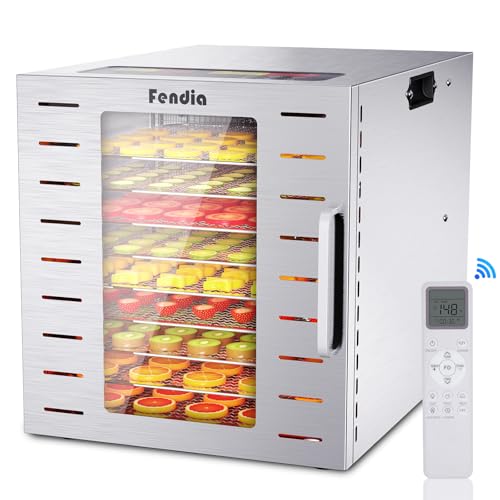
9-Tray 800W Jerky Dehydrator With Remote, 194 F
9 stainless trays800W86 to 194 FRemote control
Check price on Amazon
Best for: Serious jerky makers who process several pounds at a time.

This dehydrator pairs an 800 watt motor with a rear drying fan and 360 degree airflow, and its dial climbs to 194 degrees Fahrenheit, the highest of the six. For jerky, that ceiling is useful in a specific way: it lets you run a high-heat first hour to bring the meat surface past the commonly recommended 160 degrees, then drop to a gentler setting for the long dry.

Nine stainless steel trays, each about 11.4 inches square, give enough surface for several pounds of strips at once, and a remote control with a 1 to 24 hour timer means you do not have to open the door to adjust. Against the Cosori 5-tray, you get nearly twice the trays and a higher ceiling, but a bulkier machine and a timer that stops at 24 hours rather than 48.

A machine that runs that hot deserves attention to cleaning. Fat spatter bakes onto the walls at 194 degrees, so wipe the interior while it is still warm and soak the trays in hot soapy water. Place a probe thermometer on the top and bottom trays during the first batch to confirm that the dial matches what the meat sees, since high settings can overshoot. Let it cool with the door ajar before storing it.

What works

  • 194 F ceiling allows a high-heat first stage
  • Nine stainless trays for large batches
  • Rear fan and 360 degree airflow
  • Remote control and 24 hour timer

Watch out for

  • Large and heavy
  • Timer stops at 24 hours
  • High heat bakes fat onto the walls

Spec sheet

Trays
9 stainless, 11.42 x 11.42 inch
Motor
800 watt
Temperature
86 to 194 F
Timer
1 to 24 hours
Airflow
Rear fan, 360 degree circulation
02
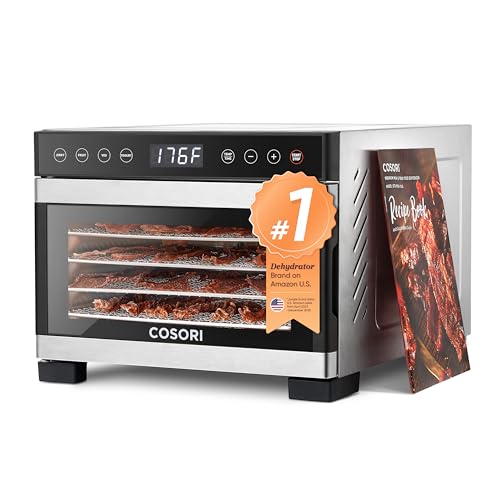
Cosori 5-Tray Stainless Dehydrator, 176 F, Jerky Preset
5 stainless trays3.1 ft²95 to 176 FJerky preset
Check price on Amazon
Best for: Small households making a batch of jerky at a time.

The compact Cosori gives you the cabinet-style horizontal airflow in a body that fits a counter, with five stainless steel trays and 3.1 square feet of drying space. The temperature range of 95 to 176 degrees in one degree steps clears the 160 degree meat guideline with room to spare, and a jerky preset gives a starting point.

The preset is the thing that makes it approachable. First-time jerky makers often guess at temperatures, and a preset with an adjustable setpoint avoids the worst mistakes. Against the nine-tray model, you give up capacity and the 194 degree ceiling, but you gain a smaller machine and a body that cleans faster.

Capacity is the limit: five trays hold perhaps a pound or two of sliced meat, enough for a household snack batch but not for a hunter's freezer. Stainless trays resist staining from marinades such as soy and teriyaki, which clear plastic trays do not. Wipe the interior after each batch and keep the fan clear of dust.

What works

  • 176 F ceiling clears the meat guideline
  • Horizontal airflow in a compact cabinet
  • Jerky preset with adjustable temperature
  • Stainless trays resist marinade stains

Watch out for

  • 3.1 sq ft limits batch size
  • Smaller than the large cabinets
  • Preset is a starting point only

Spec sheet

Trays
5 stainless steel
Drying space
3.1 square feet
Temperature
95 to 176 F in 1 degree steps
Presets
Jerky, fruit, vegetables, yogurt
Airflow
Horizontal
03
Magic Mill Pro 10-Tray Stainless Dehydrator
10 stainless traysRear fanDigital timerFruit roll trays
Check price on Amazon
Best for: People who make large jerky and pet treat batches.

Magic Mill's ten-tray cabinet uses a rear-mounted fan for heat distribution and a digital thermostat and timer that shuts the machine off automatically when the time is up. The trays are stainless steel and adjustable in spacing, and fruit roll trays are included for non-meat projects.

The auto shutoff is a quiet but real safety feature for jerky: a machine that stops itself cannot over-dry strips if you fall asleep during a long dry. Ten trays is also the largest tray count among the cabinet models here that fits a normal kitchen. Compared with the nine-tray model, it offers a bit more tray area with a smaller temperature range, since the listing gives no ceiling above the usual 176.

The listing highlights jerky and dog treats, which fits a household that makes both. Keep treats and jerky on separate trays and wash between meats. Wipe the interior and the rear fan guard after each batch, because dried meat dust accumulates there. Verify the temperature at the top and bottom trays on the first run.

What works

  • Ten adjustable stainless trays
  • Rear fan for even heat
  • Auto shutoff when the timer ends
  • Fruit roll trays included

Watch out for

  • Large footprint
  • Maximum temperature is not stated in the listing
  • Heavy to move

Spec sheet

Trays
10 adjustable stainless
Fan
Rear-mounted
Control
Digital thermostat and timer
Safety
Automatic shutoff when the timer ends
Extras
Fruit roll trays included
04
8-Tray 650W Stainless Dehydrator, 167 F
8 stainless trays650W95 to 167 F1 to 48 hour timer
Check price on Amazon
Best for: Families who want an eight-tray cabinet with a long timer.

This eight-tray cabinet carries a 650 watt heater, a rear-mounted drying fan and an air circulation system that the listing says removes the need to rotate trays. It sets between 95 and 167 degrees and from 1 to 48 hours, so a long overnight dry is within range.

The 167 degree ceiling is above the usual 160 degree meat guidance by just a few degrees, which is enough for jerky but leaves little margin for a hot first stage. It sits between the compact Cosori and the nine-tray model: more trays than the Cosori, a 48 hour timer that outlasts the nine-tray model's 24 hours, and a lower ceiling than both big machines.

Stainless trays and a rear fan make it a straightforward jerky machine for a family. Slice meat to an even thickness, lay strips without overlapping and check the temperature on the lowest tray during the first batch. Wash trays promptly and wipe the interior while warm.

What works

  • Eight full-size stainless trays
  • Rear fan and circulation system
  • 1 to 48 hour timer
  • 167 F ceiling clears the meat guideline

Watch out for

  • Small margin above 160 F
  • Brand has a short track record
  • Large footprint

Spec sheet

Trays
8 full-size stainless
Motor
650 watt
Temperature
95 to 167 F
Timer
1 to 48 hours
Airflow
Rear fan with circulation system
05
Cosori 5-Tray 350W Dehydrator, 165 F, Expandable
5 BPA-free trays350W165 F maxExpandable to 7
Check price on Amazon
Best for: Beginners trying jerky who do not want to buy a cabinet.

The stacking Cosori reaches 165 degrees, which the maker contrasts with the 158 degree ceiling of many competitors for safer jerky. Five BPA-free trays expand to seven, a 350 watt motor drives the air, and a 48 hour timer covers long dries.

It is the budget way into jerky for anyone who is willing to work around a stack. Airflow in a stack is less even, so rotate trays during the dry and check the temperature at the top. Against the compact Cosori cabinet, you get a lower price and an expandable stack but give up even airflow and stainless trays.

Clear plastic trays pick up marinade color and smell, so line them with a mesh sheet and wash promptly. Keep strips thin and uniform, and use a thermometer to confirm the upper trays reach the target. It works best for small batches of lean meat.

What works

  • 165 F maximum reaches jerky range
  • Expandable from five to seven trays
  • 48 hour timer
  • Compact footprint

Watch out for

  • Stacking airflow is uneven
  • Plastic trays take on marinade color
  • 350 watt heater is slow

Spec sheet

Trays
5 BPA-free, expandable to 7
Motor
350 watt
Max temperature
165 F
Timer
48 hours
Design
Stacking
06
Cosori 6-Tray Stainless Dehydrator, 6.5 ft², 165 F
6 stainless trays6.5 ft²600W rear fanUnder 48 dB
Check price on Amazon
Best for: Jerky makers who run the machine in a living area.

This Cosori is the quiet one: a brushless motor with a stated noise level below 48 decibels, a rear-mounted fan and 6.5 square feet of drying space across six stainless trays. The temperature range stops at 165 degrees.

For jerky, the quiet matters because a batch can run for six or more hours in a kitchen or living area. The 165 degree ceiling clears the 160 degree meat guideline but leaves less headroom than the 176 and 194 degree machines, so it suits a straightforward dry rather than a hot-start method.

The larger drying area handles more than the compact Cosori and is quieter than the big cabinets. Clean the interior while warm, check the fan guard and verify temperature at two tray levels on the first batch. It is the pick for jerky in a shared living space.

What works

  • Brushless motor with a stated sub 48 dB level
  • 6.5 sq ft of stainless tray area
  • Rear fan for even airflow
  • 165 F ceiling clears the meat guideline

Watch out for

  • Lower headroom than 176 F machines
  • Large footprint
  • Fewer trays than the big cabinets

Spec sheet

Trays
6 stainless steel
Drying space
6.5 square feet
Motor
600 watt, brushless
Temperature
95 to 165 F
Noise claim
Below 48 dB

Spec sheet decoder

What the numbers on the box really mean

The specs manufacturers lead with, translated into what they tell you about real-world performance.

Maximum temperature

The highest setting the machine can hold.

Watch forThe 9-tray reaches 194 F, while the Cosori stack stops at 165.

Rear-mounted fan

A fan at the back that pushes air horizontally across the shelves.

Watch forThe cabinets use it and the stack does not.

Watts

Heater and fan power, which affects heat-up and recovery.

Watch forThe 9-tray lists 800, the 8-tray 650, the 350 stack 350.

Auto shutoff

The machine stops when the timer ends.

Watch forThe Magic Mill Pro lists it.

Brushless motor

A motor design that runs quieter.

Watch forThe Cosori 6-tray lists one with a sub 48 dB claim.

Methodology

How We Evaluated These Food Dehydrators for Jerky

Temperature ceiling

We compared each machine's top setting to the roughly 160 degree meat guideline, from the 9-tray's 194 to the Cosori's 165.

Airflow design

We separated rear-fan cabinets from stacking designs because even airflow decides jerky quality.

Trays and cleanup

We favored stainless trays and removable parts that clean after fat spatter.

Capacity and timer

We matched tray area and timer length to typical jerky batches.

Noise

We credited the Cosori 6-tray's stated noise level for living-space use.

Decision guide

How to Choose the Right Food Dehydrators for Jerky

By Batch Size

SituationPickWhy
A pound or twoCosori 5-Tray Cabinet3.1 sq ft and a jerky preset
Family batches8-Tray 650WEight trays and 48 hour timer
Several pounds at once9-Tray 800W RemoteNine trays and 194 F ceiling
Large batches and pet treatsMagic Mill Pro 10-TrayTen trays and auto shutoff

By Budget

TierPickWhy
LowestCosori 350W Stack165 F in a stack
Low-mid8-Tray 650WCabinet with long timer
MidCosori 5-Tray CabinetPresets and stainless
Higher9-Tray 800W RemoteHighest ceiling and capacity

Cabinet vs Stack for Jerky

Cabinet

A rear-fan cabinet like the Cosori 6-tray dries every shelf evenly, which matters for meat safety and texture.

Stack

The Cosori 350W stack costs less and expands, but requires tray rotation and a thermometer check.

Choose a cabinet if jerky is a regular project; a stack works for an occasional experiment.

By Temperature Headroom

SituationPickWhy
Wants a hot first stage9-Tray 800W Remote194 F ceiling
Wants presetsCosori 5-Tray Cabinet176 F and a jerky preset
Straight dry at 165 FCosori 6-Tray165 F, quiet
Just over 160 F8-Tray 650W167 F ceiling

For Venison and Beef Jerky Specifically

Look for

A ceiling above 160 F, even airflow and room to lay strips flat. Trim fat, slice against or with the grain evenly and chill the meat before slicing.

In this comparison

The 9-tray at 194 F and the compact Cosori at 176 F lead for lean meat, with the Magic Mill Pro suiting large batches.

When to Spend More

Spend more if

You make jerky monthly or in volume, where the 9-tray's headroom and capacity pay back.

Save if

You make jerky once or twice a year. The Cosori 350W stack reaches 165 F for less.

Ownership

Maintenance schedule

The upkeep that decides whether this machine lasts two seasons or ten.

TaskIntervalWhy it matters
Wipe the interior while warmAfter each batchFat spatter bakes on as the machine cools. A damp cloth removes it while it is soft.
Soak and wash traysAfter each batchMarinade sugars and fat residue spoil the next batch. Stainless trays tolerate hot soapy water.
Clean the fan guardMonthlyMeat dust clogs the guard and cuts airflow.
Verify temperatureFirst batch and yearlyA probe thermometer on the top and bottom trays confirms the dial.
Check the door sealYearlyA worn seal lets heat escape and slows drying.

FAQ

Frequently Asked Questions

What temperature should jerky reach?

Many guides recommend about 160 F for meat, and some suggest reaching it before or during drying. Check the current USDA guidance and your dehydrator's manual, and verify with a probe thermometer at each shelf level, since the dial and the meat do not always agree. Use a clean probe and wipe it between strips.

Do I need a rear-fan dehydrator for jerky?

It is strongly recommended. Even airflow means every strip dries at the same rate, which matters for safety and texture, and it saves you from shuffling shelves mid-batch. A stack can still make jerky, but expect to rotate the trays and to check the top layer with a thermometer.

How thick should I slice jerky?

About a quarter inch is a common target, with thinner strips drying faster and chewier jerky coming from thicker ones. Partly freezing the meat for an hour or two makes even slices much easier, and a slicer or a very sharp knife keeps thickness uniform so every strip finishes at the same time.

Can I use plastic trays for jerky?

Yes, but they stain and hold odors. Stainless trays are easier to clean after fatty marinades.

How do I know jerky is done?

Cool a strip to room temperature and bend it. It should crack along the fold but not snap in two, with no moist or squishy spots when you press it. Condition finished jerky in a loosely closed bag for a day so moisture evens out, then seal it and keep it cool and dry.

Can I make jerky in an oven instead?

An oven set to its lowest temperature works, with the door propped open. A dehydrator saves energy and gives better control.

Bottom line

The short version

Browse more food dehydrators for jerkyon Amazon →
James Miller, Lead Machine Editor

About the author

James Miller

Lead Machine Editor, MachineFanatic

James Miller leads MachineFanatic's buying guides, turning spec sheets, manuals and owner feedback into clear verdicts on power tools, outdoor power equipment, shop machines and kitchen machines.

More from James →

Keep reading

Related guides