
Amazon affiliate links - we earn a commission.Affiliate disclosure

Buying guide · 12 min read · Updated 2026-11-07

Best Large Food Dehydrators (2026)

Six large-capacity food dehydrators with 10 to 24 trays compared by drying area, wattage, temperature ceiling, noise claims and the space each cabinet demands.

James MillerBy James MillerLead Machine Editor6 machines comparedSpec-sheet verified
Best Large Food Dehydrators

At a glance

Our top picks

Side by side

Spec comparison

MachineTraysDrying spaceMotorTemperatureTimer
Cosori 10-Tray Stainless Dehydrator, 16.2 ft², 1000WBest Large Home CabinetCosori 10-Tray Stainless Dehydrator, 16.2 ft², 1000W10 stainless, 15.6 x 15 inch16.2 square feet1000 watt95 to 165 Fn/a
18-Tray 1100W Stainless Dehydrator, 5 Presets, WindowBest Presets and Window18-Tray 1100W Stainless Dehydrator, 5 Presets, Window18 food-grade 304 stainless18 square feet1100 watt85 to 195 Fn/a
Ausegia 12-Tray Commercial Dehydrator, 22.67 ft², 1200WBest Mid-Scale CommercialAusegia 12-Tray Commercial Dehydrator, 22.67 ft², 1200W12 stainlessUp to 22.67 square feet1200 wattn/a30 minutes to 24 hours
HOPERAN 16-Tray Stainless Dehydrator, 800W, 4 PresetsBest Dual-Fan 16-TrayHOPERAN 16-Tray Stainless Dehydrator, 800W, 4 Presets16 food-grade stainlessn/an/a85 to 195 F1 to 24 hours
Septree 18-Tray Commercial Dehydrator, 2000W, 34.4 ft²Best Maximum PowerSeptree 18-Tray Commercial Dehydrator, 2000W, 34.4 ft²18 stainless, dishwasher safe34.42 square feet2000 watt70 to 190 F0.5 to 24 hours
BriSunshine 24-Tray Commercial Dehydrator, 39.3 ft², 1600WBest for Hanging JerkyBriSunshine 24-Tray Commercial Dehydrator, 39.3 ft², 1600W24 extra-large stainless39.3 square feet1600 wattn/an/a

A large dehydrator is a commercial-style cabinet adapted for a home or a small business. It trades counter space and electricity for sheer shelf area, which matters at harvest time, during hunting season or when a household preps jerky and dried fruit for a month at once.

Scale brings its own problems. A bigger cabinet needs a stronger heater and fans to keep the back shelves drying at the same rate as the front, and a bigger cabinet is harder to clean and to place. This guide ranks the lineup by how much real drying area each provides, how that area is powered and what you must give up in space.

Before you buy

6 Criteria to Look For Before Buying a Large Food Dehydrator

  1. 01

    Real drying area

    The Cosori offers 16.2 square feet on ten trays, the Ausegia up to 22.67 on twelve, the Septree 34.42 on 18 and the BriSunshine 39.3 on 24. Tray count misleads because tray sizes differ. Compare square footage and the largest batch you really make. As a working rule, plan to fill about two thirds of the stated area, because food needs gaps for air. A pound of sliced apples covers roughly one square foot of tray without overlapping, so a 16 square foot cabinet realistically dries around ten pounds of fresh fruit at a time, and a 39 square foot cabinet roughly two and a half times that.

  2. 02

    Watts per square foot

    The Cosori's 1000 watts over 16.2 square feet is about 62 watts per square foot, the Septree's 2000 over 34.42 about 58, the BriSunshine's 1600 over 39.3 about 41. More area on the same heater dries more slowly. Dense power gives faster, more even drying. The effect shows up most when the cabinet is full: a lightly loaded big machine dries quickly, but a fully loaded one with low power density slows down and develops a gradient between the shelves near the heater and those farther away. If you plan to fill every shelf, favor the denser machines and expect a long first batch while you learn how the cabinet behaves.

  3. 03

    Airflow design

    Large cabinets need strong airflow to keep back shelves in step with front ones. The HOPERAN and BriSunshine use dual fans, and the others use rear fans. A gradient across shelves means rotating or reloading trays. Even in a cabinet with good airflow, the shelf nearest the fan finishes first and the shelf in the far corner last, so plan to swap the top and bottom trays at the halfway point of a long dry and to pull finished pieces as they are ready instead of waiting for the whole rack to complete.

  4. 04

    Temperature range

    The Septree runs from 70 to 190 degrees, the 18-tray model and HOPERAN from 85 to 195, the Cosori from 95 to 165. A high ceiling gives headroom for jerky, and a low floor suits herbs and raw drying. Check which range matches your foods. Herbs and delicate raw preparations want the low end, around the lowest settings, while jerky wants the high end for a first stage. A cabinet that spans both, like the Septree and the 18-tray model, covers an entire pantry of projects, whereas the Cosori's 95 to 165 range fits fruit and jerky but not the hottest first-stage methods.

  5. 05

    Electrical demand

    A 2000 watt Septree draws about 16 amps at 120 volts, which is most of a standard 20 amp circuit and more than a 15 amp one. Check the outlet and breaker before you buy. Avoid sharing the circuit with other heavy loads. A dehydrator that runs for twelve hours at near full draw will warm the plug and the outlet, so use a heavy-gauge cord if you must extend, and never a thin household extension. A breaker that trips overnight means a ruined batch, so a dedicated circuit is the safe path for the biggest machines.

  6. 06

    Cleaning and storage

    Large trays do not fit every sink or dishwasher. The Septree lists dishwasher-safe trays, but a dishwasher must be large enough. Plan where you will wash 18 or 24 trays and where the cabinet will live.

Detailed reviews

The 6 best large food dehydrators, explained

01
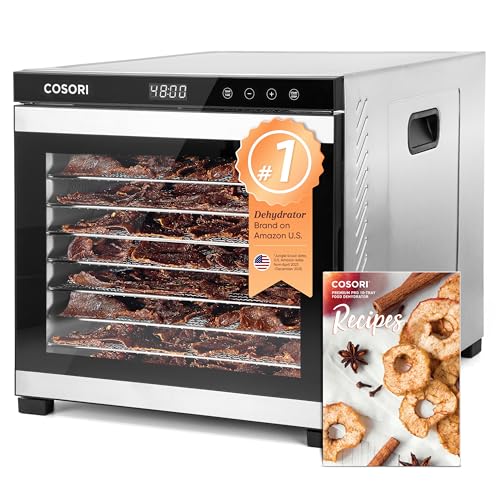
Cosori 10-Tray Stainless Dehydrator, 16.2 ft², 1000W
10 trays16.2 ft²1000W95 to 165 F
Check price on Amazon
Best for: Households that process garden harvests and several pounds of jerky.

Cosori's large cabinet gives each of its ten stainless steel trays 15.6 by 15 inches, which adds up to 16.2 square feet of drying space, and drives them with a 1000 watt motor. It tops out at 165 degrees, which the maker says follows USDA jerky safety guidelines.

This is the right size for a household and the wrong size for a business. Each tray is big enough to hold a whole tomato's worth of slices flat, and ten of them cover a garden harvest or several pounds of jerky. The power density is also the best in the guide for its class: 1000 watts across 16.2 square feet is stronger per area than the 18-tray 1100 watt cabinet.

The trays are large and awkward to wash in a normal sink, so plan to use a bathtub or a big basin. Wipe the cabinet while warm after jerky, keep the fan guard clear and give the machine space on all sides. It is a pantry or garage appliance, not a counter one.

What works

  • 16.2 sq ft of drying space across ten trays
  • 1000 watt motor for its size
  • 165 F cap matches jerky safety guidance
  • Large flat trays hold whole slices

Watch out for

  • Trays are awkward to wash in a sink
  • 165 F ceiling leaves less headroom than 190 F machines
  • Needs pantry or garage space

Spec sheet

Trays
10 stainless, 15.6 x 15 inch
Drying space
16.2 square feet
Motor
1000 watt
Temperature
95 to 165 F
Jerky limit
Capped at 165 F per USDA guidance
02
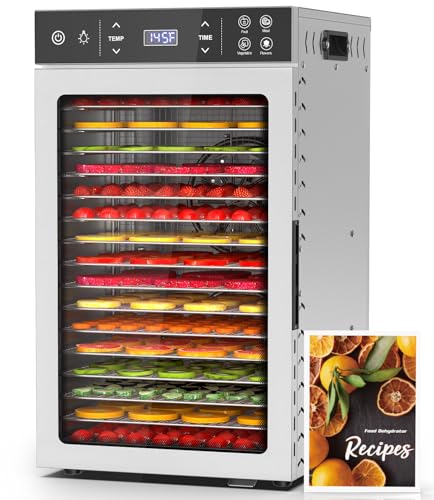
18-Tray 1100W Stainless Dehydrator, 5 Presets, Window
18 trays18 ft²1100WUnder 50 dB
Check price on Amazon
Best for: Bulk jerky and herb dryers who want presets and a window.

This cabinet carries 18 food-grade 304 stainless steel trays and 18 square feet of drying area, with five programmable presets, an 85 to 195 degree temperature range, a 48 hour timer, a viewing window and an LED light. The listing claims low-noise technology below 50 decibels.

The presets and window make a big cabinet easier to live with. A preset takes the guesswork out of a frequent recipe, and a window with a light lets you check progress without opening the door. A 195 degree ceiling is well above the jerky guideline, and 85 degrees is low enough for delicate herbs or raw dehydrating.

Against the Cosori 10-tray, you get nearly double the tray count with a smaller tray each, and a higher ceiling and a longer timer, but lower power density. Eighteen trays is a lot of shelves to wash. Load progressively, leave air gaps and verify the cabinet temperature with a probe on the first batch.

What works

  • 18 trays and 18 sq ft of drying space
  • 85 to 195 F range with 48 hour timer
  • Window with LED light
  • Five programmable presets

Watch out for

  • Lower watts per area than the Cosori
  • Eighteen trays to wash
  • Large footprint

Spec sheet

Trays
18 food-grade 304 stainless
Drying space
18 square feet
Motor
1100 watt
Temperature
85 to 195 F
Noise claim
Below 50 dB
03
Ausegia 12-Tray Commercial Dehydrator, 22.67 ft², 1200W
12 trays22.67 ft²1200WFull stainless
Check price on Amazon
Best for: Small producers and large families who dry in bulk.

Ausegia markets a 12-tray cabinet with a usable area of up to 22.67 square feet, a 1200 watt heater and a full stainless steel body. The digital panel sets time from 30 minutes to 24 hours in 30 minute steps, and the listing describes an automatic shutdown with a cooling air phase one minute before the timer ends.

That is more area than the Cosori on fewer, bigger trays, with the heater power to match. The 30 minute timer steps allow finer control than most competitors offer, and the cooling stage protects the heater. It sits between the home and the commercial class and suits a small food business or a family that processes large quantities.

Its weight and size demand a dedicated stand or counter. Check the door seal, wipe the interior while warm and verify temperature at several tray levels, since big trays can leave a temperature gradient. The 24 hour timer limit is fine for most dries.

What works

  • 22.67 sq ft usable area on 12 trays
  • 1200 watt heater
  • 30 minute timer steps
  • Cooling stage before shutdown

Watch out for

  • 24 hour timer limit
  • Heavy and large
  • Brand has a short track record

Spec sheet

Trays
12 stainless
Drying space
Up to 22.67 square feet
Motor
1200 watt
Timer
30 minutes to 24 hours
Body
Full stainless steel
04
HOPERAN 16-Tray Stainless Dehydrator, 800W, 4 Presets
16 trays800W dual fans85 to 195 F4 presets
Check price on Amazon
Best for: Bulk dryers who want dual fans and a high temperature ceiling.

HOPERAN builds this cabinet around dual rear-mounted fans and 16 stainless steel trays, with four presets, an 85 to 195 degree range and a timer from 1 to 24 hours. The listing claims 360 degree airflow and 30 percent faster drying from the dual fans.

Two fans matter in a big cabinet. A single fan has trouble keeping the far corners as dry as the near ones across 16 shelves, and a second fan evens the gradient. The 195 degree ceiling matches the 18-tray cabinet and exceeds the Cosori's, which gives headroom for a hot first stage on jerky.

Compared with the 18-tray model, it has two fewer trays and a 24 hour timer rather than 48, but dual fans. Load shelves evenly and leave space between food on each tray. Wash trays promptly, clean the fan guards and verify the temperature at top and bottom. The speed claim is the maker's, so treat it as an upper bound.

What works

  • Dual rear fans for 360 degree airflow
  • 85 to 195 F range
  • 16 stainless trays
  • Four presets

Watch out for

  • 24 hour timer limit
  • 30 percent faster drying is a maker claim
  • Large footprint

Spec sheet

Trays
16 food-grade stainless
Fans
Dual rear-mounted, 800W
Temperature
85 to 195 F
Timer
1 to 24 hours
Presets
4
05
Septree 18-Tray Commercial Dehydrator, 2000W, 34.4 ft²
18 trays34.42 ft²2000W70 to 190 F
Check price on Amazon
Best for: Small businesses and hunting camps that need very large capacity.

Septree sells this as a commercial-grade cabinet with 18 stainless steel trays, 34.42 square feet of drying space and a 2000 watt motor. Digital presets span 70 to 190 degrees with an integrated 0.5 to 24 hour timer, and the listing says the trays are dishwasher safe.

It has the most power and nearly the most area of any machine here, and that matters at scale: a 2000 watt heater can recover quickly after a door opening even with 18 loaded trays. The 70 degree floor is also the lowest in the lineup, a plus for raw food and herb drying. A large-capacity machine like this one suits a business or a hunting camp.

It also demands a dedicated electrical setup: 2000 watts is a significant draw on a household circuit, so check that the outlet and breaker can supply it. Giving it a shelf of its own, wiping the interior while warm and verifying the temperature on several trays are all sensible habits.

What works

  • 34.42 sq ft of drying space
  • 2000 watt heater with fast recovery
  • 70 to 190 F range
  • Dishwasher-safe stainless trays

Watch out for

  • Heavy electrical draw
  • 24 hour timer limit
  • Very large and heavy

Spec sheet

Trays
18 stainless, dishwasher safe
Drying space
34.42 square feet
Motor
2000 watt
Temperature
70 to 190 F
Timer
0.5 to 24 hours
06
BriSunshine 24-Tray Commercial Dehydrator, 39.3 ft², 1600W
24 trays39.3 ft²1600WDual fans, hooks
Check price on Amazon
Best for: Small producers who hang jerky and sausages as well as drying trays.

BriSunshine offers 24 extra-large stainless steel trays, 39.3 square feet of drying space, a 1600 watt heater and dual fans for 360 degree airflow. A distinctive feature is two drying methods: flat trays for sliced food or included hanging hooks for jerky strips and sausages.

Hanging hooks suit whole-muscle jerky and cured sausage, where strips hang vertically with air on both sides instead of lying on a tray. That is closer to how commercial jerky is made, and it removes the tray marks. At 39.3 square feet and 24 trays, it is the largest in the lineup, and the 1600 watts is lower per area than the Septree.

It is a commercial piece of equipment: it needs floor space, a strong circuit and a plan for washing 24 trays. Verify the temperature at top and bottom, space hanging strips apart and wipe the interior regularly. For a hobbyist it is overkill, for a small producer it is the right scale.

What works

  • 24 extra-large trays and 39.3 sq ft of space
  • Dual fans for airflow
  • Hanging hooks for jerky and sausages
  • 1600 watt heater

Watch out for

  • Largest and heaviest here
  • Lower watts per area than the Septree
  • Overkill for home use

Spec sheet

Trays
24 extra-large stainless
Drying space
39.3 square feet
Motor
1600 watt
Fans
Dual fans
Methods
Flat trays or hanging hooks

Spec sheet decoder

What the numbers on the box really mean

The specs manufacturers lead with, translated into what they tell you about real-world performance.

Square feet of drying space

Total usable tray area.

Watch forThe BriSunshine lists 39.3, the Septree 34.42, the Cosori 16.2.

Watts per square foot

Heater power divided by tray area, a measure of how hard the machine works.

Watch forThe Cosori and Septree are denser than the BriSunshine.

Dual fans

Two fans that move air across more shelf area.

Watch forThe HOPERAN and BriSunshine list them.

Temperature floor

The lowest setting, useful for herbs and raw drying.

Watch forThe Septree starts at 70 F.

Hanging hooks

Hooks that suspend strips so air reaches both sides.

Watch forThe BriSunshine includes them.

Methodology

How We Evaluated These Large Food Dehydrators

Drying area

We compared stated square footage rather than tray counts, from the Cosori's 16.2 to the BriSunshine's 39.3.

Power density

We divided watts by area to judge how hard each cabinet works, crediting the Cosori and Septree.

Airflow

We favored dual fans and strong rear fans for large cabinets.

Temperature range

We compared floors and ceilings, from the Septree's 70 F floor to the 195 F ceilings of the HOPERAN and 18-tray cabinet.

Practicality

We weighed electrical draw, tray size and cleaning difficulty.

Decision guide

How to Choose the Right Large Food Dehydrators

By Batch Size

SituationPickWhy
Garden harvest at homeCosori 10-Tray16.2 sq ft in a pantry-size cabinet
Bulk jerky and herbs18-Tray 1100W18 sq ft with presets
Small food businessAusegia 12-Tray22.67 sq ft with 1200 watts
Commercial scaleBriSunshine 24-Tray39.3 sq ft

By Budget

TierPickWhy
Lowest of the largeCosori 10-TraySmaller and home-sized
Low-midHOPERAN 16-TrayDual fans and 195 F ceiling
MidAusegia 12-Tray22.67 sq ft
HigherSeptree 18-Tray2000 watts and 34.42 sq ft

Dual Fan vs Single Rear Fan

Dual fans

The HOPERAN and BriSunshine move more air across big cabinets, which helps keep back and front shelves in step.

Single rear fan

The Cosori and others rely on one fan, which works well at ten trays and less so at 24.

Pick dual fans for 16 or more trays; a single fan is enough at ten.

By Electrical Setup

SituationPickWhy
Standard 15 amp kitchen circuitCosori 10-Tray1000 watts is manageable
20 amp circuit available18-Tray 1100WAbout 9 amps
Dedicated 20 amp circuitSeptree 18-Tray2000 watts draws most of a 20 amp circuit
Workshop or camp with a generatorBriSunshine 24-Tray1600 watts

For Bulk Jerky Specifically

Look for

A ceiling above 160 F, enough area for many strips and ideally a way to hang strips. Dual fans help keep every strip at the same pace.

In this comparison

The BriSunshine's hanging hooks and the HOPERAN's 195 F ceiling suit bulk jerky.

When to Spend More

Spend more if

You process meat or produce in volume every season, where a Septree or an Ausegia saves hours.

Save if

You dry a bushel at a time. The Cosori 10-Tray is large enough.

Ownership

Maintenance schedule

The upkeep that decides whether this machine lasts two seasons or ten.

TaskIntervalWhy it matters
Wash trays promptlyAfter each batchLarge trays hold lots of residue, and sugar hardens quickly. Soak in a bathtub or large basin.
Wipe the interior while warmAfter each batchFat spatter bakes on when the cabinet cools.
Clean fan guardsMonthlyDust cuts airflow, which matters more in a big cabinet.
Check the door sealYearlyA leaky seal wastes heat across a large volume.
Inspect the power cordEach seasonHigh wattage stresses cords and plugs.

FAQ

Frequently Asked Questions

Do I need a large dehydrator?

Only if you regularly dry a bushel or more, or process several pounds of meat at once. A smaller cabinet is easier to place and clean, uses less electricity per batch when half loaded and still gives even drying. Many households that think they need a large machine are better served by a mid-size cabinet.

How much power does a large dehydrator use?

Wattage ranges from 1000 to 2000, so check your circuit. A 2000 watt model draws most of a 20 amp circuit, and a 1000 watt model about 8 amps. Running costs depend on hours, so a 12 hour batch at 1000 watts uses roughly 12 kilowatt-hours, which is worth weighing against the value of the food you are drying.

Can I run it in a garage?

Yes, but keep it away from dust, moisture and pests, and check the ambient temperature. A cold garage slows drying and a damp one adds humidity that the machine must remove, so expect longer cycles in winter. Place it on a level, heat-safe surface and keep the air intake clear of walls.

How do I wash large trays?

In a bathtub, a large basin or a large dishwasher if the model lists dishwasher-safe trays. Soak sticky trays in hot water for a few minutes first and use a soft brush on the mesh. Measure the dishwasher rack before assuming 15 inch trays will fit, since many racks are narrower than that.

Is a window needed?

It saves heat by letting you check without opening the door.

What is better for jerky, hooks or trays?

Hooks let air reach both sides of a strip, which is closer to commercial drying and avoids tray marks on the meat. Trays are simpler and hold marinated strips without dripping onto the machine floor. If you make sausages or long strips, hooks are worth having, and otherwise trays are fine.

Bottom line

The short version

Browse more large food dehydratorson Amazon →
James Miller, Lead Machine Editor

About the author

James Miller

Lead Machine Editor, MachineFanatic

James Miller leads MachineFanatic's buying guides, turning spec sheets, manuals and owner feedback into clear verdicts on power tools, outdoor power equipment, shop machines and kitchen machines.

More from James →

Keep reading

Related guides