
Amazon affiliate links - we earn a commission.Affiliate disclosure

Buying guide · 12 min read · Updated 2026-11-07

Best Food Dehydrators Under $100 (2026)

Six food dehydrators priced under $100 compared by airflow, temperature ceiling, tray material and timers, with honest limits for jerky and fruit.

James MillerBy James MillerLead Machine Editor6 machines comparedSpec-sheet verified
Best Food Dehydrators Under $100

At a glance

Our top picks

Side by side

Spec comparison

MachineTraysTemperatureHeaterTimerDesign
Cosori 5-Tray Stainless Dehydrator, 3.1 ft², 176 FBest Overall Under the CapCosori 5-Tray Stainless Dehydrator, 3.1 ft², 176 F5 stainless steel95 to 176 F, 1 degree stepsn/an/an/a
OSTBA 400W 5-Tray Stainless Dehydrator, 95 to 160 FBest Stainless StackOSTBA 400W 5-Tray Stainless Dehydrator, 95 to 160 F5 stainless steel, removable racks95 to 160 F400 watt1 to 48 hoursn/a
Cosori 5-Tray 350W Dehydrator, Expandable to 7, 165 FBest Expandable StackCosori 5-Tray 350W Dehydrator, Expandable to 7, 165 F5 BPA-free, expandable to 7n/a350 watt48 hoursStacking
Elite Gourmet 5-Tray Stacking Dehydrator, 11.4 inchBest Simple Dial StackElite Gourmet 5-Tray Stacking Dehydrator, 11.4 inch5 clear BPA-free, 11.4 inch95 to 158 Fn/an/aStacking, expandable
Magic Mill 5-Tray Stainless Stack, 240W, 48H TimerBest Low-Power Stainless StackMagic Mill 5-Tray Stainless Stack, 240W, 48H Timer5 stackable stainless steeln/a240 watt48 hour digitalCompact stack
Konfintos 250W Small Dehydrator, 5 BPA-Free TraysBest Smallest FootprintKonfintos 250W Small Dehydrator, 5 BPA-Free Trays5 transparent BPA-free, height-adjustablen/a250 wattn/aStacking

Under a hundred dollars, a dehydrator buyer chooses between two designs: a stack of round plastic trays with a fan in the base or lid, or a few small cabinets with a rear fan. The cap is generous enough for either, but not for a large machine, so the real question is which compromise suits the food you want to dry.

The compromises are specific. Stacks dry unevenly but cost less and fit small spaces, cabinets dry evenly but hold fewer trays, and the ceiling temperature decides whether jerky is realistic. Listing prices move, and the cap reflects listing prices when this guide was updated, so check the current price before buying.

Before you buy

6 Criteria to Look For Before Buying a Food Dehydrator Under $100

  1. 01

    What the cap realistically buys

    Under $100 you can reach one horizontal-airflow cabinet and several stacks with 240 to 400 watt heaters, and you will not reach large or high-heat machines. Decide whether even airflow or expandability matters more. A buyer who dries meat monthly is better off with the cabinet that dries every tray evenly, while a gardener who dries one overwhelming week a year gets more from a stack that grows. Because the cap is firm, avoid stretching to a larger machine that will sit unused, and avoid shopping on tray count alone. Prices move, and the cap reflects listing prices when this guide was updated.

  2. 02

    Airflow design

    The Cosori cabinet pushes air across each tray from the rear, while the OSTBA, Elite Gourmet, stacking Cosori, Magic Mill and Konfintos use stacks. A stack dries unevenly, so you rotate trays. If you dry meat or large batches, the cabinet is worth the premium. The practical difference is time and attention: a cabinet batch can be loaded and left, while a stack batch wants a mid-cycle shuffle and a final sort of over-dry and under-dry pieces. Over a season of weekly drying, that saved attention adds up to hours.

  3. 03

    Temperature ceiling

    The Cosori cabinet reaches 176 degrees, the stacking Cosori 165, the OSTBA 160 and the Elite Gourmet 158. Jerky guidance often asks for about 160, so a 158 ceiling is a poor fit. For fruit and herbs, any of them works. If you want jerky from a machine with a low ceiling, some makers suggest heating the meat in an oven first and then drying it in the dehydrator, but that adds a step and an uneven result, so it is better to buy a machine whose ceiling matches the job and verify it with a probe the first time.

  4. 04

    Tray material and spacing

    The Cosori cabinet, OSTBA and Magic Mill use stainless trays, while the others use clear BPA-free plastic. Stainless resists stains, and adjustable spacing, as on the OSTBA, handles thick and thin pieces. Plastic is cheaper and lighter.

  5. 05

    Timer and controls

    The OSTBA, stacking Cosori and Magic Mill offer 48 hour timers, the Cosori cabinet has presets and the Elite Gourmet has only a dial. A timer prevents over-drying. Without one you need a separate alarm.

  6. 06

    Heater power

    The Magic Mill's 240 watts, Konfintos' 250, Cosori's 350 and OSTBA's 400 decide drying speed and recovery. A low-watt stack is slow with full loads. Plan batches accordingly. A 240 watt stack loaded with five full trays can take most of a day to dry what a 400 watt stack finishes overnight, and the difference is larger in a cool or humid kitchen. If your kitchen is cold, run the machine in a warmer room and avoid placing it near a window or exterior door.

Detailed reviews

The 6 best food dehydrators under $100, explained

01
Cosori 5-Tray Stainless Dehydrator, 3.1 ft², 176 F
5 stainless trays3.1 ft²95 to 176 F4 presets
Check price on Amazon
Best for: Buyers who want even airflow and a jerky-capable ceiling under the cap.

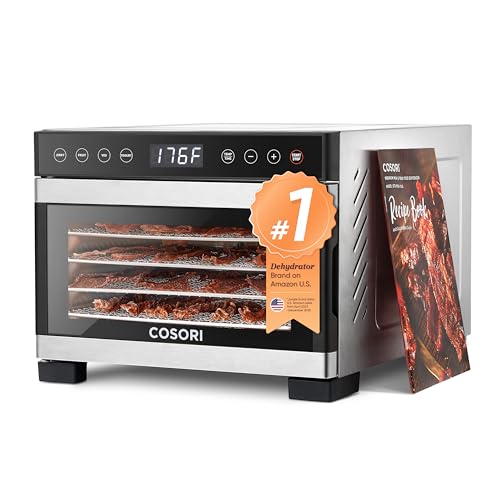
This is the only horizontal-airflow cabinet under the cap, and that is why it leads. Air crosses each of the five stainless steel trays from the rear, which dries evenly without rotating shelves, and 3.1 square feet of drying space is enough for a family batch of apples or a pound or two of jerky. The temperature runs from 95 to 176 degrees in one degree steps, with four presets for jerky, fruit, vegetables and yogurt.

The ceiling is the second reason. At 176 degrees it clears the roughly 160 degrees often recommended for meat with margin, while every stacking competitor in the guide tops out at 158 or 160. Stainless trays also resist the staining that clear plastic collects, which matters for turmeric, berries and marinades. A cookbook, mesh screen and fruit roll sheet ship in the box.

The limits are capacity and expansion. Five trays do not stretch to seven the way the stacking Cosori does, so a garden harvest needs several rounds. Wash the trays by hand, wipe the interior and keep the fan guard clear. Presets are starting points, and a probe thermometer is the way to confirm the actual temperature.

What works

  • Horizontal airflow dries trays evenly
  • 176 F ceiling clears the jerky guideline
  • Stainless trays resist stains
  • Presets, mesh screen and fruit roll sheet included

Watch out for

  • Five trays do not expand
  • Smaller capacity than the stacks can reach
  • Yogurt preset is not a precise incubator

Spec sheet

Trays
5 stainless steel
Drying space
3.1 square feet
Temperature
95 to 176 F, 1 degree steps
Presets
Jerky, fruit, vegetables, yogurt
Extras
Cookbook, mesh screen, fruit roll sheet
02
OSTBA 400W 5-Tray Stainless Dehydrator, 95 to 160 F
5 stainless trays400W95 to 160 F2 tray heights
Check price on Amazon
Best for: Buyers who want a stainless stack with adjustable spacing and a 48 hour timer.

OSTBA puts stainless steel racks into a stacking dehydrator with a 400 watt heater, a digital drying cycle that sets temperature from 95 to 160 degrees and a timer from 1 to 48 hours. The trays can be spaced at either 0.55 inch for sliced strawberries or 1.02 inch for thicker cuts.

The two spacing options solve a real problem with stacks. Thin fruit slices need small gaps for fast airflow, while jerky strips and thick pieces need more room, and a fixed-spacing stack forces a compromise. The 160 degree maximum meets the meat guideline at its edge, which is better than competitors at 158, though it leaves no headroom for a hot first stage. Against the Cosori cabinet, the OSTBA is a stack, so rotate trays for evenness.

Stainless racks are removable and wash easily. Because the heater is 400 watts, load lightly and use the long timer for jerky. Verify the temperature at the top tray with a thermometer, and wipe the base after each use.

What works

  • Stainless racks resist stains and odors
  • Two tray spacings for thin and thick food
  • 95 to 160 F with a 1 to 48 hour timer
  • 400 watt heater is strong for a stack

Watch out for

  • Stacking airflow needs tray rotation
  • 160 F ceiling has no headroom
  • Five trays limit batch size

Spec sheet

Trays
5 stainless steel, removable racks
Heater
400 watt
Temperature
95 to 160 F
Timer
1 to 48 hours
Spacing
0.55 or 1.02 inch between trays
03
Cosori 5-Tray 350W Dehydrator, Expandable to 7, 165 F
5 trays, up to 7350W165 F max48 h timer
Check price on Amazon
Best for: Gardeners who want to expand capacity over time.

The stacking Cosori reaches 165 degrees, which the maker contrasts with the 158 degrees of many rivals, and offers five BPA-free trays that expand to seven. A 350 watt motor and a 48 hour timer round out the package.

Expandability is the unique feature under the cap. A garden harvest can be stretched with two extra trays, and a small batch runs on five. The 165 degree ceiling clears the meat guideline with a little margin, which makes jerky a reasonable project, though a stack dries unevenly and you must rotate trays.

Compared with the Cosori cabinet, it costs less and expands, but gives up even airflow and stainless trays. Use mesh sheets for sticky fruit, line up pieces in a single layer and check the top tray with a probe thermometer. The 350 watt heater is modest, so expect long drying times for a full stack.

What works

  • Expands from five to seven trays
  • 165 F ceiling reaches jerky range
  • 48 hour timer
  • Compact base

Watch out for

  • Stacking airflow needs rotation
  • 350 watt heater is slow with full loads
  • Plastic trays stain

Spec sheet

Trays
5 BPA-free, expandable to 7
Heater
350 watt
Max temperature
165 F
Timer
48 hours
Design
Stacking
04
Elite Gourmet 5-Tray Stacking Dehydrator, 11.4 inch
5 BPA-free trays11.4 inch trays95 to 158 FDial control
Check price on Amazon
Best for: First-time dehydrator buyers drying fruit and herbs.

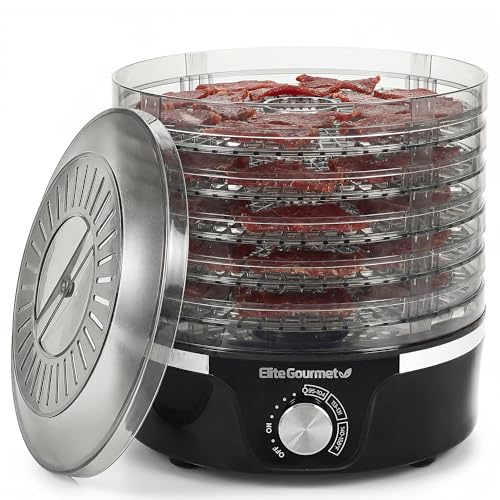
Elite Gourmet is the basic stack: five clear BPA-free trays that stand 8.5 to 10.75 inches tall, a dial with a power indicator and a 95 to 158 degree range. The maker lists jerky, fruit chips, fruit rolls and granola.

The dial is both its charm and its limit. There is no timer, so you must watch the clock, and the 158 degree maximum sits below the usual jerky guideline. Against the OSTBA and the stacking Cosori, the Elite Gourmet is the cheapest and simplest, with no timer and a lower ceiling. Apple chips, herbs and vegetables suit it well.

Rotate trays and use a separate timer. Clear plastic trays can stain and hold odors over time, so line them with mesh for sticky foods. It is an honest first dehydrator for someone who wants to try fruit drying without a big commitment.

What works

  • Simple dial with a power light
  • Trays expand to fit thicker food
  • Compact and light
  • Easy to store

Watch out for

  • No timer
  • 158 F ceiling is low for jerky
  • Uneven drying means rotating trays

Spec sheet

Trays
5 clear BPA-free, 11.4 inch
Height
Stacks 8.5 to 10.75 inch
Temperature
95 to 158 F
Control
Dial with power indicator
Design
Stacking, expandable
05
Magic Mill 5-Tray Stainless Stack, 240W, 48H Timer
5 stainless trays240W48 h timerAdjustable trays
Check price on Amazon
Best for: Small-batch dryers who want stainless trays and a timer.

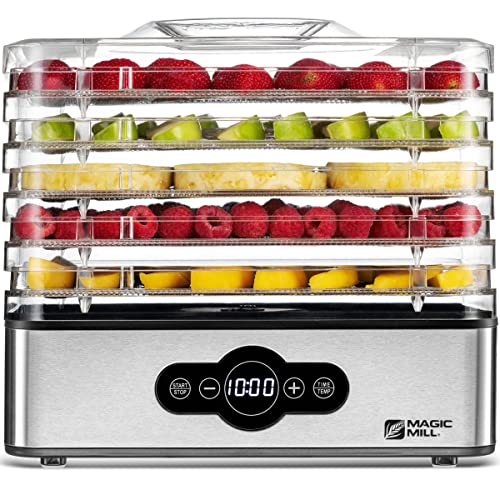
Magic Mill offers stainless steel trays on a compact stack with a 240 watt drying element, a digital 48 hour timer and temperature control. The trays are adjustable in spacing and the listing describes the steel as meeting quality checks.

The 240 watt element is the lowest heater power in the guide, which means it dries slowly and recovers slowly after the door opens. The stainless trays and digital timer make it unusual under the cap, but the power limits it to light loads such as herbs, fruit slices and small jerky batches. Compared with the OSTBA's 400 watts, it is a gentler machine.

Set the timer generously, load lightly and rotate trays. Wash the stainless trays in the sink, wipe the base and check the temperature with a thermometer, since a low-watt stack may not reach the dial setting at the far end.

What works

  • Stainless trays on a compact stack
  • 48 hour digital timer
  • Adjustable tray spacing
  • Easy to clean

Watch out for

  • 240 watt heater is slow
  • Light loads only
  • Stacking airflow is uneven

Spec sheet

Trays
5 stackable stainless steel
Heater
240 watt
Timer
48 hour digital
Control
Digital temperature
Design
Compact stack
06
Konfintos 250W Small Dehydrator, 5 BPA-Free Trays
5 BPA-free trays250WCompactHeight-adjustable trays
Check price on Amazon
Best for: Apartment cooks drying herbs and fruit in small batches.

Konfintos sells a small dehydrator for everyday home use with an energy-efficient 250 watt heater and five stackable, height-adjustable, transparent BPA-free trays. The listing targets jerky, fruit, herbs and pet treats and emphasizes saving counter space.

It is the smallest and lightest of the six. A low-power heater suits small batches, and height-adjustable trays handle thicker pieces. The trade-offs are the same as other budget stacks: slow drying, uneven airflow and no temperature range stated in the listing text we reviewed, so check the specification page before relying on it for meat. A machine that does not publish its ceiling should be assumed to stop at the usual 158 degrees until you confirm otherwise.

Dry small batches, rotate trays and use a thermometer. Wash the trays by hand and store the stack nested. It is a reasonable choice for herbs and apple chips in a small kitchen, and a poor choice for a hunter's jerky.

What works

  • Small and space-saving
  • Height-adjustable trays
  • Energy-efficient 250 watt heater
  • Transparent trays let you check progress

Watch out for

  • Slow drying with low power
  • Temperature range should be verified
  • Not suited to meat in volume

Spec sheet

Trays
5 transparent BPA-free, height-adjustable
Heater
250 watt
Class
Small, space-saving
Use
Jerky, fruit, herbs, pet treats
Design
Stacking

Spec sheet decoder

What the numbers on the box really mean

The specs manufacturers lead with, translated into what they tell you about real-world performance.

Horizontal airflow

Air moves from the rear across each tray.

Watch forThe Cosori cabinet is the only one with it under the cap.

Maximum temperature

The highest setting, which limits what you can dry safely.

Watch forThe Elite Gourmet stops at 158, the Cosori cabinet reaches 176.

Tray spacing

The gap between trays that controls airflow for thick or thin food.

Watch forThe OSTBA offers 0.55 and 1.02 inch.

Watts

Heater power affecting drying speed and recovery.

Watch forThe Magic Mill lists 240, the OSTBA 400.

BPA-free

Plastic made without bisphenol A.

Watch forMost stacks use BPA-free plastic trays, which can still stain.

Methodology

How We Evaluated These Food Dehydrators Under $100

Value within the cap

We selected models at or below the cap on the update date and ranked them by what the budget buys: airflow, ceiling and trays.

Airflow

We separated the one horizontal-airflow cabinet from the stacks.

Temperature ceiling

We compared top settings with the jerky guideline, from 176 on the Cosori cabinet to 158 on the Elite Gourmet.

Trays and controls

We favored stainless trays, adjustable spacing and timers.

Heater power

We noted that low watts mean slow drying and weighed it for each model.

Decision guide

How to Choose the Right Food Dehydrators Under $100

By Food Type

SituationPickWhy
Jerky and fruit togetherCosori 5-Tray Cabinet176 F and even airflow
Fruit slices of mixed thicknessOSTBA 5-TrayTwo tray spacings
Garden harvest burstsCosori 350W ExpandableGrows to seven trays
Herbs and apple chipsElite Gourmet 5-TraySimple and light

By Budget Within the Cap

TierPickWhy
LowestKonfintos 250WSmallest and simplest
LowElite Gourmet 5-TrayBasic stack
Low-midCosori 350W ExpandableTimer and 165 F
Top of the capCosori 5-Tray CabinetHorizontal airflow and presets

Cabinet vs Stack Under the Cap

Cabinet

The Cosori 5-Tray dries evenly and reaches 176 F, but does not expand.

Stack

The OSTBA, Cosori 350W, Elite Gourmet and others cost less and some expand, but dry unevenly.

Pick the cabinet if you want jerky; pick a stack if you mostly dry fruit and herbs.

By Controls

SituationPickWhy
Wants presetsCosori 5-Tray CabinetFour presets
Wants a 48 hour timerOSTBA 5-Tray1 to 48 hours
Wants a plain dialElite Gourmet 5-TrayNo electronics
Wants stainless and a timerMagic Mill 5-Tray48 hour digital timer

For Jerky on a Budget Specifically

Look for

A ceiling above 160 F, even airflow and room for flat strips. Verify temperature with a probe.

In this comparison

The Cosori cabinet at 176 F and the stacking Cosori at 165 F are the realistic picks for jerky under the cap.

When to Spend More

Spend more if

You dry meat often or in volume. A larger cabinet with a rear fan is worth it above the cap.

Save if

You dry fruit a few times a year. The Konfintos or Elite Gourmet is enough.

Ownership

Maintenance schedule

The upkeep that decides whether this machine lasts two seasons or ten.

TaskIntervalWhy it matters
Wash trays after each batchAfter each useSugar and fat residue spoil the next batch. Stainless trays tolerate hot water, plastic ones are best hand washed.
Rotate stack traysMidway through a dryStacks dry unevenly, so swapping trays evens the result.
Wipe the baseAfter each useDrips and sugar collect in the base and cause odors and pests. Wipe it with a damp cloth once it has cooled, and keep the stack dry before storing it nested in a cupboard.
Verify temperatureFirst batchA probe thermometer confirms the dial, which matters most on low-watt stacks.
Clean the fan guardMonthlyDust cuts airflow and slows drying.

FAQ

Frequently Asked Questions

Can I make jerky under $100?

Yes, with a model that reaches at least about 160 F, such as the Cosori models or the OSTBA at its limit. Verify the temperature with a probe at the top and bottom trays, slice the meat evenly and expect to rotate trays on a stack. Avoid any model that tops out at 158 F if jerky is the main goal.

Is a stack good enough for fruit?

Yes. Rotate trays and slice evenly, and a stack dries fruit well. Apples, bananas, strawberries and tomatoes are forgiving foods, and small differences between trays are easy to correct by pulling finished pieces early. A stack is a fine way to learn what you like to dry before deciding whether to upgrade.

Why do cheap stacks dry unevenly?

Air passes through the stack, so trays nearest the fan and heater dry first and the far trays last. Rotating trays halfway through helps, as does loading thin, fast-drying food near the heat and thick food farther away. Avoid overloading any tray, since crowded pieces block the airflow that the stack already struggles to deliver.

Do I need a timer?

It helps prevent over-drying and lets you run overnight. Without one, use a separate alarm and check the batch at the earliest time it could be done. A timer that stops the heater is the safer choice if you leave the house, and the OSTBA, stacking Cosori and Magic Mill all offer one under the cap.

Are plastic trays safe?

BPA-free trays are food-grade, but they stain. Stainless avoids that.

What does the cap mean?

The $100 cap reflects listing prices when this guide was updated. Prices move, so check the current listing.

Bottom line

The short version

Browse more food dehydrators under $100on Amazon →
James Miller, Lead Machine Editor

About the author

James Miller

Lead Machine Editor, MachineFanatic

James Miller leads MachineFanatic's buying guides, turning spec sheets, manuals and owner feedback into clear verdicts on power tools, outdoor power equipment, shop machines and kitchen machines.

More from James →

Keep reading

Related guides