

Amazon affiliate links - we earn a commission.Affiliate disclosure

Buying guide · 16 min read · Updated 2026-11-06

Best Generators for Power Tools (2026)

Six portable and battery generators compared on starting watts, 120V and 240V outlets and clean power, so saws, compressors and chargers run reliably.

James MillerBy James MillerLead Machine Editor6 machines comparedSpec-sheet verified
Best Generators for Power Tools

At a glance

Our top picks

Side by side

Spec comparison

A job site without power is a day lost, and a generator is the usual fix. The trouble is that tools do not draw the figure printed on their label. Motors pull several times their running load for a split second at start, and the generator has to ride through that surge without sagging or tripping.

This guide explains how to read starting and running watts, why an inverter generator matters for chargers and brushless tools, and when a 240 V outlet is required. Use the picks above for the short list, then read each review below to match outlets, fuel and weight to the tools you actually own.

Before you buy

6 Criteria to Look For Before Buying a Generator for Power Tools

  1. 01

    Starting versus running watts

    An induction motor draws two to three times its running current for a fraction of a second at start, so the generator's surge rating decides whether the tool starts, while its rated watts decide whether it keeps running. A circular saw is typically around 1,200 to 1,400 running watts, and a 1 HP air compressor can need over 4,000 starting watts. Buying on running watts alone is the classic mistake. Among these picks the WEN 56477i offers 4,800 surge and 4,000 rated, the WEN 6800 gives 6,800 surge and 5,100 rated on gas, and the Efurden gives 4,400 peak and 3,400 running.

  2. 02

    Inverter versus conventional output

    A conventional open-frame alternator ties its output frequency to engine speed, and its waveform can carry total harmonic distortion in the range of 20 percent or more, while an inverter generator rebuilds a clean sine wave electronically with distortion in the low single digits. That difference matters for brushless tools, battery chargers and electronics, which can overheat or fail on dirty power. Clean power does not mean more capacity, though. Every gas unit in this guide is an inverter design, and the EGO 3000 outputs a pure sine wave, so power quality is not a differentiator here.

  3. 03

    120V and 240V outlets

    Most portable tools run on 120 V, but a 3 HP table saw, large compressor or welder often needs 240 V, and a 120 V-only generator cannot supply it. A 240 V outlet is usually an L14-30R twist-lock, and the plug on your tool must match. Check the plug type before you buy, because adapters are not always safe. The WEN 6800 is the only pick here with a 120/240 V outlet, while the PowerSmart 3800 offers a single 30 A L5-30R twist-lock at 120 V.

  4. 04

    Fuel type and storage

    Gasoline goes stale in a few months, and ethanol blends attract moisture, so a generator left with fuel in the carburetor often will not start the next year. Propane stores indefinitely and burns cleaner, at the cost of lower output, usually about 10 to 15 percent. The WEN 6800 drops from 5,100 to 4,500 rated watts on propane, and the PowerSmart goes from 3,300 to 3,100. If you use a generator seasonally, a dual fuel unit is a strong option. A fuel shutoff, as on both WEN units, lets you run the carburetor dry before storage.

  5. 05

    Noise and runtime

    Noise ratings are only meaningful with a stated load and distance. A 59 dBA figure at 25 percent load, as the PowerSmart claims, will rise as the load increases, and an open frame unit like the Efurden or Oxseryn at under 72 dBA at 23 ft is louder. Runtime figures also assume light loads: the Efurden claims 14 hours at 25 percent load from 2 gal, but at full load the same tank lasts much less. For a work site, size the generator so the typical load is 50 percent or less, which keeps the engine quieter and saves fuel.

  6. 06

    Safety and weight

    Portable generators produce carbon monoxide, and a CO shutdown sensor that kills the engine at dangerous levels is a significant safeguard, though never a reason to run a unit indoors or in a garage. Both WEN units and the PowerSmart list CO sensors, while the Efurden and Oxseryn do not. Weight matters for jobs where you carry the unit: the 56 lb Efurden is far easier than a 5,000 watt dual fuel unit. Always run generators outdoors, at least 20 ft from windows and doors, and use a GFCI-protected cord for tools.

Detailed reviews

The 6 best generators for power tools, explained

01
WEN 56477i 4800W RV-Ready Inverter Generator
4800 surge watts4000 rated watts224cc engineCO shutdown
Check price on Amazon
Best for: Contractors and serious DIYers who need 120 V power for saws, compressors and chargers with clean output.

This is an inverter generator, which means the engine drives an alternator that produces raw AC, an electronic stage converts it to DC, and an inverter rebuilds a clean 60 Hz sine wave. That clean output is what protects the electronics in modern cordless chargers, brushless tools and laptops. With 4,000 rated watts it covers a corded 15 A circular saw, a compressor and a worksite charger rack at the same time.

The 4,800 surge figure is what gets a motor started, and it is the number to compare against a tool's starting load. At 4,000 rated watts it sits between the Efurden at 3,400 and the WEN 6800 dual fuel at 5,100, and it is the smallest unit here that comfortably handles a 1.5 HP compressor. It does not offer a 240 V outlet, so a 240 V table saw or welder is out. The four 120 V outlets and the TT-30R RV receptacle give plenty of flexibility.

Ownership is straightforward. The fuel shutoff lets you run the carburetor dry before storage, which prevents varnish, and the CO shutdown sensor kills the engine if exhaust builds up near the unit. Use fresh fuel with stabilizer, change the oil per the manual, and run it monthly. The three year warranty is the longest in this roundup.

What works

  • Inverter output is clean enough for chargers and electronics
  • Four thousand rated watts runs a saw plus a small compressor
  • Watchdog CO sensor shuts down in unsafe exhaust conditions
  • Fuel shutoff helps prevent carburetor varnish in storage

Watch out for

  • No 240 V outlet for table saws, welders or big compressors
  • Heavier and louder at full load than a battery power station
  • Gas only, so fuel storage and stabilizer are your responsibility

Spec sheet

Surge watts
4,800
Rated watts
4,000
Engine
224cc, gasoline
Outlets
Four 120V, one TT-30R, 12V DC, two USB
Safety
CO shutdown sensor, fuel shutoff
Warranty
3 years
02
WEN 6800W Dual Fuel Inverter Generator with 240V
5100 W gas rated4500 W propane120/240V outletDual fuel
Check price on Amazon
Best for: Shops and job sites running 240 V saws, compressors or welders, or anyone who wants propane as a fuel.

The 6800 is the one to buy if any of your tools need 240 V. Its L14-30R outlet supplies both 120 V and 240 V from one receptacle, which lets you run a 240 V table saw, a larger air compressor or a welder, something no other generator in this guide can do. It is also the only pick that runs on either gasoline or propane, with 5,100 rated watts on gas and 4,500 on propane.

The propane drop in output is real and normal. A gaseous fuel carries less energy per cycle, so you lose about 600 watts. Against the WEN 56477i at 4,000 rated, it adds about a quarter more capacity, and it more than doubles the PowerSmart 3800's 3,300 watts on gas. It is, however, larger and heavier, and the outlet count is lower, so if you need many 120 V outlets you will want a distribution cord.

Propane is a big ownership upgrade. It stores indefinitely, burns cleaner and avoids carburetor gum, which is the leading cause of generators that will not start in year three. Use the fuel shutoff on gas, keep a twist-lock adapter handy and confirm your tool's plug matches the L14-30R. The bonded neutral configuration also allows low power electric vehicle charging, though that is outside the power tool use case.

What works

  • Only pick here with a 120/240V outlet for 240V tools
  • Runs on gas or propane with clear rated figures for each
  • Highest rated output in this lineup at 5,100 watts
  • CO shutdown sensor and fuel shutoff are both included

Watch out for

  • Heavier and bulkier than the 4,000 watt class generators
  • Only three outlets, so you may need a power distribution cord
  • Output on propane is about 600 watts lower than on gasoline

Spec sheet

Gas
6,800 surge, 5,100 rated watts
Propane
6,000 surge, 4,500 rated watts
Engine
224cc dual fuel
Main outlet
L14-30R 120/240V
Other outlets
Two 120V three-prong
Safety
CO shutdown sensor, fuel shutoff
03
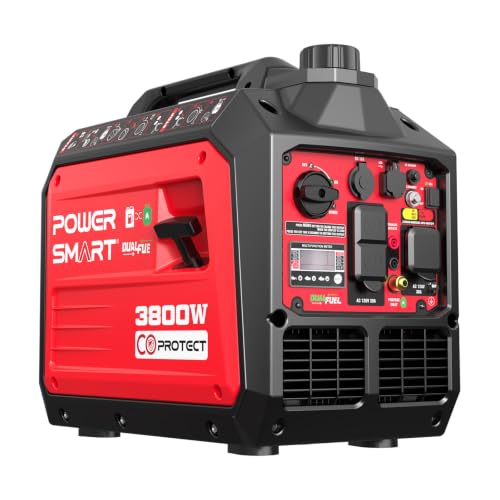
PowerSmart 3800W Dual Fuel Inverter Generator
3300 W rated gas3100 W propane59 dBA at 25% loadDual fuel
Check price on Amazon
Best for: Quiet work near neighbors or occupied buildings, and users who prefer propane's shelf life.

The PowerSmart is the compact dual fuel option. It gives 3,300 running watts on gas and 3,100 on propane, which is enough for a corded miter saw, a worksite radio and a charger rack, but not for a large compressor starting load. The Eco mode throttles engine speed to match the load, which is where the quoted 59 dBA at 25 percent load comes from, and it makes a visible difference in how annoying it is to work next to.

Compared with the Efurden, it carries less rated power at 3,300 against 3,400 but adds propane and a certified safety package. The 1.3 gal tank is smaller than the 2 gal tank on the Efurden, so its 8 hour runtime at a light 25 percent load is lower than the Efurden's 14 hours. The propane figure of up to 24 hours on a standard 20 lb cylinder is the better reason to buy: you set it up once and let it run.

It carries overload, short circuit, CO sensor and low oil shutdown protection, and it is certified against ANSI/PGMA G300 and UL 2201, which are the standards that matter for portable generators. Keep the oil topped up and run propane through the carburetor before storage so it starts reliably next year.

What works

  • Eco mode keeps noise near 59 dBA at light load
  • Propane runs up to 24 hours on a 20 pound cylinder
  • Safety package includes CO sensor and low oil shutdown
  • Compact and easier to carry than the 5,000 watt class

Watch out for

  • Single twist-lock outlet means a cord adapter for most tools
  • Smaller 1.3 gallon tank limits gasoline runtime
  • Not enough surge for a large 240 V compressor or welder

Spec sheet

Gas
3,800 starting, 3,300 running watts
Propane
3,500 starting, 3,100 running watts
Noise
59 dBA at 25% load, Eco mode
Runtime
8 hours at 25% on 1.3 gal gas
Propane runtime
Up to 24 hours on 20 lb tank
Outlet
120V 30A L5-30R twist-lock
04
Efurden 4400W Open Frame Inverter Generator
4400 peak watts3400 running2 gal tank56 lb
Check price on Amazon
Best for: Budget-conscious buyers who need a lighter 120 V generator for corded saws and chargers.

The Efurden is a conventional open frame inverter, which means it has no sound-dampening enclosure, and that is how it keeps weight to 56 lb. For a lone worker moving between jobs, 56 lb is a significant advantage over the heavier WEN units. It gives 3,400 running watts, so it handles a corded circular saw and a charger rack, but a compressor with a large starting load needs a careful check.

Its 2 gal tank with a fuel gauge is a practical feature, and the 14 hour figure at 25 percent load is the best runtime among the gas units here. Against the WEN 56477i at 4,000 rated, you give up about 600 rated watts and the CO sensor and fuel shutoff features, which are listed in the WEN's spec sheet but not in the Efurden's. That matters if you plan to run it near an enclosed space.

There is a near-identical 4,400 watt model sold under another brand, listing the same ratings and weight, which suggests a shared factory design. Do not assume any warranty and support will be equal between them. Ownership means standard oil changes, fuel stabilizer and keeping the open frame dry, since there is no enclosure to protect the engine and alternator from rain.

What works

  • Fifty-six pounds is easy to lift into a truck bed
  • Two gallon tank gives a long runtime at light loads
  • Inverter output is suitable for chargers and electronics
  • Includes a 30 amp RV outlet and 12 volt DC port

Watch out for

  • Open frame is louder than enclosed inverter generators
  • No listed CO shutdown sensor, unlike the WEN units
  • Rated watts are lower than the WEN 56477i by about 600

Spec sheet

Peak watts
4,400
Running watts
3,400
Outlets
Two 120V AC, one 30A RV, one 12V DC
Tank
2 gallons with fuel gauge
Runtime
Up to 14 hours at 25% load
Weight
56 lb, open frame
05
EGO POWER+ 3000W Battery Inverter Power Station
2000 W continuous3000 W peakPure sine wave56V ARC batteries
Check price on Amazon
Best for: EGO battery owners who want silent, fume-free power for chargers and light corded tools.

This unit is not a generator in the engine sense. It is an inverter that runs from EGO 56 V ARC lithium batteries, which means no fuel, no exhaust and nothing to start. It supplies 2,000 watts continuous and 3,000 peak with a pure sine wave, so it is suitable for chargers, small corded tools and electronics, and it can run indoors, which no gas unit can.

The limitation is energy, not power. A battery pack holds a fixed number of watt-hours, so at a few hundred watts it will run for a while, but a saw pulling 1,500 watts will drain the packs quickly. Compared with the WEN 56477i at 4,000 rated watts, it has half the capacity and a runtime that depends entirely on how many batteries you own. The LED display shows remaining run time, which takes the guesswork out of planning.

Its best use is for EGO owners who already have several batteries and want quiet, clean power for short tasks. It is weather resistant, but the batteries and charger are sold separately. Keep batteries stored partially charged, and if you do not already own the platform, the cost of the battery packs can exceed the cost of a gas generator.

What works

  • No fuel or exhaust, so it is safe to use indoors
  • Pure sine wave output suits sensitive electronics
  • Runtime display shows what the batteries have left
  • Five year tool warranty is the best coverage in this guide

Watch out for

  • Batteries and charger are not included in the box
  • Runtime is limited by battery capacity on heavy tools
  • Peak power is below the gas WEN units for large motors

Spec sheet

Continuous power
2,000 watts
Peak power
3,000 watts
Outlets
Three 120V AC, four USB
Waveform
Pure sine wave
Power source
EGO 56V ARC batteries (sold separately)
Warranty
5 years
06
Oxseryn 4400W Open Frame Inverter Generator
4400 peak watts3400 running2 gal tank56 lb
Check price on Amazon
Best for: Shoppers who want a light 120 V generator and will choose between near-identical 4400 watt models on support and price.

The Oxseryn lists the same peak and running watts, tank size, outlet count and weight as the Efurden, so treat them as near-equivalent machines. That is useful because you can pick whichever has the better current price, support or return policy. Its inverter output gives clean power for chargers and electronics, and its open frame keeps it light enough to carry alone.

It adds a noise figure of under 72 dBA measured from 23 ft away, which is a manufacturer claim and is louder than the PowerSmart's 59 dBA at 25 percent load. In practice 72 dBA at that distance is typical for an open frame generator, so you can run a conversation near it, but you will want it away from the work area. Compared with the WEN 56477i at 4,000 rated watts, the 3,400 running watts is meaningfully lower, and a larger compressor will bog it down.

A factory note on the listing mentions a slight smell during first use, which is typical of new engines burning off protective coatings. Run it outdoors, break it in with a light load and follow the oil change schedule early. As with any open frame unit, keep it out of rain and watch the oil level, since no low oil shutdown is listed.

What works

  • Same 3,400 running watt class as the Efurden at low cost
  • Fifty-six pounds makes it easy to move alone
  • Two gallon tank and fuel gauge for long light-load runtime
  • Provides a 30 amp RV outlet and a 12 volt DC port

Watch out for

  • Noise claim of 72 dBA at 23 ft is louder than the PowerSmart
  • No listed CO sensor or low oil shutdown on the spec sheet
  • Brand support is unclear compared with an established name

Spec sheet

Peak watts
4,400
Running watts
3,400
Outlets
Two 120V AC, one RV, one 12V DC
Runtime
Up to 14 hours at 25% load
Noise
Under 72 dBA at 23 ft
Weight
56 lb

Spec sheet decoder

What the numbers on the box really mean

The specs manufacturers lead with, translated into what they tell you about real-world performance.

Running watts

The continuous power a generator can supply without overheating or shutting down. Add up the running watts of everything that will operate at the same time to find your minimum.

Watch forListings often lead with a peak figure. The Efurden and Oxseryn show 4,400 peak but 3,400 running, so size to the 3,400 number, not the bigger one.

Starting (surge) watts

The brief burst available for a few seconds to start motors. A motor's locked-rotor current is several times its running current until it spins up.

Watch forSurge is usually about 20 percent above rated watts on inverters, so a large compressor rated for 4,500 starting watts can trip a 4,000 watt unit.

Total harmonic distortion

A measure of how far the output waveform deviates from a pure sine wave. Lower values mean cleaner power, which suits chargers and brushless motors.

Watch forFew listings print THD. Open frame conventional alternators can run very high, so confirm it is a true inverter if you will charge expensive batteries.

Rated runtime at 25% load

How long the tank lasts at a quarter of the rated output. Fuel burn does not scale linearly, so a unit at half load uses much more than twice the fuel.

Watch forThe 14 hour Efurden figure and the 8 hour PowerSmart figure use different tank sizes. Compare gallons and watts, not just hours.

Peak versus continuous (battery)

A battery inverter like the EGO 3000 can output 3,000 W peak but only 2,000 W continuously, and its runtime depends on battery capacity in watt-hours.

Watch forThe 3,000 in the name is a peak, not a continuous rating. Calculate watt-hours: a 1,500 W saw drains a small battery pack in minutes.

Methodology

How We Evaluated These Generators for Power Tools

Power headroom for tools

We compared rated and surge watts against typical corded tool loads such as a circular saw, a compressor and chargers. The WEN 6800 at 5,100 rated watts has the most headroom, and the PowerSmart at 3,300 has the least among the gas units. We rewarded surge capacity that can start a motor reliably.

Output quality and outlet mix

We checked whether the output is an inverter sine wave and what outlets are provided. A 120/240 V outlet on the WEN 6800 was weighted heavily for shop use, while the PowerSmart's single twist-lock outlet was marked down for requiring adapters.

Fuel flexibility and storage behavior

We considered gas, propane and battery fuel options and how each affects year three ownership. Dual fuel units like the WEN 6800 and PowerSmart avoid stale gasoline problems, and units with a fuel shutoff were favored. Battery operation on the EGO 3000 avoids fuel entirely but depends on the batteries you own.

Noise, weight and portability

We compared stated noise levels and weights against how you would use the unit. The Efurden and Oxseryn at 56 lb score for portability, the PowerSmart for its 59 dBA Eco mode figure, and the heavier WEN units score lower on carry but higher on capacity.

Safety features and warranty

We checked for a CO shutdown sensor, low oil shutdown and overload protection. Both WEN units and the PowerSmart list a CO sensor, while the open frame 4,400 watt units do not. We also considered the WEN's 3 year and EGO's 5 year warranties against brands with little published support.

Decision guide

How to Choose the Right Generators for Power Tools

By Your Tool Load

Add the running watts of tools used at the same time, then check that the largest starting load fits within the surge rating.

Your toolsRecommended pickWhy
Circular saw plus chargersEfurden 4400W3,400 running watts covers a saw and charger rack
Saw, compressor and radio togetherWEN 56477i4,000 rated and 4,800 surge handle the compressor start
240 V table saw or welderWEN 6800 Dual FuelOnly pick with a 120/240V outlet
Quiet worksite with light toolsPowerSmart 380059 dBA at 25 percent load in Eco mode
Chargers and a small saw for short jobsEGO 3000 Power StationSilent, fume-free power from batteries
Tight budget with a basic sawOxseryn 4400WSame 3,400 running watt class at lower cost

If one tool has a large starting surge, such as a compressor, size for that tool first and add the rest on top.

By Budget

Tiers are relative and prices change often, so check the live listing before buying.

Budget tierRecommended pickWhat you give up
Most affordableOxseryn 4400WLouder open frame and unclear support
Lower midEfurden 4400WNo CO sensor listed
MidPowerSmart 3800Lower rated watts, single outlet
Upper midWEN 56477iNo 240 V, gas only
PremiumWEN 6800 Dual FuelWeight and size
Premium upperEGO 3000 Power StationBatteries are a separate purchase

The EGO is premium only if you do not own the battery platform. If you already have packs, it is the cheapest quiet option.

Gas Engine vs Battery Inverter

The choice is between a fuel engine and a battery bank, and the right one depends on how much energy you need.

Gas or dual fuel engine

An engine turns a tank of fuel into hours of power, so it can run a compressor or saw all day and refuel in a minute. The costs are noise, exhaust that demands outdoor use, and fuel storage. The WEN 56477i, WEN 6800, PowerSmart 3800, Efurden and Oxseryn all belong here.

Battery inverter

A battery inverter is silent and fume-free and can run indoors, but its energy is limited to the packs you own. It suits chargers, lights and short saw runs. The EGO 3000 is the only unit in this guide in this group.

Choose gas if you run saws or compressors for hours. Choose the EGO if your loads are small and short.

By Fuel and Storage

Fuel behavior is the biggest year three ownership factor.

PreferenceRecommended pickWhy
Propane or gasoline choiceWEN 6800 Dual Fuel5,100 W on gas, 4,500 W on propane
Propane for long runtimePowerSmart 3800Up to 24 hours on a 20 lb cylinder
Gas with fuel shutoffWEN 56477iLets you run the carburetor dry before storage
Long runtime on gasEfurden 4400W2 gal tank with fuel gauge
No fuel at allEGO 3000 Power StationRuns from stored battery energy
Seasonal storage with minimal fussWEN 6800 Dual FuelPropane does not go stale

Use fuel stabilizer in any gasoline you plan to store for more than a month.

For Running a Compressor and Saw Specifically

This combination is the hardest on a portable generator because of starting surge.

Look for

A surge rating at least twice your compressor's running watts and enough rated watts to run the saw at the same time. A 1 HP compressor can need over 4,000 starting watts, so a 3,400 watt unit may not be enough. Also check outlets: a 240 V compressor needs a 240 V outlet.

In this comparison

The WEN 56477i handles a small compressor and a saw with 4,000 rated and 4,800 surge watts. If the compressor is 240 V, the WEN 6800 with 5,100 rated and 6,800 surge watts is the one that actually fits.

Start the compressor first, then the saw, so the surge does not stack.

When to Spend More

Extra spend pays off in capacity, noise and safety features.

Spend more if

You run 240 V tools, a compressor or you work for hours daily. The WEN 6800 gives the most capacity and dual fuel, and the WEN 56477i gives clean 4,000 watt power and a CO sensor. Spend more on the EGO 3000 only if you already own the batteries.

Save if

You run a saw and chargers occasionally. The Efurden or Oxseryn at 3,400 running watts does the job and weighs 56 lb. Save on the PowerSmart if you want quiet operation without a large power reserve.

Do not buy more capacity than your largest starting load needs. Oversizing costs fuel and weight.

Ownership

Maintenance schedule

The upkeep that decides whether this machine lasts two seasons or ten.

TaskIntervalWhy it matters
Change engine oilFirst 5 hours, then every 50 to 100 hoursBreak-in debris collects in new engines, and fresh oil protects the bearings. Check the manual interval for your model.
Check oil levelBefore every startLow oil damages the engine quickly. Units with low oil shutdown, such as the WEN and PowerSmart, protect themselves but you should still check.
Run carburetor dry or add stabilizerBefore storage over 30 daysGasoline left in a carburetor leaves varnish that blocks jets. The WEN fuel shutoff and a stabilizer both prevent this.
Clean or replace air filterEvery 25 to 50 hoursA clogged filter starves the engine and raises fuel use. Dusty job sites need more frequent cleaning.
Inspect spark plugEvery 100 hoursA fouled plug causes hard starts and rough running. Replace it with the type the manual specifies.
Exercise the generatorMonthly for 10 minutesRunning keeps seals lubricated and burns off stale fuel. It also confirms the unit starts before you need it.

FAQ

Frequently Asked Questions

What size generator do I need for power tools?

Add the running watts of every tool that will operate at the same time, then check the largest starting load against the surge rating. A circular saw is roughly 1,200 to 1,400 watts running, and a compressor can need several thousand watts to start. In this lineup the 3,400 watt Efurden suits a saw and chargers, while the WEN 56477i at 4,000 rated watts is a safer all-round size.

How much should I spend on a tool generator?

Prices vary from the most affordable open frame 4,400 watt units to premium dual fuel machines and battery power stations. Price by the starting load you need and the outlets you require, not by the headline number. A cheaper unit that cannot start your compressor wastes the saving. Check the current Amazon price before deciding.

Do I need an inverter generator for cordless tool chargers?

A clean inverter output is the safer choice for chargers and brushless tools, since distorted power can stress the charging electronics. Open frame conventional generators can have much higher harmonic distortion. All gas generators in this guide are inverter designs, and the EGO 3000 outputs a pure sine wave, so any of them is suitable.

Is the peak wattage on the box what my generator really delivers?

No. Peak or surge watts are available only for a few seconds to start motors, while rated or running watts are what it can supply continuously. The Efurden shows 4,400 peak but 3,400 running. Size your continuous load to the running figure and your starting load to the peak.

Can I run a generator in my garage?

Never. Generators produce carbon monoxide, which can kill in minutes in an enclosed space, even with the door open. Run them outdoors at least 20 ft from windows and doors, away from vents. A CO shutdown sensor, as on both WEN units and the PowerSmart, is a backup, not permission to run one indoors. Only the battery-based EGO 3000 is made for indoor use.

Should I pick propane or gasoline?

Propane stores indefinitely, burns cleaner and avoids carburetor varnish, but gives about 10 to 15 percent less output. The WEN 6800 gives 5,100 rated watts on gas and 4,500 on propane. If you use the generator seasonally, propane or a dual fuel unit prevents the most common no-start problem. If you need maximum output and refuel often, gasoline is fine.

Bottom line

The short version

Browse more generators for power toolson Amazon →
James Miller, Lead Machine Editor

About the author

James Miller

Lead Machine Editor, MachineFanatic

James Miller leads MachineFanatic's buying guides, turning spec sheets, manuals and owner feedback into clear verdicts on power tools, outdoor power equipment, shop machines and kitchen machines.

More from James →

Keep reading

Related guides