
Amazon affiliate links - we earn a commission.Affiliate disclosure

Buying guide · 13 min read · Updated 2026-11-07

Best GoXLR Streaming Mixers (2026)

The GoXLR, GoXLR Mini and four rival streaming mixers compared on preamps, faders, effects and platform support so you can pick the right desk for your stream.

James MillerBy James MillerLead Machine Editor5 machines comparedSpec-sheet verified
Best GoXLR Streaming Mixers

At a glance

Our top picks

Side by side

Spec comparison

A streaming mixer sits between your microphone and your computer, giving you faders for game sound, chat, music and your voice, plus a preamp that makes an XLR microphone sound better than a USB headset ever could. It is built for people who talk over content in real time.

The deciding questions are how many microphones you need, whether you want motors and a sampler or just clean faders, and which operating system your streaming machine runs. Answer those first, then look at lighting and extras.

Before you buy

6 Criteria to Look For Before Buying a GoXLR Streaming Mixer

  1. 01

    Motorized versus manual faders

    The GoXLR's motorized faders move when you switch a profile, so the physical position always matches the mix. Manual faders on the Mini and the Maono G3 stay where you left them. If you swap between gaming, chatting and recording profiles often, motors are a real convenience. A good test is to ask how often you change your audio layout during a stream. If the answer is rarely, a manual fader saves cost and moving parts without hurting the workflow.

  2. 02

    Preamp quality and phantom power

    The Midas preamp on the GoXLR and GoXLR Mini offers 48V phantom power with EQ, compression and gating. Cheaper boards like the Ampligame SC3 offer a basic preamp with fewer controls. A quiet preamp matters most when you use a dynamic microphone that needs plenty of gain. Gain also matters because many broadcast dynamic microphones are low output, and a preamp that runs out of clean gain forces you to add hiss when you boost afterwards.

  3. 03

    Number of microphones

    The GoXLR family and the Ampligame SC3 take one microphone, while the RODECaster Duo takes two combo jacks. Streamers who bring on a co-host need two real inputs. Plan for the largest group you expect, not the smallest. If you only occasionally have a guest, a cheap second USB microphone can be a workaround, but separate tracks and level control are lost.

  4. 04

    Operating system support

    The GoXLR Mini is officially supported on Windows, and the Maono G3 is a Windows-focused mixer. Mac users should check support before buying. A mixer that does not run on your system is a costly mistake. Always read the current compatibility notes on the maker's page, since driver and app support changes with each operating system release.

  5. 05

    Routing and submixes

    A good streaming mixer lets you hear a different mix from your audience. The Maono G3 offers three submixes and the GoXLR uses its channel layout for the same effect. Simple boards offer a single monitor mix, which is enough for chat but not complex setups. Think of submixes as a way to keep a loud game from drowning a guest's voice in your own headphones while the stream stays balanced.

  6. 06

    Sampler and effects

    A sampler plays clips on a button, which is useful for audience interaction. The GoXLR has one, and the RODECaster Duo has SMART pads. Treat these as nice extras and do not pay for them if you never plan to play clips. Clips are fun for a few weeks, so check that the novelty will survive a year of use before paying for the feature.

Detailed reviews

The 5 best goxlr streaming mixers, explained

01
TC-Helicon GoXLR 4-channel mixer with motorized faders
Motorized fadersMidas preamp48V phantomSampler
Check price on Amazon
Best for: A serious streamer who wants motorized faders, a sampler and a Midas preamp.

The GoXLR is the reference design of this category. Four motorized faders control microphone, game, music and chat, and they move on their own when you switch a profile or change a mix in software. A Midas preamp with 48V phantom power drives a condenser or a dynamic microphone, and a chain of equalizer, compressor and limiter shapes the voice before it reaches the computer.

The tradeoff is complexity and platform support. The full desk includes a sampler, vocal effects and routing that a podcaster will rarely touch, and the software leans toward Windows. Compared with the GoXLR Mini, you gain motorized faders and the sampler, and compared with the cheaper rivals you gain a polished preamp and a mature software ecosystem. If a mixer is the center of your stream, this is the one that feels like a studio.

Ownership favors people who like to tune. Motorized faders add moving parts, so keep the desk clear of crumbs and cables, and update the application when your operating system changes. Save profiles for gaming, chatting and recording, and the unit repays the setup effort every session.

What works

  • Motorized faders move with profile changes
  • Midas preamp with 48V phantom power
  • EQ, compressor and limiter chain on the voice
  • Sampler and vocal effects for audience interaction

Watch out for

  • Software is built around Windows
  • Motorized faders add moving parts to maintain

Spec sheet

Channels
4-channel mixer
Faders
Motorized
Preamp
Midas with 48V phantom
Processing
EQ, compressor, limiter
Extras
Sampler and vocal effects
02
TC-Helicon GoXLR Mini USB broadcast mixer
Midas preampEQ and gatingUSB interfaceCompact
Check price on Amazon
Best for: A streamer who wants Midas preamp quality without the full desk.

The GoXLR Mini keeps the heart of the full desk, the Midas preamp with EQ, compression and gating, and drops the motorized faders and the sampler. It is a simpler USB-based mixer with intuitive controls that gets a streamer live quickly. The result is the same studio-quality voice at a lower tier, which is the real selling point.

The compromise is the control surface. Manual faders cannot move when you change a profile, and without the sampler, you lose a favorite audience-interaction tool. Compared with the full GoXLR, it is smaller and easier to place, and compared with the Fifine SC3 it offers a proper Midas preamp and deeper software.

For ownership, keep it clean and update the software with your operating system. The platform support is officially Windows, so Mac users should check before buying. A short USB cable and a decent XLR cable matter more than extra accessories. Streamers who switch to a Mini after the full desk rarely miss the motors once their layout is saved.

What works

  • Same Midas preamp as the full desk
  • EQ, compression and gating for the voice
  • Simple USB layout that is quick to learn
  • Smaller footprint than the full GoXLR

Watch out for

  • No motorized faders or sampler
  • Officially supported only on Windows

Spec sheet

Preamp
Midas with phantom power
Processing
EQ, compression, gating
Connection
USB audio interface
Faders
Manual
Platform
Officially supported on Windows
03
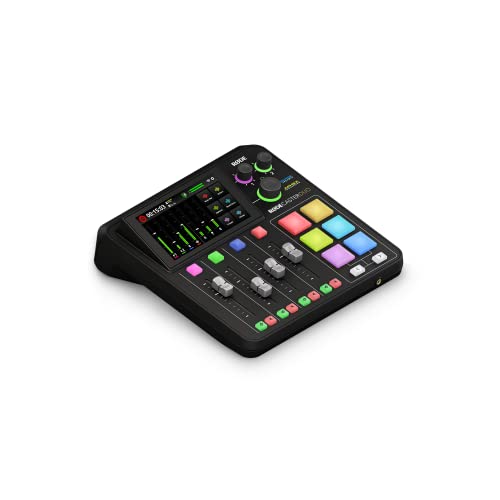
RODECaster Duo compact audio production studio
2 combo jacks4 fadersTouchscreen6 SMART pads
Check price on Amazon
Best for: A creator who streams and records podcasts and wants standalone operation.

The RODECaster Duo is a different philosophy: a production console that records and mixes on its own. Two combo jacks feed ultra-low-noise preamps, four faders give tactile control, and a touchscreen with haptic feedback manages routing. Six SMART pads with bank switching cover the role of the GoXLR sampler without needing a computer.

Its tradeoff is that it is built more for content production than for game streaming. It does not have the same gaming-first routing as the GoXLR, and it costs more. Against the Maono G3, it offers more polish and standalone operation, and against the GoXLR Mini, it offers two inputs and a touchscreen.

Ownership is easy as long as you keep the firmware current. Keep the touchscreen clean, store files on a fast drive, and treat it as a studio piece that sits permanently on the desk.

What works

  • Two combo jacks with ultra-low-noise preamps
  • Four broadcast-quality faders for tactile control
  • SMART pads replace a sampler without a computer
  • Records and mixes standalone

Watch out for

  • Costs more than game-oriented mixers
  • Routing is less game-centric than the GoXLR

Spec sheet

Mic inputs
2 Neutrik combo jacks
Faders
4 broadcast-quality
Display
Touchscreen with haptic feedback
Pads
6 SMART pads
Operation
Works with or without a computer
04
Maono G3 4-fader streaming mixer with 3 submixes
4 faders3 submixesDual PCXLR interface
Check price on Amazon
Best for: A technical streamer with two PCs who needs flexible submixes.

The Maono G3 is a rival that competes on routing. Any audio source can be mapped to one of four faders, and three submixes build separate experiences for you, your viewers and a recording. Dual PC support makes it appealing for streamers who split gaming and encoding across two computers.

The tradeoff is polish. The preamp and software ecosystem are younger than the GoXLR's, and the unit has no motorized faders or sampler. Compared with the GoXLR Mini, it offers more submix flexibility, but the Mini has the proven Midas preamp. It is a good fit for a technical streamer who wants to map sources freely.

Ownership favors people who save a mapping and stick to it. Keep the software updated and the cabling between the two PCs stable. Treat it as a younger platform and read the release notes before upgrades.

What works

  • Maps any audio source to four faders
  • Three submixes for different listeners
  • Dual PC streaming support
  • XLR interface for a studio microphone

Watch out for

  • Younger software ecosystem than the GoXLR
  • No motorized faders or sampler

Spec sheet

Faders
4, map any source
Submixes
3 for different listeners
PC support
Dual PC streaming
Mic input
XLR interface
Platform
Windows PC
05
Fifine Ampligame SC3 one-mic gaming audio mixer
1 XLR inputIndi-faderUSB plug and playMute button
Check price on Amazon
Best for: A new streamer with one XLR microphone and a small budget.

The Ampligame SC3 is the simplest board here. One XLR microphone input, a smooth fader, a front mute button and a front monitor switch cover everything a one-person stream needs, and it works as a USB plug and play device with no software required. Having the mute and monitor buttons on the front makes it quicker to use mid-game.

The tradeoff is that it is a single-microphone box with limited effects and no routing for game or chat. Compared with the GoXLR Mini, it gives up the Midas preamp, the EQ and the multi-channel mixer, but it costs a fraction and has almost nothing to learn. It is a good first step for a new streamer.

Ownership is trivial. Keep the knobs clean and the USB cable short. If your stream grows, plan to move up to a GoXLR Mini or a Maono G3. A boom arm and a pop filter give the SC3 more upgrade value than any other accessory.

What works

  • One XLR input with a smooth volume fader
  • Front mute and monitor buttons for quick control
  • USB plug and play with no software
  • Lowest tier of the group

Watch out for

  • Single microphone and no multi-channel mixing
  • Limited effects compared with the GoXLR

Spec sheet

Mic input
1 XLR
Control
Volume fader and mute
Connection
USB plug and play
Monitoring
Front monitor button
Platform
PC

Spec sheet decoder

What the numbers on the box really mean

The specs manufacturers lead with, translated into what they tell you about real-world performance.

Midas preamp

A microphone preamplifier design known for low noise and a clean tone. It suits both condenser and dynamic microphones. A cleaner preamp also means less noise reduction later in software.

Watch forThe GoXLR and GoXLR Mini share it, and the Ampligame SC3 does not.

Motorized fader

A fader with a small motor that moves it to a stored position. It keeps the physical control in sync with the software. The motors also let software recall layouts for different streams.

Watch forOnly the full GoXLR has them, and the others use manual faders.

Submix

A separate mix of the same sources for a defined listener. It lets you hear something different from your audience. They are most useful when a game is loud and chat is quiet.

Watch forThe Maono G3 has three submixes.

48V phantom power

Voltage on the XLR line that powers condenser microphones. Dynamic microphones do not need it. Many dynamic microphones never need it, and leaving it off is safest.

Watch forTurn it off before connecting a ribbon microphone.

Combo jack

A socket that accepts an XLR plug or a quarter inch jack. It lets you connect microphones or instruments to the same input. They are handy for a vocal microphone and a guitar on the same unit.

Watch forThe RODECaster Duo has two combo jacks.

Methodology

How We Evaluated These GoXLR Streaming Mixers

Preamp and voice chain

We compared preamp design and onboard processing on each desk. The GoXLR and GoXLR Mini share a Midas preamp with EQ, compression and gating, while the Ampligame SC3 is basic. Voice quality set the first scores. We also looked at whether the unit supplies phantom power for condensers.

Control surface

We looked at fader type, buttons and the screens on each unit. The GoXLR has motorized faders and the RODECaster Duo has a touchscreen. Faster control scored higher. We considered how quickly a streamer can mute a microphone in an emergency.

Routing and flexibility

We checked submixes, dual PC support and mapping options. The Maono G3 offers three submixes and the GoXLR offers channel profiles. Flexible routing mattered for complex streams. We noted which models allow different mixes for you and your audience.

Platform and software

We compared which operating systems each unit supports and how mature the software is. The GoXLR Mini is officially Windows-supported. Mature software scored higher. We also read release notes to see how often software is updated.

Ownership

We considered moving parts, desk space and cables. Owner feedback patterns on motorized faders and small knobs informed this. Simpler units scored higher for long-term use. We counted how many cables a typical setup needs to run each device.

Decision guide

How to Choose the Right GoXLR Streaming Mixers

By Stream Setup

SituationPickWhy
One PC, one microphone, serious streamGoXLRMotorized faders and a Midas preamp
One PC, tight deskGoXLR MiniSame preamp in a smaller body
Two PCsMaono G3Dual PC support and submixes
Streaming and podcastingRODECaster DuoTwo inputs and standalone recording
First stream on a tiny budgetAmpligame SC3Plug and play with one XLR

By Budget

SituationPickWhy
Lowest tierAmpligame SC3Simple one-mic board
Entry routingMaono G3Submixes and four faders
Mid tier MidasGoXLR MiniStudio preamp without motors
Upper tier full deskGoXLRMotorized faders and sampler
Premium studioRODECaster DuoStandalone production console

Motorized vs Manual Faders

Motorized

The full GoXLR moves its faders when you change a profile, so the desk always matches the mix. It adds moving parts and cost.

Manual

The Mini, the Maono G3 and the Ampligame SC3 keep faders where you leave them. They are simpler and more durable, but do not follow profile changes.

Streamers who swap profiles often should pick motors, and everyone else can use manual faders.

Platform Fit

SituationPickWhy
Windows streaming PCGoXLR MiniOfficially supported on Windows
Windows with deep routingMaono G3Windows PC focus with submixes
Mixed or standalone workflowRODECaster DuoWorks with or without a computer
Plain USB on any PCAmpligame SC3USB plug and play

For Streaming Specifically

Look for

Look for a quiet preamp, separate control of game, chat and music, and a quick mute. Extra effects matter less than clean routing. Make sure it supports your operating system.

In this comparison

The GoXLR gives the deepest streaming control, and the Mini gives most of it for less. The Maono G3 suits dual PC streams, and the Ampligame SC3 suits a basic voice-only setup.

When to Spend More

Spend more if

Spend more if you stream daily, switch profiles often or want a sampler. The full GoXLR and RODECaster Duo reward heavy use.

Save if

Save if you only need a clean voice and a mute button. The Ampligame SC3 and GoXLR Mini cover that need.

Ownership

Maintenance schedule

The upkeep that decides whether this machine lasts two seasons or ten.

TaskIntervalWhy it matters
Update the control softwareTwice a yearUpdates keep the mixer compatible with your operating system. Install between streams. Read the release notes first so a changed layout does not surprise you mid-stream.
Clean faders and knobsTwice a yearDust causes scratchy movement. A dry brush is usually enough. Keep the desk clear of crumbs, since they find their way into motorized faders.
Check USB and XLR cablesEvery few monthsA failing cable causes dropouts and crackle. Swap cables before blaming the unit.
Back up your profilesAfter each changeA saved profile restores your mix after a reset or a reinstall. Export the profile file to a second drive for safety.
Cover the desk when idleDailyA cover keeps dust and drinks out of the controls.

FAQ

Frequently Asked Questions

Is the GoXLR worth it over a USB microphone?

Yes if you want faders for game and chat, a proper preamp and voice processing. A USB microphone is simpler for a single voice and costs less. Many streamers find the biggest improvement comes from an XLR dynamic microphone on a boom arm, with the mixer adding control rather than magic.

What is the difference between the GoXLR and the GoXLR Mini?

The full desk has motorized faders and a sampler. The Mini keeps the Midas preamp and processing but uses manual faders and drops the sampler. If you are unsure, start with the Mini and upgrade only if you miss the motors.

Do these work on a Mac?

The GoXLR Mini is officially supported on Windows, and many rivals are Windows-focused. Check your platform before buying. Check the vendor page for your exact operating system version, since support differs from release to release.

Can I use a condenser microphone?

Yes. The GoXLR family and the Maono G3 offer phantom power. Check that the unit supplies 48V before connecting a condenser.

How long will a streaming mixer last?

The wear items are faders, knobs and, on the GoXLR, motors. With cleaning and gentle use, a unit can last many years. Keep the unit away from drinks and use a dust cover when you travel or leave the room.

Do I need a sampler?

Only if you play clips for your audience. Many streamers never use one, so do not pay extra for it. If you want a sampler later, a software soundboard can do the job on the same PC.

Bottom line

The short version

Browse more goxlr streaming mixerson Amazon →
James Miller, Lead Machine Editor

About the author

James Miller

Lead Machine Editor, MachineFanatic

James Miller leads MachineFanatic's buying guides, turning spec sheets, manuals and owner feedback into clear verdicts on power tools, outdoor power equipment, shop machines and kitchen machines.

More from James →

Keep reading

Related guides