
Amazon affiliate links - we earn a commission.Affiliate disclosure

Buying guide · 13 min read · Updated 2026-11-07

Best Hat Heat Presses (2026)

Seven hat heat presses compared by platen shapes, pressure, heating design and cap stretchers, with notes on pressing vinyl, patches and DTF transfers on caps.

James MillerBy James MillerLead Machine Editor7 machines comparedSpec-sheet verified
Best Hat Heat Presses

At a glance

Our top picks

Pressing a cap is harder than pressing a shirt because the front panel is curved, stitched and stiff. A flat platen bridges the curve and leaves gaps, so a hat press uses a curved upper plate and a matching lower form to push the transfer evenly into the fabric.

Cap shapes vary widely, from structured six-panel hats to soft dad caps and low-profile styles. Platen curvature, size and the way the cap is held decide whether a design lies flat, and a press that fits only one cap shape will frustrate you the first time a customer orders another.

Before you buy

6 Criteria to Look For Before Buying a Hat Heat Press

  1. 01

    Platen shape and size

    Cap crowns vary, so platen curvature and size decide whether the design lies flat. The VEVOR four-platen press lists 5.9 by 3 to 7.9 by 3.5 inches, and the HTVRONT models list two platens. Match the platens to the caps you will press. Measure the front panel of your most common cap, including the height from brim to the top seam, and compare it with the platen size so the whole design fits inside. Designs that cross the center seam need extra care, because the seam is thicker than the panel and can lift the transfer if the pad does not give.

  2. 02

    Pressure

    Curved, seamed fabric needs firm pressure, particularly for DTF films and patches. The HTVRONT Auto Hat Press lists over 80 kilograms. Manual presses depend on your leverage, which a four-bar linkage improves.

  3. 03

    Heating plate

    A cast aluminum plate spreads heat more evenly than a thin silicone one. The HTVRONT manual and the EENOUR list cast aluminum. Even heat prevents a half-bonded transfer.

  4. 04

    Cap holding

    A stretcher keeps the crown flat while you close the press. The 550 watt press has a stay-put stretcher and VEVOR includes one. A cap that shifts during pressing ruins the alignment.

  5. 05

    Automation

    The HTVRONT Auto and VEVOR 3-in-1 close with a button. This saves effort when you press many caps. For a few hats a month, manual is fine.

  6. 06

    Controls and safety

    The VEVOR lists 32 to 449 degrees F and 1 to 999 seconds, while the LIKCUT uses four presets and a 10 minute auto-off. Digital control suits repeatable work, presets suit beginners.

Detailed reviews

The 7 best hat heat presses, explained

01
HTVRONT Auto Hat Press, 80 kg pressure, dual platens
One-touch auto80 kg pressureDual platensDTF and patches
Check price on Amazon
Best for: Sellers pressing patches, DTF and vinyl on caps in batches.

The HTVRONT Auto Hat Press automates the awkward part of cap pressing. With one touch it closes, holds for the set time and releases, so you are not leaning on a handle with a wrist angle that tires after a dozen hats. The listing cites over 80 kilograms, about 176 pounds, of pressure, which is the kind of force that DTF transfer films and embroidery patches need to bond into a curved, seamed surface.

Two platens with a quick-swap design let you fit different cap sizes without tools. Compared with the manual VEVOR four-platen press it has fewer platen shapes but more consistent force, and compared with the HTVRONT manual hat press it removes the effort from every press.

Use it with a cap form that keeps the crown shaped, wear gloves when removing the hat and let the plate heat fully before the first cap. Keep the platens clean and check the pressure on a scrap cap before a batch of customer orders, since a different crown stiffness changes how the force spreads. Structured caps with a buckram front resist the curve and push back, while soft unstructured caps collapse under the plate and need a firmer form. Pre-press the cap front for a couple of seconds to flatten stitching and drive out moisture, align the design on the center seam with a ruler and keep a spare cap for the first test so the paying order never takes the first mistake.

What works

  • One-touch automatic cycle
  • Over 80 kilograms of pressure
  • Quick-swap dual platens
  • Handles DTF films and embroidery patches

Watch out for

  • Higher tier than manual presses
  • Only two platen shapes

Spec sheet

Operation
One-touch automatic
Pressure
Over 80 kg (176 lb)
Platens
Two, quick-swap
Use
DTF films and embroidery patches
Control
Temperature and timer
02
VEVOR hat press, four interchangeable platens, cap stretcher
4 platens580 W dual tubes32-449 FCap stretcher
Check price on Amazon
Best for: Makers who press many cap styles and sizes.

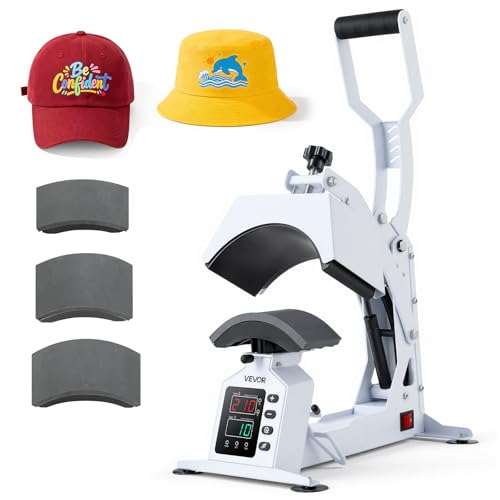
VEVOR supplies four platens, listed at 5.9 by 3, 6.6 by 2.7, 6.6 by 3.9 and 7.9 by 3.5 inches, plus a cap stretcher. Dual heating tubes and a PTFE-coated plate run at 580 watts, with an LED display and countdown alerts for temperature from 32 to 449 degrees F and time from 1 to 999 seconds.

The platen range is the point: low-profile caps, standard crowns and larger designs each get a matching shape. Compared with the EENOUR, which has two platens, it fits a wider range of customer orders, and compared with the automatic HTVRONT it is cheaper but depends on your hand pressure.

Swap platens only when the press is cool, and keep each one labeled. Use the cap stretcher so the crown sits flat, and check that the design sits within the platen with a small margin. Wipe the PTFE plate with a damp cloth when cool. With four platens it is easy to press with the wrong one, so write the size on the back of each in marker and match it to the cap before every job. A low-profile cap on a tall platen leaves the edges of the design unsupported, and a deep crown on a shallow platen bunches the fabric. Replace a platen cover if it hardens, because a worn cover is a quiet cause of faded corners that look like a transfer defect.

What works

  • Four platens fit a wide range of caps
  • Dual heating tubes at 580 watts
  • LED control with countdown alerts
  • Cap stretcher included

Watch out for

  • Manual pressure depends on your hand
  • Platen swaps add steps

Spec sheet

Platens
5.9 x 3, 6.6 x 2.7, 6.6 x 3.9 and 7.9 x 3.5 inches
Power
580 watts, dual heating tubes
Temperature
32 to 449 degrees F
Timer
1 to 999 seconds
Coating
PTFE-coated plate
03
VEVOR 3-in-1 auto hat press, no-crease platens
Auto close3 lower platens6.41x3.15 plateAuto pressure
Check price on Amazon
Best for: Hands-free cap pressing at a middle price tier.

VEVOR's 3-in-1 closes at a button press and adjusts pressure automatically. Three interchangeable lower platens, including 6.6 by 2.7 and 6.6 by 3.8 inch sizes, work with a 6.41 by 3.15 inch heating plate that the maker calls larger than most competitors.

The no-crease claim refers to the platen shape that avoids pressing a fold line into the crown. Compared with the HTVRONT Auto Hat Press it offers three lower platens instead of two, though without a listed pressure number, and compared with the manual VEVOR it adds automation.

Load the cap on the lower form, align the design with the center seam and press the button. Keep fingers clear of the closing plate, and wait for the release before removing the cap. Test on a scrap hat to confirm the auto pressure suits the crown. Automatic pressure is a convenience but it is also a black box, since you cannot see how much force the press applies to a thin cap compared with a thick one, so watch for a design that looks pressed in too deeply or a patch that edge-lifts. Keep a notebook of cap brand, platen and time so that you reproduce what worked. Never reach into the closing path while the machine is cycling.

What works

  • Automatic close and pressure adjustment
  • Three interchangeable lower platens
  • Large 6.41 by 3.15 inch heating plate
  • No-crease platen design

Watch out for

  • No pressure figure listed
  • Fewer upper plate options than the four-platen press

Spec sheet

Operation
Automatic close and release
Lower platens
Three interchangeable
Platen sizes
6.6 x 2.7 and 6.6 x 3.8 inches plus a third
Heating plate
6.41 x 3.15 inches
Pressure
Adjusts automatically
04
HTVRONT manual hat press, cast aluminum plate, four-bar linkage
Cast aluminum plateFour-bar linkage2 platensHTV, patches, DTF
Check price on Amazon
Best for: Manual pressing of vinyl, patches and DTF on caps.

This HTVRONT model is manual, with a one-piece cast aluminum heating plate that the maker contrasts with silicone plates. An upgraded four-bar linkage and an extended lever are designed to make pressure easier to apply by hand.

Two platens of 6.5 by 3.3 and 6.5 by 2.5 inches cover standard and low crowns. Compared with the automatic HTVRONT it needs your arm for each press, but it costs less and has fewer moving parts to go wrong.

A four-bar linkage multiplies force near the end of the stroke, so you feel the pressure build as the handle closes. Practice the motion on scrap caps, keep the lever path clear and use a protective sheet over the transfer. Store the platens flat. The linkage design is worth understanding: a four-bar mechanism trades handle travel for force, so a long pull gives a strong clamp at the end. If the press feels light, check that the cap is seated against the lower form and the stretcher is not holding the crown loose. A press that clamps with a spongy feel often has a worn pad or a bent hinge, and both are repairable before they cost you a batch of ruined hats.

What works

  • One-piece cast aluminum plate
  • Four-bar linkage and extended lever ease pressing
  • Two platens for common crown sizes
  • Handles HTV, patches and DTF

Watch out for

  • Manual effort for every cap
  • Only two platen sizes

Spec sheet

Heating plate
One-piece cast aluminum
Mechanism
Upgraded four-bar linkage with extended lever
Platen 1
6.5 x 3.3 inches
Platen 2
6.5 x 2.5 inches
Use
HTV, patches and DTF
05
550 W hat press, 6.7x3.8 and 6.7x2.5 platens, stay-put stretcher
550 W2 platensStay-put stretcher110 V
Check price on Amazon
Best for: Manual pressers who want a stretcher that stays put.

This press runs at 550 watts on 110 volts with a 6.7 by 3.8 inch curved upper plate and two interchangeable platens. Its distinguishing feature is a stay-put cap stretcher that does not snap back like a spring-loaded one.

The stretcher matters because holding a cap flat while closing the press is the awkward part of manual pressing. Compared with the EENOUR it offers a larger upper plate, and compared with the VEVOR four-platen it fits fewer cap shapes.

Seat the cap on the stretcher so the front panel is smooth, align the design to the center seam and close firmly. Let the plate cool before storing, and check that the stretcher releases cleanly without pulling the transfer. Because a hands-free stretcher keeps the crown tensioned, it helps with patches that have a thick backing, since the cap does not spring back mid-press. Keep the stretcher clean of adhesive residue, which builds up if a transfer edge lifts, and check its tension after a few weeks of use so it still holds firmly. A press at this wattage heats quickly, so avoid leaving it on while you rearrange the next batch of caps.

What works

  • Stay-put stretcher frees both hands
  • 550 watts of heating power
  • Curved 6.7 by 3.8 inch upper plate
  • Two interchangeable platens

Watch out for

  • Fewer platen shapes than the four-platen model
  • Manual pressure

Spec sheet

Power
110 volts, 10 amps, 550 watts
Upper plate
6.7 x 3.8 inches curved
Lower platens
6.7 x 3.8 and 6.7 x 2.5 inches
Stretcher
Stay-put, hands-free
Position
Upper-middle tier
06
EENOUR hat press, two platens, thick curved pad
2 platensCast aluminum200-400 FThick curved pad
Check price on Amazon
Best for: Beginners wanting a thicker pad at a lower tier.

EENOUR includes two quick-swap heating pads, a cast aluminum plate that reaches 200 to 400 degrees F and a cap stretcher. Its upgraded thick curved pad is meant to avoid the gaps and wrinkles that thin pads leave when they bridge the curve of a cap.

The pad design addresses the main complaint about basic cap presses, which is a transfer that lifts at the edges because the pad flattened over the curve. Compared with the HTVRONT manual press it has a similar two-platen setup at a lower tier.

Press firmly, use heat tape on the corners of the transfer, and let the cap cool on the form before removing it. Check the pad for compression after a few hundred presses. A compressed pad is a cheap fix compared with a ruined stack of caps, so replace it as soon as you see a flat spot or a ridge. Press a small test transfer on a scrap cap each session to confirm the pad still hugs the crown, and pay attention to the edges of the design, which are the first place a thin or worn pad shows its age.

What works

  • Thick curved pad reduces gaps and wrinkles
  • Cast aluminum plate heats evenly
  • Two quick-swap platens
  • Cap stretcher included

Watch out for

  • Only two platens
  • Manual operation

Spec sheet

Platens
Two quick-swap pads
Plate
Cast aluminum
Temperature
200 to 400 degrees F
Pad
Thick curved, no gaps
Includes
Caps stretcher
07
LIKCUT SZ01 lightweight hat press, four heat levels
4 heat levels10 min auto-offLightweight3 s press
Check price on Amazon
Best for: Casual makers pressing a few caps at the lowest tier.

The LIKCUT SZ01 is the lightest and simplest press here, with four preset heating levels and a 10 minute auto-off. Its listing describes a three-second press, one button for temperature and an ergonomic handle.

Presets remove the numbers a beginner might get wrong, but they also remove precision, so it suits small projects with well-known settings. Unlike the VEVOR press, it has no digital temperature and time control.

Use it for light vinyl and small designs, test each heating level on a scrap cap and expect to apply your own pressure. Keep the cord clear and let the plate cool before storing. Because it has no digital readout, confirm its real temperature with an infrared thermometer on the first day and note which level suits your vinyl, then write it on a label on the handle. Use it with thinner vinyl and avoid thick patches or DTF films that need high pressure, since a light handle cannot clamp them firmly. If your orders grow, treat it as the machine you start on rather than the machine you finish on.

What works

  • Lowest price tier
  • Four simple heat presets
  • Ten minute auto-off
  • Light and portable

Watch out for

  • Limited control compared with digital models
  • Light build

Spec sheet

Heat control
Four heating levels
Safety
10 minute auto-off
Handle
Ergonomic manual
Weight
Lightweight and portable
Position
Lowest price tier

Spec sheet decoder

What the numbers on the box really mean

The specs manufacturers lead with, translated into what they tell you about real-world performance.

Platen size

The curved lower form the cap sits on.

Watch forThe lineup lists 5.9 x 3 to 7.9 x 3.5 inches.

Pressure in kilograms

The force the press applies, a measure of how well it bonds thick transfers.

Watch forThe HTVRONT Auto Hat Press lists over 80 kg.

Cast aluminum plate

A solid metal heating plate that spreads heat evenly.

Watch forThe EENOUR and HTVRONT manual list it.

Four-bar linkage

A lever design that increases force near the end of the stroke.

Watch forThe HTVRONT manual press lists it.

Auto-off

The press powers down after a period.

Watch forThe LIKCUT lists 10 minutes.

Methodology

How We Evaluated These Hat Heat Presses

Platen coverage

We compared platen sizes and counts, from four on the VEVOR to two on the EENOUR and HTVRONT models.

Pressure delivery

We read stated pressure and mechanisms, including 80 kilograms on the Auto Hat Press and the four-bar linkage on the manual HTVRONT.

Heating

We compared plate materials and power, such as 580 watts on the VEVOR and 550 watts on the stay-put model.

Operation

We separated automatic presses from manual ones and weighed effort against cost.

Value

We placed each press by price tier, from the LIKCUT at the bottom to the HTVRONT Auto at the top.

Decision guide

How to Choose the Right Hat Heat Presses

By Use

SituationPickWhy
Batches of capsHTVRONT Auto Hat PressOne-touch and 80 kg
Many cap stylesVEVOR four-platen pressFour platens
Auto at middle tierVEVOR 3-in-1Auto close
Manual with leverageHTVRONT manual pressFour-bar linkage
Easy cap holding550 W hat pressStay-put stretcher
Occasional capsLIKCUT SZ01Lowest tier

By Budget

TierPickWhy
Lowest tierLIKCUT SZ01Presets
Low tierEENOUR hat pressThick pad
Low-middle tierVEVOR four-platen pressRange of platens
Middle tierVEVOR 3-in-1Automatic
Upper tier550 W hat pressStretcher
Top tierHTVRONT Auto Hat PressAutomation

Manual vs Automatic

Manual

The VEVOR four-platen, HTVRONT manual, EENOUR and LIKCUT rely on your hand pressure. They cost less and suit light use.

Automatic

The HTVRONT Auto and VEVOR 3-in-1 close with a button and apply consistent pressure.

Choose manual for a few hats; choose automatic for batches.

Transfer Type

PreferencePickWhy
DTF films and patchesHTVRONT Auto Hat Press80 kg
VinylVEVOR four-platen pressDigital control
MixedHTVRONT manual pressCast aluminum
Light vinylLIKCUT SZ01Simple

For Selling Caps Specifically

Look for

Fast cycles, repeatable pressure and platens for popular crown shapes. Setup time per cap decides your margin.

In this comparison

The HTVRONT Auto Hat Press speeds cycles, and the VEVOR four-platen press covers the most shapes.

When to Spend More

Spend more if

You press batches or use DTF and patches: the HTVRONT Auto or VEVOR 3-in-1.

Save if

You press a few caps. The EENOUR or LIKCUT is enough.

Ownership

Maintenance schedule

The upkeep that decides whether this machine lasts two seasons or ten.

TaskIntervalWhy it matters
Clean platens when coolAfter sessionsResidue transfers to the next cap.
Check pad conditionMonthlyA compressed pad leaves gaps and wrinkles.
Use a protective sheetEvery pressIt protects the plate and the design.
Inspect cordMonthlyHeated presses need a sound plug and cord.
Store platens flatAfter useA bent platen presses unevenly.

FAQ

Frequently Asked Questions

Can I press a hat on a flat heat press?

Poorly. A curved platen matches the crown, and a flat plate leaves gaps.

How much pressure do I need?

Firm pressure, especially for DTF and patches. The HTVRONT Auto Hat Press lists over 80 kilograms.

Do I need a cap stretcher?

It helps keep the crown flat. VEVOR and the 550 watt press include one.

What platen size fits most caps?

Around 6.5 by 3 inches covers common crowns. Check your hats against the listings.

Is an automatic hat press worth it?

For batches, yes. For a few hats a month, manual is enough.

Why does my transfer peel at the edges?

Usually uneven pressure or a thin pad. Increase pressure and check the pad. A transfer that sticks in the middle but lifts at the corners usually means the pad is not following the curve or the cap is shifting during the press. Reseat the cap on the stretcher, press for a slightly longer time and let the cap cool on the form, because moving it while hot can break the bond.

Bottom line

The short version

Browse more hat heat presseson Amazon →
James Miller, Lead Machine Editor

About the author

James Miller

Lead Machine Editor, MachineFanatic

James Miller leads MachineFanatic's buying guides, turning spec sheets, manuals and owner feedback into clear verdicts on power tools, outdoor power equipment, shop machines and kitchen machines.

More from James →

Keep reading

Related guides