
Amazon affiliate links - we earn a commission.Affiliate disclosure

Buying guide · 13 min read · Updated 2026-11-07

Best Knitting Machines (2026)

Six circular knitting machines compared: Caydo electric and crank, Sentro 40 and 48 needle looms and addi Express models, with needle counts and yarn choices.

James MillerBy James MillerLead Machine Editor6 machines comparedSpec-sheet verified
Best Knitting Machines

At a glance

Our top picks

Side by side

Spec comparison

A circular knitting machine turns a hand crank, or a motor, around a ring of needles so a tube of knitted fabric grows in minutes. It is a fast way to make hats, scarves, socks and blankets, and it suits people who enjoy the result more than the slow rhythm of hand needles.

Machines differ in needle count, gauge, crank mechanics and counters, and the yarn you want to use narrows the field quickly. Choose by the projects you plan and the weight of yarn they need, then check how easy the machine is to thread and clear after a dropped stitch.

Before you buy

6 Criteria to Look For Before Buying a Knitting Machine

  1. 01

    Needle count and tube size

    Needle count sets the circumference of the tube, so 22 needles make a sock, 40 needles make a child hat and 46 to 48 needles make an adult hat or scarf. The addi Kingsize has 46, the Sentro and Caydo machines have 48 and the Professional has 22. Buy for the largest item you plan to make. A quick way to size is to measure the head or neck you are knitting for, then multiply by how much stretch your yarn has; most beginners are surprised by how much a tube relaxes after leaving the machine.

  2. 02

    Gauge and yarn weight

    Gauge is the spacing between needles, measured from the center of one needle to the next. Standard gauge is about 4.5 mm and suits fine yarn, mid gauge is about 6.5 mm, and chunky gauge suits thick yarn. Circular looms like these favor medium to chunky yarn, and fine yarn catches in the latches. If you want to use the fine yarns that are common in commercial knitwear, a dedicated fine-gauge flatbed machine is the correct tool, and these circular looms will frustrate you.

  3. 03

    Crank versus motor

    A hand crank is simple and reliable but demands an even rhythm and tires the wrist, while an electric drive like the Caydo M1 Pro holds a steady speed. Uneven cranking is the top cause of dropped stitches. If you have hand pain, a motor is a real advantage. Whichever drive you choose, keep a steady hand on the yarn so tension stays even, since the machine can only form stitches as well as the yarn is fed.

  4. 04

    Row counters

    A counter measures length without you tallying turns, which matters for scarves, blankets and matching pairs. The Sentro 48 has a smart counter and the Caydo M1 Lite has a magnetic one. A counter you trust saves unraveling. Write the row count in a notebook as well, since a counter can be knocked by accident and a written note recovers the lost number.

  5. 05

    Parts and support

    Buying a machine that is discontinued means parts are not produced, and a beginner should avoid discontinued or used models because it is hard to tell whether a problem is the machine or the technique. The addi line has a long record, while newer models are less proven. Check that spare needles and latches are available. Read recent owner feedback patterns on needle quality, since a shipment with weak latches is a common complaint on cheaper looms.

  6. 06

    Mode: tube, panel and double knit

    Some machines knit a continuous tube only, while dual-mode models like the Sentro 48 can knit a flat panel. Panels allow blankets and larger items. Choose the mode that matches your first project. If panels interest you, check whether the manual shows how to bind off and join sides, which is where beginners often get stuck.

Detailed reviews

The 6 best knitting machines, explained

01
addiExpress Kingsize hand-crank knitting machine, 46 needles
46 needlesHand crankCircularHats and scarves
Check price on Amazon
Best for: Hand knitters who want fast hats and scarves from a dependable machine.

The Kingsize is a 46 needle circular knitting machine that has been a standard for years, and its appeal is mechanical simplicity. A hand crank turns the needle cylinder, a cam lifts each needle as it passes, and a hook latch captures the yarn to form each stitch, so there is little to go wrong beyond a dropped stitch or a tangled yarn. The kit includes a yarn cake and a hat pattern, which gives a first project straight away.

The tradeoff is that it is a manual machine with limited gauge flexibility. It is built for medium to chunky yarn and tube knitting, so fine garments and shaped pieces are beyond it. Compared with the Sentro 48, it has a long reputation for parts and instructions, and against the Caydo M1 Pro it asks you to turn the crank yourself but never asks you to charge anything.

Ownership is easy: keep the needles free of lint, apply a drop of sewing machine oil occasionally and store the machine covered. Practice an even cranking speed, since uneven turning is the main cause of dropped stitches. A table clamp is part of the package, and it is worth setting it up on a stable surface.

What works

  • 46 needles give a generous tube size
  • Simple hand-crank mechanism with few failure points
  • Long-established brand with instructions and parts
  • Kit includes yarn and a hat pattern

Watch out for

  • Medium to chunky yarn only
  • Manual cranking needs a steady rhythm

Spec sheet

Needles
46
Drive
Hand crank
Format
Circular
Projects
Hats, scarves, sweaters, blankets
Set
Machine with yarn cake and hat pattern
02
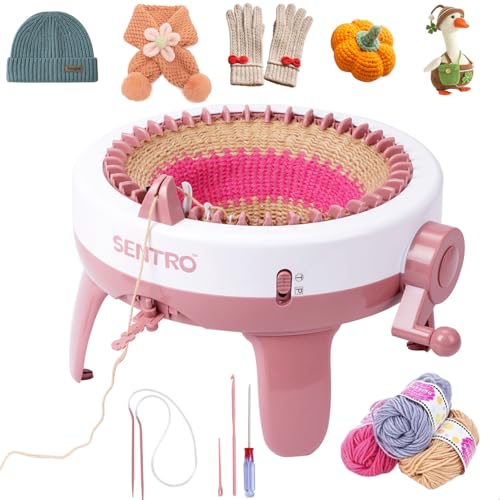
Sentro 48 needle knitting machine with smart row counter
48 needlesRow counterTube and panelManual crank
Check price on Amazon
Best for: Beginners who want a counter and panel mode at a low cost.

The Sentro 48 is a manual circular machine with a smart row counter and a dual mode design that knits either a continuous tube or a flat panel. Forty-eight needles give a slightly larger circumference than the Kingsize, and the counter takes the guesswork out of measuring a long scarf or blanket. A hand crank turns the cylinder and the loom rotates smoothly under steady pressure.

The compromise is build quality and durability. Plastic bodies can flex and the needles can bend if a yarn snag is forced, and parts support is less established than for addi. Compared with the addi Kingsize, it adds a counter and panel mode at a lower tier, and against the Caydo M1 Lite it offers similar features with a simpler counter.

Keep needles clean and straight, avoid forcing a jammed crank and store the machine in a box. Start with smooth worsted or chunky yarn and let the machine do the work.

What works

  • 48 needles with tube and panel modes
  • Smart row counter tracks length
  • Manual crank with no charging
  • Low entry cost

Watch out for

  • Plastic body is less durable than addi
  • Needles can bend if forced

Spec sheet

Needles
48
Modes
Tube and panel dual mode
Counter
Smart row counter
Drive
Manual crank
Audience
Beginners
03
Caydo M1 Pro electric 48 needle automatic knitting machine
48 needlesElectricOne-touchPreset rows
Check price on Amazon
Best for: Knitters with hand or wrist pain, or anyone who dislikes cranking.

The M1 Pro replaces the hand crank with an electric motor and a preset row system, so a single touch starts the knitting and the machine stops at the row count you set. Its proprietary control logic holds an even rotation speed, which removes the biggest cause of dropped stitches in manual machines: an uneven crank. Forty-eight needles give a generous tube.

The tradeoff is complexity and cost. A motorized machine has more parts that can fail, needs a power source and costs more than the crank models, and a jam can stall the motor against the yarn. Compared with the addi Kingsize, it is hands-free, and against the Caydo M1 Lite it is the automatic version of the same layout.

Keep the yarn path clear, load a smooth, evenly spun yarn and watch the first few rows until you trust the machine. Do not leave it running unattended on heavy yarn, and keep the motor free of lint. Keep the packaging for the first month in case you want to return it.

What works

  • Electric one-touch operation removes hand cranking
  • Preset rows stop the machine automatically
  • Even rotation reduces dropped stitches
  • 48 needles for a generous tube

Watch out for

  • More parts and a power source to manage
  • Costs more than manual models

Spec sheet

Needles
48
Drive
Electric, one-touch automatic
Control
Preset rows
Format
Circular
Operation
Hands-free
04
Caydo M1 Lite 48 needle circular knitting loom machine
48 needlesMagnetic row counterHand crankCircular
Check price on Amazon
Best for: Hobbyists who want an accurate counter on a manual machine.

The M1 Lite is the manual sibling of the M1 Pro, with a hand crank and an upgraded magnetic row counter. The counter counts accurately through each rotation without a mechanical plunger that can miss a pass, which helps when you make long or repeated panels. It has 48 needles and the same circular layout as the Pro.

The limitation is the crank. Manual turning demands an even rhythm and is tiring on long projects, and the machine has fewer automation features than the Pro. Compared with the Sentro 48, it has a better counter, and against the addi Kingsize it is newer with less record behind it.

Keep the counter magnet clean and the crank turning smoothly. Check for stuck latches after a long session, and store the machine away from dust.

What works

  • Magnetic row counter counts reliably
  • 48 needles on a manual crank machine
  • Same layout as the Pro for easy upgrade
  • Lower cost than the electric version

Watch out for

  • Manual cranking is tiring on long jobs
  • Less established than addi

Spec sheet

Needles
48
Drive
Hand crank
Counter
Upgraded magnetic row counter
Format
Circular
Audience
Beginners and hobbyists
05
Sentro 40 needle smart circular knitting machine
40 needlesCircularDouble knittingManual crank
Check price on Amazon
Best for: Smaller projects, kids' hats and accessories.

The Sentro 40 is a smaller circular machine with forty needles and a double knitting design. Fewer needles mean a smaller tube, so it suits child-size hats, cuffs, headbands and small scarves better than a full adult hat. The smaller frame is easier to hold and store, and it works with the same crank technique as the larger models.

The tradeoff is capacity. A 40 needle tube makes adult hats snug and wide scarves impossible, so you will find yourself wanting the 48. Compared with the addi Kingsize, it has fewer needles and lower cost, and against the Sentro 48 it is the smaller sibling.

Use medium weight yarn, keep the needles straight and clean and crank at an even pace. If you enjoy the hobby, expect to step up to a bigger machine. If your yarn is thin, choose the machine's finest gauge setting to avoid loose stitches.

What works

  • Compact 40 needle body
  • Double knitting loom design
  • Easy for beginners to handle
  • Lower cost than the 48 needle models

Watch out for

  • Small tube limits adult hat and wide scarf size
  • Plastic parts are less durable

Spec sheet

Needles
40
Format
Circular
Mode
Double knitting loom
Drive
Manual crank
Audience
Beginners
06
addi Express Professional 22 needle knitting machine
22 needles4 to 6 inch circularHand crankProfessional
Check price on Amazon
Best for: Socks, cuffs and small circular accessories.

The Professional is a 22 needle machine that knits small circular items from 4 to 6 inches across, which makes it the sock, cuff and mitten machine. The small ring of needles keeps tubes narrow, and a precision build gives crisp stitches on finer yarn than the bigger looms accept. It is a specialist rather than a general tool.

Its tradeoff is breadth. Twenty-two needles cannot make an adult hat, and it only suits small tubes, so most owners pair it with a larger machine. Compared with the addi Kingsize, it handles smaller sizes and finer detail, and against the Sentro 40 it is the more precise tool.

Keep the needles lint-free and lightly oiled, crank slowly on fine yarn and handle the latches gently. It is a good choice if you make many socks or small accessories.

What works

  • 22 needles for 4 to 6 inch tubes
  • Precision build for finer yarns
  • Ideal for socks and mittens
  • Part of the established addi line

Watch out for

  • Too small for hats and scarves
  • Specialist tool rather than a general machine

Spec sheet

Needles
22
Circular diameter
10 to 15 cm (4 to 6 inches)
Drive
Hand crank
Use
Socks, cuffs, small tubes
Model
addi Express Professional

Spec sheet decoder

What the numbers on the box really mean

The specs manufacturers lead with, translated into what they tell you about real-world performance.

Needle count

The number of latch needles in the cylinder. It sets the circumference of a tube. A larger needle count does not make a machine better, only larger.

Watch forThe Kingsize has 46, the Sentro 48 and Caydo machines have 48, the Sentro 40 has 40 and the Professional has 22.

Gauge

The needle spacing, from center to center. It sets how fine or chunky the yarn can be. A thin tube of fine yarn tends to curl, so fine gauge is better left to flatbed machines.

Watch forThese circular looms are not fine-gauge machines.

Row counter

A device that counts rotations. It measures how long the knitting is.

Watch forThe Sentro 48 lists a smart counter and the Caydo M1 Lite a magnetic counter.

Latch needle

A needle with a small hinged latch that opens to take yarn and closes to form a stitch. If a latch sticks, a drop of oil and a gentle flex usually frees it.

Watch forBent latches are the most common fault, so store the machine carefully.

Preset rows

A set count after which the machine stops automatically. It is a feature of the electric model.

Watch forThe Caydo M1 Pro supports preset rows.

Methodology

How We Evaluated These Knitting Machines

Tube size and needles

We compared needle counts and finished sizes. The Kingsize has 46 needles and the Professional has 22. Matching size to project mattered. We also considered how well each size matches a common project, such as an adult beanie.

Drive and control

We looked at hand crank versus electric drive. The Caydo M1 Pro is electric with preset rows, and the others are manual. Steady rotation scored higher. We compared how clearly each manual explains casting on.

Counter and features

We checked row counters and modes. The Sentro 48 and Caydo M1 Lite have counters. Useful features scored higher. We noted which counters work without batteries.

Build and support

We considered materials and brand history. The addi line has a long record. Established parts availability scored higher. We read feedback patterns on bent needles.

Ownership

We weighed setup, cleaning and owner feedback patterns. Machines that clear dropped stitches easily scored higher. We considered how easily each machine clamps to a table.

Decision guide

How to Choose the Right Knitting Machines

By Project

SituationPickWhy
Adult hats and scarvesaddiExpress Kingsize46 needles and sturdy crank
Blankets with a counterSentro 48Panel mode and smart counter
Hands-free knittingCaydo M1 ProElectric with preset rows
Accurate lengths on a crankCaydo M1 LiteMagnetic counter
Socks and cuffsaddi Express Professional22 needles

By Budget

SituationPickWhy
Lowest tierSentro 40Smaller starter
Entry 48 needlesSentro 48Counter included
Mid tier crankCaydo M1 LiteMagnetic counter
Upper tieraddiExpress KingsizeProven design
PremiumCaydo M1 ProElectric automation

Manual vs Electric

Manual crank

The Kingsize, Sentro and Caydo M1 Lite are simple and need no power. They demand an even rhythm and can tire the hand.

Electric

The Caydo M1 Pro holds steady speed and stops at a preset count. It costs more and has more parts to fail.

Casual knitters should pick manual, and anyone with hand pain should pick electric.

Tube Size

SituationPickWhy
Adult hataddiExpress Kingsize46 needles
Wide scarf or cowlSentro 4848 needles
Child hat or headbandSentro 4040 needles
Socks and mittensaddi Express Professional22 needles

For Beginners Specifically

Look for

Look for a clear manual, a row counter, easy needle replacement and a design with a good community. Start with smooth, medium weight yarn.

In this comparison

The Sentro 48 and addi Kingsize are the best beginner picks, with the Caydo M1 Pro as the hands-free upgrade.

When to Spend More

Spend more if

Spend more if you knit weekly or have hand pain. The addi Kingsize and Caydo M1 Pro reward heavy use.

Save if

Save if you want to try the craft. The Sentro 40 and 48 cover first projects.

Ownership

Maintenance schedule

The upkeep that decides whether this machine lasts two seasons or ten.

TaskIntervalWhy it matters
Clean lint from needlesAfter each projectLint builds up in the latches and causes dropped stitches. A soft brush and a pair of tweezers clear the lint quickly.
Oil lightlyEvery few projectsA drop of sewing machine oil keeps latches moving.
Straighten or replace bent needlesAs neededA bent latch snags yarn and drops stitches. Store spare needles in a labeled bag so they are never mixed.
Store coveredAlwaysDust and pets add lint and damage latches. Cover it with a cloth instead of plastic to let moisture escape.
Check the crank or motorEvery few monthsA stiff crank or noisy motor signals lint or a loose part.

FAQ

Frequently Asked Questions

Which knitting machine is best for beginners?

The Sentro 48 and addiExpress Kingsize are the easiest starts. Choose the Sentro for a counter and panel mode and the addi for durability. Many knitters start with the machine's own kit yarn and then move to a smooth acrylic or cotton blend.

What yarn should I use?

Medium to chunky smooth yarn works best. Fine, fuzzy or slubby yarn catches in the latches.

Why does my machine drop stitches?

Uneven cranking, bent latches or tight yarn tension are the usual causes. Slow down and check the needles. Check that the yarn is not tangled behind the machine, since a snag pulls hard on the needles.

Can I make clothes?

Yes, hats, scarves and tubes. Shaped garments need a flatbed machine.

Is an electric machine worth it?

Yes if hand cranking hurts or you knit often. The Caydo M1 Pro holds steady speed. A motor lets you watch the yarn feed rather than the crank, which improves results.

How long will a machine last?

With cleaning and oil, many years. Latches and needles are the parts to replace. Plan on a little regular cleaning and the machine will keep running for a long time.

Bottom line

The short version

Browse more knitting machineson Amazon →
James Miller, Lead Machine Editor

About the author

James Miller

Lead Machine Editor, MachineFanatic

James Miller leads MachineFanatic's buying guides, turning spec sheets, manuals and owner feedback into clear verdicts on power tools, outdoor power equipment, shop machines and kitchen machines.

More from James →

Keep reading

Related guides