
Amazon affiliate links - we earn a commission.Affiliate disclosure

Buying guide · 12 min read · Updated 2026-11-19

Best Low Profile RV Air Conditioners (2026)

Five slim rooftop RV air conditioners compared on shroud height, weight, heat pump options and clearance for low bridges, trees and roof racks.

James MillerBy James MillerLead Machine Editor6 machines comparedSpec-sheet verified
Best Low Profile RV Air Conditioners

At a glance

Our top picks

Side by side

Spec comparison

A low-profile air conditioner sits closer to the roof, which helps in three places: wind drag at highway speed, clearance under branches and garage doors, and the visual line of the coach. The savings are measured in inches, but those inches decide whether a rig fits under a given obstacle.

Slimmer does not automatically mean better. A thinner cabinet has less space for coil and fan, so manufacturers lean on dual fans, inverter compressors or smaller capacity to keep performance up. We compare units on the real height claims, the cooling and heating they deliver, and what they ask of your roof and electrical system.

Before you buy

6 Criteria to Look For Before Buying a Low Profile RV Air Conditioner

  1. 01

    Actual height versus your clearance

    Profile claims are measured to the top of the shroud above the roof, so they only matter against a real obstacle such as a garage door, an overhanging branch or a low bridge. The TURBRO is about 10 inches thick and the Coleman-Mach 15 is 13.9 inches, a gap of nearly four inches. Measure your tallest travel clearance before paying a premium for a slimmer cabinet.

  2. 02

    Capacity inside a thin shell

    A thinner cabinet leaves less room for coil and fan, so makers use dual fans or inverter drives to keep capacity. The FOGATTI reaches 16,000 BTU with three fans, while the Dometic Penguin II stays at 11,000 BTU. Match capacity to the coach, not the cabinet: a hot-climate 30 foot trailer needs more than the Penguin can give.

  3. 03

    Ducted or non-ducted ceiling

    Low-profile units are mostly non-ducted, built for a single ceiling assembly, while the Dometic can serve either layout. A mismatch forces a ceiling rework, which costs more than the unit itself. Look at the ceiling from inside before buying, and confirm whether your control panel is the same brand.

  4. 04

    Inverter versus fixed speed

    The TURBRO uses an inverter compressor that ramps up gently, while the Furrion, FOGATTI and Coleman-Mach units run fixed-speed. The difference shows at startup on a generator, where a fixed-speed unit can need 3,500 watts without help. If your generator is small, an inverter unit or a soft start is the sensible step.

  5. 05

    Heat pump value

    A heat pump on a low-profile unit adds shoulder-season warmth without extra roof hardware. The TURBRO, Furrion and FOGATTI include one, while the Dometic and Coleman-Mach here are cooling-led. Heat pump output falls as outdoor temperature approaches freezing, so a furnace remains necessary for cold camps.

  6. 06

    Roof opening and weight

    Most RV air conditioners fit a standard roof opening of about 14 by 14 inches with a gasket and four bolts, and units usually weigh somewhere between 70 and 110 pounds. A slim unit does not mean a light one. Check your roof structure and use a helper, since a dropped unit is a roof repair and a unit repair together.

Detailed reviews

The 6 best low profile rv air conditioners, explained

01
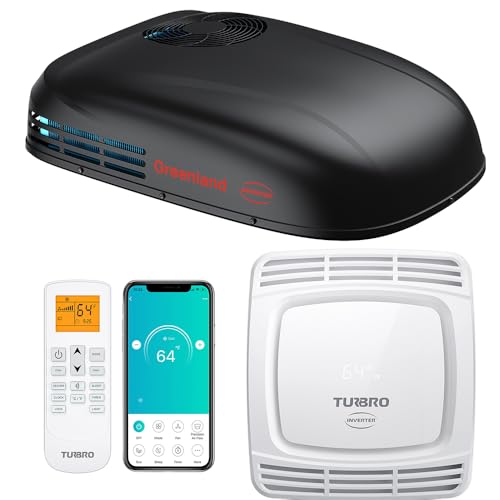
TURBRO inverter 13.5K non-ducted low-profile heat pump
13,500 BTU10 in thickInverterHeat pump
Check price on Amazon
Best for: Trailers and fifth wheels where height and efficiency both matter.

At roughly 10 inches thick, the maker says this TURBRO is up to 35 percent slimmer than most competing rooftop units, which is the headline for anyone fighting for overhead clearance. The thinness is bought with an inverter compressor, which raises efficiency by up to 30 percent over non-inverter systems according to the maker and lets the unit run at a gentle speed most of the time.

It is a non-ducted design, so the ceiling assembly must be the single-center-vent type, and it ships with cooling and heat pump heating for mild weather. The heat pump follows the usual rule: output falls as it gets colder outside. Against the Furrion Chill HE it carries the same 13,500 BTU rating but pairs it with the thinner housing.

Because the inverter electronics want clean power, a stable pedestal or a quality inverter generator is the best match. Keep the intake filter clean and lift the shroud once a year to inspect the coil and the gasket underneath.

What works

  • Roughly 10 in profile is the slimmest here
  • Inverter compressor cuts startup surge
  • Heat pump adds spring and fall warmth
  • Non-ducted install suits many standard roofs

Watch out for

  • Needs a non-ducted ceiling assembly
  • Inverter electronics need steady power

Spec sheet

Capacity
13,500 BTU
Thickness
10.0 in
Compressor
Inverter
Heating
Heat pump
Duct type
Non-ducted
02
Dometic Penguin II 11K low profile, ducted or non-ducted
11,000 BTULow profileDuct or no ductRib-reinforced
Check price on Amazon
Best for: Small trailers and campers with strict height limits.

Dometic built the Penguin II around a low-profile shroud and a rib-reinforced base pan, and the aerodynamics are the story: a sleek cover meant to reduce wind resistance while the rig is moving. It is the smallest capacity in this group at 11,000 BTU, which matters because it targets smaller rigs where a bigger unit would be excessive and the roof is crowded.

Its big flexibility advantage is the ability to serve ducted or non-ducted ceilings, so one model fits many existing installations. The trade is raw capacity: against the TURBRO 13.5K it simply moves less cooling capacity, and a hot-climate 30 foot trailer will find it marginal.

On the roof it is a straightforward, well-known layout that any RV technician has seen. Clear leaf litter from the shroud vents and inspect the sealant at the base for cracks each spring.

What works

  • Low-profile shroud reduces wind drag
  • Rib-reinforced base pan adds rigidity
  • Ducted or non-ducted application
  • Familiar design that technicians know

Watch out for

  • 11,000 BTU may be short in hot climates
  • No heat pump function listed

Spec sheet

Capacity
11,000 BTU
Profile
Low profile
Application
Ducted or non-ducted
Base
Rib-reinforced pan
Brand line
Penguin II
03
Furrion Chill HE 13.5K low-profile heat pump, R32
13,500 BTUHeat pumpR32Dual fan
Check price on Amazon
Best for: Humid-climate trailers that want heat and dehumidify in a slim unit.

Two fan motors let this Furrion move air faster than a single-fan design inside a thin cabinet, which is how it keeps 13,500 BTU of capacity while staying low. R32 refrigerant and a heat pump function round out a spec sheet aimed at buyers who want year-round comfort in a compact package.

The auto mode shifts between cooling and dehumidifying based on conditions, which is a useful trick in humid camps. Compared with the TURBRO it is a conventional fixed-speed design, so the startup surge is larger even though the capacity number matches. That is the thing to weigh if your generator is small.

Two fan motors mean two things to service eventually. Wipe the filter regularly, and when the unit is off the roof for any reason, spin both fans by hand to make sure they run free.

What works

  • Dual fan motors push air in a thin cabinet
  • R32 refrigerant and heat pump included
  • Auto mode switches between cool and dry
  • 13,500 BTU capacity in a low-profile shape

Watch out for

  • Fixed-speed startup draw is higher than inverter units
  • More motors means more parts to age

Spec sheet

Capacity
13,500 BTU
Heating
Heat pump
Refrigerant
R32
Fans
Dual motors
Profile
Low profile
04
FOGATTI 16K non-ducted low-profile heat pump, WiFi
16,000 BTUHeat pump43 dB claimWiFi app
Check price on Amazon
Best for: Large-capacity needs in a low-profile package with smart control.

Where most low-profile units cap out near 13,500 BTU, the FOGATTI reaches 16,000 BTU through a dual-motor, triple-fan system that the maker rates at 418 CFM of airflow. That is the highest capacity in this lineup, and it pairs with a quoted 43 dB noise figure and WiFi app control.

It fits the standard 14.25 inch square roof cut-out without modification, which keeps installation simple, but like other FOGATTI models it needs a 12V DC supply along with shore power. A large-capacity fixed-speed compressor also demands generator headroom, so a soft start is worth considering.

The extra capacity is wasted on a small camper, but a 30 foot trailer in Arizona will appreciate it. Check roof strength before mounting, confirm the 12V feed is fused close to the battery, and keep the grille free of pollen, since three fans pull a lot of air across the coil.

What works

  • 16,000 BTU is the largest capacity in the group
  • 418 CFM airflow from a triple-fan system
  • 43 dB quoted noise for sleeping comfort
  • Standard 14.25 in cut-out, no modification

Watch out for

  • Needs 12V DC alongside shore power
  • Fixed-speed startup draw is hefty

Spec sheet

Capacity
16,000 BTU
Airflow
418 CFM
Noise claim
43 dB
Roof cut-out
14.25 in square
Control
App and WiFi
05
Coleman-Mach 15 RV air conditioner, 15K BTU, 13.9 in profile
15,000 BTU13.9 in profileBlack shroudCooling
Check price on Amazon
Best for: Buyers who want a lot of cooling without a tall roof lump.

Coleman bills the Mach 15 as its most powerful RV air conditioner at 15,000 BTU per hour, in a shroud with a 13.9 inch profile. That height is not the thinnest here, but it is low for the capacity, and the shroud finish suits a coach with black trim.

The design priority is cooling muscle with a respectable height. Against the 10-inch TURBRO it is almost four inches taller, so check clearance before you assume the badge says low profile means the lowest. It is a traditional design, with the simplicity and parts availability that come from a long-established brand line.

Because it is a 15,000 BTU fixed-speed machine, plan generator capacity and consider a soft start. Wash the filter monthly, wipe the black shroud with a gentle cleaner and keep the vents on the cover free of debris.

What works

  • 15,000 BTU is a high output for a low cover
  • 13.9 in profile is modest for the capacity
  • Black shroud matches dark roof trim
  • Long-established brand line with wide parts support

Watch out for

  • Taller than the slimmest options here
  • Fixed-speed compressor has a hard start

Spec sheet

Capacity
15,000 BTU
Profile
13.9 in
Shroud
Polished black
Brand line
Mach 15
Positioning
Industry-leading output claim
06
Outequip 12V 10,000 BTU low-profile rooftop AC
10,000 BTU12V DCLow profileUV-stable ABS
Check price on Amazon
Best for: Vans, truck campers and small rigs that run only on 12V.

Every other unit here runs on shore power, but this Outequip is a low-profile rooftop unit that runs from the 12V system of a van, truck cab or small camper. The listing claims it cools a cabin in about 15 minutes and lists a heavy-duty construction with UV-stabilized ABS, an EPDM foam gasket and a zinc-coated condenser. That combination matters on a low-slung vehicle where the roof sees constant sun and the unit is often the only air conditioning you have.

The drawbacks follow from the 12V design. At 10,000 BTU it suits a van, a cab or a small camper, not a long trailer, and current at 12V is large, so cable size and fusing are essential. Compared with the 115V FOGATTI it gives up a huge amount of capacity in exchange for running off a battery bank.

Owners with lithium banks and a proper cutoff get the most from it. Check terminal tightness each season, since vibration loosens high-current lugs, and keep the condenser fins free of road grit.

What works

  • Runs from a vehicle 12V system, no inverter
  • Low-profile shape suits vans and truck roofs
  • UV-stabilized housing and zinc-coated condenser
  • Quick-cooling claim of about 15 minutes in a small cabin

Watch out for

  • 10,000 BTU only suits compact interiors
  • Heavy DC cable and a cutoff are mandatory

Spec sheet

Capacity
10,000 BTU
Voltage
12V DC
Housing
UV-stabilized ABS
Gasket
EPDM foam
Targets
RVs, vans, trucks, tractors

Spec sheet decoder

What the numbers on the box really mean

The specs manufacturers lead with, translated into what they tell you about real-world performance.

Profile height

The measured height from roof surface to the top of the shroud. It sets wind drag and clearance.

Watch forThe Coleman-Mach 15 is 13.9 inches and the TURBRO about 10, so compare numbers rather than the words low profile.

BTU

The cooling output a unit is rated for under standard test conditions. Real comfort depends on sun load and insulation.

Watch forThe FOGATTI is 16,000 and the Dometic 11,000, a spread that decides which coach each suits.

CFM airflow

Cubic feet per minute shows how much air the fans move. More airflow helps even cooling.

Watch forFOGATTI quotes 418 CFM; other makers in the group do not list airflow.

dB noise claim

A maker-stated sound level in the quietest mode. It is a guide, not a promise.

Watch forThe FOGATTI claims 43 dB; fans spinning faster will be louder in practice.

Inverter compressor

A compressor driven at variable speed that avoids hard on-off cycling. It trims startup load.

Watch forOnly the TURBRO among these five lists an inverter.

Methodology

How We Evaluated These Low Profile RV Air Conditioners

Profile height

We compared the stated thickness and shroud height, 10 inches on the TURBRO versus 13.9 on the Coleman-Mach. Where a maker gave no number we noted the gap. Height claims decided the ranking for clearance-driven buyers.

Capacity per inch

We looked at how much BTU each slim cabinet delivers, from the 11,000 of the Dometic to the 16,000 of the FOGATTI. Units that kept capacity with dual or triple fans scored higher. Oversized capacity in a small rig was not rewarded.

Electrical load

We checked compressor type and startup behavior, placing the inverter TURBRO first. Fixed-speed units were flagged for generator planning. 12V DC requirements, as on the FOGATTI, were noted.

Ceiling compatibility

We separated ducted, non-ducted and dual-fit models. The Dometic scored for flexibility. A mismatch with the ceiling was treated as the biggest risk.

Ownership and service

We considered parts availability, fan count and sealed refrigerant work. A long-established design like the Coleman-Mach scored for service access. Units with more motors were noted for eventual upkeep.

Decision guide

How to Choose the Right Low Profile RV Air Conditioners

By Clearance Need

SituationPickWhy
Tight garage or tree clearanceTURBRO 13.5KAbout 10 in thick
Moderate clearance, small rigDometic Penguin IICompact, low-profile shroud
Humid climate, extra airflowFurrion Chill HEDual fans in a thin shell
Clearance is fine, want powerColeman-Mach 1515,000 BTU in 13.9 in

By Budget

SituationPickWhy
Lowest outlay, small coachDometic Penguin IIBasic 11,000 BTU design
Mid budget, big capacityFOGATTI 16KHighest BTU here
Mid budget, heat pumpFurrion Chill HEHeat pump with dual fans
Premium efficiencyTURBRO 13.5KInverter compressor

Inverter vs Fixed Speed

Inverter

The TURBRO ramps its compressor, so startup surge is low and the pedestal or generator breathes easier. It costs more.

Fixed speed

The Furrion, FOGATTI, Dometic and Coleman-Mach units are simpler and cheaper, with a harder start.

Inverter for generator-camping; fixed speed is fine on a strong pedestal. If you do both, buy the inverter unit and treat the saved startup watts as an insurance policy against a tripped breaker in a crowded park on a hot weekend.

Heat Pump vs Cooling Focus

SituationPickWhy
Mild-weather heat wantedTURBRO 13.5KHeat pump included
Heat and dehumidifyFurrion Chill HEAuto mode and heat pump
Large coach with app controlFOGATTI 16KHeat pump and WiFi
Cooling is the jobDometic Penguin IISimple cooling-led unit

For Low Bridges and Trees Specifically

Look for

A stated shroud height, a thin cabinet and a slope that sheds branches. Add the height of any roof rack or antenna to your measurement, and remember that a rig sits taller when the suspension is unloaded after a trip than it does when you measured it parked.

In this comparison

The TURBRO is the slimmest at about 10 in. The Coleman-Mach 15 is nearly four inches taller, so do not treat all low-profile labels alike.

When to Spend More

Spend more if

Clearance and efficiency both matter. The TURBRO costs more but gives the thinnest, most modulating unit.

Save if

You have height to spare and a strong pedestal. The Dometic or Coleman-Mach does the job.

Ownership

Maintenance schedule

The upkeep that decides whether this machine lasts two seasons or ten.

TaskIntervalWhy it matters
Wash filterMonthly in seasonA thin unit has a tight airflow path. A clogged filter freezes the coil quickly.
Inspect roof sealantEach springA low shroud sits close to the roof, so cracks in the sealant ring admit water fast. Walk the roof perimeter with a flashlight and press on the lap sealant with a thumb; anything chalky, split or lifting should be cleaned and recoated with a compatible sealant before the next rain.
Clear shroud ventsBefore each tripLeaves and pine needles block condenser airflow. Check from a ladder.
Tighten mounting boltsTwice a yearHighway vibration loosens the four bolts. Even compression keeps the gasket sealed.
Brush condenser coilEach springPollen reduces heat rejection. A soft brush and gentle water restore airflow.

FAQ

Frequently Asked Questions

Does a low-profile unit cool as well as a standard one?

It can, if the maker keeps capacity with dual fans or an inverter drive. A 13,500 BTU low-profile unit cools like any 13,500 BTU unit.

How much height do I actually save?

The TURBRO is about 10 inches thick and the Coleman-Mach 15 is 13.9 inches. The saving is measured in a few inches, so confirm it matters for your route. If your tallest obstacle is a roof vent or a satellite dome, the air conditioner may not be the highest point on the coach at all, and the saving is worth nothing.

Can a low-profile unit replace my standard one?

Usually yes if it uses the same roof opening and ceiling type. Check ducted versus non-ducted first.

Do I need a soft start with a 16,000 BTU unit?

On a small generator, probably. Fixed-speed compressors such as the FOGATTI draw a large startup surge.

Is a heat pump worth it on a slim unit?

For shoulder-season warmth, yes. For real winter camping you still need a furnace, since heat pump output fades near freezing.

Are low-profile units quieter?

Not automatically. The FOGATTI claims 43 dB, but a thin cabinet gives less space for sound insulation.

Bottom line

The short version

Browse more low profile rv air conditionerson Amazon →
James Miller, Lead Machine Editor

About the author

James Miller

Lead Machine Editor, MachineFanatic

James Miller leads MachineFanatic's buying guides, turning spec sheets, manuals and owner feedback into clear verdicts on power tools, outdoor power equipment, shop machines and kitchen machines.

More from James →

Keep reading

Related guides