
Amazon affiliate links - we earn a commission.Affiliate disclosure

Buying guide · 13 min read · Updated 2026-11-19

Best Mini Split Air Conditioners for RVs (2026)

Six ductless mini splits for RVs compared across 115V house-style units and 12V or 24V DC splits, with SEER2, noise, line-set and mounting realities.

James MillerBy James MillerLead Machine Editor6 machines comparedSpec-sheet verified
Best Mini Split Air Conditioners for RVs

At a glance

Our top picks

Side by side

Spec comparison

A mini split divides the air conditioner into two boxes: a compressor and condenser outside, and a slim fan-coil head inside, joined by refrigerant lines and a condensate drain. That split keeps the loud half away from the bed and lets the indoor head sit high on a wall, which feels very different from a ceiling-mounted rooftop assembly.

In an RV the idea works in two forms. House-style splits run on household power and carry big efficiency ratings but need a secure outdoor mount, while purpose-built DC splits run from a battery bank and suit vans and trucks. We compare both on efficiency, noise, mounting and how much of the installation falls on you.

Before you buy

6 Criteria to Look For Before Buying a Mini Split Air Conditioner for RVs

  1. 01

    House-style versus DC split

    House-style splits such as the Rellytech, Albott, ROVSUN and COSTWAY run on 115V and carry efficiency figures between 17 and 20 SEER2, but they were designed for a fixed wall, not for a frame that flexes over potholes. DC splits such as the Treeligo 24V and VEVOR 12V run off batteries and suit vehicles. Decide whether your rig lives on a pedestal or on a battery bank, because that choice eliminates half the list immediately.

  2. 02

    Mounting and vibration

    The condenser of a house-style split is a heavy unit that expects a fixed bracket, not a trailer frame. If the rig moves, plan a secure mount and consider whether to disconnect lines or keep the system permanent. A rooftop unit is built for road vibration, while a mini split is not, so be honest about how often your rig travels. Some owners strap the outdoor unit to a rear rack or a ground stand beside the coach, which works for a seasonal site but means disconnecting and recharging lines each time the rig leaves, a job that belongs to a technician.

  3. 03

    Pre-charged versus bare lines

    A bare split needs evacuation and refrigerant charging by a technician. A pre-charged system, such as the Rellytech or COSTWAY, ships with the charge sealed in and connects with quick fittings. That difference can save a service call, but it does not remove the need to route lines safely and insulate them.

  4. 04

    Capacity and coverage claims

    A 12,000 BTU split like the Albott or COSTWAY quotes house coverage figures such as 750 square feet, but a thin-walled RV loses heat much faster. The 9,000 BTU ROVSUN suits a single room, and the 10,000 BTU VEVOR suits a cab. Judge capacity by sun load and windows, not by the square footage in a listing. A rig with a large south-facing windshield or a dark roof can need a third more cooling than the same floor area in a house, and a unit that runs flat out all afternoon never reaches its efficiency rating.

  5. 05

    Noise at the head

    Indoor sound claims range from 28 dB on the ROVSUN's mute mode and 29 dB on the Rellytech to 65 dB on the VEVOR. Those numbers describe the quietest setting. Noise also depends on where the condenser sits, since a split puts the loud compressor outside the bedroom.

  6. 06

    Electrical demands

    A 115V mini split needs a clean supply and, on a 30 amp pedestal, careful load management. A 12V DC split draws tens of amps and needs heavy cable, a fuse and low-voltage protection. The 24V Treeligo draws about half the current of a 12V unit for the same power, so cable and voltage drop are easier.

Detailed reviews

The 6 best mini split air conditioners for rvs, explained

01
Rellytech 11,500 BTU mini split heat pump, 17 SEER2
11,500 BTU17 SEER229 dB claimPre-charged
Check price on Amazon
Best for: Long-stay rigs that want quiet, efficient cooling with a simpler install.

Rellytech sells this 11,500 BTU split as a pre-charged system, meaning the refrigerant is already in the outdoor unit and the line set connects without a vacuum pump and gauge session. For an RV owner doing their own install that is a large practical advantage over a bare mini split that needs a refrigeration tech to evacuate and charge it.

The maker quotes noise as low as 29 dB, which is a claim for the quietest indoor fan setting, and it adds a one-touch self-clean mode to reduce odors. The efficiency figure of 17 SEER2 trails the 19 and 20 SEER2 numbers on some competitors, but the difference matters less than whether the installation is sound.

It belongs on a rig that stays parked, with a heavy bracket for the condenser and a drain that cannot flood the floor. Wipe the washable indoor filter every few weeks and check the line set insulation for sun damage each spring.

What works

  • Pre-charged lines simplify a do-it-yourself install
  • Quoted noise as low as 29 dB indoors
  • Cools and heats with an inverter heat pump
  • One-touch self-clean reduces odors

Watch out for

  • Wall-style design needs a custom RV mount
  • Lower SEER2 number than some competitors

Spec sheet

Capacity
11,500 BTU
Efficiency
17 SEER2
Noise claim
As low as 29 dB
Charge
Pre-charged lines
Coverage claim
550 sq ft
02
Treeligo 24V mini split RV AC, 12,000 BTU, 350 CFM
12,000 BTU24V DC350 CFM45 dB claim
Check price on Amazon
Best for: Buses, large conversions and 24V rigs that run off batteries.

Where the house-style splits wait for an outlet, the Treeligo is built to run straight from a 24V battery system. Twenty-four volts matters because the same wattage draws roughly half the current of a 12V unit, so cables can be thinner and voltage drop is smaller across a van or bus-style layout.

It pairs 12,000 BTU of cooling with 350 CFM of airflow and a quoted 45 dB sound level, controlled from an LCD panel and a remote. Against the 115V Rellytech it gives up SEER-style efficiency labeling in exchange for true battery independence, so the question is which kind of rig you drive.

A 24V system means you need a 24V bank or a proper converter, which rules out most standard 12V trailers. For the right build, such as a skoolie or a larger conversion, it is elegant. Keep terminals clean and tight, and check the refrigerant line fittings after the first season of vibration.

What works

  • 24V draws about half the current of a 12V unit
  • 350 CFM airflow from a split indoor head
  • LCD panel and remote control
  • Runs without shore power or an inverter

Watch out for

  • Needs a 24V system most trailers lack
  • No SEER2 figure to compare with house units

Spec sheet

Capacity
12,000 BTU
Voltage
24V DC
Airflow
350 CFM
Noise claim
45 dB
Control
LCD panel and remote
03
Albott 12,000 BTU mini split heater and AC, 18 SEER2, 115V
12,000 BTU18 SEER2Heat pump115V
Check price on Amazon
Best for: Park models and stationary conversions that need year-round climate control.

The Albott sits in the middle of the house-style pack: 12,000 BTU, an 18 SEER2 rating and four modes covering cooling, heating, dehumidifying and fan. Its inverter heat pump is built to keep working in cold and hot extremes, which is useful for a rig parked through a mountain winter.

Like every wall-style split it has no RV-specific mounting hardware, so the installation is your responsibility. You will need to decide where the condenser lives, how the lines pass through the wall, and how to secure the indoor head against road vibration if the rig ever moves. Compared with the Rellytech it carries a slightly higher efficiency number but lacks the pre-charged convenience claim.

The heating performance in cold weather is the reason to consider it for a seasonal workstation or a tiny-house conversion. Keep the outdoor coil free of leaves and snow and wipe the indoor filter on a schedule.

What works

  • 18 SEER2 efficiency in a 12,000 BTU unit
  • Inverter heat pump works in extreme temperatures
  • Four modes including dry and fan
  • Good size for a small cabin or park model

Watch out for

  • No RV mounting hardware, so install is custom
  • Requires household power or a large inverter

Spec sheet

Capacity
12,000 BTU
Efficiency
18 SEER2
Modes
Cool, heat, dry, fan
Voltage
115V
Compressor
Inverter
04
ROVSUN 9,000 BTU WiFi mini split, 20 SEER2, 115V
9,000 BTU20 SEER228 dB mute modeWiFi
Check price on Amazon
Best for: Small trailers and single-room spaces on a strong pedestal.

A 9,000 BTU split is a good fit for a small trailer or a converted bus bedroom, and the ROVSUN carries the highest efficiency number in the house-style group at 20 SEER2. Inverter control and WiFi app support let you pre-cool before you arrive.

The maker quotes 28 dB in a mute mode, which describes the lowest fan speed and is not a typical operating level. The smaller compressor draws less on startup than the 12,000 BTU units, which helps if you are working from a 30 amp pedestal. It is also the least capable in a hot climate, where 9,000 BTU will struggle in a sun-baked 30 foot trailer.

The mounting tradeoffs match the others. It needs an outdoor bracket, a drain plan and a careful line-set route. Rinse the outdoor coil gently and clean the indoor filter every month or two.

What works

  • 20 SEER2 is the best efficiency number in this group
  • WiFi control for pre-cooling the rig
  • Smaller compressor means gentler startup
  • Quiet mute mode for sleeping

Watch out for

  • 9,000 BTU runs short in a large or sunny coach
  • Needs the same custom mount as any wall split

Spec sheet

Capacity
9,000 BTU
Efficiency
20 SEER2
Noise claim
28 dB mute
Control
WiFi
Range
61 to 88 F setpoint
05
COSTWAY 12,000 BTU mini split heater and AC, 20 SEER2
12,000 BTU20 SEER21 ton750 sq ft claim
Check price on Amazon
Best for: Large park models and big stationary rigs wanting a high SEER2.

COSTWAY pairs 12,000 BTU with a 20 SEER2 efficiency rating, an AHRI certification and a quoted coverage of 750 square feet, which makes it the most spacious claim in the house-style set. Five working modes and a remote control cover the usual comfort needs.

That coverage figure describes a house, though, and an RV with thin walls and big windows loses far more. It is a strong choice for a large park model or a tiny home, and expect to place it carefully in a long rig. The pre-charged system is simpler to connect than a bare split, but the line set routing is still your job.

Compared with the Albott it matches capacity and leads on efficiency. Place the indoor head high at one end of the coach, keep the outdoor coil free of debris, and wash the filter every month in a dusty camp.

What works

  • 20 SEER2 efficiency at 12,000 BTU
  • AHRI certification adds credibility
  • Five modes including auto and dry
  • Large coverage claim for open floorplans

Watch out for

  • Coverage claims assume house insulation
  • Wall-style mount still needs a custom solution

Spec sheet

Capacity
12,000 BTU
Efficiency
20 SEER2
Coverage claim
750 sq ft
Modes
Auto, cool, dry, heat, fan
Certification
AHRI certified
06
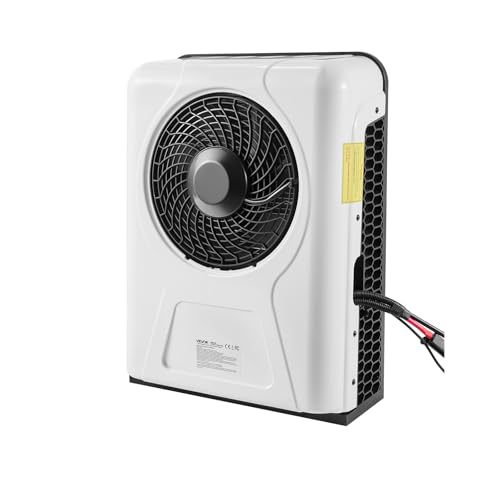
VEVOR 10,000 BTU 12V truck mini split, 400 m3/h airflow
10,000 BTU12V DC400 m3/h65 dB claim
Check price on Amazon
Best for: Truck sleepers and small vans that need 12V split cooling.

VEVOR designed this split for truck cabs and sleeper bunks, using an automotive-grade inverter compressor that runs on a vehicle 12V system. The airflow of 400 cubic meters per hour is generous for a small cabin, and the split layout puts the noisy part outside the sleeping area.

The quoted 65 dB is the loudest sound claim in the guide, and it is a reminder that DC splits in vehicles are not always whisper quiet. The 10,000 BTU capacity suits a cab, a van or a truck camper, not a trailer. Against the Treeligo it runs on 12V instead of 24V, so cabling is heavier for the same power.

It rewards good wiring: short, thick cable, a correctly sized fuse and a low-voltage cutoff. Check the line connections after the first long trip and keep the evaporator filter clean.

What works

  • Automotive-grade inverter compressor on 12V
  • 400 m3/h airflow for a compact cabin
  • Split design keeps the noisy half outside
  • Fits truck cabs and small camper bodies

Watch out for

  • Loudest sound claim in this lineup at 65 dB
  • 12V cabling must be heavy and short

Spec sheet

Capacity
10,000 BTU
Voltage
12V DC
Airflow
400 cubic meters per hour
Noise claim
As low as 65 dB
Compressor
Automotive-grade inverter

Spec sheet decoder

What the numbers on the box really mean

The specs manufacturers lead with, translated into what they tell you about real-world performance.

SEER2

A seasonal efficiency rating where higher means less electricity for the same cooling. Ratings come from a house-style test.

Watch forThe ROVSUN and COSTWAY list 20, the Albott 18, the Rellytech 17.

Pre-charged

Refrigerant is already in the outdoor unit and lines connect with fittings, reducing the need for a technician.

Watch forConfirm line-set length limits before routing through a coach wall.

Voltage

115V units use household power, while 12V and 24V units run from batteries. Current rises as voltage falls.

Watch forThe Treeligo is 24V and the VEVOR is 12V, so wiring differs greatly.

CFM or m3/h airflow

Airflow shows how much air the indoor fan moves. Higher airflow helps distribute cold air.

Watch forThe Treeligo lists 350 CFM and the VEVOR 400 m3/h; the units are not directly comparable.

Noise in dB

A maker figure for the quietest fan setting. Real operation is louder.

Watch forThe VEVOR's 65 dB is the highest claim here.

Methodology

How We Evaluated These Mini Split Air Conditioners for RVs

Mounting realism

We separated units built for a fixed wall from units built for a vehicle. House-style models were marked for stationary rigs. DC splits were judged on their cab and van fit.

Efficiency ratings

We compared SEER2 figures, 17 on the Rellytech to 20 on the ROVSUN and COSTWAY, as a guide to running cost. We noted that SEER2 comes from a house test. Capacity was weighed alongside efficiency.

Install difficulty

We looked at pre-charged systems, line-set routing and drain needs. A pre-charged unit like the Rellytech scored for simplicity. Bare lines raised the difficulty.

Electrical load

We checked voltage and draw, including the 24V Treeligo and the 12V VEVOR. DC units were judged on cable demands. 115V units were judged on how well they manage a 30 amp pedestal.

Ownership

We considered filter access, condenser exposure and refrigerant servicing. Sealed systems need certified technicians for repair. Washable indoor filters scored for ease of upkeep.

Decision guide

How to Choose the Right Mini Split Air Conditioners for RVs

By Rig Type

SituationPickWhy
Park model, rarely movesCOSTWAY 12,000 BTUHighest SEER2 at that capacity
Quiet long-stay trailerRellytech 11,500 BTULow noise claim and pre-charged
Single-room small rigROVSUN 9,000 BTUGentle startup and 20 SEER2
24V bus or conversionTreeligo 24VRuns on batteries

By Budget

SituationPickWhy
Lowest outlay, small roomROVSUN 9,000 BTUSmallest compressor
Mid-range house-styleAlbott 12,000 BTUBalanced efficiency and capacity
Mid-range DCVEVOR 12V truck splitAutomotive compressor
Premium battery systemTreeligo 24VThin cable, low current

House-Style vs DC Split

House-style 115V

The Rellytech, Albott, ROVSUN and COSTWAY have high efficiency figures and heat pumps, and they need a pedestal or large inverter. They are happiest in a rig that stays put for weeks.

DC split

The Treeligo and VEVOR run on batteries, suit vehicles and need heavy cable. They give up SEER2 labels.

House-style for stationary rigs; DC for rigs that boondock.

Noise and Sleeping

SituationPickWhy
Lightest sleeperROVSUN mute mode28 dB claim
Quiet efficient heat pumpRellytech 11,500 BTU29 dB claim
Moderate DC noiseTreeligo 24V45 dB claim
Truck cab, noise toleratedVEVOR 12V65 dB claim

For Do-It-Yourself Installs Specifically

Look for

Pre-charged lines, a clear line-set length limit and a drain plan. Confirm what mounting hardware is included.

In this comparison

The Rellytech and COSTWAY use pre-charged systems, which reduces the need for a technician. DC units still demand careful wiring.

When to Spend More

Spend more if

You live in the rig year-round or need quiet nights. The Rellytech and COSTWAY justify their cost through efficiency and low noise.

Save if

You cool a single small room occasionally. The ROVSUN 9,000 BTU is enough.

Ownership

Maintenance schedule

The upkeep that decides whether this machine lasts two seasons or ten.

TaskIntervalWhy it matters
Wash indoor filterEvery 3 to 4 weeksDust reduces airflow and ices the coil. A washable filter takes a minute.
Check line-set insulationEach springSun and weather crack the foam. Exposed copper wastes capacity and drips condensation.
Clean outdoor coilTwice a yearLeaves and pollen block the condenser. Use low-pressure water.
Verify drain flowMonthly in humid weatherA blocked drain floods the wall. Pour a little water through to confirm.
Inspect mount and DC terminalsEach seasonVibration loosens brackets and lugs. A loose bracket stresses refrigerant lines.

FAQ

Frequently Asked Questions

Can a mini split run on RV shore power?

Yes, a 115V unit can, but check the startup draw against a 30 amp pedestal. Inverter compressors start gently, which helps.

Are mini splits quieter than rooftop RV units?

Indoors, usually, because the loud compressor sits outside. Maker claims such as 28 and 29 dB describe the quietest fan speed.

Can I take a mini split on the road?

Not as easily. A house-style condenser expects a fixed bracket, so a moving rig is better served by a rooftop unit.

What does pre-charged mean?

The refrigerant is sealed in the outdoor unit, and lines connect with fittings. It reduces the need for a technician but does not remove care with the line set.

Is 24V better than 12V for a split?

For the same watts a 24V unit draws about half the current, so thinner cable and less voltage drop. It needs a 24V system.

How big a mini split does an RV need?

A single room or small trailer suits 9,000 BTU, while 11,500 to 12,000 BTU suits larger spaces. Sun load and windows matter more than square footage. If you are between sizes, the larger inverter unit is usually the safer choice because it can slow down to match a small load.

Bottom line

The short version

Browse more mini split air conditioners for rvson Amazon →
James Miller, Lead Machine Editor

About the author

James Miller

Lead Machine Editor, MachineFanatic

James Miller leads MachineFanatic's buying guides, turning spec sheets, manuals and owner feedback into clear verdicts on power tools, outdoor power equipment, shop machines and kitchen machines.

More from James →

Keep reading

Related guides