
Amazon affiliate links - we earn a commission.Affiliate disclosure

Buying guide · 13 min read · Updated 2026-11-07

Best Pottery Wheels (2026)

Six electric pottery wheels compared by motor power, centering capacity, wheel head size and splash pan design, from Speedball to VEVOR and Alldeer models.

James MillerBy James MillerLead Machine Editor6 machines comparedSpec-sheet verified
Best Pottery Wheels

At a glance

Our top picks

Side by side

Spec comparison

An electric pottery wheel spins a head so clay can be centered, opened and pulled into a form. What separates a satisfying wheel from a frustrating one is its ability to hold speed while you press into a lump of clay, which comes down to torque rather than the horsepower label.

Decide how large a piece you want to make, then look at the motor, the wheel head size and the control type. Foot pedals suit most throwers, and splash pans and drip trays matter more in a home studio than they sound.

Before you buy

6 Criteria to Look For Before Buying a Pottery Wheel

  1. 01

    Torque and centering capacity

    Centering capacity is the practical measure of a wheel, and it comes from torque. The Clay Boss lists 100 pounds, and the Artista lists 25 pounds. Horsepower is torque times RPM, and manufacturers rate power differently, with some quoting peak and others average, so do not compare labels across brands. A simple home test is to center a one pound ball, then add clay in half pound steps until the wheel slows; that point tells you the practical limit better than any label.

  2. 02

    Wheel head size

    A larger head gives room for platters and wide bowls, while a smaller head is easier to center on. The Clay Boss has 14 inches, the Artista 11 inches and the Nat Geo wheel 8 inches. Match the head to the largest piece you plan to make. If you plan to make large bowls, remember that the clay and water weight also rides on the head, so a bigger head needs a stronger motor.

  3. 03

    Speed range and control

    Speed control matters because centering needs a fast wheel and trimming needs a slow one. The VEVOR 14 inch spans 60 to 300 RPM and has a foot pedal. A pedal frees both hands, while a hand lever is a personal preference. Try to keep the pedal smooth, because a jerky pedal makes centering harder than any motor shortfall.

  4. 04

    Splash pan and cleanup

    Slip is messy, so a splash pan and a polyethylene or detachable basin make cleanup faster. The Clay Boss has a two-part pan and the Alldeer has a detachable basin. Easy cleaning saves your motor from slip. A pan that clips on and off, or a basin that lifts out, is worth more than a longer list of accessories.

  5. 05

    Noise and motor type

    A brushless motor, as on the Alldeer, runs quieter and cooler. Some brushed motors hum loudly. If you work in a shared home, check the noise before buying. If noise matters to you, ask how loud the wheel is at full speed under load, since a hum at idle can turn into a whine when it works.

  6. 06

    Height and ergonomics

    A wheel that is too low or high strains your back. The VEVOR 14 inch offers 0 to 6 inch adjustable legs. If your wheel sits on a table, check that your arms can rest comfortably. Sit at the wheel before you decide: your elbows should rest near your ribs and your forearms should reach the clay without lifting your shoulders.

Detailed reviews

The 6 best pottery wheels, explained

01
Speedball Clay Boss pottery wheel, 0.5 HP, 14 inch head
0.5 HP motor14 inch head100 lb capacitySplash pan
Check price on Amazon
Best for: Serious home potters throwing large pieces or heavy clay loads.

The Clay Boss is built around a 0.5 horsepower motor that supports up to 100 pounds of centering capacity, a figure that tells you how much clay the wheel can hold at speed without stalling. A 14 inch wheel head gives plenty of room for large platters and bowls, and a polyethylene table top with a two-part splash pan is easy to wipe down after a messy session.

The tradeoff is size and weight. A wheel with this much power is bulky, does not stow easily and sits at the upper end of the cost range here. Compared with the Artista, it has far more centering capacity, and against the VEVOR 14 inch units it has the more established ecosystem of parts and accessories. It is a studio wheel that happens to fit a home.

Ownership is straightforward. Clean slip out of the pan and off the table after every session, since dried clay dust is abrasive, and check the drive belt periodically. Lubricate only as the manual says, and keep electrical parts dry by using a sponge and a bucket rather than a hose.

What works

  • 0.5 HP motor for up to 100 pounds of centering capacity
  • 14 inch wheel head suits large platters and bowls
  • Polyethylene table top is easy to clean
  • Two-part splash pan contains slip

Watch out for

  • Bulky and not easy to store
  • Costs more than compact wheels

Spec sheet

Motor
0.5 HP
Wheel head
14 inches
Centering capacity
Up to 100 lb
Table
Polyethylene table top
Splash pan
Two-part
02
Speedball Artista potter's wheel, 1/3 HP, 11 inch head
1/3 HP motor11 inch head25 lb capacityPortable
Check price on Amazon
Best for: Small to medium pieces in a space-limited home studio.

The Artista offers a one third horsepower motor and an 11 inch head in a lightweight, compact body. Its 25 pound capacity suits mugs, small bowls and vases, and the lighter build lets you stow it in a closet between sessions. For someone throwing small to medium pieces, it is a sensible, quiet starting point.

The limit is capacity. Twenty-five pounds is far below the Clay Boss's 100 pounds, so large pieces and heavy clay loads stall or slow the wheel. Compared with the VEVOR 14 inch machines, it has a smaller head but a longer track record, and against the Nat Geo wheel it has a real potter's motor.

Keep it clean and dry, wipe clay slurry off the head and pan and store it covered. Replace worn splash pan parts so slip does not drip onto the motor housing. A small kiln or a studio that fires for you completes the workflow.

What works

  • Lightweight and compact for easy storage
  • 1/3 HP motor suits mugs and bowls
  • 11 inch head is a practical size
  • Established brand with accessories

Watch out for

  • 25 pound capacity limits large pieces
  • Less torque for heavy clay

Spec sheet

Motor
1/3 HP
Wheel head
11 inches
Centering capacity
25 lb
Design
Lightweight and compact
Use
Home studio
03
VEVOR 14 inch 450W pottery wheel, 60 to 300 RPM
450W motor14 inch head60 to 300 RPMAdjustable legs
Check price on Amazon
Best for: Potters who want a large head and adjustable height at a modest cost.

The VEVOR 14 inch offers a 450 watt motor, a 14 inch aluminum alloy turntable and a speed range from 60 to 300 RPM, plus legs that adjust through 0 to 6 inches so you can set the height to your seat and posture. An ABS water basin catches slip, and the foot pedal controls speed hands-free.

The tradeoff is support and torque numbers that are harder to compare. A 450 watt motor is comparable in power to the Clay Boss's 0.5 HP, but the brand publishes less torque data and has less depth in parts and accessories. Compared with the Alldeer 11 inch, it has a larger head and a higher-power motor, and against the Clay Boss it costs less.

Check bolts after unboxing, keep the foot pedal free of slip and wipe down the basin after every session. Do not overload the wheel with more clay than the motor can hold.

What works

  • 450W motor and 14 inch aluminum head
  • 60 to 300 RPM speed range
  • 0 to 6 inch adjustable leg height
  • ABS basin contains slip

Watch out for

  • Less published torque and support data
  • Parts and accessories are thinner than Speedball

Spec sheet

Motor
450W
Wheel head
14 inch aluminum alloy
Speed
60 to 300 RPM
Height
0 to 6 inch adjustable legs
Basin
ABS water basin
04
Alldeer 11 inch 350W brushless pottery wheel
350W brushless11 inch headDetachable basinFoot pedal
Check price on Amazon
Best for: Home potters who want a quiet, modern motor in a compact wheel.

The Alldeer uses a 350 watt brushless motor, which runs cooler and quieter than a brushed one and has no carbon brushes to wear out. An 11 inch head and a detachable basin make it easy to clean, and a pottery kit bundles tools so you can start throwing quickly. The brushless motor also holds speed smoothly under load.

The limit is centering capacity and brand support. A 350 watt motor handles moderate clay amounts but not very large pieces, and the brand has less record than Speedball. Compared with the Artista, it is more modern and quieter, and against the VEVOR 14 inch it is smaller but has a brushless motor.

Rinse the basin after use, wipe the head and keep the pedal clear of slip. A brushless motor still wants a dry environment and a cover for storage. Fit a rubber mat under the wheel to damp vibration and protect the floor.

What works

  • 350W brushless motor runs cool and quiet
  • Detachable basin simplifies cleaning
  • Includes a pottery tool kit
  • 11 inch head suits most home work

Watch out for

  • Lower centering capacity than the Clay Boss
  • Less established brand support

Spec sheet

Motor
350W brushless
Wheel head
11 inches
Basin
Detachable
Control
Foot pedal
Kit
Professional pottery kit
05
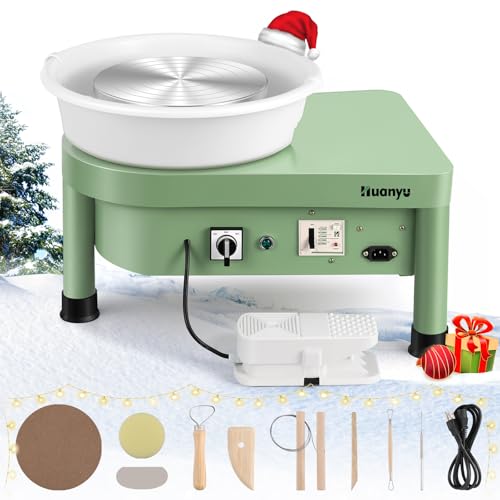
Huanyu 10 inch electric pottery wheel with foot pedal
10 inch headFoot pedalAluminum turntableScratch-resistant body
Check price on Amazon
Best for: First-time potters throwing small pieces on a tight budget.

The Huanyu is a compact 10 inch wheel with an aluminum alloy turntable and a foot pedal for speed control, aimed at adults who want to try throwing at home. A bright, scratch-resistant body is easy to wipe, and the smaller head keeps the machine light and affordable.

Its compromise is power and published detail. The listing gives less information on motor wattage and centering capacity than the Speedball units, so it is best matched to small pieces. Compared with the Alldeer 11 inch, it has a smaller head and less documented motor, and against the Artista it offers a similar size at a lower tier.

Expect to keep loads small and to center clay in smaller portions. Clean it after each session, and avoid soaking the motor housing. It is a stepping stone rather than a long-term studio wheel. A good apron and a few basic tools turn it from a gadget into a hobby.

What works

  • Foot pedal speed control
  • Aluminum alloy turntable
  • Light and easy to store
  • Lowest cost wheel here

Watch out for

  • Less documented motor power
  • Small head limits piece size

Spec sheet

Wheel head
10 inches
Control
Foot pedal
Turntable
Aluminum alloy
Body
Scratch-resistant finish
Use
Beginners and home use
06
National Geographic hobby pottery wheel, 8 inch variable speed
8 inch wheelVariable speedArm toolsHobby class
Check price on Amazon
Best for: Teens and adults trying pottery on a table top.

This hobby wheel has an 8 inch head with variable speed and an arm system developed with professional potters. It is a desktop machine meant for small pieces and for learning the feel of centering, with a design that is simple and quiet enough for a living room table.

The tradeoff is scale. An 8 inch head and a small motor limit you to tiny pieces, and it does not have the torque for serious throwing. Compared with the Huanyu and Alldeer, it is smaller, and against the Artista it is more of a learning tool than a studio instrument.

Keep the clay small and soft, wipe slip from the head and store the unit covered. It suits a first taste of pottery, and most users move to a larger wheel if they continue.

What works

  • Variable speed on an 8 inch head
  • Designed with professional potters
  • Compact desktop footprint
  • Quiet enough for indoor use

Watch out for

  • Small head and motor limit piece size
  • Not suited to serious throwing

Spec sheet

Wheel
8 inch
Speed
Variable
Design
Developed by professional potters
Features
Innovative arm attachment
Use
Adults and teen beginners

Spec sheet decoder

What the numbers on the box really mean

The specs manufacturers lead with, translated into what they tell you about real-world performance.

Centering capacity

The maximum clay weight the wheel can hold while you center it. It is the best everyday indicator of torque. Centering capacity falls as the clay gets stiffer, so soften your clay when testing a limit.

Watch forThe Clay Boss lists 100 lb and the Artista 25 lb.

Horsepower versus watts

Horsepower and watts both measure motor power. The ratings may be peak or average, so they are not directly comparable. Ask what peak means in the listing, because it may describe a short burst only.

Watch forThe Clay Boss lists 0.5 HP and VEVOR lists 450W.

Brushless motor

A motor without brushes that runs cooler, quieter and lasts longer. It holds speed smoothly. Brushless units also tend to give a more even speed at the lowest settings.

Watch forThe Alldeer lists 350W brushless.

RPM range

The slowest and fastest speed. A wide range supports both centering and trimming. Slow speeds are valuable for trimming and for beginners learning to control the wheel.

Watch forThe VEVOR 14 inch spans 60 to 300 RPM.

Wheel head diameter

The size of the spinning disk. A bigger head supports larger work. Larger heads let you throw wider pieces but need more strength to center.

Watch forThe Clay Boss has 14 inches, the Huanyu 10 inches.

Methodology

How We Evaluated These Pottery Wheels

Power and capacity

We compared motor ratings and centering capacity. The Clay Boss lists 100 lb and 0.5 HP, while the Artista lists 25 lb. Real capacity scored higher than label numbers. We also noted whether the listing gives centering capacity or only a power number.

Head and control

We looked at head size, speed range and pedal control. The VEVOR 14 inch spans 60 to 300 RPM. Wider range scored higher. We compared how clearly each wheel shows its speed range.

Cleanup design

We checked basins and splash pans. The Clay Boss has a two-part pan and the Alldeer has a detachable basin. Easier cleaning scored higher. We looked at how much of the pan can be removed for cleaning.

Noise and motor

We considered motor type and noise. The Alldeer's brushless motor scored higher for quiet. We checked noise comments in owner feedback patterns.

Ownership

We weighed brand support, parts and owner feedback patterns. Established brands scored higher for parts. We looked at how easy it is to find replacement pans and pedals.

Decision guide

How to Choose the Right Pottery Wheels

By Piece Size

SituationPickWhy
Large platters and heavy claySpeedball Clay Boss100 lb capacity and 14 inch head
Mugs and small bowlsSpeedball Artista1/3 HP and 25 lb capacity
Medium pieces, big headVEVOR 14 inch450W and 14 inch head
Moderate pieces, quietAlldeer 11 inchBrushless motor
Tiny pieces and trialsNational Geographic 8 inchDesktop starter

By Budget

SituationPickWhy
Lowest tierHuanyu 10 inchFoot pedal basic
Entry hobbyNational Geographic 8 inchVariable speed starter
Mid tierAlldeer 11 inchBrushless and kit
Upper mid tierVEVOR 14 inch450W and large head
PremiumSpeedball Clay BossStudio capacity

Studio Wheel vs Hobby Wheel

Studio wheel

The Clay Boss and Artista are built for repeated use with heavier clay. They cost more and weigh more.

Hobby wheel

The Nat Geo, Huanyu and smaller VEVOR and Alldeer models suit light use. They are cheaper but limit piece size.

Serious potters should pick a studio wheel, and casual users can choose a hobby wheel.

Control and Ergonomics

SituationPickWhy
Foot pedal and adjustable heightVEVOR 14 inch0 to 6 inch legs
Quiet motorAlldeer 11 inchBrushless
Compact storageSpeedball ArtistaLightweight
Tabletop useNational Geographic 8 inchDesktop

For Home Studios Specifically

Look for

Look for a splash pan, a quiet motor and a wheel you can store. Plan a spot for wet clay and a bucket and sponge cleanup routine.

In this comparison

The Alldeer 11 inch and Artista suit small spaces, and the Clay Boss suits a dedicated corner.

When to Spend More

Spend more if

Spend more if you throw large or heavy pieces weekly. The Clay Boss and VEVOR 14 inch offer capacity.

Save if

Save if you want to try pottery. The Huanyu and Nat Geo cover first steps.

Ownership

Maintenance schedule

The upkeep that decides whether this machine lasts two seasons or ten.

TaskIntervalWhy it matters
Wipe slip after each sessionEvery sessionDried clay is abrasive and clogs the pan and head. Wiping prevents buildup. Keep a dedicated sponge and bucket so clay never reaches the sink drain.
Check the drive belt or couplingEvery few monthsA worn belt slips and cuts torque.
Keep the pedal clear of slipEvery sessionSlip in the pedal makes speed control sticky. Wipe the pedal contacts with a dry cloth.
Cover the wheel when idleAlwaysDust and clay dust shorten motor life. Use a breathable cover rather than plastic to avoid trapped moisture.
Inspect the power cordTwice a yearWater and clay near electricity need a sound cord.

FAQ

Frequently Asked Questions

How much power does a pottery wheel need?

Centering capacity depends on torque. A 25 pound wheel handles mugs, and a 100 pound wheel handles large pieces. If you are unsure, buy for the largest piece you can imagine making in a year, not the smallest piece you start with.

Is a foot pedal better than a hand lever?

Most throwers prefer a pedal because it frees both hands. It is a personal preference. Many beginners find a pedal easier after a short adjustment period.

Do I need a splash pan?

Yes. It contains slip and protects the motor housing. A tray of water and a sponge nearby keep the area clean.

Can I use it indoors?

Yes, with a spill mat and a cleanup routine. Brushless motors are quieter.

How long will a wheel last?

With cleaning and a dry environment, many years. Belts and pedals are the wear items. Plan to replace splash pan parts and pedals before the motor itself fails.

What clay should I use?

Use a stoneware or earthenware clay suited to your kiln. Start with a smaller amount and work up. A mid-fire stoneware is a forgiving first clay.

Bottom line

The short version

Browse more pottery wheelson Amazon →
James Miller, Lead Machine Editor

About the author

James Miller

Lead Machine Editor, MachineFanatic

James Miller leads MachineFanatic's buying guides, turning spec sheets, manuals and owner feedback into clear verdicts on power tools, outdoor power equipment, shop machines and kitchen machines.

More from James →

Keep reading

Related guides