
Amazon affiliate links - we earn a commission.Affiliate disclosure

Buying guide · 12 min read · Updated 2026-11-07

Best Pottery Wheels for Beginners (2026)

Six beginner pottery wheels compared by head size, speed range and kit contents, from a 6 inch Alldeer mini to 11 and 12 inch foot pedal wheels for adults.

James MillerBy James MillerLead Machine Editor6 machines comparedSpec-sheet verified
Best Pottery Wheels for Beginners

At a glance

Our top picks

Side by side

Spec comparison

MachineMotorWheel headSpeedControlKit
VEVOR 11 inch 450W pottery wheel, 30 to 300 RPMBest OverallVEVOR 11 inch 450W pottery wheel, 30 to 300 RPM450W11 inch aluminum30 to 300 RPMFoot pedaln/a
Alldeer 11 inch 350W brushless pottery wheelBest Quiet PickAlldeer 11 inch 350W brushless pottery wheel350W brushless11 inchesn/aFoot pedalProfessional pottery kit
Bonoutil 12 inch pottery wheel with bat systemBest Large HeadBonoutil 12 inch pottery wheel with bat systemn/a12 inchesn/aSpeed knob and foot pedaln/a
National Geographic hobby pottery wheel, 8 inch variable speedBest Desktop WheelNational Geographic hobby pottery wheel, 8 inch variable speedn/an/aVariablen/an/a
Alldeer 6 inch mini pottery wheel all-in-one kitBest Mini Starter KitAlldeer 6 inch mini pottery wheel all-in-one kitn/an/aAdjustablen/aAll-in-one starter kit
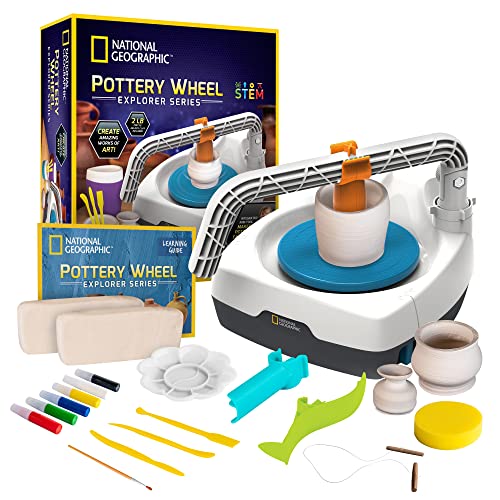
National Geographic pottery wheel kit for kidsBest for KidsNational Geographic pottery wheel kit for kids2-speed electricn/an/an/aComplete beginner kit

A first pottery wheel should be forgiving. It needs a motor strong enough to center a lump of clay without stalling, a speed range that goes slow enough to learn on, and a splash pan that keeps the mess manageable in a home.

Beginner kits range from toy-like desktop wheels for air-dry clay to proper electric wheels with foot pedals. Decide whether you want a quick craft session or a real hobby with kiln-fired pieces before choosing a size and motor.

Before you buy

6 Criteria to Look For Before Buying a Pottery Wheel for Beginners

  1. 01

    A slow speed floor

    Beginners need the wheel to turn slowly while they learn to center and open the clay. The VEVOR 11 inch starts at 30 RPM and tops out at 300. A wheel that cannot go slow makes every lesson harder, so check the lowest speed before the highest. Learning to center is mostly a matter of steady hand pressure at a slow, even speed, so a wheel that lets you creep along gives you more successful attempts per hour.

  2. 02

    Enough motor for real clay

    A toy motor stalls on a pound of stoneware. The VEVOR lists 450 watts and the Alldeer 11 inch lists 350 watts brushless. If you want to throw real clay, buy at least a 350 watt wheel, and avoid decorative models. A good rule is to buy the motor you will need in a year, because wheels are heavy and awkward to sell on.

  3. 03

    Head size

    An 11 or 12 inch head, as on the Alldeer, VEVOR and Bonoutil, supports bowls and mugs, while an 8 inch head limits you to tiny cups. A bigger head is harder to center on but gives growth room. Match it to the first things you want to make. Do not forget the seat: a stool at the right height matters as much as a few extra inches of head.

  4. 04

    Foot pedal and hands-free control

    A foot pedal frees both hands to hold clay, which is how real throwing works. The VEVOR, Alldeer and Bonoutil all include one. Hand-lever or button-only wheels make learning slower. Try a pedal with your foot flat on the floor, since a pedal that needs you to lift your heel will tire you quickly.

  5. 05

    Clay type

    Air-dry clay does not fire in a kiln, and kiln-fired clay needs a firing source. The National Geographic kids kit uses air-dry clay, while the adult wheels use any throwing clay. Decide whether you can fire pieces before buying a kit. If you cannot fire clay, consider a studio membership that fires your work for a small fee.

  6. 06

    Splash pan and cleanup

    Slip is messy, so a detachable basin on the Alldeer and a pan on the VEVOR make cleanup faster. A wheel that is hard to clean tends to be neglected. Plan a bucket and sponge routine. Keep a dedicated bucket for slip and let it settle, then scoop the solids into the trash instead of the drain.

Detailed reviews

The 6 best pottery wheels for beginners, explained

01
VEVOR 11 inch 450W pottery wheel, 30 to 300 RPM
450W motor11 inch head30 to 300 RPMFoot pedal
Check price on Amazon
Best for: Adult beginners who want a real wheel with slow learning speeds.

This VEVOR pairs a 450 watt motor with an 11 inch aluminum turntable and a speed range from 30 to 300 RPM, and that slow 30 RPM end is the feature a beginner values most. Slow speeds let you learn to center, open and pull walls without the wheel spinning away from you, and the foot pedal frees both hands for the clay. The 11 inch head is large enough for bowls and mugs without being unwieldy.

The tradeoff is power numbers and brand depth. A 450 watt motor is strong for a beginner machine, but the listing publishes little torque or centering capacity data, and parts and accessories are thinner than for Speedball. Compared with the Alldeer 11 inch, it offers a higher-power motor and a slower speed floor, and against the Bonoutil 12 inch it has a smaller head but a wider documented range.

Plan on a sponge, a bucket and a wipe-down after every session. Keep the pedal clear of slip, and keep loads modest until you build technique.

What works

  • 450W motor handles real centering practice
  • 30 RPM floor for learning control
  • 11 inch aluminum head suits bowls and mugs
  • Foot pedal frees both hands

Watch out for

  • Limited published torque data
  • Thinner parts and accessory support

Spec sheet

Motor
450W
Wheel head
11 inch aluminum
Speed
30 to 300 RPM
Control
Foot pedal
Footprint
Space-saving design
02
Alldeer 11 inch 350W brushless pottery wheel
350W brushless11 inch headDetachable basinTool kit
Check price on Amazon
Best for: Beginners in a shared home who want a quiet wheel with a tool kit.

The Alldeer 11 inch uses a 350 watt brushless motor, which stays cooler and quieter than a brushed one and has no carbon brushes to wear. A detachable basin makes cleanup easy, and a bundled tool kit means you can start throwing without shopping for sponges and ribs. The 11 inch head gives enough room for typical beginner projects.

The limit is capacity and brand history. A 350 watt motor handles ordinary amounts of clay but will stall on very large loads, and the brand has less proven support than Speedball. Compared with the VEVOR 11 inch, it has less power but a quieter brushless design, and against the Alldeer mini it is a real wheel instead of a desk toy.

Rinse the basin, wipe the head and keep the pedal clean. Start with a pound or two of clay and increase as you gain control. A studio shelf for drying pieces makes the whole routine tidier.

What works

  • 350W brushless motor runs quietly
  • Detachable basin simplifies cleanup
  • Pottery tool kit included
  • 11 inch head is a practical size

Watch out for

  • Lower power than the 450W units
  • Less established brand support

Spec sheet

Motor
350W brushless
Wheel head
11 inches
Basin
Detachable
Kit
Professional pottery kit
Control
Foot pedal
03
Bonoutil 12 inch pottery wheel with bat system
12 inch headBat systemSpeed knobFoot pedal
Check price on Amazon
Best for: Beginners who plan to make larger pieces and want bats.

The Bonoutil offers a 12 inch head with a bat system, which lets you throw on a removable disc so you can lift finished pieces off without distorting them. A speed knob sets the range and a foot pedal controls speed on the fly, so it handles like a small studio wheel. The sturdy structure gives it a stable feel for centering.

Its tradeoff is information and heft. The listing offers less detail about motor power than the VEVOR, and a 12 inch head is a bigger commitment in space and weight than a compact wheel. Compared with the VEVOR 11 inch, it adds a bat system and a larger head, and against the Nat Geo wheel it is a serious machine.

Keep bats dry and clean, wipe the head and store the wheel covered. Learn to center before you step up to larger clay weights. Bats are cheap, so buy a few so you can throw several pieces in a session.

What works

  • 12 inch head gives room for larger work
  • Bat system lifts pieces cleanly
  • Speed knob plus foot pedal
  • Sturdy construction

Watch out for

  • Less published motor detail
  • Bigger and heavier than 8 to 11 inch wheels

Spec sheet

Wheel head
12 inches
Bat system
Included
Control
Speed knob and foot pedal
Build
Sturdy and durable
Use
Adults and beginners
04
National Geographic hobby pottery wheel, 8 inch variable speed
8 inch wheelVariable speedArm toolsTeen and adult
Check price on Amazon
Best for: Teens and adults who want a small desktop wheel with variable speed.

This 8 inch wheel has variable speed and an arm system developed with professional potters, aimed at teens and adults who want a desktop machine that behaves like a real wheel in miniature. The variable speed gives you room to learn centering, and the design keeps it light and tidy.

The limitation is scale and motor. An 8 inch head confines you to small cups and bowls, and the motor is not meant for heavy clay. Compared with the Alldeer mini, it is more refined and adult-oriented, and against the 11 inch wheels it is smaller and cheaper but also a stepping stone.

Keep the clay small and soft, wipe slip off after use and store it covered. If you keep going, expect to move to a larger wheel.

What works

  • Variable speed on an 8 inch wheel
  • Arm tools designed with professional potters
  • Compact and tidy for a desk
  • Aimed at adult and teen beginners

Watch out for

  • Small head limits piece size
  • Motor not meant for heavy clay

Spec sheet

Wheel
8 inch
Speed
Variable
Design
Developed by professional potters
Arm
Innovative arm tool
Audience
Adults and teen beginners
05
Alldeer 6 inch mini pottery wheel all-in-one kit
6 inch wheelAdjustable speedTwo-way rotationAll-in-one kit
Check price on Amazon
Best for: A low-cost first trial for kids and adults.

The Alldeer mini is a 6 inch desktop wheel with adjustable speed and two-way rotation, sold as an all-in-one kit so a first-time user receives everything needed to start. Two-way rotation matters because left-handed throwers spin the wheel the other way, and a small kit like this makes the first session painless.

The tradeoff is that it is a trial machine. A 6 inch head and a small motor suit tiny pieces and air-dry clay, and it is not a long-term wheel. Compared with the National Geographic 8 inch, it is smaller and cheaper, and against the VEVOR 11 inch it is more of a craft toy.

Use small amounts of soft clay and wipe the head after each session. Treat it as a way to find out whether you enjoy pottery before investing in a full wheel. Store it on a shelf in its box when you are not using it.

What works

  • All-in-one starter kit
  • Adjustable speed and two-way rotation
  • Compact desktop size
  • Lowest cost way to try a wheel

Watch out for

  • 6 inch head limits piece size
  • Not a long-term wheel

Spec sheet

Wheel
6 inch
Speed
Adjustable
Rotation
Two-way
Kit
All-in-one starter kit
Audience
Kids, beginners, adults
06
National Geographic pottery wheel kit for kids
2-speed motor2 lb air-dry clay3 arm attachmentsTool set
Check price on Amazon
Best for: Children's craft sessions with air-dry clay.

This kit is designed for children, with a two-speed electric motor, two pounds of air-dry clay, three arm attachments and a set of tools. Everything is in the box, so a family can start a project the day it arrives. The arm tools help children shape clay without needing the strength of a full wheel.

Its tradeoff is that it is a kids' product. The motor and wheel are small, and air-dry clay is a different material from kiln-fired clay, so it does not teach throwing technique the way a real wheel does. Compared with the National Geographic 8 inch adult wheel, it is simpler and safer for children, and against the VEVOR it is a toy by comparison.

Supervise young users, keep the clay damp while working and wipe slip off the motor housing. It suits a craft afternoon more than a lifelong hobby. Check the age rating before giving it to a younger child.

What works

  • Complete kit with clay and tools
  • Two-speed motor suits younger users
  • Arm attachments help shape clay
  • Simple setup

Watch out for

  • Small motor and wheel
  • Air-dry clay does not teach kiln-fired throwing

Spec sheet

Motor
2-speed electric
Clay
2 lb air-dry
Arm tools
3 attachments
Kit
Complete beginner kit
Audience
Kids

Spec sheet decoder

What the numbers on the box really mean

The specs manufacturers lead with, translated into what they tell you about real-world performance.

Minimum RPM

The slowest rotation speed. A low floor helps you learn control. You rarely need the top speed during a first year of throwing.

Watch forThe VEVOR 11 inch lists 30 RPM.

Brushless motor

A motor with no brushes that is quieter and longer lived. Real torque matters more than the number on the label.

Watch forThe Alldeer 11 inch lists 350W brushless.

Bat system

A removable disc that sits on the wheel head so you can lift finished pieces without distorting them. A bat also protects the base of a thin piece from fingers during lifting.

Watch forThe Bonoutil 12 inch includes one.

Two-way rotation

The wheel can spin clockwise or counterclockwise to suit left or right handed throwers. Left-handed throwers often prefer to spin the wheel the other way.

Watch forThe Alldeer mini includes it.

Air-dry clay

Clay that hardens without firing. It is not food safe or waterproof. Always read the label, since some air-dry clays are not safe for food. It works well for decorative pieces and school projects.

Watch forThe Nat Geo kids kit includes 2 lb.

Methodology

How We Evaluated These Pottery Wheels for Beginners

Learning speeds

We compared the slowest and fastest speeds. The VEVOR 11 inch starts at 30 RPM and the Alldeer mini offers adjustable speed. Slow control scored higher. We also noted how clearly each listing states its speed floor.

Motor power

We looked at wattage and motor type. The VEVOR is 450W and the Alldeer is 350W brushless. Real power for clay scored higher. We compared power ratings against the head size each motor has to turn.

Head and kit

We compared head size and what is in the box. The Bonoutil has a 12 inch head and a bat system. Useful kits scored higher. We counted useful tools in each kit.

Cleanup

We checked basins and splash pans. The Alldeer 11 inch has a detachable basin. Easy cleaning scored higher. We looked at how many parts can be removed for washing.

Ownership

We weighed noise, storage and owner feedback patterns. Quiet, stable wheels scored higher. We also considered how heavy each wheel is to move.

Decision guide

How to Choose the Right Pottery Wheels for Beginners

By Experience Level

SituationPickWhy
Adult learning to throwVEVOR 11 inch30 RPM floor and 450W
Quiet shared homeAlldeer 11 inchBrushless motor
Plan larger workBonoutil 12 inchBat system and big head
Desk trial for teens or adultsNational Geographic 8 inchVariable speed
Kids craft afternoonNational Geographic kids kitAir-dry clay kit

By Budget

SituationPickWhy
Lowest tierAlldeer 6 inch miniAll-in-one kit
Kids craftNational Geographic kids kitSimple kit
Entry adultNational Geographic 8 inchVariable speed
Mid tier real wheelAlldeer 11 inchBrushless and kit
Upper mid tierVEVOR 11 inch450W and slow speeds

Desktop Toy vs Real Wheel

Desktop wheels

The Alldeer mini, Nat Geo 8 inch and kids kit are cheap and tidy. They are small and do not teach real throwing weights.

Real wheels

The VEVOR, Alldeer 11 inch and Bonoutil have real motors, pedals and room to grow. They need space and cost more.

Casual crafters can pick a desktop wheel, and anyone planning to continue should buy a real wheel.

Clay and Firing

SituationPickWhy
You can fire stonewareVEVOR 11 inchHandles throwing clay
You use a studio kilnBonoutil 12 inchBats for transport
No kiln accessNational Geographic kids kitAir-dry clay
Tiny test piecesAlldeer 6 inch miniSmall footprint

For Home Learning Specifically

Look for

Look for a slow minimum speed, a foot pedal, a splash pan and a quiet motor. A class or video lessons shorten the learning curve a great deal.

In this comparison

The VEVOR 11 inch and Alldeer 11 inch are the best learning wheels, and the mini kits are best for a quick trial.

When to Spend More

Spend more if

Spend more if you plan to stick with pottery. The VEVOR 11 inch or Bonoutil will not be outgrown quickly.

Save if

Save if you are curious. The Alldeer mini and Nat Geo wheels let you test the interest.

Ownership

Maintenance schedule

The upkeep that decides whether this machine lasts two seasons or ten.

TaskIntervalWhy it matters
Wipe slip after each sessionEvery sessionDried clay is abrasive and clogs pans and pedals. Rinse the sponge in a bucket, not the sink.
Keep the pedal dryEvery sessionSlip in the pedal makes speed control sticky and can short components. A silicone-free spray keeps pedal contacts moving without leaving residue.
Check bolts and the headMonthlyA loose head wobbles and ruins centering. Check them again after moving the wheel.
Cover when idleAlwaysClay dust shortens motor life. A fitted cloth cover lets the wheel breathe.
Inspect the cordTwice a yearWater near electricity requires a sound cord. Replace a worn cord rather than taping it.

FAQ

Frequently Asked Questions

What is the best pottery wheel for a beginner?

The VEVOR 11 inch is the best overall with a 450W motor and a 30 RPM floor. The Alldeer 11 inch is the quiet alternative. If you are unsure, pick the wheel with the slowest speed floor, since it forgives mistakes. Whichever you choose, a few hours of instruction in the first month saves months of frustration.

Do I need a foot pedal?

Yes for real throwing, since it frees both hands. Desktop kits may use a knob. A short class first will teach you what to look for in a wheel.

Can I use air-dry clay?

Yes on kids kits, but it does not fire in a kiln or hold water. Real throwing uses stoneware or earthenware. Check the label for food safety if you plan to use pieces for drinks.

How much clay can a beginner wheel hold?

Small wheels handle a pound or two. Larger loads need more motor power, so start small. A firm, damp clay ball of one pound is a good starting load.

Do I need a kiln?

For lasting, waterproof pieces, yes, or a studio that fires for you. Air-dry clay is only for decorative items. Spare pedals and splash pans are the parts most often replaced.

How long will a wheel last?

With cleaning and a dry space, many years. Pedals and belts are the wear items. Mid-range stoneware is the usual friendly first choice.

Bottom line

The short version

Browse more pottery wheels for beginnerson Amazon →
James Miller, Lead Machine Editor

About the author

James Miller

Lead Machine Editor, MachineFanatic

James Miller leads MachineFanatic's buying guides, turning spec sheets, manuals and owner feedback into clear verdicts on power tools, outdoor power equipment, shop machines and kitchen machines.

More from James →

Keep reading

Related guides