
Amazon affiliate links - we earn a commission.Affiliate disclosure

Buying guide · 12 min read · Updated 2026-11-15

Best Propane Tent Heaters (2026)

Seven propane tent heaters compared by BTU range, safety shutoffs, fuel hookup and tent size, from 3,800 BTU radiant units to forced-air workhorses.

James MillerBy James MillerLead Machine Editor7 machines comparedSpec-sheet verified
Best Propane Tent Heaters

At a glance

Our top picks

Side by side

Spec comparison

A propane tent heater turns a freezing canvas box into a place you can cook breakfast in, but it does so by burning fuel in a space with very little air. Most of the engineering that separates a good one from a risky one is about what the heater does when something goes wrong.

The decisions come down to heat range, safety shutoffs, how you feed it fuel and how big your shelter really is. A heater that is right for a wall tent can be far too much for a two-person dome, and the reverse leaves a family cold.

Before you buy

6 Criteria to Look For Before Buying a Propane Tent Heater

  1. 01

    Oxygen depletion sensor and tip switch

    An oxygen depletion sensor cuts the pilot when air gets thin and a tip-over switch cuts fuel when the unit is knocked. Both are standard on the Mr. Heater Buddy, Big Buddy and Little Buddy and are named in the 12,000 BTU unit listing. They reduce risk but do not remove carbon monoxide, so a battery CO alarm and a cracked vent remain the real protection. Never buy a flame heater for a tent that lacks both shutoffs.

  2. 02

    BTU matched to tent volume

    A tent has very little air, so more BTU is not better. The Little Buddy at 3,800 BTU covers up to 95 sq ft, the Buddy at 9,000 covers about 225 sq ft and the Big Buddy at 18,000 covers up to 450 sq ft. The Buyplus at 30,000 BTU is a utility size. Pick the smallest unit that holds your shelter at a comfortable level, because oversized output forces you to open vents and waste fuel.

  3. 03

    Low setting for overnight idle

    A heater with a low step can hold a warm tent without constant on and off cycling. The Buddy offers 4,000 BTU and the Big Buddy adds the same low step beneath 18,000. The Little Buddy has just one 3,800 BTU setting, which is effectively a low step by design. A fixed high flame, as on many generic units, overheats nylon fast.

  4. 04

    Fuel type and cylinder logistics

    Propane vaporizes down to extreme cold while butane loses pressure when it freezes, so the dual-fuel 9,000 BTU unit is best run on propane in winter. A 1 lb cylinder at 9,000 BTU gives a bit over two hours, but the Little Buddy at 3,800 BTU reaches up to 5.6 hours. Heavier use calls for a hose and a 20 lb tank kept outside the tent.

  5. 05

    Radiant versus forced air

    Radiant heaters like the Buddy line warm people and gear directly, which suits small sleeping tents. Forced-air units like the L.B. White Premier 80 move warm air through ducts and let the flame stay outdoors. Forced air is cleaner for large event or outfitter tents but needs power for the blower and a big tank.

  6. 06

    Clearances and a stable base

    Radiant faces get hot enough to melt nylon, and manuals give minimum clearances in front and above. Set the heater on flat, firm ground or a heat-safe board, never directly on a sleeping pad or the tent floor edge. A wide stable base matters more than a handsome finish when a boot catches the leg at 3 a.m.

Detailed reviews

The 7 best propane tent heaters, explained

01
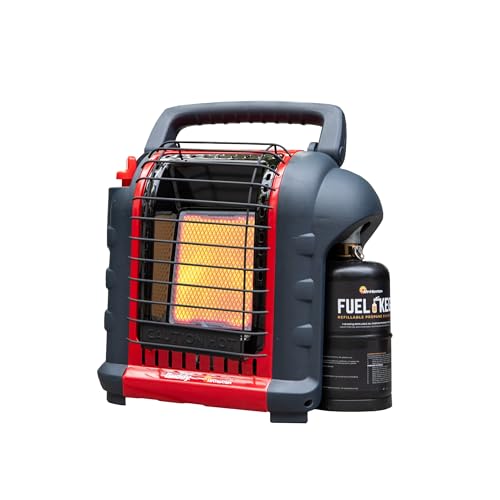
Mr. Heater Portable Buddy 4,000 or 9,000 BTU radiant
4,000/9,000 BTURadiantIndoor rated225 sq ft
Check price on Amazon
Best for: Campers with a 3 to 6 person tent who want a proven low and high setting.

The Buddy is a catalytic-free radiant burner that glows a ceramic tile face and warms whatever it points at. It has two fixed outputs, 4,000 and 9,000 BTU per hour, and the manufacturer lists it for approximately 225 square feet. That two-step range is the reason it works in tents, since you can idle it low once the shelter has warmed instead of cycling the flame on and off.

It is designed and approved for indoor and outdoor use, with the usual caveat that indoor use is not approved in Canada or Massachusetts. Treat that as a floor, not a licence: the oxygen depletion sensor and tip-over switch reduce risk but the heater still releases carbon monoxide and moisture into a closed tent. Next to the Little Buddy it moves more than twice the heat per hour, which is welcome in a wall tent and wasteful in a one-person shelter.

On a 1 lb cylinder the high setting runs only a little over two hours, so most owners move to a hose and a 20 lb tank for longer trips. The tile face, the pilot orifice and the regulator are the parts to keep dust and sand out of. Spare cylinders live outside the sleeping area, and the heater rides in its original box or a padded bin so the tile face does not crack.

What works

  • Two heat steps let you hold a tent at a comfortable level
  • Oxygen depletion sensor shuts the pilot off if air gets thin
  • Tip-over switch cuts fuel flow if the unit gets knocked
  • Runs off 1 lb cylinders or a hose and larger tank

Watch out for

  • Releases moisture and carbon monoxide, so a vent and alarm are mandatory
  • High setting drains a 1 lb cylinder in a bit over two hours

Spec sheet

Output steps
4,000 or 9,000 BTU/hr
Rated area
About 225 sq ft
Fuel
1 lb cylinder or hose kit
Heat type
Radiant
Approval
Indoor and outdoor use
02
Mr. Heater Big Buddy Midnight 4,000, 9,000 or 18,000 BTU
18,000 BTU max3 heat steps450 sq ftRadiant
Check price on Amazon
Best for: Wall tents, outfitter shelters and big family canvas.

Big Buddy adds a third power step at 18,000 BTU per hour, which is exactly twice the high setting of the standard Buddy. The listing gives it a coverage area of up to 450 square feet, so this is the model for wall tents, outfitter tents and cold-weather canvas where the 9,000 BTU unit runs flat out and still loses.

The benefit of the three steps is control. You can blast a frozen tent to a livable temperature on 18,000, then drop to 4,000 for the night shift, and the same oxygen sensor and tip protection apply at every level. The cost is fuel appetite, because the top step uses fuel fast, so a hose and tank are almost mandatory rather than optional.

In a small tent this heater is the wrong tool, since the radiant face would overheat the shelter within minutes and push you to crack the door open. Cold campers in large canvas tents are the audience. It weighs noticeably more than the Little Buddy, so it rides in a truck or on a sled, not a pack.

What works

  • Three steps up to 18,000 BTU cover the coldest nights
  • Heats rooms up to about 450 sq ft by its rating
  • Same oxygen sensor and tip switch as the smaller Buddies
  • Low 4,000 BTU step lets it idle in a warm tent

Watch out for

  • Far too much heat for a small dome or backpacking tent
  • Top step burns fuel fast, so a hose and tank are needed

Spec sheet

Output steps
4,000, 9,000 or 18,000 BTU/hr
Rated area
Up to 450 sq ft
Heat type
Radiant, two tiles
Fuel
1 lb cylinders or hose
Finish
Midnight series
03
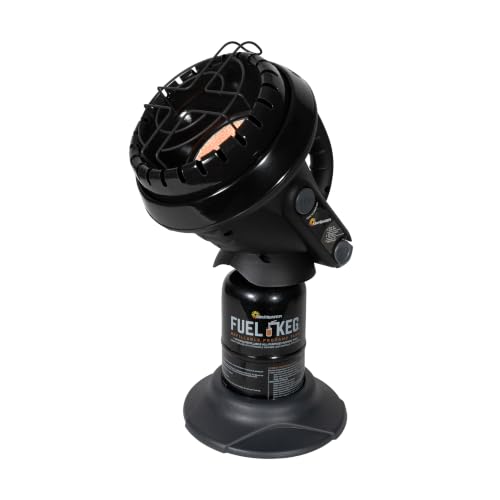
Mr. Heater Little Buddy Midnight 3,800 BTU radiant
3,800 BTU1 lb cylinder95 sq ftRadiant
Check price on Amazon
Best for: Two-person tents and short winter trips on 1 lb cylinders.

The Little Buddy has one setting, 3,800 BTU per hour, and the listing quotes up to 5.6 hours of runtime from a single 1 lb cylinder. That number is the key spec: propane holds roughly 21,000 BTU per pound, so a low-output burner stretches a cylinder across an entire evening.

Coverage is up to 95 square feet, which fits a two-person tent with room to spare. It shares the oxygen depletion sensor and tip protection of the bigger Buddies. Because there is no high step, it cannot rescue a tent that is very cold, but it also cannot overheat a nylon dome the way a 9,000 BTU unit can.

Compared with the Buddy it gives up more than half the output in exchange for more than double the burn time per cylinder. That makes it easier to pack and cheaper to run for weekend use. Keep spare cylinders outside and keep the tile face dry, since moisture on the tile is the most common cause of hard starts.

What works

  • Up to 5.6 hours from one 1 lb cylinder
  • Single setting is simple and hard to misuse
  • Oxygen sensor and tip switch protect a close space
  • Small footprint packs beside a stove and tent

Watch out for

  • Only one 3,800 BTU setting, with no boost for a cold start
  • Rated for roughly 95 sq ft, so it struggles in bigger tents

Spec sheet

Output
3,800 BTU/hr
Rated area
Up to 95 sq ft
Runtime
Up to 5.6 hr per 1 lb
Fuel
1 lb propane cylinder
Approval
Indoor and outdoor use
04
L.B. White Premier 80 DF forced-air LP tent heater
Forced airDuctableThermostatElectronic ignition
Check price on Amazon
Best for: Large canvas tents, hunting camps and job-site shelters.

This is the odd one in the lineup, and it exists for large event and outfitter tents rather than camping. It is a forced-air heater with a blower, electronic ignition and thermostatic control, and the 80 in the name points to the 80,000 BTU class. Because it is ductable, the design lets you site the unit outside and run warm air through ducting into the shelter, which keeps the flame away from fabric.

That layout is the safest way to heat a big tent with propane, since the burner and its exhaust stay outdoors. The downside is that it needs a power source for the blower and a full-size propane supply, so it is a base-camp tool. It is also the heaviest and most expensive thing here by a wide margin on the shelf and in setup effort.

For a family dome or backpacking shelter it is a bad idea in every direction: size, power needs and output all overshoot. For a hunting camp with a wall tent or a heated work tent it is the cleanest way to move real heat.

What works

  • Thermostat holds a large tent at a steady temperature
  • Ductable design lets the flame sit outside the tent
  • Electronic ignition avoids matches and lighters
  • Forced air moves heat through a big space quickly

Watch out for

  • Needs power for the blower and a full-size propane tank
  • Overkill and bulky for any tent a family sleeps in

Spec sheet

Type
Forced air, ductable
Class
80 series, high output
Ignition
Solid state electronic
Control
Thermostatic
Fuel
LP, hose and tank
05
Buyplus 30,000 BTU propane heater, dual rotating heads
30,000 BTU3 modesRotating headsShutoff valve
Check price on Amazon
Best for: Big shelters and open-front work or hunting tents.

The Buyplus has two heating heads that each rotate 30 degrees, so you can fan the heat across a wide tent instead of blasting one corner. The listing gives it 3 adjustable modes and a safety shut-off valve, plus a heavy steel body with a safety mesh over the burners. Total output is quoted at 30,000 BTU, which is more than three times a standard Buddy on high.

Its place in a tent guide is narrow. Outdoors at a bivouac, a frozen workshop or a large open-front shelter it makes sense. Inside a modest sleeping tent, the output is far beyond what the air volume needs and it will force you to open vents to dump heat.

It ships as an outdoor and utility heater and takes a hose and larger tank, so plan the tank location before the trip.

What works

  • Two rotating heads spread warmth across a wider area
  • Three modes let you step power down
  • Shut-off valve is included for gas control
  • Heavy steel body with mesh over the burners

Watch out for

  • 30,000 BTU is far too much heat for a sleeping tent
  • Less documented indoor approval than the Mr. Heater units

Spec sheet

Output
30,000 BTU (listing)
Modes
3 adjustable
Heads
Rotate 30 degrees
Safety
Shut-off valve
Body
Heavy steel with mesh
06
Portable 9,000 BTU dual-fuel heater, 8 ft hose, self-ignition
9,000 BTUButane or propane8 ft hoseSelf-ignite
Check price on Amazon
Best for: Campers who already carry butane and propane canisters.

This heater accepts both 8 oz butane canisters and propane, and it comes with an 8 ft hose so the fuel can sit away from the heat. It also has self-ignition, a butane cartridge ejection with safety lock and tip-over protection. The fuel is not included, so budget for canisters before you leave.

Dual fuel matters in tents because butane stops vaporizing well in freezing cold and propane does not, so the propane option is what you rely on when temperatures fall. The hose is the useful detail, since it lets you keep the cylinder at a distance and out of the radiant zone. At 9,000 BTU it matches the Buddy on high output, though without a brand-name record of low-setting control.

It makes a reasonable second heater or a pick for campers who already carry canisters for a stove.

What works

  • Takes butane canisters or propane
  • 8 ft hose keeps fuel away from the heat
  • Self-ignition and a cartridge safety lock
  • Tip-over protection on the base

Watch out for

  • Butane loses pressure in hard cold
  • Fuel is not included in the box

Spec sheet

Output
9,000 BTU (listing)
Fuel
8 oz butane or propane
Hose
8 ft
Ignition
Self-ignition
Safety
Tip-over, cartridge lock
07
12,000 BTU portable radiant propane heater with ODS and tip-over
12,000 BTUODSTip-overCordless
Check price on Amazon
Best for: Medium tents and emergency use where cost matters.

The 12,000 BTU number puts this between the Buddy and the Big Buddy, with an oxygen depletion sensor and tip-over protection named in the listing. It is cordless, works on standard propane and is aimed at tents, outages and emergency heating.

That output sits in an awkward middle: more than a 9,000 BTU Buddy, but without the three clean steps of the Big Buddy. Check whether your unit has a low setting, since a fixed high flame in a small tent will push you to open the door.

It is the choice when you want a basic radiant heater for a medium tent and a lower entry cost, with the understanding that support and parts availability are thinner than for the established Mr. Heater line.

What works

  • Oxygen depletion sensor named in the listing
  • Tip-over protection built into the base
  • No electricity needed to run
  • Output sits above the standard 9,000 BTU class

Watch out for

  • Fewer proven heat steps than the Buddy line
  • Thinner parts and support than established brands

Spec sheet

Output
12,000 BTU (listing)
Safety
ODS and tip-over
Power
No electricity
Use
Tents, outages, emergencies
Fuel
Standard propane

Spec sheet decoder

What the numbers on the box really mean

The specs manufacturers lead with, translated into what they tell you about real-world performance.

BTU per hour

This is the heat the burner releases, not the heat that ends up in your tent. A tent loses heat through thin fabric quickly, so the same unit that warms a house room may barely keep up.

Watch forThe Buddy tops out at 9,000 BTU while the Buyplus claims 30,000, which only suits very large shelters.

Rated square footage

This is the manufacturer's estimate of floor area the heater can warm in normal conditions. A tent's floor area is a poor proxy because walls leak heat.

Watch forLittle Buddy lists 95 sq ft, Buddy 225 sq ft, Big Buddy up to 450 sq ft.

ODS

Oxygen depletion sensor, a pilot that goes out when oxygen drops below a safe level. It protects against a starved flame but does not detect carbon monoxide at low levels in other ways.

Watch forPresent on the Mr. Heater units and named on the 12,000 BTU heater, so confirm it before you buy any other.

Runtime per cylinder

Fuel use equals BTU per hour, so the same cylinder lasts longer on a lower step. One pound of propane holds about 21,000 BTU.

Watch forLittle Buddy quotes 5.6 hours, while the Buddy on high is closer to two hours.

Ductable forced air

A blower moves heated air through a flexible duct so the burner can sit outside a tent. It improves safety around fabric but adds power and weight needs.

Watch forOnly the L.B. White Premier 80 here works this way.

Methodology

How We Evaluated These Propane Tent Heaters

Safety shutoffs

We read each listing for oxygen depletion sensors and tip-over protection and gave the Mr. Heater models the highest marks for documented approvals. Units with vague claims lost points. A flame heater without both shutoffs cannot be recommended for a tent.

Heat range versus tent size

We compared output steps to realistic tent volumes, from the 3,800 BTU Little Buddy to the 30,000 BTU Buyplus. Heaters that offer a low step scored well for overnight use. Oversized single-step units lost points for small shelters.

Fuel logistics

We weighed how each unit takes fuel, from 1 lb cylinders to hose and tank kits and butane canisters. Runtime per cylinder, such as 5.6 hours on the Little Buddy, shaped the rankings. Fuel that is hard to carry or that fails in the cold cost points.

Ownership reality

We looked at what fails by year three, mainly dirty pilots, cracked tiles and worn hoses. Brands with replaceable parts and long track records scored higher. This is based on the spec sheet and owner feedback patterns.

Fit across the lineup

We placed each model by the tent it suits, so the Little Buddy leads small shelters, the Buddy leads mid-size tents and the Big Buddy and L.B. White Premier 80 lead big shelters. Overlap with another pick lowered a heater's rank.

Decision guide

How to Choose the Right Propane Tent Heaters

By Tent Size

SituationPickWhy
One or two person domeMr. Heater Little Buddy3,800 BTU and about 95 sq ft by its rating
Three to six person tentMr. Heater Portable Buddy4,000 and 9,000 BTU steps, about 225 sq ft
Wall tent or outfitter canvasMr. Heater Big BuddySteps to 18,000 BTU, up to 450 sq ft
Large event or hunting camp tentL.B. White Premier 80 DFDuctable forced air keeps the flame outdoors

By Budget

SituationPickWhy
Lowest spend for a sleeping tentMr. Heater Little BuddySingle cylinder and simple design
Mid spend for an all-round heaterMr. Heater Portable BuddyTwo steps and a proven safety package
Entry spend on a generic radiant12,000 BTU radiant propane heaterODS and tip-over in the listing
Highest spend for big sheltersL.B. White Premier 80 DFBlower, thermostat and ducting

Radiant vs Forced Air

Radiant

The Buddy, Big Buddy, Little Buddy and the 12,000 BTU unit warm people and gear directly. They are simple, quiet and need no power, but the flame sits inside the shelter.

Forced air

The L.B. White Premier 80 DF uses a blower and ducting to move warm air from an outdoor unit. It is cleaner for fabric safety but needs power and a big tank.

Small and mid tents want radiant; large shelters can justify forced air.

By Fuel System

SituationPickWhy
Pack light with 1 lb cylindersMr. Heater Little BuddyUp to 5.6 hours per cylinder
Mixed butane and propane canistersPortable 9,000 BTU dual-fuel heaterAccepts 8 oz butane or propane
Long trips with a 20 lb tankMr. Heater Big BuddyHose kit suits high output
Frozen morningsMr. Heater Portable BuddyPropane vaporizes in deep cold

For Sleeping Warm Specifically

Look for

A low output step, a solid oxygen depletion sensor and a vent plan. Pair any flame heater with a battery CO alarm and never leave it running while you sleep.

In this comparison

The Mr. Heater Little Buddy at 3,800 BTU and the Portable Buddy at its 4,000 BTU step suit short warm-up sessions before bed, with the heater shut off for sleep.

When to Spend More

Spend more if

You use a wall tent or lead groups: the Big Buddy or L.B. White Premier 80 DF give real heat headroom and better control.

Save if

You camp in small tents for weekends: the Little Buddy or a 12,000 BTU radiant does the job without extra capacity.

Ownership

Maintenance schedule

The upkeep that decides whether this machine lasts two seasons or ten.

TaskIntervalWhy it matters
Inspect hose and connectionsBefore each tripCracks and loose fittings leak propane. Brush soapy water on connections and look for bubbles.
Clean the burner tileEach seasonDust and spider webs choke the flame. Blow off the face gently with low pressure air.
Check the pilot and sensorEach tripA pilot that goes out repeatedly points to a dirty orifice or tripped sensor. Do not bypass the shutoff.
Test the CO alarmBefore sleepingA battery alarm is the only thing that senses carbon monoxide. Press the test button every trip.
Store cylinders upright and outsideAfter every tripPropane cylinders belong outside living spaces. Keep them cool and away from direct sun.

FAQ

Frequently Asked Questions

Is it safe to run a propane heater inside a tent?

Indoor-rated radiant heaters such as the Mr. Heater Buddy have an oxygen depletion sensor and tip switch, but they still release carbon monoxide and moisture. Vent the tent, use a battery CO alarm and do not sleep with the flame on.

Which is better, the Buddy or the Little Buddy?

The Buddy has 4,000 and 9,000 BTU steps and suits a three to six person tent. The Little Buddy has a single 3,800 BTU setting and suits a one or two person shelter, with up to 5.6 hours per 1 lb cylinder.

How long does a 1 lb cylinder last?

Propane holds about 21,000 BTU per pound, so a 9,000 BTU high setting runs a little over two hours. The Little Buddy at 3,800 BTU reaches up to 5.6 hours by its listing.

Does bigger BTU mean warmer?

No. A tent has little air, so an oversized heater forces you to open vents. The 30,000 BTU Buyplus suits a very large shelter, while a 9,000 BTU Buddy is plenty for most tents.

Why does butane struggle in the cold?

Butane stops vaporizing well as it nears freezing, so pressure and flame drop. Propane keeps vaporizing in deep cold, which is why the dual-fuel unit is best run on propane in winter.

Do I need a CO alarm?

Yes. The sensor on the heater protects against low oxygen, not against every carbon monoxide scenario. A battery CO alarm hung at sleeping height is the standard safeguard in any tent with a flame.

Bottom line

The short version

Browse more propane tent heaterson Amazon →
James Miller, Lead Machine Editor

About the author

James Miller

Lead Machine Editor, MachineFanatic

James Miller leads MachineFanatic's buying guides, turning spec sheets, manuals and owner feedback into clear verdicts on power tools, outdoor power equipment, shop machines and kitchen machines.

More from James →

Keep reading

Related guides