
Amazon affiliate links - we earn a commission.Affiliate disclosure

Buying guide · 11 min read · Updated 2026-11-15

Best Small Tent Heaters (2026)

Five compact propane and butane heaters for one to three person tents, compared by output, fuel hookup, safety shutoffs and how long a cylinder lasts.

James MillerBy James MillerLead Machine Editor5 machines comparedSpec-sheet verified
Best Small Tent Heaters

At a glance

Our top picks

Side by side

Spec comparison

Anyone who has woken in a frosted dome knows why people bring heat into a tent. A small tent holds so little air that the usual heater advice flips. The question is rarely how much heat you can make, and usually how little you can get away with before the shelter turns stuffy, damp or unsafe.

That makes fuel type, burner size and safety shutoffs more important than headline BTU. Weight, packed size and how quickly the heater lights in cold hands also count, since a small-tent camper usually carries everything on a short walk or a sled. A heater that suits a two-person dome gives up capacity, so the practical task is matching a modest output to a realistic volume.

Before you buy

6 Criteria to Look For Before Buying a Small Tent Heater

  1. 01

    Output sized to a small tent

    A one to three person tent has very little air, so a 4,300 BTU Uniflasy or the 4,000 BTU low step of the Mr. Heater Buddy is closer to right than a 9,000 BTU high step. Oversized output overheats nylon and forces you to open vents. The usual mistake is buying the biggest number on the page. A rough check is to ask whether the tent has room to open a door flap without losing all the heat, and if not, downsize.

  2. 02

    Tip-over protection

    Small tents have uneven floors and gear, so a heater gets knocked. The INTCOLL lists tip-over protection and the Buddy has a tip switch plus oxygen sensor. A heater without a base-level shutoff is a fire risk on a slope. Even with a shutoff, set the unit on a flat board or a stable patch of ground and keep boots, bags and cords out of its path.

  3. 03

    Fuel compatibility

    The INTCOLL takes 1 lb propane and iso-butane, and the Uniflasy takes propane or butane. Propane keeps working below freezing while butane sputters, so choose the fuel for the season. Carrying only one fuel simplifies the pack. If you already own a canister stove, the INTCOLL and Uniflasy let you share fuel, which cuts the number of items in the bag.

  4. 04

    Ignition reliability

    Cold fingers fail with a lighter, so a built-in igniter is a real feature. The INTCOLL has one-click ignition and the Uniflasy has two modes. A backup is useful because piezo igniters wear out. Carry a small lighter anyway, since a cold igniter can fail on the first night of a trip.

  5. 05

    Moisture and ventilation

    Burning propane releases water vapor, which wets a sleeping bag in a small tent. Crack a high and a low vent and keep the heater off while you sleep. A dry-heat alternative exists on powered campsites. Open the vents before lighting, not after the tent already feels stuffy, because the first signs of trouble are easy to miss.

  6. 06

    Weight and footprint

    The Caynel and Uniflasy are small enough for a pack, while the Buddy is bulkier. If you hike in, weight matters more than a second heat step. Add the cylinder weight to the heater weight before deciding, since the fuel is part of what you carry.

Detailed reviews

The 5 best small tent heaters, explained

01
INTCOLL 1 lb propane and iso-butane dual-fuel tent heater
Dual fuel1 lb cylinderSelf-igniteTip guard
Check price on Amazon
Best for: Campers who want one heater that takes both fuels.

The INTCOLL is built around a 1 lb propane cylinder and includes a connector so it also takes iso-butane canisters, the same fuel many campers already carry for a stove. A built-in one-click ignition lights it without a lighter, and the base is designed to resist tipping. For a tiny shelter that is the right set of priorities: simple fuel, simple lighting, and a footprint that is not top-heavy.

Dual fuel matters because the two fuels behave differently in cold. Propane keeps vaporizing in deep cold, while iso-butane blends lose pressure near freezing, so the heater is best treated as a propane unit in winter and a canister unit in shoulder season. That flexibility gives it an edge over single-fuel models for a camper with mixed gear.

Next to the Mr. Heater Buddy it gives up documented heat steps and brand-backed parts, so confirm what settings your exact unit offers. Keep the connector threads clean and store the heater with the valve closed and cylinder removed. A small zip bag for the connector keeps the one part that is easy to lose on a trip. In use, place it at the foot of the tent on a flat surface so the radiant side faces the gear rather than the walls.

What works

  • Takes propane cylinders or iso-butane with a connector
  • Built-in ignition lights without a lighter
  • Tip-over protection built into the base
  • Compact size fits a two-person tent

Watch out for

  • Iso-butane weakens in freezing cold
  • Heat steps are less documented than the Buddy

Spec sheet

Fuel
1 lb propane or iso-butane
Connector
Included for canisters
Ignition
One-click built-in
Safety
Tip-over protection
Use
Tent and camp
02
Mr. Heater Portable Buddy Midnight 4,000 or 9,000 BTU
4,000/9,000 BTU225 sq ftIndoor ratedRadiant
Check price on Amazon
Best for: Two and three person tents that need a low and high setting.

The Buddy offers two documented heat steps, 4,000 and 9,000 BTU per hour, and the listing gives it a heating area of about 225 square feet. In a small tent the 4,000 BTU step is the one you will live on, since 9,000 BTU is more than a two-person dome needs. Having both steps means the same heater handles a frozen start and a calm evening.

It is designed and approved for indoor and outdoor use, with the note that indoor approval does not extend to Canada or Massachusetts. The oxygen depletion sensor and tip protection lower risk, but venting and a CO alarm are still required in a closed tent.

Compared with the Uniflasy at 4,300 BTU it moves more than double the heat on high, which is wasteful in a bivy but useful in a three-person tent. Think of the choice as buying a system instead of a single gadget: the heater, a hose kit, a stand and a CO alarm all fit together in the pack. The brand's parts supply and long record are the real reasons it ranks near the top. Owners who camp a few times a year tend to value that: a replacement tile, regulator or hose is easy to find, which is not always true for unbranded heaters. Pack it in the original box or a padded bin so the tile face does not crack in transit.

What works

  • Two steps let you idle at 4,000 BTU
  • Oxygen sensor and tip switch protect a close space
  • Rated for about 225 sq ft
  • Long parts and support history

Watch out for

  • 9,000 BTU is more than a small dome needs
  • Needs a vent and CO alarm like any flame heater

Spec sheet

Output steps
4,000 or 9,000 BTU/hr
Rated area
About 225 sq ft
Type
Radiant
Approval
Indoor and outdoor
Fuel
1 lb cylinder or hose kit
03
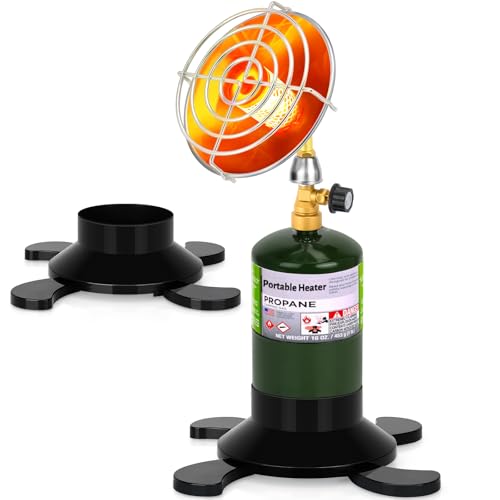
Portable radiant propane tent heater with control valve
Radiant2 modes200 sq ftCordless
Check price on Amazon
Best for: Short sessions when you want warmth fast.

This model runs two heating modes that you change by rotating the control valve, and the listing claims coverage up to 200 square feet with a roughly two-second warm-up. It is cordless and sold as a tent and patio heater. For a small tent, the useful part is the lower mode, which lets you avoid overheating a compact space.

The quick warm-up claim describes how fast the radiant surface glows, not how fast the air in a tent warms. Radiant heat reaches you first, while the tent fabric and gear stay cold for a while.

It competes with the INTCOLL on simplicity and price, but offers less information on fuel compatibility and approvals, so check the unit's labels. Wipe the burner face dry and keep the valve clean after each trip. A second pass with a dry cloth around the control knob removes the grit that makes valves stiff over a season. Because fuel compatibility is vague on the listing, match the cylinder type to the labeled fitting before you leave home.

What works

  • Two modes selected with a control valve
  • Cordless design needs no power
  • Listed coverage up to about 200 sq ft
  • Compact enough to share space with a stove

Watch out for

  • Less fuel and approval detail than the Mr. Heater
  • Radiant glow warms you faster than the air

Spec sheet

Heat type
Radiant propane
Modes
Two settings by valve
Coverage
Up to 200 sq ft (listing)
Warm-up
About 2 seconds (listing)
Power
Cordless
04
Uniflasy 4,300 BTU 2-in-1 propane and butane heater
4,300 BTUPropane/butane2 ignitionsCompact
Check price on Amazon
Best for: One or two person tents and ice fishing shelters.

The Uniflasy outputs about 4,300 BTU per hour, close to the Mr. Heater Buddy's low step, and works with either propane or butane through two connection options. It has two ignition modes, so a failed built-in igniter still leaves a manual route. The listing pitches it at tents, fishing and hiking.

Smaller output is the whole point in a one or two person tent: it is hard to overheat nylon with a burner this size, and a cylinder lasts longer than it would on a 9,000 BTU heater. The compromise is that it cannot rescue a big cold space.

Compared with the INTCOLL it has a similar fuel story and a similar footprint. Keep the second ignition mode in mind as a backup and inspect the connections each trip. It is also the easiest of the five to tuck beside a sleeping pad bag, though it should never be placed where a sleeper can roll into it. For fishing huts and ground blinds its small body is a bonus rather than a limit.

What works

  • 4,300 BTU is hard to overheat a small tent with
  • Two ignition modes give a backup
  • Takes propane or butane
  • Small enough to carry in a day pack

Watch out for

  • Not enough output for a larger or very cold tent
  • Butane option weakens in freezing temperatures

Spec sheet

Output
4,300 BTU/hr
Fuel
Propane or butane
Connections
Two ways
Ignition
Two modes
Use
Tent, fishing, hiking
05
Caynel 2-in-1 portable propane heater and camp stove
2-in-1Heater and stoveLightOutdoor
Check price on Amazon
Best for: Ice fishing and hunting shelters where one burner does both jobs.

The Caynel is a combined heater and stove, so one burner and one cylinder cover warming and cooking. The listing describes it as small and light, with use cases from ice fishing to hunting. In a small tent, the double duty cuts what you carry.

The tradeoff is that a heater that also boils water is a tabletop burner, not a controlled radiant panel. Heat output depends on how you use it, and an open flame inside a tent needs close attention to fabric and ventilation.

It makes sense for a hunting blind or an ice shelter where you want one device. For sleeping tents, the Buddy or INTCOLL offer cleaner safety features. Keep the burner clean after cooking so grease does not clog it. Spills of soup or boiled-over water are the usual cause of a burner that will not light the next morning. Pot handles should never overhang the sides of a unit used inside a small tent, where one bump scatters hot liquid across the floor.

What works

  • Heater and stove share one fuel supply
  • Small and light for carrying
  • Works for ice fishing and hunting shelters
  • Simple tabletop layout

Watch out for

  • Open flame use needs close attention in a tent
  • Fewer documented safety shutoffs

Spec sheet

Function
Heater and stove
Fuel
Propane or liquefied gas
Weight
Small and light
Use
Camping, fishing, hunting
Placement
Tabletop

Spec sheet decoder

What the numbers on the box really mean

The specs manufacturers lead with, translated into what they tell you about real-world performance.

BTU output

Heat released per hour. In a small tent a modest number is a feature, since it holds comfort without overheating.

Watch forUniflasy lists 4,300 BTU while the Buddy reaches 9,000.

Rated area

Manufacturer's estimate of floor area. Tents lose heat through thin fabric so treat it as a ceiling.

Watch forBuddy lists about 225 sq ft and the quick-heat model lists up to 200 sq ft.

Dual fuel

The heater accepts two fuels, often propane and butane. Each behaves differently as the temperature drops.

Watch forINTCOLL and Uniflasy both claim it, so check cold performance.

Oxygen depletion sensor

A safety pilot that shuts down when oxygen falls. It reduces risk but is not a CO alarm.

Watch forDocumented on the Mr. Heater Buddy.

Ignition type

Built-in igniters light the burner without a flame source. Backup methods help when one fails.

Watch forUniflasy lists two ignition modes.

Methodology

How We Evaluated These Small Tent Heaters

Output versus tent volume

We compared each heater's output with small-tent air volume, from the 4,300 BTU Uniflasy to the 9,000 BTU Buddy. Smaller, controllable output scored higher. Oversized single-step heaters lost points. This weighting reflects how little air a small shelter holds and how quickly it overheats.

Safety features

We checked for tip-over protection, oxygen sensors and ignition systems named in each listing. The Mr. Heater Buddy led on documented approvals. Gaps in listing detail lowered scores. We treated a missing safety claim as a missing feature rather than assuming it exists.

Fuel flexibility

We looked at which fuels each unit accepts and how that holds up in cold. Propane-capable units ranked above butane-only designs for winter. Units that accept both fuels, such as the INTCOLL and the Uniflasy, got credit for flexibility.

Portability

We scored size and weight, favoring the Uniflasy and INTCOLL for pack carry. The Buddy is heavier but more capable. Bulky shapes that crowd a small floor were marked down.

Ownership

We considered parts, igniters and connectors, which wear first by year three. Brand support and clear ignition backups gave a lift. Heaters with a single point of failure, such as one igniter, ranked lower for long-term use.

Decision guide

How to Choose the Right Small Tent Heaters

By Tent Size

SituationPickWhy
One-person or two-person domeUniflasy 4,300 BTUHard to overheat a small shelter
Two to three person tentINTCOLL dual-fuel heater1 lb fuel and tip protection
Three person or larger tentMr. Heater Portable BuddyLow and high steps
Ice shelter or blindCaynel 2-in-1 heater and stoveOne burner warms and cooks

By Budget

SituationPickWhy
Lowest outlayCaynel 2-in-1One device, one fuel supply
Mid-range valueINTCOLL dual-fuelTwo fuels and built-in ignition
Small and simpleUniflasy 4,300 BTULow output, two ignitions
Brand-backed spendMr. Heater Portable BuddySupport and approvals

Propane vs Butane

Propane

Keeps vaporizing in deep cold. The Mr. Heater Buddy and the quick-heat model run on it and are the better winter picks.

Butane or iso-butane

Lighter canisters but weaker in freezing temperatures. The INTCOLL and Uniflasy accept it as a secondary option.

Winter users pick propane, shoulder-season hikers can use canisters.

By Ignition Preference

SituationPickWhy
Wants lighter-free startINTCOLLOne-click ignition
Wants a backupUniflasyTwo ignition modes
Wants quick glowPortable radiant model with control valveFast warm-up claim
Wants a known systemMr. Heater Portable BuddyDocumented pilot and sensor

For Cold Sleepers Specifically

Look for

A low heat step, tip-over protection and a plan to switch the heater off before sleeping. Pair it with a CO alarm.

In this comparison

The Mr. Heater Buddy at 4,000 BTU and the Uniflasy at 4,300 BTU suit pre-bed warm-ups in a small tent.

When to Spend More

Spend more if

You want documented approvals and parts: the Mr. Heater Portable Buddy gives both.

Save if

You camp a few weekends: the Uniflasy or Caynel meets small-tent needs.

Ownership

Maintenance schedule

The upkeep that decides whether this machine lasts two seasons or ten.

TaskIntervalWhy it matters
Check connectorsBefore each tripThreads wear and leak. A soapy water brush shows bubbles at any weak joint.
Test the igniterBefore each tripPiezo igniters fail quietly. Confirm a spark in the garage, not on a cold ridge.
Clean the burnerEnd of seasonDust and webs block ports. Blow it out with low pressure air.
Remove the cylinderAfter every tripStoring with fuel attached stresses seals. Keep cylinders cool and upright.
Test a CO alarmEach tripNo heater shutoff replaces an alarm. Press the test button before lighting.

FAQ

Frequently Asked Questions

What size heater does a two-person tent need?

A small tent needs only a few thousand BTU. The 4,300 BTU Uniflasy or the 4,000 BTU step of the Mr. Heater Buddy is closer to right than a 9,000 BTU high setting. A heater that is slightly small can be run longer, while one that is too big needs the door open.

Is a dual-fuel heater better?

It adds flexibility, since the INTCOLL takes propane or iso-butane. Butane weakens in freezing cold, so winter use should rely on propane. In mild weather the lighter canister option is easier to carry.

Can I sleep with the heater on?

No. Even units with an oxygen sensor release carbon monoxide and moisture. Warm the tent, then shut the heater off before sleeping. A warm sleeping bag and a insulated pad do the overnight work.

Do I need ventilation?

Yes. Crack a high and a low vent to let combustion gases escape and fresh air in. Add a battery CO alarm. Carbon monoxide has no smell, so the alarm is the only warning you get.

Are electric heaters an option?

Only with a campsite hookup. Ceramic heaters add no moisture, but they need power and weather protection, so most backcountry tents use propane or butane. If you do have a pedestal, a small ceramic unit is the lowest-risk way to warm a tent.

How long does a cylinder last?

A 1 lb propane cylinder holds roughly 21,000 BTU, so a 4,000 BTU step runs around five hours while a 9,000 BTU step runs a little over two.

Bottom line

The short version

Browse more small tent heaterson Amazon →
James Miller, Lead Machine Editor

About the author

James Miller

Lead Machine Editor, MachineFanatic

James Miller leads MachineFanatic's buying guides, turning spec sheets, manuals and owner feedback into clear verdicts on power tools, outdoor power equipment, shop machines and kitchen machines.

More from James →

Keep reading

Related guides