
Amazon affiliate links - we earn a commission.Affiliate disclosure

Buying guide · 16 min read · Updated 2026-11-06

Best Quiet RV Generators (2026)

Six quiet RV generators compared on noise rating, rated watts, air conditioner capacity, fuel type and outlets, from 1,900 W trailers to 4,000 W coaches.

James MillerBy James MillerLead Machine Editor6 machines comparedSpec-sheet verified
Best Quiet RV Generators

At a glance

Our top picks

Side by side

Spec comparison

MachineOutputNoiseFuel tankWarrantyRV outlet
Honda EU3200i 3200W Quiet Inverter GeneratorBest OverallHonda EU3200i 3200W Quiet Inverter Generator3,200 W maximum54 to 58 dBA1.2 gal, 3.3 to 8.6 h3 years residentialn/a
Westinghouse 5000 Peak Watt Inverter GeneratorBest Run TimeWestinghouse 5000 Peak Watt Inverter Generator5,000 W peak, 3,900 W ratedAs low as 52 dBA3.4 gal, up to 18 h3 yearsTT-30R 30 A
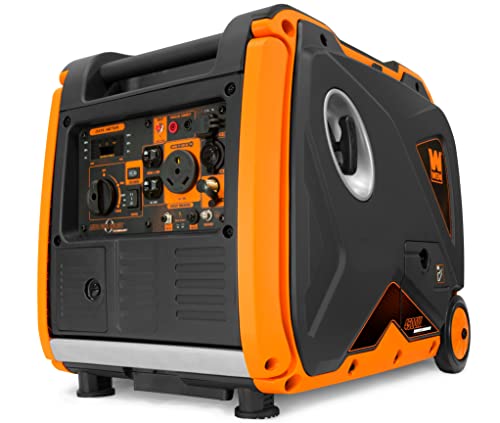
WEN DF451i 4500W Dual Fuel Inverter GeneratorBest Dual FuelWEN DF451i 4500W Dual Fuel Inverter Generatorn/a58 dBA at quarter load, 22 ftn/an/aTT-30R
WEN 56477i 4800W Quiet Inverter GeneratorBest Power per DollarWEN 56477i 4800W Quiet Inverter Generator4,800 W surge, 4,000 W ratedn/an/a3 yearsn/a
Westinghouse 2550 Peak Watt Inverter GeneratorBest Small QuietWestinghouse 2550 Peak Watt Inverter Generator2,550 W peak, 1,900 W ratedAs low as 52 dBA1.16 gal, up to 11 hn/aTT-30R
Yamaha EF2200iS 2200W Inverter GeneratorBest Proven Small UnitYamaha EF2200iS 2200W Inverter Generator2,200 W maximumn/an/an/an/a

A quiet RV generator is an inverter generator sized to run a camper air conditioner, a fridge, a microwave and lights without annoying the next site over. Campground quiet hours, shared walls and a rooftop AC compressor make the decision harder than a simple watt count, because the loudest and most powerful machine is often the one you cannot run when you need it.

This guide explains how noise ratings are measured, why starting watts decide whether a rooftop air conditioner will start, and how fuel type and outlets change daily use. Start with the picks above to narrow the list, then read the reviews below to match a machine to your rig, your campgrounds and your tolerance for weight and refueling.

Before you buy

6 Criteria to Look For Before Buying a Quiet RV Generator

  1. 01

    Noise rating and test conditions

    Decibels are a logarithmic scale, so a 6 dBA difference is roughly the gap between a murmur and a clear hum at the next campsite. The Honda EU3200i quotes 54 to 58 dBA, the Westinghouse 5000 Peak Watt quotes as low as 52 dBA, and the WEN DF451i quotes 58 dBA at quarter load and 22 feet. Always ask what load and distance the number comes from, because a quarter-load figure rises when the air conditioner starts. A generator that is 3 dBA louder at the same distance emits twice the acoustic power.

  2. 02

    Air conditioner starting capacity

    A 13,500 BTU rooftop unit runs on roughly 1,300 to 1,500 watts but draws about twice that on startup, and a soft start device lowers the surge. Honda says the EU3200i runs most 13,500 BTU units, while the Westinghouse 2550 and the Yamaha EF2200iS, at 1,900 and 2,200 watt class output, are a stretch. For two air conditioners, look at the WEN 56477i at 4,000 rated watts or the Westinghouse 5000 Peak Watt at 3,900. Buyers often forget the converter, fridge and lights that also run while the AC does.

  3. 03

    TT-30R outlet and RV plug

    Most travel trailers use a 30 amp TT-30 plug, and a TT-30R receptacle on the generator accepts it directly. The Westinghouse 5000 Peak Watt, the Westinghouse 2550, the WEN DF451i and the WEN 56477i all list a TT-30R, and the Yamaha lists a standard RV outlet. Without it you need an adapter, and the adapter cannot raise the generator's output. A 50 amp coach also needs a 50 amp plug or a conversion that limits available power.

  4. 04

    Fuel type and tank size

    Dual fuel units let you run on a propane cylinder you already carry, at a derate of about 10 percent, as the WEN DF451i's 3,500 W gasoline versus 3,150 W propane shows. Tank size affects refueling: the Westinghouse 5000 Peak Watt quotes up to 18 hours on 3.4 gallons, while the Honda EU3200i's 1.2 gallon tank gives 3.3 to 8.6 hours. For overnight air conditioning, choose the bigger tank or plan a midnight refill.

  5. 05

    Weight and wheels

    Weight determines where you can store and lift the generator. The Westinghouse 2550 at 43 pounds loads by hand, the Honda EU3200i at under 60 pounds is a two-handed lift, and the wheeled WEN units and the Westinghouse 5000 Peak Watt are designed to roll. If you load from a rear carrier or into a truck bed, anything over about 60 pounds becomes a chore. Ask how the unit will move when full of fuel and oil.

  6. 06

    Carbon monoxide protection

    Generators produce carbon monoxide, and RV campgrounds are crowded, so exhaust can drift into a neighbor's camper. A CO shutdown sensor, such as Honda's CO-Minder or the WEN Watchdog on the 56477i, adds a safety layer. It does not replace correct placement: keep the exhaust pointed away from sleeping areas and at least 20 feet from windows. Also run a battery-powered CO alarm inside your camper.

Detailed reviews

The 6 best quiet rv generators, explained

01
Honda EU3200i 3200W Quiet Inverter Generator
54 to 58 dBA3,200 W max1.2 gal tankCO-Minder
Check price on Amazon
Best for: RV owners who want the quietest, best-supported generator that still starts a 13,500 BTU AC.

The EU3200i is the quiet RV generator by reputation and by the numbers. Honda quotes 54 to 58 dBA across its load range, and the engine has the variable speed throttle that lets it idle down when your load is light. Honda states it is suited to most 13,500 BTU RV air conditioners, which is the real test for a travel trailer: it carries a rooftop unit and still has room for a converter and lights.

The cost is that it is a premium machine with modest tankage. The 1.2 gallon tank runs 3.3 to 8.6 hours depending on load, so an overnight AC run means a refill, where the Westinghouse 5000 Peak Watt unit's 3.4 gallon tank is quoted at up to 18 hours at light load. It is also a 3,200 watt maximum, so it sits between the 2,200 watt Yamaha and the 4,000 watt class WEN. Against the Yamaha EF2200iS, it adds around 1,000 watts of headroom, which is the margin you want for an air conditioner.

Ownership is where it justifies the price. The CO-Minder sensor shuts the engine down if carbon monoxide rises near the unit, the Bluetooth app handles service reminders and remote stop, and the three year residential warranty comes with a broad dealer network. Use stabilized fuel and run the carburetor dry before storage. Note that Honda does not sell this exact model in California, where the EU3200iAC2 is the equivalent.

What works

  • Quoted 54 to 58 dBA is among the quietest 3,000 watt class units
  • Honda says it runs most 13,500 BTU RV air conditioners
  • CO-Minder shuts the engine down if carbon monoxide builds up
  • Dealer network and three year warranty back it up

Watch out for

  • Premium price compared with the other picks in this roundup
  • 1.2 gallon tank means a refill during an overnight AC run
  • Not sold in California under this model number

Spec sheet

Output
3,200 W maximum
Noise
54 to 58 dBA
Fuel tank
1.2 gal, 3.3 to 8.6 h
Weight
Under 60 lb
CO protection
CO-Minder shutdown
Connectivity
Bluetooth service app
Warranty
3 years residential
02
Westinghouse 5000 Peak Watt Inverter Generator
3,900 W rated52 dBA low3.4 gal tankRemote start
Check price on Amazon
Best for: RV travelers who want long unattended run times and a TT-30R outlet at a 3,900 watt rating.

Westinghouse's 5000 peak model is built around endurance. A 3.4 gallon tank and an Economy Mode mean the quoted run time reaches up to 18 hours at light load, which covers a night of fridge, lights and a fan without refueling. Rated output is 3,900 watts with under 3 percent harmonic distortion, and it carries an RV-ready TT-30R outlet, so a 30 amp trailer cord plugs in without an adapter.

The tradeoff is size. This is a wheel-and-handle machine, not a carry-it-by-hand unit, and its noise floor of as low as 52 dBA applies only at light load. Compared with the Honda EU3200i's 3,200 watt maximum, the Westinghouse gives about 700 more watts and nearly three times the tank, but it is much heavier and louder under load. Compared with the 4,000 rated watt WEN 56477i, it is similar in output but quieter at idle.

A rotating digital display shows fuel level, output, remaining run time and lifetime hours, which is useful for planning refuels and service. Remote key fob start, electric start and recoil are all included. Backed by three years of coverage, it is a solid long-haul choice, and the 3.4 gallon tank reduces the number of times you handle gasoline. Use stabilizer for storage and keep the tank full to limit condensation.

What works

  • Quoted run time reaches up to 18 hours at light load
  • Remote key fob plus electric and recoil start options
  • Rotating display shows fuel level and remaining run time
  • TT-30R outlet takes a 30 amp RV cord without an adapter

Watch out for

  • Larger and heavier than the Honda EU3200i for loading
  • 52 dBA is a light-load figure, louder at full output
  • No CO shutdown sensor is listed in the feature set

Spec sheet

Output
5,000 W peak, 3,900 W rated
Noise
As low as 52 dBA
Fuel tank
3.4 gal, up to 18 h
RV outlet
TT-30R 30 A
Starting
Remote key fob, electric and recoil
THD
Under 3%
Warranty
3 years
03
WEN DF451i 4500W Dual Fuel Inverter Generator
3,500 W gas rated3,150 W propane58 dBA at 22 ftElectric start
Check price on Amazon
Best for: RV owners who carry propane and want one quiet 3,000 watt class generator that runs on either fuel.

The DF451i answers a specific problem: how to run a generator on propane you already carry. It makes 3,500 rated watts on gasoline and 3,150 on propane, a derate of about 10 percent, and its Auto Fuel Selection switches from propane to gasoline automatically to extend run time. For an RV that already has a propane tank, that flexibility reduces dependence on gas stations.

It is also a rated 58 dBA at quarter load and 22 feet, a measurement with a stated distance and load that is easy to compare. That is slightly louder than the Honda's 54 dBA low end, but it comes with a keyless electric start, onboard wheels and a TT-30R. Compared with the 2,200 watt Yamaha it has about 1,300 more rated watts, and compared with the WEN 56477i it trades 500 watts of gasoline output for propane capability.

Ownership needs a bit more care. Dual fuel systems add regulators and hoses that deserve a periodic inspection, and gasoline should be drained or stabilized if the machine sits. A fuel shutoff helps with that. The engine is EPA III and CARB compliant, so it can be sold in strict states. Keep propane cylinders upright and secure, and never run the generator in an enclosed space.

What works

  • Runs on propane or gasoline with automatic fuel switching
  • Keyless electric start and a recoil backup are both included
  • Noise is quoted at 58 dBA at a stated 22 ft and quarter load
  • Complies with EPA III and CARB for strict-state sales

Watch out for

  • Propane output falls to 3,150 W rated from 3,500 W on gas
  • Louder than the Honda EU3200i's quoted 54 to 58 dBA
  • Dual fuel hoses and regulators need periodic inspection

Spec sheet

Gasoline
4,500 W surge, 3,500 W rated
Propane
4,500 W surge, 3,150 W rated
Engine
212cc, EPA III and CARB
Noise
58 dBA at quarter load, 22 ft
RV outlet
TT-30R
Starting
Keyless electric, recoil backup
04
WEN 56477i 4800W Quiet Inverter Generator
4,000 W rated4,800 W surge224cc engineCO Watchdog
Check price on Amazon
Best for: RVers who need maximum rated power for two air conditioners or a large coach on a budget.

The 56477i is the horsepower answer in this roundup. It makes 4,000 rated watts on gasoline and 4,800 surge from a 224cc engine, enough to run a 15,000 BTU rooftop air conditioner with margin and a microwave on top. That makes it the strongest rated output among the gasoline-only picks and the one to choose if you travel with two air conditioners or a large fifth wheel.

Its compromises are noise and weight. WEN positions it as quiet and lightweight, but at 4,000 watts it is not as quiet as the Honda, and it is a wheeled machine. If you need the quietest possible campground manners, the Honda EU3200i at 54 to 58 dBA is the better fit, while the Westinghouse 5000 Peak Watt unit quotes as low as 52 dBA at light load. The 56477i has more outlets, four 120 volt receptacles plus a TT-30R, so you can plug in a table of devices directly.

A CO Watchdog shutdown and a fuel shutoff are part of the package, and the warranty is three years. The fuel shutoff lets you run the carburetor dry before storage, which protects against gum from old gasoline. This is a gasoline-only machine, so plan fuel logistics accordingly, and keep a supply of fresh stabilized fuel.

What works

  • Rated at 4,000 watts, the most gasoline power in this roundup
  • Four 120 V outlets and a TT-30R give plenty of plug points
  • CO Watchdog shuts the engine down on dangerous levels
  • Fuel shutoff lets the carburetor run dry for storage

Watch out for

  • Louder at full load than the Honda EU3200i
  • Wheeled bulk is hard to lift into a small trunk
  • Gasoline only, with no propane option

Spec sheet

Output
4,800 W surge, 4,000 W rated
Engine
224cc
Outlets
Four 120 V, TT-30R, 12 V DC, two USB
Safety
CO Watchdog shutdown
Fuel system
Fuel shutoff
Mobility
Onboard wheels and pull handle
Warranty
3 years
05
Westinghouse 2550 Peak Watt Inverter Generator
1,900 W rated52 dBA low43 lbTT-30R outlet
Check price on Amazon
Best for: Small trailer and pop-up owners without an air conditioner who want a quiet, lightweight unit.

This is the entry for small trailers, teardrops and pop-ups that never carry an air conditioner. It delivers 1,900 rated watts, enough for a fridge, a microwave, lights and a laptop, and quotes as low as 52 dBA for quiet operation. It weighs 43 pounds, which is easy to lift into a truck bed, and has an RV-ready TT-30R outlet.

The 1.16 gallon tank is quoted at up to 11 hours of run time in Economy Mode, which suits overnight loads. Compared with the Honda EU3200i it carries about 1,300 less rated watts but a lower weight and a lower price, so it fits a different job. Compared with the Yamaha EF2200iS, it has similar class output and a stated 52 dBA, so the decision comes down to brand preference and dealer access. If you need to run an air conditioner, step up to the EU3200i or the WEN units.

Parallel capability lets you link two units later if your needs grow, which is a cheaper path than buying a larger machine up front. The usual ownership routine applies: oil changes, stabilizer, and a clean air filter. It is covered by three years of parts and labor.

What works

  • Weighs 43 pounds so it loads easily into a truck bed
  • Quoted noise as low as 52 dBA in Economy Mode
  • Up to 11 hours of run time from a 1.16 gallon tank
  • Parallel capable to double output with a second unit

Watch out for

  • 1,900 rated watts cannot run a 13,500 BTU rooftop AC
  • Smaller output than every other pick except the Yamaha
  • Parallel kit is sold separately and adds to the cost

Spec sheet

Output
2,550 W peak, 1,900 W rated
Weight
43 lb
Noise
As low as 52 dBA
Fuel tank
1.16 gal, up to 11 h
RV outlet
TT-30R
THD
Under 3%
Parallel
Capable
06
Yamaha EF2200iS 2200W Inverter Generator
2,200 W max79cc engineRV outletSmart Throttle
Check price on Amazon
Best for: Small-trailer owners who want a brand with a long record and simple controls.

Yamaha's EF2200iS is the long-running alternative to the EU2200i class, and its appeal is simplicity. A 79cc engine, a muffler designed for low noise and Smart Throttle that senses load and adjusts engine speed give it a reputation for steady, quiet running. A standard RV outlet means no adapter hunt, and a DC outlet lets you charge 12 volt batteries.

Its limitations are the usual ones for a 2,200 watt class machine. It has the output for a fridge, a microwave and lights, but not for a 13,500 BTU air conditioner, which is why the Honda EU3200i and the WEN pair sit above it. The Yamaha is also the least documented pick here, so you will want to confirm the weight, rated watts and noise rating on the manufacturer's page before you buy. Against the Westinghouse 2550, it is the pricier name with similar power.

The illuminated LED display and Smart Dial knob make start-up straightforward, which helps first-time owners. Treat it like any small engine: use fresh fuel, change the oil on schedule, and check the air filter. It is a good second generator for a small trailer or a backup for a larger rig that only needs a trickle of power.

What works

  • Smart Throttle matches engine speed to the load for quiet
  • Standard RV outlet avoids adapters at the campsite
  • Illuminated LED display shows generator status at a glance
  • DC outlet allows direct 12 V battery charging

Watch out for

  • Output tops out at 2,200 W, too little for a rooftop AC
  • Fewer published specs than the other picks in this roundup
  • Priced like a name brand against the Westinghouse 2550

Spec sheet

Output
2,200 W maximum
Engine
79cc
Throttle
Smart Throttle load sensing
Display
Illuminated multi-function LED
Outlets
RV outlet and DC outlet
Control
Smart Dial knob

Spec sheet decoder

What the numbers on the box really mean

The specs manufacturers lead with, translated into what they tell you about real-world performance.

dBA at stated load

A sound pressure level measured at a set distance and load. A low-load figure shows the best case, while the full-load figure shows what the neighbors hear when your air conditioner runs.

Watch forQuoted levels like 52 dBA on the Westinghouse units come from light-load tests, while Honda publishes a range across loads.

Rated watts

The power a generator can supply continuously. It is the number to compare against your running loads.

Watch forHeadlines such as 5000 peak watts on the Westinghouse hide the 3,900 watt rating, and 4800 surge on the WEN hides 4,000.

Starting watts

The brief peak a generator can supply while a compressor spins up. It is higher than the rated figure.

Watch forA starting surge only helps if it lasts long enough. Soft start devices reduce the demand rather than the generator increasing its supply.

THD

Total harmonic distortion shows how far the output departs from a pure sine wave. Under 3 percent is the usual standard for electronics.

Watch forThe Westinghouse units quote under 3 percent. Confirm the claim covers all loads.

Derate on propane

Propane carries less energy than gasoline per volume, so a dual fuel generator makes less power on propane.

Watch forThe WEN DF451i drops from 3,500 to 3,150 watts, so size your loads against the lower number.

Methodology

How We Evaluated These Quiet RV Generators

Noise against stated conditions

We compared quoted noise figures such as the Honda EU3200i's 54 to 58 dBA, the Westinghouse 52 dBA low and the WEN DF451i's 58 dBA at 22 feet. We looked at whether the figure stated the load and distance. Unstated conditions were treated as less reliable.

Air conditioner capability

We matched rated watts to the demands of a 13,500 BTU rooftop unit. The Honda EU3200i, Westinghouse 5000 Peak Watt, WEN DF451i and WEN 56477i were treated as capable, and the Westinghouse 2550 and Yamaha EF2200iS were treated as suitable for loads without AC.

RV connections

We checked for a TT-30R outlet or an RV-ready receptacle, since a missing one forces an adapter. We also compared the count of 120 volt outlets, from the Westinghouse 2550's two to the WEN 56477i's four.

Fuel and run time

We compared tank size and quoted run time, such as the Westinghouse 5000's 18 hours on 3.4 gallons and the Honda's 3.3 to 8.6 hours on 1.2 gallons. Dual fuel capability on the WEN DF451i was treated as a benefit for propane users.

Safety and warranty

We looked for CO shutdown, low oil shutdown and warranty length, with three years on the Honda, Westinghouse and WEN units. Lack of published detail, as with the Yamaha's thin spec listing, reduced confidence.

Decision guide

How to Choose the Right Quiet RV Generators

By Rig Type

Pick the machine from the size of your coach.

RV typeRecommended pickWhy
Teardrop or pop-up, no ACWestinghouse 2550 Peak Watt1,900 W rated at 43 lb
Small trailer, simple needsYamaha EF2200iS2,200 W with RV outlet
Travel trailer with one ACHonda EU3200i54 to 58 dBA, 3,200 W max
Travel trailer, long overnight runWestinghouse 5000 Peak Watt3.4 gal tank, 3,900 W rated
Propane carried on boardWEN DF451i3,150 W on propane
Large fifth wheel or two ACsWEN 56477i4,000 W rated

By Budget

Relative tiers only.

Budget tierRecommended pickWhy
LowestWestinghouse 2550 Peak WattSmallest and cheapest to own
Low to midYamaha EF2200iSProven small brand
MidWEN DF451iDual fuel and 3,500 W
Mid, most wattsWEN 56477iHighest rated watts here
Upper midWestinghouse 5000 Peak WattLong run time and remote start
PremiumHonda EU3200iQuietest and best supported

Quiet and Compact vs High Output

A bigger engine is louder and heavier.

Quiet and compact

The Honda EU3200i at 54 to 58 dBA, the Westinghouse 2550 at as low as 52 dBA and the Yamaha EF2200iS suit crowded campgrounds. They give up capacity, so choose them for a single AC or none.

High output

The WEN 56477i at 4,000 rated watts, the Westinghouse 5000 Peak Watt at 3,900 and the WEN DF451i at 3,500 handle bigger coaches and two air conditioners. They are heavier and louder at full load.

Choose the quiet group for most travel trailers. Choose the high output group only if you run two air conditioners or an electric water heater.

By Fuel Preference

Fuel choices affect storage and refueling.

Fuel preferenceRecommended pickWhy
Gasoline, long run timeWestinghouse 5000 Peak WattUp to 18 h on 3.4 gal
Gasoline, premium engineHonda EU3200iEco Throttle, 8.6 h best case
Gasoline with fuel shutoffWEN 56477iRun the carburetor dry
Propane or gasolineWEN DF451iAuto fuel switching
Small tank, light useWestinghouse 2550 Peak Watt1.16 gal, up to 11 h

For Campground Quiet Hours Specifically

Look for

A noise rating at a stated distance and load, a throttle that slows at light load and a design that lets you place it well away from neighbors. Remember that an air conditioner raises the load and so the noise.

In this comparison

The Honda EU3200i with its 54 to 58 dBA range is the best fit, with the Westinghouse 2550 at as low as 52 dBA for small trailers. The WEN DF451i's 58 dBA at 22 feet is clear and comparable.

When to Spend More

Spend more if

You camp in parks that enforce noise limits or you keep the generator for many years. The Honda EU3200i justifies a premium with its noise range, CO-Minder sensor and dealer network.

Save if

You run a single AC rarely, or you camp where noise is not a concern. The WEN 56477i gives 4,000 rated watts at a lower price, and the Westinghouse 2550 covers small trailers without AC.

Ownership

Maintenance schedule

The upkeep that decides whether this machine lasts two seasons or ten.

TaskIntervalWhy it matters
Change engine oilFirst 20 hours, then every 100 hours or yearlySmall inverter engines hold little oil and run hot under an air conditioner load. Fresh oil protects bearings during long summer runs.
Clean or replace the air filterEvery 50 hours, sooner in dustCampground dust clogs filters quickly. A clogged filter raises fuel use and can cause rough running.
Replace the spark plugEvery 100 to 200 hoursA worn plug causes hard starts under load. It is a cheap and quick service.
Stabilize fuel or run the carburetor dryBefore storage over 30 daysOld ethanol gasoline leaves varnish in the carburetor. Use stabilizer or the fuel shutoff to avoid a no-start.
Inspect propane hoses and regulatorEach season for dual fuel unitsCracked hoses leak propane. A soapy water check at the fittings is a simple leak test.
Test CO and low oil shutdownsAt the start of each seasonSensors that are never checked can fail silently. Follow the manual's test procedure.

FAQ

Frequently Asked Questions

What size quiet generator do I need for a 13,500 BTU RV air conditioner?

A 13,500 BTU rooftop unit runs on about 1,300 to 1,500 watts but needs roughly twice that to start, unless it has a soft start device. Honda states that the EU3200i runs most 13,500 BTU units, and the 3,900 and 4,000 rated watt Westinghouse and WEN units have more margin. A 2,000 watt generator can work with a soft start, but with little margin.

Is a quiet generator worth more than a cheaper open frame unit?

For RVs, usually yes. Inverter generators slow the engine at light load, output cleaner power for electronics and are much quieter, which matters in campgrounds with quiet hours. Open frame units are cheaper per watt but louder and heavier. If you camp off-grid with nobody nearby, the cheaper unit may be enough.

How do I compare noise ratings between brands?

Check the load and distance behind each figure. Honda publishes 54 to 58 dBA over its load range, Westinghouse quotes 52 dBA as a low-load figure and WEN's 58 dBA is quarter load at 22 feet. A 3 dBA difference is twice the acoustic power, though it sounds only slightly louder. Real noise rises with the air conditioner running.

Can I run a generator while driving or in a campsite enclosure?

Never run a generator inside a vehicle, garage, tent or enclosed space. Exhaust contains carbon monoxide, which can accumulate even outdoors under an awning. Place it on level ground with the exhaust pointed away from sleeping areas, and run a battery CO alarm in the camper.

What is the difference between a TT-30R and a regular outlet?

A TT-30R is a 30 amp, 120 volt receptacle shaped for the plug found on most travel trailers. A household outlet is 15 or 20 amps. Without the TT-30R you need an adapter, which does not increase the generator's capacity. The Westinghouse and WEN units in this roundup list a TT-30R.

Can I run my generator on propane to avoid stale gasoline?

Yes, with a dual fuel unit such as the WEN DF451i. Propane keeps indefinitely, burns cleaner and leaves no carburetor varnish. The catch is a derate of about 10 percent, from 3,500 to 3,150 watts on this model. Keep cylinders upright and secure and inspect the hose for cracks.

Bottom line

The short version

Browse more quiet rv generatorson Amazon →
James Miller, Lead Machine Editor

About the author

James Miller

Lead Machine Editor, MachineFanatic

James Miller leads MachineFanatic's buying guides, turning spec sheets, manuals and owner feedback into clear verdicts on power tools, outdoor power equipment, shop machines and kitchen machines.

More from James →

Keep reading

Related guides