
Amazon affiliate links - we earn a commission.Affiliate disclosure

Buying guide · 13 min read · Updated 2026-11-25

Best Rain Barrel Pumps (2026)

Five pumps for moving rain barrel water to a garden hose, from mains-powered submersibles to cordless stick pumps, compared on flow, head and power source.

James MillerBy James MillerLead Machine Editor5 machines comparedSpec-sheet verified
Best Rain Barrel Pumps

At a glance

Our top picks

Side by side

Spec comparison

A rain barrel stores free water, but gravity alone delivers almost no pressure. A barrel on a stand gives about half a pound per square inch for each foot of height, which is enough to fill a watering can and nowhere near enough to run a spray nozzle or a soaker line.

A pump bridges that gap. The question is what kind: a corded submersible that sits in the barrel, or a cordless pump that works with no outlet nearby. Here we weigh five options by flow, lift, power source and how well each copes with a barrel of leaves and silt.

Before you buy

6 Criteria to Look For Before Buying a Rain Barrel Pump

  1. 01

    Corded or cordless

    A corded submersible like the FLUENTPOWER or Algreen needs an outdoor outlet within cord reach, while cordless stick or diaphragm pumps run on batteries. If your barrels sit at the far end of a yard, cordless saves an extension cord. If they sit near the house, corded moves more water and never runs out of battery mid-job.

  2. 02

    Flow versus head

    GPH is the volume at no lift, and head is how high the pump can push. The FLUENTPOWER lists 1050 GPH and 36 feet, the ALDERVIC 720 GPH and 32 feet, the TaskStar 720 GPH and 16 feet, and the SEESII 206 GPH and 75 feet. A garden hose and nozzle reduce real flow well below the headline number. For a barrel on the ground, you need very little head, so a smaller pump with auto shutoff often feels better in use than a large one that sprays at full force and wastes water.

  3. 03

    Auto control and shutoff

    A float switch like the FLUENTPOWER's starts and stops a pump as the water level changes, and the SEESII shuts off when you close the nozzle. A pump with neither needs you to watch it. Dry running kills many pumps within minutes, so auto control is protection as well as convenience. If your pump lacks a float, a cheap outlet timer or a habit of stopping when you hear the pitch change are the usual substitutes, and neither is as reliable as a switch.

  4. 04

    Sediment and leaf tolerance

    A rain barrel collects leaves, pollen and silt. A submersible should sit on a block above the floor, and a stick pump should not rest on the bottom. A fine inlet screen blocks debris and keeps nozzles from clogging. Clean the barrel once or twice a year, and fit a mesh screen on the downspout inlet, so less of the roof reaches the pump in the first place.

  5. 05

    Battery runtime

    The TaskStar gives about 30 minutes per battery and 60 in total, and the SEESII gives up to 60 minutes per battery. A typical barrel of 55 gallons empties in a few minutes at 720 GPH, so runtime matters most for long watering sessions or many barrels. Two batteries let you charge one while you use the other, which is the quiet advantage of kits that include a pair, and a spare pack extends a Saturday of watering without a break.

  6. 06

    Winter storage

    Water left in a pump freezes and cracks the housing. Drain the barrel, pull the pump and store it indoors. Keep cordless batteries inside, since cold weather reduces capacity and shortens life. Leave the barrel valve open and the hose coiled loosely over winter so no pocket of water remains to freeze and split a fitting.

Detailed reviews

The 5 best rain barrel pumps, explained

01
FLUENTPOWER 1/2 HP 1050 GPH rain barrel submersible pump
1/2 HP1050 GPH36 ft max headFloat auto control
Check price on Amazon
Best for: Barrels near an outdoor outlet that need strong flow and automatic control.

FLUENTPOWER sizes this submersible for a rain barrel with a half horsepower motor, a 1050 GPH rating and a 36 foot maximum head. An extension pipe brings the outlet up to the barrel rim for an easier hose connection, and a tethered float switch starts and stops the pump as the water level changes, with a manual option as well. For a barrel that sits near an outlet, it is the most hands-off setup in this group.

The real cost is that GPH ratings assume no restriction, and a garden hose and nozzle cut real flow well below the number on the box. Dry running is the main way to kill a pump like this, and a float switch that sticks against the barrel wall can leave it running on air. The pump also needs a power cord that reaches a protected outdoor outlet. Set beside the cordless pumps here, it moves more water and asks for a power source.

Ownership is about keeping the intake clean. Lift the pump out occasionally, rinse the screen, check that the float swings freely and use a GFCI outlet. Drain the barrel and store the pump indoors before a freeze. If your barrel is fed from a roof with a lot of tree cover, a mesh basket or a stocking over the pump intake gives you an extra layer of filtering for very little effort.

What works

  • 1050 GPH rating with a 36 foot maximum head
  • Float switch starts and stops the pump automatically
  • Extension pipe brings the outlet to the barrel rim
  • Manual mode available

Watch out for

  • Needs a protected power outlet nearby
  • Float can stick and risk dry running
  • Real flow through a hose is far below the rating

Spec sheet

Motor
1/2 horsepower
Flow
1050 GPH rated
Max head
36 feet
Control
Auto float and manual
Outlet
Extension pipe to the barrel rim
02
SEESII 206 GPH cordless diaphragm pump, 75 foot lift
206 GPHCordlessAuto shutoff2x4.0Ah batteries
Check price on Amazon
Best for: Barrels far from an outlet where a hose and wand are the main tools.

SEESII builds this cordless diaphragm pump for moving rain barrel water to a garden hose, with a 206 GPH flow rating, self-priming to about 9.8 feet and a claimed lift of 75 feet. Two 4.0Ah batteries each run up to 60 minutes and charge in about 90 minutes, and the pump shuts itself off when you close the nozzle. That auto shutoff is the feature that makes it behave like a small pressure pump.

The tradeoff is flow. At 206 GPH it moves about 3.4 gallons a minute, which is enough for a hose and a watering wand but slow for filling a large tank. A diaphragm pump also has a lower flow than a submersible of the same price class. It does not need an outlet, which is the reason to pick it.

Carry the batteries inside during winter and charge them before use. Rinse the inlet and keep the hose from kinking, and check the nozzle shutoff by closing it and listening for the pump to stop. Before each season, run it for a minute on clean water so you find a clogged valve or a tired battery in the driveway, not in the middle of a dry spell.

What works

  • Cordless with two 4.0Ah batteries
  • Auto shutoff when the nozzle closes
  • Self-priming diaphragm design
  • Lift claim of 75 feet for sloped yards

Watch out for

  • 206 GPH is slow for filling large containers
  • Battery runtime limits long watering sessions
  • Battery care is another chore

Spec sheet

Flow
206 GPH
Lift
Up to 75 feet claimed
Self-priming
9.84 feet
Batteries
Two 4.0Ah, up to 60 minutes each
Control
Auto shutoff when the nozzle closes
03
ALDERVIC 720 GPH cordless stick water pump, 32 foot head
720 GPH32 ft max head21V batteriesCordless stick
Check price on Amazon
Best for: Filling watering cans and larger containers quickly from a barrel.

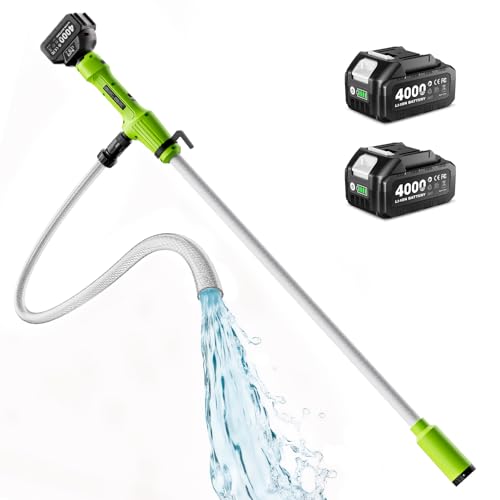
ALDERVIC sells a stick-style cordless pump rated at 720 GPH with a 32 foot maximum head and two 21 volt 4.0Ah batteries. The maker lists multiple uses, including pool drainage, garden irrigation and aquarium work. A stick design drops straight into a barrel and moves a lot of water in a short time.

A fair warning is that this kind of pump is a transfer tool, not a pressure pump. It moves water well but has no pressure switch or auto shutoff, so you control it by hand. Sticks also pick up sediment from the bottom, which is why a barrel with sludge needs a filter screen. Next to the SEESII, it moves more water and offers less pressure control.

Use it for filling cans, buckets and tanks. Rinse it after use, keep the inlet off the floor of the barrel and charge the batteries before the first watering of the season. Because a stick pump has no switch that senses water level, stop it as soon as the barrel runs low, or the motor will run dry and the impeller will wear faster than it should.

What works

  • 720 GPH rating for quick transfers
  • Two 21V 4.0Ah batteries included
  • Stick design drops into a barrel
  • Works for several garden and pool tasks

Watch out for

  • No pressure switch or auto shutoff
  • Draws sediment from a dirty barrel
  • Battery runtime limits long jobs

Spec sheet

Flow
720 GPH
Max head
32 feet
Batteries
Two 21V 4.0Ah
Form
Stick pump
Uses
Pool drain, irrigation, aquarium
04
TaskStar 720 GPH cordless stick pump with 2.2 inch head
720 GPH16 ft lift2.2 inch head60 minute total
Check price on Amazon
Best for: Barrels with narrow openings or owners who want a multi-fluid tool.

TaskStar offers a cordless stick pump with a slim 2.2 inch head that fits a 55 gallon drum bung and narrow containers, a 720 GPH rating and a 16 foot lift. Two 4.0Ah batteries give about 30 minutes each, for a combined 60 minutes, and each recharges in roughly two hours. It is also listed for water and diesel, which makes it a multi-use tool.

The tradeoff is runtime and lift. Thirty minutes per battery is enough for a few barrels but not a whole garden, and a 16 foot lift is shorter than the ALDERVIC figure. The slim head is an advantage in a tight barrel opening.

Pick this one if you need a pump that also handles other fluids. Use water mode for the garden, rinse thoroughly if you ever move other liquids and keep a spare battery charged. If you do use it for anything other than clean water, keep a separate hose and label it, since oil residue in a hose that later waters vegetables is a problem no rinse fully solves.

What works

  • Slim 2.2 inch head fits narrow openings
  • 720 GPH rating with a 16 foot lift
  • Two 4.0Ah batteries included
  • Works for water and diesel transfers

Watch out for

  • 30 minutes per battery limits big jobs
  • Lift is shorter than other cordless pumps
  • No automatic shutoff

Spec sheet

Flow
720 GPH
Lift
16 feet
Head width
2.2 inch slim filter
Runtime
30 minutes per battery, 60 total
Recharge
About 2 hours per battery
05
Algreen 500 GPH rain barrel submersible pump kit
500 GPHSubmersibleFlow controlHose fittings
Check price on Amazon
Best for: Gardeners who want a simple kit to feed a hose from one or two barrels.

Algreen sells a 500 GPH submersible kit with a flow control, hose connection fittings and clamps, and the manufacturer says it can water a garden directly from up to two rain barrels. It is an all-in-one kit, so you get the fittings you need to connect to a garden hose without a hardware store run. The flow control lets you tame the stream for delicate plants.

The tradeoff is power and automation. A 500 GPH pump moves less than half the 1050 GPH FLUENTPOWER, and the kit lacks the float switch that makes the top pick hands-free. It needs a power cord, and the barrel must stay full enough to cover the pump.

Treat it as a simple, low-cost kit. Place it on a block to keep it out of the silt, rinse the screen and keep the cord plugged into a GFCI outlet. A simple timer on the outlet can double as a dry-run guard, because it limits how long the pump can run if you forget it, which is the cheapest protection a kit without a float switch can have.

What works

  • All-in-one kit with hose fittings and clamps
  • Flow control for gentle watering
  • Can feed a hose from up to two barrels
  • Simple submersible design

Watch out for

  • Lower flow than the 1050 GPH pump
  • No float switch or auto control listed
  • Needs a nearby protected outlet

Spec sheet

Flow
500 GPH
Type
Submersible
Control
Flow control
Included
Hose connection fittings and clamps
Barrels
Waters from up to 2 barrels

Spec sheet decoder

What the numbers on the box really mean

The specs manufacturers lead with, translated into what they tell you about real-world performance.

GPH

Gallons per hour is the rated flow at no lift. Real flow is lower through a hose and nozzle.

Watch forFLUENTPOWER lists 1050 GPH, SEESII lists 206 GPH.

Max head

The vertical height a pump can lift water. Flow drops toward zero as head approaches the limit.

Watch forA 36 foot head is far more than a garden needs.

Float switch

A tethered float that turns the pump on and off with the water level. It protects against dry running.

Watch forFLUENTPOWER lists one.

Self-priming

The pump can pull water up to itself without being submerged. It lifts a limited height.

Watch forSEESII lists about 9.8 feet.

Battery Ah

Amp-hours describe how much charge a battery holds. More Ah means more runtime.

Watch forALDERVIC, SEESII and TaskStar each use 4.0Ah packs.

Methodology

How We Evaluated These Rain Barrel Pumps

Fit for a rain barrel

We checked whether each pump suits a barrel, from the extension pipe on the FLUENTPOWER to the slim head on the TaskStar. A pump that sits comfortably in a barrel scored higher, and we noted which designs need a hole in the barrel and which simply drop in through the top, since not every barrel has a large opening.

Flow and lift

We compared GPH and head figures, such as 1050 GPH and 36 feet versus 206 GPH and 75 feet. We treated maker numbers as claims, and we noted that a pump with a lower number and an auto shutoff can be nicer to use than a stronger pump you have to babysit.

Control and protection

We looked at float switches, auto shutoff and flow controls. A pump that protects itself from dry running scored higher, because the most common way owners lose a pump is by letting it run after the barrel empties, and no warranty covers that kind of neglect.

Power practicality

We weighed corded convenience against cordless freedom. A pump that matches the distance to your outlet scored better. We also noted the cord length and battery chemistry where the listing gave them, since both decide how far from the house the pump can work.

Care and storage

We considered how easy each pump is to drain, clean and store for winter. A pump with removable screens and a simple housing is easier to keep healthy than one that needs tools to open.

Decision guide

How to Choose the Right Rain Barrel Pumps

By Barrel Location

SituationPickWhy
Barrel near an outletFLUENTPOWER 1050 GPHFloat control and high flow
Barrel far from powerSEESII 206 GPH cordlessAuto shutoff and a long lift
Quick fills of cans and bucketsALDERVIC 720 GPHHigh-flow cordless stick
Narrow barrel openingTaskStar 720 GPHSlim 2.2 inch head

By Budget

TierPickWhy
LowestAlgreen 500 GPH kitSimple corded kit
Low to midTaskStar 720 GPHCordless with a multi-fluid use
MidALDERVIC 720 GPHCordless with 21V batteries
UpperFLUENTPOWER 1050 GPHFloat control and strongest flow

Submersible vs Stick Pump

Submersible

The FLUENTPOWER and Algreen sit in the barrel and push water through a hose. They move more water and need a power cord.

Stick

The ALDERVIC and TaskStar are cordless sticks that you drop in and carry. They transfer well but run on batteries.

Choose a submersible for a permanent setup; choose a stick for flexibility.

Pressure Axis

PreferencePickWhy
Runs like a pressure pumpSEESII 206 GPHAuto shutoff at the nozzle
Automatic level controlFLUENTPOWER 1050 GPHFloat switch
Gentle flow controlAlgreen 500 GPHFlow control
Manual control onlyALDERVIC 720 GPHNo auto shutoff

For Small Vegetable Gardens Specifically

Look for

A pump that gives a gentle stream and works with a hose and wand. High flow is less important than control.

In this comparison

The SEESII 206 GPH shuts off at the nozzle, and the Algreen kit adds a flow control.

When to Spend More

Spend more if

You water a large garden from several barrels. The FLUENTPOWER's flow and float control save time.

Save if

You water a few beds. The Algreen kit or the TaskStar is enough.

Ownership

Maintenance schedule

The upkeep that decides whether this machine lasts two seasons or ten.

TaskIntervalWhy it matters
Rinse the inlet screenEvery few usesDebris clogs the screen and cuts flow. A quick rinse restores it, and a soft brush clears the fine silt that a stream of water leaves behind in the mesh.
Check the floatEach seasonA stuck float leads to dry running. Make sure it swings freely, and move the tether if it rubs the barrel wall or a fitting where it can snag as the level changes.
Charge batteriesBefore each useCold weather lowers capacity. Charge indoors, let a cold battery warm to room temperature first and unplug the charger once the pack is full.
Drain and storeBefore freezing weatherWater in a pump can freeze and crack it. Store indoors.
Inspect the cord and outletEvery seasonA cracked cord near water is dangerous. Use a GFCI outlet.

FAQ

Frequently Asked Questions

Why do I need a pump on a rain barrel?

Gravity gives only about half a pound per square inch per foot of height, which is too little for a nozzle. A pump adds the pressure to run a hose.

Corded or cordless?

Corded pumps move more water and never run down, but need an outlet. Cordless pumps give freedom and need charging.

What is dry running?

It is a pump running with no water. It overheats and fails quickly, because the water around the motor is what carries the heat away. Use a float switch or auto shutoff, and stop the pump when the barrel gets low.

How much flow do I need?

A garden hose with a wand needs only a few gallons per minute. Higher flow helps fill containers quickly, but a pump much larger than your hose can use just sprays harder and drains the barrel faster.

Can I use a pump on dirty barrel water?

Yes with a screen, but silt wears pumps. Keep the pump off the bottom and clean the barrel, and consider a first-flush diverter on the downspout, which sends the dirtiest water of each storm away from the barrel.

Should I store the pump for winter?

Yes. Drain it, dry it and store it indoors so it does not freeze.

Bottom line

The short version

Browse more rain barrel pumpson Amazon →
James Miller, Lead Machine Editor

About the author

James Miller

Lead Machine Editor, MachineFanatic

James Miller leads MachineFanatic's buying guides, turning spec sheets, manuals and owner feedback into clear verdicts on power tools, outdoor power equipment, shop machines and kitchen machines.

More from James →

Keep reading

Related guides