
Amazon affiliate links - we earn a commission.Affiliate disclosure

Buying guide · 12 min read · Updated 2026-11-07

Best Robotic Pool Cleaners for Fine Debris (2026)

Six robotic pool cleaners compared for fine debris: filter micron ratings, suction design, runtime and rinse routines for silt, pollen and dust.

James MillerBy James MillerLead Machine Editor6 machines comparedSpec-sheet verified
Best Robotic Pool Cleaners for Fine Debris

At a glance

Our top picks

Side by side

Spec comparison

Fine debris means silt, pollen, dust and the powdery film that settles on a pool floor after wind or construction. A robot that handles leaves can still leave a gray haze behind, because the particles slip through a coarse basket and return to the water.

What matters is the finest layer of the filter stack and how quickly it clogs. Strong flow helps, but a very fine mesh needs frequent rinsing, so the honest choice weighs capture against upkeep and the pool's actual dirt.

Before you buy

6 Criteria to Look For Before Buying a Robotic Pool Cleaner for Fine Debris

  1. 01

    Finest filter layer

    A typical basket stops material around 180 microns, which is fine for sand and most insects but lets silt and pollen pass. The Aiper Scuba S1 lists a replaceable three micron layer, the only stated fine rating in this lineup. Finer mesh catches more but clogs faster. Ask what the finest layer is before assuming a robot handles dust.

  2. 02

    Clogging and rinse cost

    Fine mesh packs with silt within a single cycle on a dusty pool. The Dolphin Nautilus CC Plus has a top-load basket that rinses in seconds, while layered stacks like the Aiper take longer. A clogged filter drops flow and cleans worse than a clean coarse one. Buy the stack you are willing to rinse every run.

  3. 03

    Flow and intake layout

    The Beatbot Sora 10 and Sora 30 rate 6,800 GPH and the CliBot S5 rates 5,580, while the Zebary C1 spreads intake across two ports. Flow lifts fine dust, but it does not guarantee capture without a fine filter. Pair high flow with a fine stage if you can.

  4. 04

    Runtime for slow passes

    Fine debris is best handled in slow, repeated sweeps. The Sora 10 lists up to 300 minutes and the Aiper eco mode up to 270, while the CliBot S5 lists 180. A battery that parks early leaves dust. Corded models like the Dolphin never run short.

  5. 05

    Where the silt settles

    Dust collects on shelves, steps and low-flow corners. The Sora 30 adds a platform zone with ultrasonic sensing for shallow ledges. A floor-only robot will miss them. Check your pool for ledges before choosing.

  6. 06

    Replacement filter supply

    A fine layer is a consumable and wears out. The Aiper sells a replaceable three micron layer, while newer brands may be harder to restock. Confirm spares exist before you commit. A robot with no spare filter is a robot that ends the season early.

Detailed reviews

The 6 best robotic pool cleaners for fine debris, explained

01
Aiper Scuba S1 with replaceable 3 micron layer
3 micron layerDual filtration270 min eco mode11 sensors
Check price on Amazon
Best for: Pools plagued by silt, pollen and powdery film.

A three micron layer is far finer than the usual coarse basket, and the maker offers it as a replaceable part. That is the feature that makes this the fine-debris specialist: particles that most robots pass back into the water stay in the filter instead. A second, coarser layer shields it so leaves do not smother the fine stage immediately.

The tradeoff is clogging. Ultra-fine mesh fills with silt quickly, so the robot is at its best with a rinse after every run and a spare layer in the pool box. An eco mode stretches runtime to roughly 270 minutes in the app, which gives slow passes more time to settle fine dust into the filter.

It is the premium choice here and costs more than the Beatbot Sora 10, whose advantage is raw flow rather than filtration. Eleven sensors plan the route so the passes are even. Treat the fine layer as a consumable, and budget for replacements each season. After a dust storm or a round of construction nearby, expect to rinse twice in one day.

What works

  • Replaceable three micron layer keeps silt out of the water
  • Double-layer system shields the fine stage from leaves
  • Eco mode stretches runtime to about 270 minutes
  • Eleven sensors plan even coverage passes

Watch out for

  • Ultra-fine mesh clogs quickly and needs frequent rinsing
  • Fine layer is a consumable that must be replaced
  • Premium cost within this lineup

Spec sheet

Fine layer
Replaceable 3 micron filter layer
Filtration
Double-layer system
Eco runtime
Up to 270 minutes via the app
Sensors
Eleven high-precision sensors
Coverage
Floor, wall, waterline, shallow areas
02
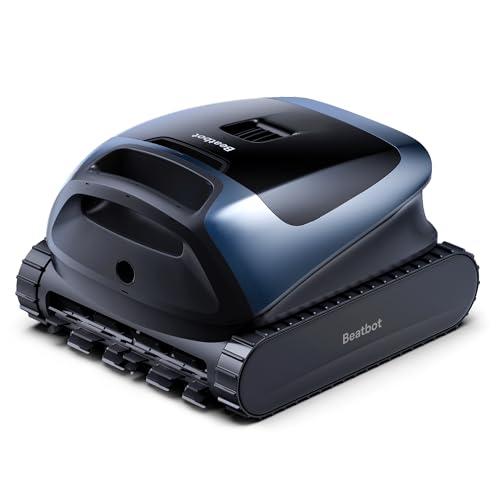
Beatbot Sora 10 cordless, 6,800 GPH
6,800 GPH ratedUp to 300 minWaterline reachShallow-area mode
Check price on Amazon
Best for: Large pools where flow and long runs matter more than a micron rating.

The Sora 10 attacks fine debris with water flow rather than mesh. A 6,800 GPH rated pump pulls a lot of water through the filter per hour, so dust that settles on the floor gets moved into the basket in fewer passes. The HydroBalance layout is meant to keep the body planted so that flow stays effective on walls.

It does not list a micron figure, so you should not assume it matches the Aiper's three micron layer. Where it earns its place is the long run: a battery rated up to 300 minutes supports slow, thorough sweeps, and waterline scrubbing deals with the greasy film that holds fine dust at the surface.

Rinse the filter after every run, because fine dust compacts as it dries. Keep the robot shaded, and charge it after every cycle. The lithium pack will fade over seasons, so treat the long runtime as a new-pack figure.

What works

  • High pump rating moves a lot of water per hour
  • Long battery window supports slow thorough sweeps
  • Waterline scrubbing lifts the film that holds dust
  • Surface parking spares the retrieval struggle

Watch out for

  • No micron rating stated on the listing
  • Pump rating is not the same as capture
  • Battery capacity fades over several seasons

Spec sheet

Pump rating
6,800 GPH via HydroBalance layout
Runtime
Up to 300 minutes
Battery
About 7,300 mAh pack
Zones
Floor, wall, waterline, shallow areas
Retrieval
Surface parking
03
Beatbot Sora 30 with ultrasonic shallow sensing
6,800 GPH rated4-zone cleaningPlatform cleaningSurface parking
Check price on Amazon
Best for: Pools with a sun shelf or ledge where fine silt settles.

Fine debris collects where water moves least, and in many pools that means a shallow sun shelf. The Sora 30 adds a platform zone to the floor, wall and waterline coverage, with ultrasonic sensing that lets it work shallow water without stranding itself. That makes it the choice when your silt problem is a ledge.

It shares the Sora 10's pump rating, and like it, the listing gives no micron figure, so the filter stack should be judged by rinse results. The extra platform capability costs more, and on a plain deep pool it adds nothing.

Wipe the ultrasonic sensors after each run, because sunscreen film confuses them. Rinse the filter promptly, since fine dust packs down as it dries. Keep the body out of sun and charge after each cycle.

What works

  • Platform zone cleans the shallow ledge where silt settles
  • Ultrasonic sensing prevents stranding in shallow water
  • Same high pump rating as the Sora 10
  • One-touch recall brings it to the surface

Watch out for

  • No micron rating on the listing
  • Platform mode is wasted on a plain deep pool
  • Costs more than the Sora 10

Spec sheet

Pump rating
6,800 GPH
Zones
Floor, waterline, wall and platform
Sensing
Ultrasonic sensing for shallow areas
Navigation
AI navigation
Retrieval
Surface parking with one-touch recall
04
Zebary C1 cordless with dual suction ports
200 min runtimeDual suction ports4,500 mAh batteryPools to 2,500 sq ft
Check price on Amazon
Best for: Larger pools that want a wide intake footprint on a mid-range budget.

Two suction ports on the underside spread intake across the width of the body, a layout that tends to lift fine dust from a broader strip of floor per pass. A pair of sensors monitors motor load and speed, which lets the robot adjust when the filter starts to clog. That is a thoughtful touch for fine-debris work, where clogging is the main problem.

A 4,500 mAh pack gives up to 200 minutes and the maker lists pools up to 2,500 square feet, above-ground or in-ground. Compared with the Aiper it is less specific about its filter, and the brand is newer, so parts support deserves a question.

Windy days load the pool with dust, so rinse the filter after each run then in particular. Charge promptly and shade the robot. It is the lower-cost route to wide intake coverage.

What works

  • Dual suction ports widen the intake footprint
  • Sensors watch motor load and react to clogging
  • 200 minutes covers pools to 2,500 square feet
  • Rated for above-ground and in-ground use

Watch out for

  • Newer brand with less certain parts support
  • Filter fineness is not stated on the listing
  • Smaller battery than the longest-run models

Spec sheet

Runtime
Up to 200 minutes
Intake
Dual suction ports
Battery
4,500 mAh six-cell pack
Pool size
Up to 2,500 square feet
Sensing
Dual sensors monitor motor load
05
CliBot S5 with triple brushless motors
5,580 GPH ratedTriple brushless motors180 min runtime4 cleaning modes
Check price on Amazon
Best for: Mid-size pools where a floor-only fine-dust pass is the main job.

The S5 puts three brushless motors to work, which usually means the suction motor is separate from the drive and keeps its speed when the robot climbs. For fine debris, steady suction matters because dust is lifted by flow near the surface. A 5,580 GPH rating and 180 minutes of runtime suit a mid-size pool.

Its four modes let you run a floor-only pass, which is where most fine debris lives, without wasting battery on walls. The listing does not state a micron rating, so rinse results are the real test. Compared with the Sora 10, it has less runtime and a lower cost.

Shade the pack and charge after each run. Rinse the filter basket at once, as fine dust cakes when it dries. Ask the seller about spare filters, and note that a brand new to the market may not stock them next year.

What works

  • Separate suction motor keeps flow steady on walls
  • Floor-only mode targets where dust settles
  • 180 minutes suits a mid-size pool
  • Mid-range cost for the motor package

Watch out for

  • No micron rating stated on the listing
  • Less established brand for spare parts
  • Shorter runtime than the Sora 10

Spec sheet

Pump rating
5,580 GPH
Motors
Three brushless motors
Runtime
Up to 180 minutes
Modes
Four cleaning modes
Reach
Floor and walls
06
Dolphin Nautilus CC Plus corded with top-load filter
Corded powerTop-load filterActive scrubbing brushSmart navigation
Check price on Amazon
Best for: Dusty yards where several short runs a day beat one long cycle.

A corded robot never runs out of power, which suits the repeated slow passes fine debris demands. An active brush agitates settled silt so that suction can lift it, and a top-load basket makes the constant rinsing a thirty-second job. The listing does not state a micron figure, so judge its fine capture by the water clarity you see.

Its value is in being able to run twice in a day without a charge. If your pool picks up dust after every windy afternoon, that endurance matters. Compared with the Aiper it filters less finely on paper but costs less to run and has no battery to age.

Uncoil the cable on the deck and rinse the basket after every run. Check the brush each season. Keep the transformer sheltered. Because dust returns after every windy spell, a corded robot that can start again at once is a quiet advantage.

What works

  • Corded power allows repeat runs without charging
  • Active brush loosens settled silt
  • Top-load basket rinses in seconds
  • No battery to age or replace

Watch out for

  • No micron rating stated
  • Cable can tangle on busy pool layouts
  • Less fine capture on paper than the Aiper

Spec sheet

Power
Corded via transformer
Filter access
Top-load basket
Brush
Active scrubbing brush
Navigation
Smart navigation
Pool type
In-ground pools

Spec sheet decoder

What the numbers on the box really mean

The specs manufacturers lead with, translated into what they tell you about real-world performance.

Micron rating

The size of the largest particle a layer passes. Lower numbers catch finer dust but clog sooner.

Watch forThe Aiper lists three microns, while others leave the figure unstated.

Dual-layer filtration

A coarse stage protects a fine stage so leaves do not smother it. It lets one robot handle both debris types.

Watch forThe Aiper uses it, so rinse both stages.

GPH rating

Rated pump flow. It shows the motor can move water, not that fine dust is captured.

Watch forThe Sora 10 and Sora 30 list 6,800, but neither states a micron rating.

Dual suction ports

Two underside inlets that widen the intake footprint. They lift dust from a broader strip per pass.

Watch forThe Zebary C1 uses them.

Motor load sensing

Sensors that watch motor speed and load to detect clogging. They let the robot adjust or warn.

Watch forThe Zebary C1 has dual sensors that monitor load.

Methodology

How We Evaluated These Robotic Pool Cleaners for Fine Debris

Filter fineness

We looked for any stated micron figure on each listing. Only the Aiper Scuba S1 lists one, at three microns. We refused to assume a figure for the others.

Clogging resilience

We considered layered stacks, top-load access and motor load sensing. The Zebary sensors and Dolphin basket scored for upkeep. We favoured designs you can rinse quickly.

Flow and intake

We compared pump ratings and intake layout, from the Sora 10 at 6,800 GPH to the CliBot S5 at 5,580. We treated GPH as motor strength only. Dual ports counted for coverage.

Runtime for slow passes

We compared stated minutes from 180 to 300 and the corded option. Slow repeated sweeps suit fine dust. We discounted for battery fade.

Ownership

We read for spare filters, brand reach and ease of handling. Filter mesh ratings and basket design on the listings, together with owner comments about silt and sand, guided this ranking. A supply of replacement layers counted heavily.

Decision guide

How to Choose the Right Robotic Pool Cleaners for Fine Debris

By Type of Fine Debris

SituationPickWhy
Silt and pollen filmAiper Scuba S1Three micron replaceable layer
Dust on a sun shelfSora 30Platform zone and shallow sensing
Windy-day dust, large poolSora 10High flow and a long run
Dust plus occasional leavesZebary C1Wide dual intake
Repeat runs dailyNautilus CC PlusCorded, no charging

By Budget

Budget tierPickWhy
Lowest in the lineupZebary C1Wide intake at the lowest tier
Lower middleCliBot S5Triple motors
MiddleSora 10Flow and runtime
Upper middleNautilus CC PlusCorded durability
PremiumAiper Scuba S1Fine three micron layer

The Sora 30 sits near the top; check the listing for current pricing.

Fine Mesh vs Big Basket

Fine mesh (Aiper Scuba S1)

Captures silt and pollen that coarse baskets pass. It clogs fast and needs rinsing every run plus spare layers.

Big coarse basket (Dolphin, CliBot, Sora)

Handles leaves and grit and rinses quickly. It lets the finest dust return to the water.

Dust is your problem, pick fine mesh. Leaves are, pick the big basket.

By Run Style

PreferencePickWhy
One long slow cycleSora 10300 minute window
Eco-mode slow sweepsAiper Scuba S1270 minutes in eco mode
Several short runsNautilus CC PlusNo charging between runs
Floor-only dust passCliBot S5Dedicated floor-only mode
Adaptive to cloggingZebary C1Motor load sensors

For Powdery Film Specifically

Look for

Look for a stated micron rating, a replaceable fine layer and a rinse-friendly design, in that order of priority. Film settles on floors and shelves and hangs at the waterline. Ignore flow numbers if they come without a filter spec.

In this comparison

The Aiper is the only one with a stated figure. The Sora 30 reaches shelves and the Sora 10 scrubs the waterline.

When to Spend More

Spend more if

Silt and pollen are constant and you want clear water. The Aiper's fine layer and the Sora 30's ledge reach are the premium answers. Spare layers pay for themselves in clarity.

Save if

Your debris is mostly leaves and grit. The Zebary C1 or CliBot S5 covers that, and rinsing often does the rest.

Ownership

Maintenance schedule

The upkeep that decides whether this machine lasts two seasons or ten.

TaskIntervalWhy it matters
Rinse every filter stageAfter every runFine dust cakes as it dries and is hard to remove. A same-day rinse keeps flow steady.
Replace the fine layerEvery few months in seasonFine mesh stretches and clogs permanently. A fresh layer restores capture.
Wipe sensors and portsWeeklyFilm on sensors confuses navigation and blocked ports cut intake. A wipe restores both.
Charge and shade the batteryAfter each runHeat ages lithium cells. Charging promptly keeps capacity.
Check brush and tracksEach seasonWorn brushes leave silt behind. Replacing them restores contact.

FAQ

Frequently Asked Questions

Does a finer filter always clean better?

It captures finer particles, but it clogs faster. If you will not rinse after every run, a coarser filter often cleans more reliably in practice. Match the mesh to your habits.

Which robot is best for fine debris?

The Aiper Scuba S1 is the pick because it states a replaceable three micron layer. The Beatbot models rely on flow instead. Check the listing for a micron figure.

Can a robot replace my pool filter for dust?

No. It collects debris in its own basket and eases load on the main filter, but your pump and filter still circulate and clean the water. Use both.

How often should I rinse?

After every run, ideally the same day. Dried silt packs into mesh and is hard to remove. A quick hose-down is enough, and a soft brush frees stubborn film from the mesh.

Does suction number matter for dust?

Only with a good filter behind it. A high GPH rating moves water but a coarse basket still passes fine particles. Look for micron data.

How long do fine layers last?

They are consumables and wear out over a season or so depending on load. Keep a spare on hand. Replacement supply is part of the purchase.

Bottom line

The short version

Browse more robotic pool cleaners for fine debrison Amazon →
James Miller, Lead Machine Editor

About the author

James Miller

Lead Machine Editor, MachineFanatic

James Miller leads MachineFanatic's buying guides, turning spec sheets, manuals and owner feedback into clear verdicts on power tools, outdoor power equipment, shop machines and kitchen machines.

More from James →

Keep reading

Related guides