
Amazon affiliate links - we earn a commission.Affiliate disclosure

Buying guide · 12 min read · Updated 2026-11-07

Best Robotic Pool Cleaners for Steps (2026)

Six robotic pool cleaners compared for pools with steps, ledges and benches: shallow-water reach, mapping, climbing and what no robot does well.

James MillerBy James MillerLead Machine Editor6 machines comparedSpec-sheet verified
Best Robotic Pool Cleaners for Steps

At a glance

Our top picks

Steps are where robots struggle most. A robot built to drive across a flat floor and climb a wall has to cope with short vertical risers, narrow treads and water that is only inches deep, and many simply turn back or strand themselves.

Honest shopping starts with the claims. Few makers state step cleaning outright, so look for shallow-water capability, platform or multi-level cleaning and good mapping, then plan on a hand brush for the tread edges.

Before you buy

6 Criteria to Look For Before Buying a Robotic Pool Cleaner for Steps

  1. 01

    Shallow-water capability

    Steps and benches sit in a few inches of water, and many robots refuse to enter it. The Beatbot Sora 70 lists work in areas as low as eight inches and the Aiper Scuba S1 lists shallow-area cleaning. A robot that cannot work shallow water leaves the ledge untouched. Check the minimum depth on the listing, because a robot that refuses shallow water leaves a bench stained and the owner scrubbing by hand.

  2. 02

    Mapping and obstacle sensing

    The AquaSense 2 Ultra uses an AI camera and the S1 uses eleven sensors. Mapped robots know where steps are, while random bounce robots hit them repeatedly. Cameras need clear water and a clean lens. Sensors are more forgiving, which matters in a pool that cycles between clear and cloudy.

  3. 03

    Honest step claims

    Few makers say a robot cleans steps, and none here promises full tread coverage. The AquaSense 2 Ultra lists multi-level pools and the Sora 70 lists shallow areas. Treat anything stronger as marketing. Plan on a hand brush for tread edges, and treat any robot that claims otherwise with suspicion. A claim without a depth or a mechanism is only marketing.

  4. 04

    Traction and chassis

    The TALOSBO C1 uses a triple-motor layout for climbing, and the Dolphin models use tracked chassis. A chassis that grips can cross a low riser, while a weak one slides back. Ask how the robot handles a three or four inch step. Real owners report mixed results, so read recent feedback for your exact model before buying.

  5. 05

    Cable snag risk

    A corded robot like the Dolphin Nautilus CC Plus can snag on handrails and bench corners near steps. A snag pulls the robot off course. Cordless robots avoid it. Route the cable clear or choose cordless, and keep the deck length short so it cannot loop around a rail.

  6. 06

    Retrieval from shallow water

    A robot that strands on a step has to be fetched, and that is awkward in a pool with a deep end. The Sora 70 and AquaSense 2 Ultra park at the surface. A strand-prone robot with no recall is a chore.

Detailed reviews

The 6 best robotic pool cleaners for steps, explained

01
Beatbot AquaSense 2 Ultra with AI camera mapping
AI camera mappingMulti-level cleaningPlant debris detectionCaddy included
Check price on Amazon
Best for: Pools with steps, benches and several depth levels.

Steps defeat robots that cannot see them, and the AquaSense 2 Ultra is the one here that builds a picture of the pool. An AI camera maps the layout and detects obstacles, and the listing says it cleans multi-level pools, which is the closest thing to a step claim in this lineup. A mapped path means the robot knows where the treads are instead of bumping into them.

The camera needs a clean lens and reasonably clear water to work, so a murky pool undermines it. It is also the premium option in the field, and a pool with no steps gains little from it. Against the Sora 70, it relies on vision rather than a larger battery.

Wipe the camera window after each run and keep the caddy handy, because the robot is heavy when wet. Rinse the filter and charge the battery promptly. Give the water a day to clear after a shock treatment before sending the robot in. Run the first cycle after any big layout change, such as a new bench or removable ladder, while you watch from the deck.

What works

  • AI camera maps steps, benches and obstacles
  • Lists cleaning for multi-level pools and platforms
  • Plant debris recognition adapts the pass
  • Included caddy tames the wet weight

Watch out for

  • Camera needs a clean lens and clear water
  • Premium cost within the field
  • Still leaves tread edges for a hand brush

Spec sheet

Navigation
AI camera for mapping and obstacle detection
Layouts
Cleans multi-level pools and platforms
Debris detection
Recognises plant debris such as leaves
Cleaning modes
Five-in-one pool coverage
Transport
Caddy for lifting and storage
02
Beatbot Sora 70 with 8 inch shallow-water reach
8 inch shallow reachJetPulse skimming10,000 mAh battery5 hr floor runtime
Check price on Amazon
Best for: Pools with shallow benches or sun shelves at low water depth.

The number to read here is eight inches, the lowest water depth the listing says the Sora 70 can work. That is the depth of a bench or top step in many pools, and it means the robot can sweep a ledge that other models avoid entirely. Everything else in its specification is large: a 10,000 mAh pack and up to five hours of floor cleaning.

It adds surface cleaning with jets that push floating debris toward the machine. That helps near steps, where floating debris collects in the stagnant corner. Here the most costly robot comes with a maker who does not claim it climbs a vertical riser.

Charge after every cycle and rinse the filter. Check the surface jets and intakes for stuck debris. Keep the robot in the shade, since the large pack will age faster in heat. If it parks on a shelf instead of the surface, note which step it prefers and brush that area more often.

What works

  • Works water as shallow as eight inches
  • Surface jets clear debris from stagnant corners
  • Large ten thousand mAh pack for long runs
  • Covers surface, waterline, floor and walls

Watch out for

  • Most costly machine in this lineup
  • Does not claim to climb vertical risers
  • Surface mode shortens the runtime figure

Spec sheet

Shallow reach
Works areas as low as 8 inches
Surface system
JetPulse dual jets
Battery
10,000 mAh pack
Floor runtime
Up to 5 hours
Coverage
Surface, waterline, floor, walls, shallow areas
03
Aiper Scuba S1 with shallow-area cleaning
Shallow-area cleaning11 sensorsDual-path routing270 min eco mode
Check price on Amazon
Best for: Pools with a shallow shelf where sensor routing avoids stranding.

Eleven sensors and a dual-path routing algorithm are what the S1 brings to a pool with steps. The sensors read walls and obstacles, so it turns before stranding itself, and the listing names shallow-area cleaning as one of its zones. Routing that plans passes is more useful near steps than raw suction.

It is not a stair-climber, and the maker does not say so. Treat it as a good all-rounder that handles a shallow shelf and cleans the floor around the steps. Against the AquaSense 2 Ultra it has no camera, and it costs less.

Rinse both filter layers after each run and keep a spare fine layer. Charge after each cycle and shade the pack. The app is where the eco mode lives, so confirm it connects at the pool edge. After a few cycles, watch whether it turns cleanly at the shelf or keeps bumping the same corner.

What works

  • Eleven sensors turn the robot before it strands
  • Lists shallow-area cleaning as a zone
  • Eco mode stretches runtime to about 270 minutes
  • Dual-layer filter handles silt and leaves

Watch out for

  • No camera for mapping steps
  • Does not claim to climb risers
  • Fine filter layer clogs quickly

Spec sheet

Reach
Floor, wall, waterline and shallow areas
Sensors
Eleven high-precision sensors
Routing
Dual-path algorithm for coverage
Eco runtime
Up to 270 minutes via the app
Filtration
Dual-layer with replaceable 3 micron stage
04
TALOSBO C1 with wall climbing and 7 app modes
Wall climbing7 app modesTriple motors180 min runtime
Check price on Amazon
Best for: Mid-size pools where traction and app modes matter on a moderate budget.

The TALOSBO C1 is the mid-priced option with traction. A triple-motor layout and strong wall climbing give it grip on smooth steps and risers, and seven modes in the app let you choose a floor or wall pass that suits a step area. It states a pool size of up to 1,615 square feet.

It makes no claim about steps themselves, so treat its climbing as a bonus rather than a promise. A newer brand also raises the parts question. Compared with the Aiper S1 it has less routing intelligence but more modes.

Rinse the filter at once, then charge after each cycle. Keep the battery out of heat. Run a floor-only pass first, then a wall pass, so the robot does not waste battery on the areas it handles poorly. Because the brand is newer, photograph the model label for later filter orders.

What works

  • Triple-motor layout gives strong wall traction
  • Seven modes let you split floor and wall passes
  • States a clear rated area
  • Moderate cost for the feature set

Watch out for

  • Makes no claim about step cleaning
  • Newer brand, so parts support needs checking
  • Less routing intelligence than the Aiper S1

Spec sheet

Climbing
Wall climbing with waterline scrubbing
Modes
Seven cleaning modes via the app
Motors
Triple motors
Runtime
Up to 180 minutes
Rated area
In-ground pools up to 1,615 square feet
05
Dolphin Nautilus CC Plus corded with smart navigation
Corded powerSmart navigationWall-climbing brushTop-load filter
Check price on Amazon
Best for: Pools with steps where repeat cycles are easier than a battery.

Steps reward patience, and a corded robot can spend as long as it likes on them. The CC Plus never runs out of power, so you can run a second cycle over the step area without a charge. Smart navigation steers it around obstacles, and the active brush scrubs the surfaces it can reach.

Near steps, the cable is the hazard, because it can snag on a handrail or the corner of a bench and pull the robot off course. Compared with the cordless Beatbot models, it has no shallow-water sensing and no camera. Its edge is dependability.

Uncoil the cable before each run and route it clear of the handrails. Rinse the top-load basket after every cycle. Check the brush each season, and keep the transformer sheltered. A short length of cable tied back to a deck hook keeps it clear of the handrail footing.

What works

  • Corded power allows repeat cycles over steps
  • Smart navigation steers around obstacles
  • Top-load basket empties in seconds
  • No battery to age or replace

Watch out for

  • Cable can snag on handrails and benches
  • No shallow-water sensing or camera
  • Heavier to lift out of the water

Spec sheet

Power
Corded through a transformer
Navigation
Smart navigation
Brush
Active scrubbing brush on a climbing chassis
Filter access
Top-load basket
Pool type
In-ground pools
06
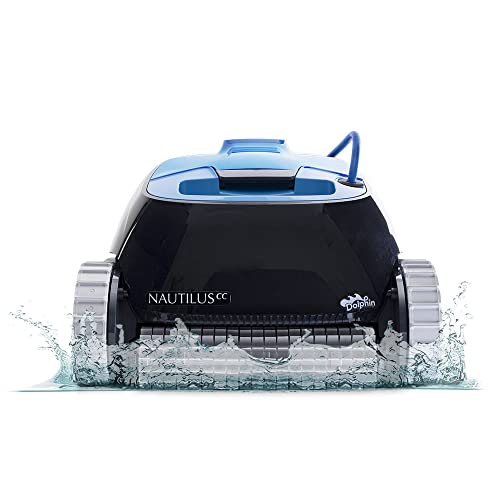
Dolphin Nautilus CC with active scrubbing brush
Corded powerActive brushWall climbingTop-load filter
Check price on Amazon
Best for: Pools with a few simple steps and an owner who wants the plainest machine.

The basic Nautilus CC is the plain corded option. It climbs walls, scrubs with an active brush and empties from the top, and there is no app, camera or sensor suite to go wrong. In a pool with a few simple steps it is a sensible, low-fuss machine.

It does not map the pool, so its handling of steps is whatever its tracks and chassis allow. Compared with the CC Plus it is cheaper and has no smart navigation, and compared with the AquaSense 2 Ultra it is a far simpler tool. Expect it to clean the floor and walls and leave the step edges to you.

Rinse the basket after every run and keep the cable clear of handrails. Inspect the brush each season. Because it is simple, it is easy to keep running for years. A spare brush and a spare set of tracks cost little and extend its life considerably.

What works

  • Plain plug-and-press operation
  • Active brush scrubs as it climbs walls
  • Top-load basket empties in seconds
  • No battery or app to manage

Watch out for

  • No mapping, so step handling is limited
  • Cable can snag on handrails
  • No shallow-area sensing

Spec sheet

Power
Corded through a transformer
Brush
Active scrubbing brush
Climbing
Wall-climbing design
Filter access
Top-load basket
Operation
Plug in, drop in, press start

Spec sheet decoder

What the numbers on the box really mean

The specs manufacturers lead with, translated into what they tell you about real-world performance.

Minimum water depth

The shallowest water a robot will enter. It decides whether it can work a bench or top step.

Watch forThe Sora 70 lists eight inches.

Multi-level cleaning

A claim that the robot handles pools with several depth levels. It implies mapping or sensing.

Watch forThe AquaSense 2 Ultra lists it.

Camera mapping

A camera builds a map of the pool and detects obstacles. It needs clear water.

Watch forThe AquaSense 2 Ultra relies on it.

Sensor count

The number of sensors reading walls and obstacles. More sensors give better turning decisions.

Watch forThe Aiper Scuba S1 lists eleven.

Triple-motor layout

Three motors separate drive from suction. It gives climbing more traction.

Watch forThe TALOSBO C1 uses one.

Methodology

How We Evaluated These Robotic Pool Cleaners for Steps

Shallow-water claims

We looked for stated minimum depths and shallow-area zones. The Sora 70 at eight inches stood out. We treated every claim as the maker's.

Mapping and sensing

We compared camera, sensor and basic navigation. The AquaSense 2 Ultra camera and the Scuba S1 sensors led. We considered water clarity limits.

Traction

We considered motor layout and chassis. The TALOSBO C1 triple-motor design stood out. We flagged that step climbing is rarely claimed.

Cable and retrieval

We weighed cable snag risk against battery limits. Surface parking counted for shallow strandings. We kept handling in mind.

Ownership

We read for parts and upkeep. Which listings claim step and stair cleaning, and how owners say that works in practice, set the order here. We noted that tread edges need hand brushing.

Decision guide

How to Choose the Right Robotic Pool Cleaners for Steps

By Step Layout

SituationPickWhy
Several depth levelsAquaSense 2 UltraCamera maps multi-level pools
Shallow bench or shelfSora 70Works water to eight inches
Moderate shelf, sensorsAiper Scuba S1Shallow-area zone and eleven sensors
Smooth steps, app modesTALOSBO C1Triple-motor traction
A few simple stepsDolphin Nautilus CCPlain and dependable

By Budget

Budget tierPickWhy
Lowest in the lineupDolphin Nautilus CCPlain corded
Lower middleTALOSBO C1Traction and modes
MiddleAiper Scuba S1Sensors and shallow reach
Upper middleDolphin Nautilus CC PlusCorded with navigation
PremiumAquaSense 2 UltraCamera mapping

The Sora 70 sits at the top; check the listing for current pricing.

Camera vs Sensors

Camera (AquaSense 2 Ultra)

Maps the pool and recognises debris. It needs a clean lens and clear water. Best for complex layouts.

Sensors (Aiper Scuba S1)

Reads walls and obstacles reliably in cloudy water. It has less detail than a map. Best for simpler step layouts.

Complex steps and clear water, pick the camera. Moderate steps, pick sensors.

By Power Type

PreferencePickWhy
Repeat cycles over stepsNautilus CC PlusCorded, no charging
Cordless, long runSora 70Five hours
Cordless with eco modeAiper Scuba S1270 minutes in eco
Cordless with app modesTALOSBO C1180 minutes
No battery, no appDolphin Nautilus CCPlain corded

For Tread Edges Specifically

Look for

Look for shallow reach and mapping, then accept that tread edges need a brush. No listing here promises full tread cleaning. A telescoping pole brush is the real step cleaner, and it costs a fraction of any robot on this list.

In this comparison

The Sora 70 reaches shallow shelves and the AquaSense 2 Ultra maps levels. Neither replaces a hand brush, and both are better thought of as shelf and floor cleaners than as step cleaners.

When to Spend More

Spend more if

Your pool has a complex step layout or a wide shelf. The AquaSense 2 Ultra and Sora 70 are built for those. They reduce repeat strandings and the awkward pole rescue that follows each one.

Save if

Your steps are simple. The Dolphin CC or TALOSBO C1 cleans the floor and walls, and a pole brush handles the treads.

Ownership

Maintenance schedule

The upkeep that decides whether this machine lasts two seasons or ten.

TaskIntervalWhy it matters
Rinse filtersAfter every runDried debris clogs mesh. Fine layers clog first.
Wipe camera and sensorsWeeklyFilm on lenses and sensors causes bad turns. A wipe restores sensing.
Brush the steps by handEvery week or twoRobots miss tread edges. A pole brush stops algae taking hold.
Charge and shade the batteryAfter each cordless runHeat ages lithium cells. Charging promptly keeps capacity.
Route the cable clear of railsBefore each corded runA snagged cable pulls the robot off course and can stall it on a step. A clear route avoids it.

FAQ

Frequently Asked Questions

Can a robot clean pool steps?

Partly. Some robots work shallow areas and others map multi-level pools, but none promises full tread cleaning. A hand brush finishes the job, and doing it weekly keeps algae from taking hold.

Which is best for a pool with steps?

The AquaSense 2 Ultra is best for complex layouts because of its camera mapping. The Sora 70 suits shallow shelves. Pick from your layout, and be wary of paying for features your steps will never use.

Does a camera help with steps?

Yes, because it maps where steps are. It needs clear water and a clean lens. Sensors are a more forgiving alternative.

Is corded or cordless better near steps?

Cordless avoids cable snags on handrails. Corded allows repeat cycles without charging. Route a corded cable clear of rails.

Will a robot strand on the steps?

It can, especially without shallow sensing. A recall feature or surface parking helps. Check the minimum depth on the listing, because a robot that refuses shallow water leaves a bench stained and the owner scrubbing by hand.

Do I still need to brush?

Yes. Tread edges and corners are the hardest areas for any robot. A weekly pole brush keeps algae away.

Bottom line

The short version

Browse more robotic pool cleaners for stepson Amazon →
James Miller, Lead Machine Editor

About the author

James Miller

Lead Machine Editor, MachineFanatic

James Miller leads MachineFanatic's buying guides, turning spec sheets, manuals and owner feedback into clear verdicts on power tools, outdoor power equipment, shop machines and kitchen machines.

More from James →

Keep reading

Related guides