
Amazon affiliate links - we earn a commission.Affiliate disclosure

Buying guide · 13 min read · Updated 2026-11-19

Best RV Air Conditioners for 30 Amp Service (2026)

Six RV air conditioners compared for 30 amp pedestals: running amps, startup surge, soft start needs and how much capacity the breaker can really feed.

James MillerBy James MillerLead Machine Editor6 machines comparedSpec-sheet verified
Best RV Air Conditioners for 30 Amp Service

At a glance

Our top picks

Side by side

Spec comparison

A thirty amp RV service is a hard electrical ceiling, and the air conditioner is the biggest thing living under it. The breaker does not care how cool you want the coach; it cares how many amps flow when the compressor runs and, more briefly, when it starts.

That is why capacity alone is the wrong shopping metric on this service. The units that work well share two traits: a modest running draw and a startup that does not slam the breaker. We rank each pick on those two behaviors, then on what is left in the budget for a microwave, a water heater or a coffee maker.

Before you buy

6 Criteria to Look For Before Buying a RV Air Conditioner for 30 Amp Service

  1. 01

    Running amps versus the breaker

    A 30 amp service delivers about 3,600 watts at 120 volts, and a typical rooftop unit draws roughly 12 to 16 amps while running. The Coleman-Mach 15 PowerSaver quotes 11.7 amps, which leaves room for a few small appliances. A microwave and an air conditioner together will often trip the breaker, so know your running figures before adding loads.

  2. 02

    Startup surge

    The compressor starts with a current spike several times higher than its running draw. On a marginal pedestal that spike causes a dip or a trip. A soft start capacitor cuts the spike sharply, and an inverter compressor such as the TURBRO avoids it by ramping gradually. Of the two, the inverter is the more complete solution.

  3. 03

    Capacity you can feed

    An 18,000 BTU unit like the Arsenda cools more than a 13,500 BTU one, but it also draws more and surges harder. A 30 amp rig is usually better served by 13,500 to 15,000 BTU with careful load management than by the largest unit on a weak supply. Match capacity to what the breaker can sustain, not to the biggest number in a listing.

  4. 04

    Voltage drop at the pedestal

    Long extension cords and tired campground pedestals sag in voltage, and low voltage makes a compressor draw more current. A unit that works at 120 volts in your driveway can struggle at 108 volts in a crowded park. Inverter units like the TURBRO tolerate sag better, and a good cord of the right gauge matters more than any unit.

  5. 05

    12V control requirement

    Several large units, including the Arsenda and the other FOGATTI-style designs, need both 115V AC and 12V DC to operate. A drained house battery stops them even with a perfect pedestal. Check your battery and the disconnect before blaming the air conditioner for a dead start.

  6. 06

    Load management habits

    The best hardware still loses to bad habits. Run the microwave and the air conditioner at different times, switch off the water heater's electric element on hot days and consider an energy management system. On 30 amps, a single hair dryer plus the air conditioner is often enough to trip the breaker.

Detailed reviews

The 6 best rv air conditioners for 30 amp service, explained

01
Coleman-Mach 15 Quiet PowerSaver heat pump, 15K BTU
15,000 BTU11.7 amp drawHeat pumpDucted
Check price on Amazon
Best for: Ducted rigs on a 30 amp pedestal that want heat and headroom.

The PowerSaver name describes the whole point of this Coleman-Mach 15: it pairs 15,000 BTU of cooling and heat pump heating with a quoted running draw of 11.7 amps. That figure leaves most of a 30 amp service for everything else, which is rare at this capacity and is why it tops the list.

It is a ducted design with a noise-reducing layout, so it only suits coaches with a ceiling duct network. The all-black shroud is a styling choice that also hides roof grime. As with any heat pump, heating output falls as the outdoor air approaches freezing.

Compared with an 18,000 BTU unit it gives up capacity but gains breathing room on the breaker. Even so, it is a fixed-speed machine, so the starting surge can still trip a marginal pedestal if another load is running. Stagger the microwave and the air conditioner, wash the filter monthly and keep the roof gasket in good shape.

What works

  • Quoted 11.7 amp running draw leaves room for appliances
  • 15,000 BTU with a built-in heat pump
  • Noise-reducing ducted design
  • Black shroud suits dark roof trim

Watch out for

  • Ducted only, so useless for single-assembly ceilings
  • Starting surge can still trip a loaded breaker

Spec sheet

Capacity
15,000 BTU
Running draw claim
11.7 amps
Heating
Heat pump
Duct type
Ducted
Shroud
Black
02
TURBRO inverter 13.5K non-ducted heat pump, 10 in thick
13,500 BTUInverterHeat pumpNon-ducted
Check price on Amazon
Best for: Non-ducted trailers that also run from a small generator.

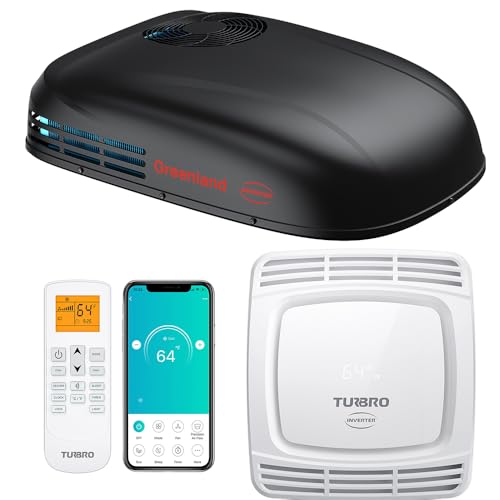
An inverter compressor is the most effective electrical fix an air conditioner can carry for a 30 amp service. The TURBRO ramps its compressor speed up gradually, which removes the sharp startup spike that trips pedestal breakers, and the maker says it is up to 30 percent more efficient than non-inverter systems.

It is also about 10 inches thick, a slim profile that helps with wind drag and clearance. It is non-ducted, so it suits the common center-vent ceiling, and it includes heat pump warming for mild weather. Against the Coleman-Mach 15 it trades 1,500 BTU of capacity for gentler starts.

The electronics want clean power, so a marginal pedestal with sagging voltage is the weak point. Use it with an inverter generator where possible, wash the filter monthly and inspect the roof gasket each spring.

What works

  • Inverter compressor removes the startup spike
  • Up to 30 percent efficiency claim over non-inverter
  • Slim 10 in profile reduces drag
  • Heat pump included for mild weather

Watch out for

  • Sensitive to sagging pedestal voltage
  • Only 13,500 BTU for large sunny coaches

Spec sheet

Capacity
13,500 BTU
Compressor
Inverter
Efficiency claim
Up to 30% over non-inverter
Thickness
10.0 in
Heating
Heat pump
03
Dometic FreshJet 3 Series 15K rooftop AC, white
15,000 BTULightweightE-coated coilsNon-ducted
Check price on Amazon
Best for: Buyers who prize service access over electrical cleverness.

Dometic's FreshJet 3 15K is a conventional fixed-speed unit, which means it sets the baseline for what a 30 amp pedestal has to cope with. The compressor starts hard, so the realistic arrangement is the air conditioner running alone or with only small loads, and a soft start capacitor added for safety.

What it offers is dependability: e-coated evaporator coils for corrosion resistance, lighter construction and a design that reuses an existing air distribution box on non-ducted rigs. Parts stock and technician knowledge are the best in the industry, which matters when a failure on a hot weekend needs a fast fix.

Against the Coleman-Mach 15 it has no stated low-amp claim and no heat pump in this listing. Add a soft start, wash the filter often and check the gasket each spring.

What works

  • E-coated coils resist corrosion
  • Lightweight construction eases installation
  • Reuses an existing distribution box
  • Strong parts and technician support

Watch out for

  • No low-amp or soft-start claim
  • No heat pump in this listing

Spec sheet

Capacity
15,000 BTU
Series
FreshJet 3
Evaporator
E-coated coils
Fit
Reuses existing ADB
Shroud
White
04
TOSOT 16,000 BTU RV AC heat pump, 43 dB claim
16,000 BTU12,500 BTU heat43 dB claimWhite
Check price on Amazon
Best for: Large trailers on 30 amps that value quiet and heat.

At 16,000 BTU with a 12,500 BTU heat pump, the TOSOT is the largest unit that still makes sense for a careful 30 amp owner, and its 43 dB sound claim makes it the quietest of the group. It suits a rig where you want both capacity and a bedroom-friendly sound level.

The cost of that capacity is amps. A 16,000 BTU fixed-speed compressor draws more than a 13,500 BTU one while running and surges harder at startup, so a soft start is a sensible companion on a 30 amp pedestal. Do not run the microwave while the compressor is starting.

Compared with the TURBRO it offers more capacity and a quieter claim but none of the inverter gentleness. Check your pedestal voltage under load with a plug-in meter, aiming to stay above roughly 108 volts when the compressor is running, wash the filter often and recheck the roof bolts after the first trip.

What works

  • 16,000 BTU cooling for hot-climate trailers
  • 12,500 BTU heat pump for shoulder seasons
  • 43 dB claim is the quietest here
  • Standard non-ducted roof fit

Watch out for

  • Larger fixed-speed compressor leans on the breaker
  • Soft start is wise on a 30 amp pedestal

Spec sheet

Cooling
16,000 BTU
Heating
12,500 BTU heat pump
Noise claim
43 dB
Mounting
Standard roof opening
Shroud
White
05
Arsenda 18,000 BTU rooftop RV AC, 110-120V non-ducted
18,000 BTUHeat pump50 dB claim115V plus 12V
Check price on Amazon
Best for: Large rigs in hot climates willing to manage electrical load.

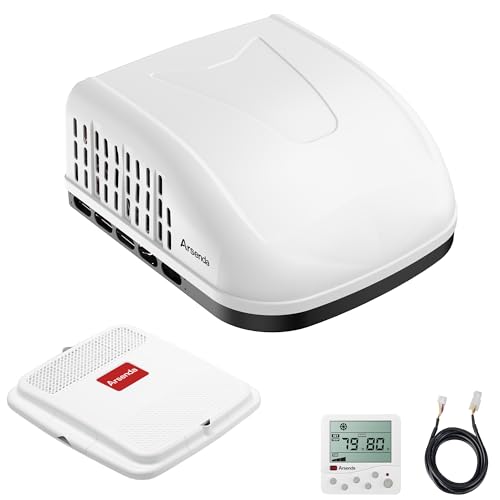
Arsenda's 18,000 BTU unit is the biggest compressor in the group, and that is exactly the caution flag for a 30 amp service. A large fixed-speed unit can draw a startup surge that leaves little room on a pedestal, so this pick suits owners who accept running it alone or adding a soft start.

It includes a heat pump and a 50 dB sound claim, and it is built for non-ducted ceilings. Like other Arsenda models it needs both 115V AC and 12V DC power, so the house battery must be healthy for the controls to wake up. A drained battery stops it even on a strong pedestal.

Buy it when the rig is large and the climate is hot, but plan the electrical load carefully. Compared with the TOSOT it offers 2,000 BTU more capacity for a heavier startup. Wash the filter often and inspect the DC feed.

What works

  • 18,000 BTU for large or sunny coaches
  • Built-in heat pump
  • 50 dB sound claim
  • Non-ducted standard roof opening

Watch out for

  • Largest compressor means the heaviest startup surge
  • Needs both 115V AC and 12V DC

Spec sheet

Capacity
18,000 BTU
Heating
Heat pump
Noise claim
50 dB
Power
115V AC plus 12V DC
Duct type
Non-ducted
06
VEVOR 13,500 BTU non-ducted RV AC with distribution box
13,500 BTUADB included65 dB claim3 modes
Check price on Amazon
Best for: Budget rebuilds on 30 amps that need the ceiling box included.

VEVOR ships its 13,500 BTU unit with the air distribution box, which is a useful saving for a rebuild. At 13,500 BTU the compressor is a standard size, a safer load for a 30 amp pedestal than the larger units, though it is a fixed-speed design with the usual startup surge.

It offers auto, cooling and three-speed fan modes and fits the standard 14.25 inch roof opening. The 65 dB noise claim is the loudest in this guide, a trade for the lower cost and the included parts. It is cooling only, so there is no heat pump to cover cool mornings.

For a 30 amp rig that mostly needs reliable cooling at modest cost, it is a reasonable choice. Add a soft start, wash the filter monthly and recheck the mounting bolts after the first long trip.

What works

  • Standard 13,500 BTU is a manageable breaker load
  • Air distribution box included
  • Auto, cool and fan modes
  • Fits the standard 14.25 in opening

Watch out for

  • 65 dB claim is the loudest here
  • Cooling only with a fixed-speed start

Spec sheet

Capacity
13,500 BTU
Interior parts
Air distribution box included
Noise claim
65 dB
Modes
Auto, cool, 3-speed fan
Roof opening
14.25 in square

Spec sheet decoder

What the numbers on the box really mean

The specs manufacturers lead with, translated into what they tell you about real-world performance.

Running amps

The current the unit draws while cooling steadily. It sets how much capacity is left for other appliances.

Watch forThe Coleman-Mach 15 quotes 11.7 amps; most other makers do not publish a figure.

Startup surge

The brief, high current when the compressor starts. A soft start or inverter drive cuts it.

Watch forFixed-speed units such as the Dometic and VEVOR draw the largest spikes.

Inverter compressor

A drive that ramps compressor speed instead of switching it on and off. It lowers startup load and improves efficiency.

Watch forThe TURBRO is the only inverter unit here.

BTU

Rated cooling capacity under a standard test. Higher BTU generally means higher amps.

Watch forThe Arsenda's 18,000 BTU versus the VEVOR's 13,500 BTU is a large amp gap.

12V DC requirement

Some units draw control power from the coach battery as well as shore power.

Watch forThe Arsenda needs both, so a dead battery stops it, and a lithium conversion with a battery disconnect left open is a common cause of a unit that appears to be broken.

Methodology

How We Evaluated These RV Air Conditioners for 30 Amp Service

Running draw

We looked for stated amp draws, finding the Coleman-Mach 15's 11.7 amps as the only explicit figure. We estimated the rest from capacity class using typical 12 to 16 amp running ranges. Lower draw scored higher on a 30 amp service.

Startup behavior

We compared compressor types, putting the inverter TURBRO ahead of the fixed-speed Dometic, TOSOT and Arsenda units. We noted where a soft start capacitor is the sensible add-on. Large compressors were penalized, because the startup spike is what trips a 30 amp breaker far more often than steady running does.

Capacity fit

We matched capacity, from 13,500 to 18,000 BTU, to what a breaker can feed. We did not reward capacity the supply cannot sustain. Heat pump options earned credit where they cut electric heat draw. We also considered whether a unit would leave enough headroom for a refrigerator, lights and a laptop charger running at the same time.

Control and power needs

We flagged the 12V DC requirement on the Arsenda. Units that run from shore power alone scored simpler. Voltage tolerance was considered for inverter designs.

Ownership and support

We considered brand parts stock, with Dometic first, and corrosion protection such as e-coated coils. Cheaper units were credited for price but marked for service risk.

Decision guide

How to Choose the Right RV Air Conditioners for 30 Amp Service

By Appliance Load

SituationPickWhy
Microwave and small loads alongsideColeman-Mach 15 PowerSaver11.7 amp running claim
Small generator backupTURBRO 13.5K inverterGentle start
Air conditioner runs aloneArsenda 18KCapacity over breathing room
Mid-size trailer, simpleVEVOR 13.5KStandard load

By Budget

SituationPickWhy
Lowest outlayVEVOR 13.5KIncludes ceiling box
Mid-range, trustedDometic FreshJet 3 15KParts and service
Mid-range, quietTOSOT 16K43 dB claim
Premium low-ampColeman-Mach 15 PowerSaverQuoted 11.7 amps

Inverter vs Soft Start

Inverter

The TURBRO ramps its compressor, so startup surge is low. It costs more and needs clean power.

Soft start add-on

A capacitor kit on a Dometic, TOSOT or Arsenda cuts the spike for a small cost. It does not change running amps.

Inverter for a new unit; soft start if you already own a fixed-speed one.

Ducted vs Non-Ducted

SituationPickWhy
Ducted ceilingColeman-Mach 15 PowerSaverBuilt for ducted
Non-ducted, quietTOSOT 16KQuiet claim
Non-ducted, slimTURBRO 13.5KAbout 10 in thick
Non-ducted rebuildVEVOR 13.5KBox included

For Crowded Campgrounds Specifically

Look for

A low running draw, a gentle start and tolerance for sagging voltage. Carry a surge protector and a heavy cord.

In this comparison

The TURBRO's inverter tolerates sag better. The Coleman-Mach 15 leaves the most amps spare.

When to Spend More

Spend more if

You camp often on 30 amp pedestals. The Coleman-Mach 15 and TURBRO pay back in tripped breakers avoided.

Save if

You camp occasionally and manage loads. The VEVOR with a soft start works.

Ownership

Maintenance schedule

The upkeep that decides whether this machine lasts two seasons or ten.

TaskIntervalWhy it matters
Wash filterMonthly in seasonA clogged filter makes the compressor run longer and draw more amps. A clean filter helps your breaker too.
Check pedestal and cordEvery tripA hot plug or a thin cord causes voltage drop, which raises amp draw. Replace damaged cords promptly, and feel the plug after an hour of cooling: if it is hot to the touch, the connection is wasting power as heat and needs attention.
Clean condenser coilTwice a yearDirty coils make the compressor work harder. Use low-pressure water.
Inspect soft start wiringYearlyA soft start sits near the compressor and sees vibration. Check connections and capacitor condition.
Tighten roof boltsTwice a yearLoose bolts shift the gasket and let in water. Even torque keeps the seal.

FAQ

Frequently Asked Questions

Can I run an RV air conditioner on 30 amps?

Yes, most rooftop units run fine on 30 amps. The limit is what else is on at the same time, since a microwave plus the air conditioner often trips the breaker. A realistic budget is one air conditioner plus lights, the refrigerator and a couple of small electronics, with the big heating or cooking loads kept out of the same minute.

Do I need a soft start?

On a fixed-speed unit with a marginal pedestal or a small generator, a soft start is cheap insurance. An inverter compressor makes it unnecessary.

Is 15,000 BTU too much for 30 amps?

Not usually. A unit like the Coleman-Mach 15 quotes 11.7 amps running. The surge at startup is what needs managing.

Why does my breaker trip when the compressor starts?

The startup surge can be several times the running current. Low pedestal voltage makes it worse. A soft start or inverter drive reduces it. Also check the pedestal itself: a worn receptacle or a loose lug adds resistance, which drops voltage under load and makes the same unit look underpowered.

Will an 18,000 BTU unit work on 30 amps?

It can, but it leaves little room for other loads and surges harder. Use it alone or add a soft start. If you want that capacity regularly, consider an energy management system that sheds the water heater and other big loads automatically whenever the compressor is working.

Does a heat pump draw less than electric heat?

Yes in mild weather, since it moves heat instead of making it. It still uses power, so watch the total on a 30 amp service. Electric resistance heat on the same unit can draw as much as a space heater, which is why heat pump models are kinder to a small breaker.

Bottom line

The short version

Browse more rv air conditioners for 30 amp serviceon Amazon →
James Miller, Lead Machine Editor

About the author

James Miller

Lead Machine Editor, MachineFanatic

James Miller leads MachineFanatic's buying guides, turning spec sheets, manuals and owner feedback into clear verdicts on power tools, outdoor power equipment, shop machines and kitchen machines.

More from James →

Keep reading

Related guides