
Amazon affiliate links - we earn a commission.Affiliate disclosure

Buying guide · 13 min read · Updated 2026-11-19

Best RV Air Conditioners for Camper Vans (2026)

Six air conditioners for camper vans compared on weight, roof footprint, 12V draw, heat output and the no-install portable option for rented or shared vans.

James MillerBy James MillerLead Machine Editor6 machines comparedSpec-sheet verified
Best RV Air Conditioners for Camper Vans

At a glance

Our top picks

Side by side

Spec comparison

A camper van is the hardest place to put an air conditioner. The cabin is small, the roof is already crowded with fans, vents and panels, payload is tight, and the electrical system is a single battery bank that also runs the fridge and lights.

Buyers here should weigh the physical footprint as heavily as the cooling number. Weight, thickness, roof cut-out size and whether the unit can run directly on battery voltage decide whether an air conditioner fits the van or fights it. We rank each pick on those practical limits first and on raw capacity last.

Before you buy

6 Criteria to Look For Before Buying a RV Air Conditioner for Camper Vans

  1. 01

    Weight and payload

    Traditional rooftop units can weigh well past 70 pounds, which eats payload in a van and loads a roof that was never designed for it. The Xenjum weighs about 43 pounds, which makes it a standout. Weigh the unit alongside the bracket, the reinforcement and the extra battery capacity the unit demands.

  2. 02

    Roof footprint and cut-out

    A rooftop unit needs a clean, reinforced cut-out and a sealed gasket, and a van roof is thin sheet metal that flexes. Measure the space between the existing fans and any solar panels before ordering. If you cannot find a safe spot, the BAYKUL portable unit avoids the cut entirely.

  3. 03

    Cooling capacity for a small cabin

    A van cabin is small but thinly insulated, with big windows and a dark roof. The 8,200 BTU and 8,500 BTU units suit short vans, the 10,000 to 11,000 BTU units suit standard vans, and the 12,000 BTU Gidrox suits long or high-roof vans. Insulation and window covers shift the load more than the badge.

  4. 04

    Heat output

    A van that camps in shoulder seasons benefits from a unit with real heat. The 8,200 BTU unit offers matched heating and cooling, the Gidrox adds a 9,000 BTU heat pump, and the 8,500 BTU unit heats only 3,400 BTU. In very cold weather a diesel heater is the better tool, and the air conditioner supplements it.

  5. 05

    Battery draw and wiring

    Small DC units pull tens of amps at 12V. A 300 to 900 watt range like the Countrymod's means a peak near 75 amps at 12V. Size the cable, fuse and bank for the peak, add a low-voltage cutoff and expect an air conditioner to need a bank of at least a few hundred amp-hours for real use.

  6. 06

    Noise in a small cabin

    A van is a sound box, so a loud unit is unavoidable at night. Quoted levels range from 30 dB on the 8,200 BTU unit to 35 dB on the Xenjum and 45 to 55 dB on the Countrymod. Those are claims for the quietest mode. Rubber mounting and a sealed gasket matter as much as the number.

Detailed reviews

The 6 best rv air conditioners for camper vans, explained

01
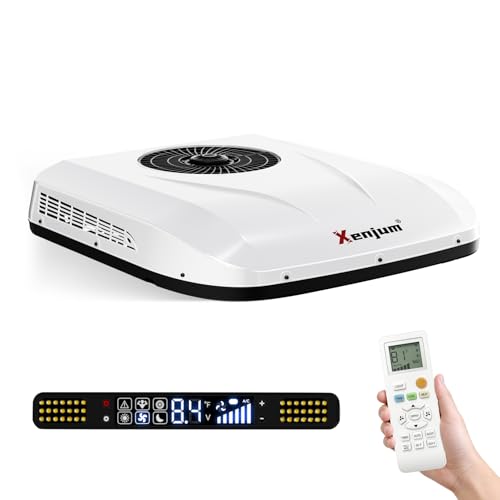
Xenjum 12V 11,000 BTU RV AC with heater, 43 lb
11,000 BTU43 lb12V DC35 dB claim
Check price on Amazon
Best for: Most camper vans that can take a standard rooftop cut-out.

Weight is the first filter in a van, and at about 43 pounds the Xenjum is a fraction of a typical rooftop unit that can run past 70. That keeps payload and roof loading in check. An inverter scroll compressor modulates its speed on 12V DC, which holds the battery draw down and avoids the hard startup surge of a fixed-speed machine.

The maker quotes 11,000 BTU of cooling and a 4,500 BTU heater, so it covers a typical van interior without drama. The 35 dB sound claim is for the quietest mode and will rise at full output, but a small cabin makes any fan noise more present, so a quiet baseline helps.

Compared with the 8,500 BTU unit below it offers more cooling at modest extra weight. The roof needs a clean, sealed cut-out and sound reinforcement. Use heavy cable and a fuse, keep a low-voltage cutoff on the bank and inspect the roof seal every spring.

What works

  • Roughly 43 lb keeps payload and roof loading low
  • Inverter scroll compressor trims battery draw
  • 11,000 BTU with a 4,500 BTU heater
  • 35 dB quietest-mode claim

Watch out for

  • Heater is only a 4,500 BTU supplement
  • Requires a clean roof cut-out and reinforcement

Spec sheet

Cooling
11,000 BTU
Heating
4,500 BTU
Weight
43 lb
Compressor
Inverter scroll
Noise claim
35 dB
02
8,200 BTU 12V DC RV AC with heating, non-ducted rooftop
8,200 BTU8,200 BTU heat30 dB claim12V DC
Check price on Amazon
Best for: Four-season vans that need real heat as well as cooling.

Most small 12V units offer more cooling than heating. This one balances them, quoting 8,200 BTU of cooling and 8,200 BTU of heat, which matters for a four-season van where the nights are as much a problem as the afternoons. Five operating modes cover everything from cooling to a low-power sleep setting.

The maker says noise can be as low as 30 decibels, the quietest claim in this guide, and a minimum power consumption figure is listed for its lowest mode. That quiet baseline is valuable when the bed is only a few feet from the roof unit. The trade is cooling capacity: 8,200 BTU suits a short wheelbase van and will struggle in a long sun-baked one.

Compared with the Xenjum it gives up about 2,800 BTU of cooling but gains a much stronger heater. Check the roof seal after the first season and keep the DC terminals clean.

What works

  • Matched 8,200 BTU cooling and heating
  • Quoted 30 dB minimum noise
  • Five operating modes including sleep
  • Runs direct from 12V DC

Watch out for

  • Smaller cooling capacity than 10,000 BTU units
  • Brand support and parts stock are thin

Spec sheet

Cooling
8,200 BTU
Heating
8,200 BTU
Noise claim
As low as 30 dB
Voltage
12V DC
Modes
5 operating modes
03
12V 8,500 BTU low-profile rooftop RV AC, variable frequency
8,500 BTU3,400 BTU heat12V DCLow profile
Check price on Amazon
Best for: Smaller vans that want gentle modulation and modest draw.

A vortex variable-frequency compressor is the efficiency story here, and it lets a small 8,500 BTU unit modulate instead of cycling on a small battery bank. The low-profile, non-ducted design suits a van roof where height and clearance matter.

The maker quotes 8,500 BTU cooling and 3,400 BTU heating, which makes it a cooling-first machine with a light heater. That is a fine balance for a van that mostly camps in summer and shoulder seasons. Stable power output and low-noise operation are listed, though no decibel figure appears in the data.

Against the 8,200 BTU alternative it has a lower heating capacity and a different compressor type. Because it is a small unit it draws less current, which is kind to a modest bank. Wire it with a proper fuse, check the sealant every spring and wipe the filter regularly.

What works

  • Variable-frequency compressor modulates output
  • Low profile suits tight roof clearance
  • Small capacity draws less from the battery
  • Non-ducted design needs no interior ducts

Watch out for

  • Heater is only 3,400 BTU
  • No decibel figure in the listing

Spec sheet

Cooling
8,500 BTU
Heating
3,400 BTU
Compressor
Vortex variable-frequency
Voltage
12V DC
Profile
Low profile non-ducted
04
Gidrox 12V 12,000 BTU inverter heat pump RV AC, 43 dB
12,000 BTU9,000 BTU heat12V DC43 dB claim
Check price on Amazon
Best for: Larger vans wanting efficient heat and strong cooling on 12V.

A heat pump gives a van efficient warmth without the draw of an electric element, and the Gidrox pairs a 9,000 BTU heat pump with 12,000 BTU of cooling on a 12V inverter compressor. The maker quotes an average power use of about 350 watts and a 40 dB sleep mode.

It is the highest cooling capacity among the 12V options here, which suits a long van or a high-roof model with a big window. The heat pump does lose output in cold air, so it complements a diesel heater rather than replacing one in winter.

Compared with the Xenjum it gives more cooling and a much stronger heat pump, at what is probably a higher weight and price. Wire it with heavy cable, a fuse and a low-voltage cutoff, and check the roof seal every spring. A brushless fan and sound-insulated cabinet keep the noise down.

What works

  • 12,000 BTU is the largest 12V cooling here
  • 9,000 BTU heat pump instead of a resistive heater
  • Quoted average draw around 350 watts
  • 40 dB sleep mode claim

Watch out for

  • Heat pump fades in very cold air
  • Likely heavier and costlier than smaller units

Spec sheet

Cooling
12,000 BTU
Heating
9,000 BTU heat pump
Voltage
12V DC
Average draw claim
About 350W
Sleep mode claim
40 dB
05
Countrymod 12V DC 10,000 BTU RV AC, app control
10,000 BTU300 to 900WApp control45 to 55 dB
Check price on Amazon
Best for: Van owners who want scheduling and a stated power range.

The Countrymod states its operating range openly: 300 to 900 watts as the inverter compressor ramps. For a van, that range tells you what the wiring and battery must supply at the peak and what a quiet cruise costs. The maker claims about 0.3 kilowatt-hours per hour of use.

App control lets you schedule cooling and pre-chill the cabin while the sun still feeds the panels. A 45 to 55 dB noise claim is the loosest in this guide, so it is not the choice for a light sleeper. It is a 10,000 BTU unit, which fits a standard-length van well.

Compared with the Xenjum it lacks a weight figure and a heater listing in the data, so check the specification sheet before buying. Plan for the 900 watt peak, use heavy cable and verify roof reinforcement.

What works

  • States a 300 to 900 watt operating range
  • App control for scheduling
  • 10,000 BTU suits standard vans
  • About 0.3 kWh per hour claim

Watch out for

  • Noise claim of 45 to 55 dB is the loosest here
  • No weight or heater figure in the listing

Spec sheet

Cooling
10,000 BTU
Power range
300 to 900W
Energy claim
About 0.3 kWh per hour
Noise claim
45 to 55 dB
Control
App
06
BAYKUL 6-in-1 portable camping AC and heater, 6,800 BTU
6,800 BTU cool7,500 BTU heatPortable6-in-1
Check price on Amazon
Best for: Rented or shared vans where drilling the roof is off the table.

Not every van can take a roof cut, and not every van owner wants to. The BAYKUL is a portable air conditioner and heater that needs no installation, which makes it the choice for a rented van, a shared vehicle or a rig where the roof is already full.

It provides 6,800 BTU of cooling and 7,500 BTU of heating, with six modes including dehumidify, sleep and timer. A slim, compact body is meant to fit in a van without eating the floor. The compromise of any portable unit is the exhaust: it needs a hose out a window or door and a place to stand.

Compared with the rooftop units it uses floor space and a hose, but costs nothing in roof structure or sealant. Check the hose connection and drain, and store it dry between trips. It is the sensible pick when permanence is not an option.

What works

  • No roof cut or installation needed
  • 6,800 BTU cooling and 7,500 BTU heating
  • Six modes including dehumidify and timer
  • Slim, compact body

Watch out for

  • Uses floor space and needs an exhaust hose
  • Lower capacity than rooftop units

Spec sheet

Cooling
6,800 BTU
Heating
7,500 BTU
Type
Portable, no roof install
Modes
Cool, heat, fan, dry, sleep, timer
Design
Slim and compact

Spec sheet decoder

What the numbers on the box really mean

The specs manufacturers lead with, translated into what they tell you about real-world performance.

Unit weight

Total weight on the roof, including the shroud. It affects payload, handling and roof stress.

Watch forXenjum lists about 43 lb; most others do not publish a weight.

Heating BTU

The unit's heating capacity. Heat pump and resistive heaters differ in draw.

Watch forThe 8,200 BTU unit heats 8,200 BTU; the 8,500 BTU unit only 3,400 BTU.

Power range in watts

The span between minimum cruise and peak pull-down draw on an inverter unit.

Watch forThe Countrymod's 300 to 900 watts means a peak near 75 amps at 12V.

Portable versus rooftop

A portable unit stands on the floor with an exhaust hose, while a rooftop unit bolts through the roof.

Watch forThe BAYKUL needs a window or door for its hose.

dB quietest mode

A maker claim for the lowest-fan setting. A van cabin makes any noise more present.

Watch forThe 30 dB claim on the 8,200 BTU unit is a minimum, not typical running noise.

Methodology

How We Evaluated These RV Air Conditioners for Camper Vans

Weight and footprint

We prioritized weight, using the Xenjum's roughly 43 lb as a benchmark against 70 lb or more for traditional rooftop units. We also checked profile and roof cut-out needs. Portable units were assessed on floor space.

Cooling and heating balance

We compared capacities from 6,800 BTU to 12,000 BTU and heating from 3,400 BTU to 9,000 BTU. A van needs cooling first but benefits from real heat. Matched heating and cooling earned credit.

Battery impact

We looked at compressor type and stated draw, such as the Countrymod's 300 to 900 watts and the Gidrox's roughly 350 watt average. Inverter and variable-frequency designs scored higher. High peak draw was noted.

Noise claims

We compared quoted levels from 30 dB to 55 dB as maker claims. In a small cabin, the quietest baseline matters. We did not treat claims as measurements.

Installation realism

We judged how difficult each unit is to fit in a van, from a roof cut to a portable setup. Units needing no cut scored for ease. Roof reinforcement was considered.

Decision guide

How to Choose the Right RV Air Conditioners for Camper Vans

By Van Length

SituationPickWhy
Short wheelbase van8,200 BTU 12V unitMatched heat and cool, 30 dB claim
Compact van, light draw12V 8,500 BTU variable frequencyModest draw
Standard vanXenjum 11,000 BTUAbout 43 lb
Long or high-roof vanGidrox 12,000 BTULargest cooling, heat pump

By Budget

SituationPickWhy
Lowest outlay, no installBAYKUL portableNeeds no roof cut
Low outlay, small van12V 8,500 BTU unitVariable frequency
Mid-rangeCountrymod 10,000 BTUApp and stated range
Higher, strong heatGidrox 12,000 BTUHeat pump

Rooftop vs Portable

Rooftop

The Xenjum, Gidrox, Countrymod and the two smaller 12V units bolt to the roof and use no floor space. They need a cut-out and reinforcement.

Portable

The BAYKUL needs no installation but takes floor space and an exhaust hose through a window or door.

Rooftop for an owned van you use often; portable for rented, shared or roof-limited vans.

Heating Priority

SituationPickWhy
Cold nights matter8,200 BTU 12V unit8,200 BTU heat
Efficient heat pumpGidrox 12,000 BTU9,000 BTU heat pump
Light heat onlyXenjum 11,000 BTU4,500 BTU heater
Heat from a portableBAYKUL 6-in-17,500 BTU heating

For Light Sleepers Specifically

Look for

A low sound claim, brushless fans and rubber isolation under the unit. A sealed gasket and tight screws prevent rattle.

In this comparison

The 8,200 BTU unit claims 30 dB and the Xenjum 35 dB. The Countrymod claims 45 to 55 dB and is the loosest.

When to Spend More

Spend more if

You live in the van or camp in all seasons. The Gidrox and the heat-and-cool 8,200 BTU unit repay the cost.

Save if

You camp occasionally in summer. The BAYKUL or the 8,500 BTU unit is enough.

Ownership

Maintenance schedule

The upkeep that decides whether this machine lasts two seasons or ten.

TaskIntervalWhy it matters
Inspect roof sealEach springA thin van roof flexes, which cracks sealant. A leak behind the headliner is costly and slow to find, and wet insulation in a steel cavity starts rust long before it shows on the outside.
Check DC terminalsEvery seasonHigh-current lugs loosen on a vibrating vehicle. A warm terminal wastes power and risks a fire.
Wash filterEvery 3 to 4 weeksA small cabin has little airflow margin, so a clogged filter ices the coil fast.
Tighten mounting hardwareTwice a yearRoad vibration is harsher on a van roof. Even torque keeps the gasket sealed and quiet.
Empty and dry the portable unitAfter each useStanding water in a portable unit grows biofilm and smells. Drain it and let it dry before storing.

FAQ

Frequently Asked Questions

Can I put a rooftop air conditioner on a camper van?

Yes, if the roof can be cut and reinforced safely and there is space between fans and panels. Many vans use a 12V unit of 8,500 to 12,000 BTU. Get the structure right before cutting.

How much does a van air conditioner weigh?

Traditional units can weigh over 70 pounds, but the Xenjum lists about 43. Weight matters for payload and roof stress, so check the figure before buying.

How many batteries does a van air conditioner need?

A 300 to 900 watt unit pulls up to roughly 75 amps at 12V, so a bank of at least a few hundred amp-hours is typical. Runtime depends on insulation, shade and thermostat cycling. A van with reflective window covers and a closed roof fan can run the unit on its low setting for hours, while the same van with bare glass will keep the compressor at full tilt all afternoon.

Is a portable air conditioner a good van option?

It works when you cannot cut the roof. It needs an exhaust hose through a window or door and floor space, and its capacity is lower. For a rented van it is the sensible choice.

Do I need a heater as well?

For cold nights a diesel or propane heater is more effective. A 12V unit's heater or heat pump covers mild weather and saves fuel. Use it as a supplement only, because in real winter conditions the battery cost of electric heat is far higher than burning a little diesel.

Will it fit my roof fan opening?

Some units mount in a standard 14 inch opening, but van roofs vary. Check the unit's footprint and the space beside your existing fans before ordering, and remember that a roof rib, a solar panel or a rack crossbar may sit exactly where the new unit wants to go. Lay a cardboard template on the roof first and walk around it.

Bottom line

The short version

Browse more rv air conditioners for camper vanson Amazon →
James Miller, Lead Machine Editor

About the author

James Miller

Lead Machine Editor, MachineFanatic

James Miller leads MachineFanatic's buying guides, turning spec sheets, manuals and owner feedback into clear verdicts on power tools, outdoor power equipment, shop machines and kitchen machines.

More from James →

Keep reading

Related guides