
Amazon affiliate links - we earn a commission.Affiliate disclosure

Buying guide · 13 min read · Updated 2026-11-19

Best RV Air Conditioners for Pop-Up Campers (2026)

Six cooling units for pop-up campers compared on weight, wattage, window and tent fit, and which options a canvas-sided camper and its small battery can handle.

James MillerBy James MillerLead Machine Editor6 machines comparedSpec-sheet verified
Best RV Air Conditioners for Pop-Up Campers

At a glance

Our top picks

Side by side

Spec comparison

A pop-up camper turns the whole air conditioning question upside down. The roof lifts, the sides are canvas or soft panels, and the structure cannot carry a heavy rooftop unit. The space is small but leaky, and the power supply is often a basic circuit or a modest battery.

That leaves three practical forms: a portable unit that sits on the floor and vents through a window, a window-style unit that sits in an opening, and a compact battery-voltage unit for the few pop-ups with a rigid roof section. We rank each on weight, wattage and how well it works with a soft-sided shell.

Before you buy

6 Criteria to Look For Before Buying a RV Air Conditioner for Pop-Up Campers

  1. 01

    Roof and wall structure

    A pop-up's roof lifts on cranks or struts and its sides are canvas or thin panels. A rooftop unit weighs 70 pounds or more, far beyond what a lift-up top can carry. Portable and window-style units move the weight to the floor or a rigid frame, which is why the CYMYYDS, tent unit and COSTWAY lead this list.

  2. 02

    Wattage and circuit limits

    Many pop-up campers have a 15 or 20 amp circuit or a modest power station. The CYMYYDS draws a rated 280 watts, easy on either. A 6,500 BTU window unit draws far more, so check your supply. Match the unit to the circuit before buying, because a tripped breaker at midnight is no relief.

  3. 03

    Sealing a soft-sided shell

    Canvas sides leak cold air and let in heat, so any air conditioner works against a leaky envelope. Seal the openings, close the vents and use reflective covers on the sunniest wall. A small unit in a sealed sleeping zone beats a big unit in an open tent.

  4. 04

    Exhaust and drain paths

    Portables need an exhaust hose through a window or panel and a way to handle condensate. A tight panel around the hose stops hot air coming back in. The 7,000 BTU tent unit and the CYMYYDS both need this, so plan the panel before the first trip.

  5. 05

    Noise in a small space

    A pop-up is a small sound box, so noise is amplified. Claims run from 35 dB on the Xenjum to 45 dB on the CYMYYDS and 58 dB on the 7,000 BTU unit in sleep mode. Those are quietest-mode figures. Place the unit away from your head and on a soft mat. A folded towel under the base and a clear gap between the unit and the canvas stop the hum from traveling through the floor frame and the walls.

  6. 06

    Capacity matched to the space

    A pop-up has a small volume, so 2,700 to 7,000 BTU often suffices. An oversized unit short-cycles and leaves the air clammy. Use the smallest unit that holds your target temperature, and add shade and reflective covers before stepping up in size. A thermometer by the bed tells you more than any coverage claim on a box.

Detailed reviews

The 6 best rv air conditioners for pop-up campers, explained

01
CYMYYDS 2,700 BTU portable RV AC, 280W rated draw
2,700 BTU280W45 dB sleepPortable
Check price on Amazon
Best for: Pop-ups on a basic circuit or power station that need sleeping-zone cooling.

At a rated 280 watts, this unit asks for less than a hair dryer, which makes it the one air conditioner on this list that a basic pop-up circuit or a mid-size power station can feed without drama. The maker says it uses a real compressor, not an evaporative cooler, and quotes 2,700 BTU, about 900 watts of cooling.

That is a small amount of cold, and it matters how you use it. In a pop-up with canvas sides it will cool a sleeping area or a bunk end, not the whole camper, and it works best with the openings sealed and the unit pointed at the bed. The sleep mode is quoted at 45 dB, quiet enough for a tent-like space.

Against the larger units here it trades capacity for the lowest electrical demand. Vent the hose out a window panel, drain it as the maker directs and store it dry between trips.

What works

  • Rated draw of only 280 watts
  • Real compressor, not an evaporative cooler
  • 45 dB sleep mode claim
  • Portable and easy to stow

Watch out for

  • 2,700 BTU only cools a small zone
  • Needs an exhaust hose through a panel

Spec sheet

Capacity
2,700 BTU, about 900W cooling
Rated draw
280W
Noise claim
45 dB sleep mode
Compressor
Real compressor
Type
Portable 3-in-1
02
COSTWAY 6,500 BTU RV window AC with WiFi and voice control
6,500 BTUETL certifiedWiFi app24H timer
Check price on Amazon
Best for: Pop-ups with hookups and a rigid window opening.

A window-style unit needs an opening, and many pop-ups have one in the front or rear wall. The COSTWAY is sold as an RV window air conditioner with 6,500 BTU of cooling, ETL certification and WiFi plus voice control, which puts real capacity in a camper that has a rigid frame to hold it.

The weight sits at the window, not the roof, so the structure is not asked to carry it overhead. A 24 hour timer and cooling, fan and other modes round out the controls. It needs a panel or a custom insert to seal the opening, and a canvas-sided camper may need extra bracing.

Compared with the CYMYYDS it gives more than twice the capacity but draws much more power, so it wants hookups or a large battery system. Check the gasket and the drain tube every season and remove it for travel.

What works

  • 6,500 BTU is real capacity for a small camper
  • Weight sits at the window, not the roof
  • WiFi and voice control
  • ETL-certified design

Watch out for

  • Needs a sealed opening and extra bracing on soft walls
  • Draws far more power than portable units

Spec sheet

Capacity
6,500 BTU
Type
RV window unit
Certification
ETL certified
Control
WiFi app, voice
Timer
24 hour
03
7,000 BTU portable tent AC, 4-in-1, compact
7,000 BTU58 dB sleep21.4 in long4 modes
Check price on Amazon
Best for: Soft-sided pop-ups wanting more capacity than a mini portable.

This portable unit is sold for tents, which makes it a natural fit for a pop-up's soft shell. It measures about 21 by 12 by 14 inches, small enough to sit on the floor beside a bunk, and the maker quotes 7,000 BTU of cooling with cool, dry, sleep, fan and timer modes.

The sleep mode is claimed at 58 dB, louder than the 45 dB CYMYYDS, so it is a trade of capacity for noise. Because it is compact and remote-controlled, it can be pointed at the bed from across the camper. As with any portable, the exhaust hose needs a path through a window or panel.

Compared with the COSTWAY it avoids the window mount but uses floor space. Seal around the hose, drain the condensate as directed and let the unit dry before storing it.

What works

  • Compact body around 21 by 12 by 14 inches
  • 7,000 BTU cooling in a portable
  • Five modes with a remote
  • Designed for tent and camper use

Watch out for

  • 58 dB sleep mode is louder than the smallest unit
  • Needs a hose path and floor space

Spec sheet

Capacity
7,000 BTU
Dimensions
21.38 x 12.4 x 14.29 in
Noise claim
58 dB sleep mode
Modes
Cool, dry, sleep, fan, timer
Control
Remote
04
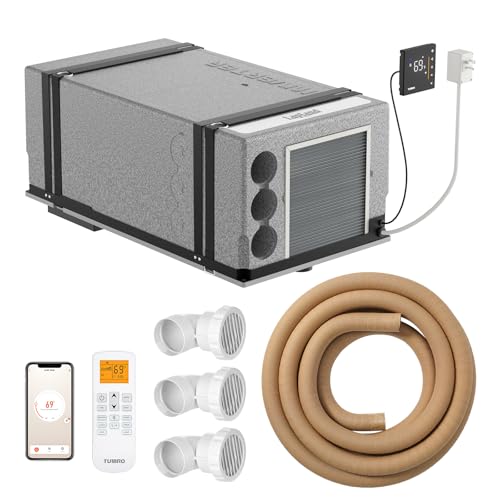
TURBRO inverter under-bench RV AC with heat pump, 115V
InverterHeat pumpUnder bench115V
Check price on Amazon
Best for: Pop-ups with a rigid bench and no spare roof structure.

For pop-ups that have a hard-sided dinette or storage bench, an under-bench inverter unit moves the weight to the floor. TURBRO's version uses an inverter compressor and a heat pump, keeps the roof clear and avoids any cut in the lift-up top.

The layout asks for an exhaust path and a drain, and it needs a bench with the space and airflow it requires. A soft-sided pop-up with a thin floor may not offer that, so check the frame. Inverter control keeps the draw modest at a steady setpoint.

Compared with the portables it is a permanent installation with real capacity and heat. Keep the intake clear, check the drain route and inspect connections after the first trip.

What works

  • Weight sits on the floor, not the roof
  • Inverter compressor modulates output
  • Heat pump included
  • No cut in the lift-up top

Watch out for

  • Needs a bench with space, exhaust and drain
  • Permanent install is a project

Spec sheet

Compressor
Inverter
Mounting
Under bench
Heating
Heat pump
Roof impact
No roof load
Voltage
115V
05
12V 8,500 BTU low-profile rooftop RV AC, variable frequency
8,500 BTU3,400 BTU heat12V DCLow profile
Check price on Amazon
Best for: Hard-top pop-ups with solar and a lithium bank.

A few pop-ups, particularly hard-top conversions, have a roof that can carry a small unit. For those, this 12V low-profile model offers 8,500 BTU of cooling and 3,400 BTU of heating with a variable-frequency compressor, which modulates instead of cycling.

It runs on battery voltage, so it suits a pop-up with a solar and lithium setup. The low profile helps because a pop-up often tucks under low branches. The roof, however, must be rigid and reinforced, and an ordinary lift-up top cannot take it.

Against the portables it is a fixed installation with a higher draw and more cooling. Use heavy cable, a fuse and a low-voltage cutoff, and check the seal every spring.

What works

  • Variable-frequency compressor modulates
  • 12V DC operation suits solar setups
  • Low profile suits tight clearance
  • 8,500 BTU with a light heater

Watch out for

  • Needs a rigid, reinforced roof
  • Heating is only 3,400 BTU

Spec sheet

Cooling
8,500 BTU
Heating
3,400 BTU
Compressor
Vortex variable frequency
Voltage
12V DC
Profile
Low profile non-ducted
06
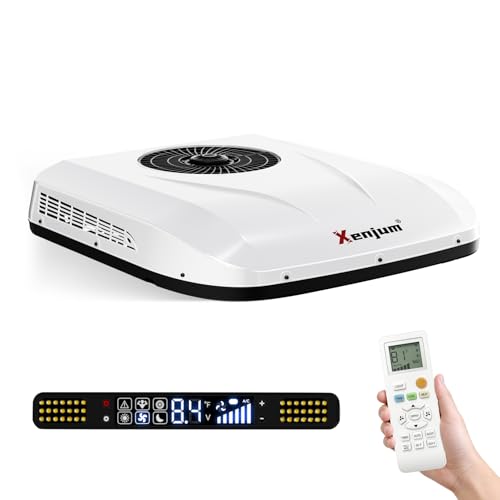
Xenjum 12V 11,000 BTU RV AC with heater, 43 lb
11,000 BTU43 lb12V DC35 dB claim
Check price on Amazon
Best for: Rigid-roof campers that want the lightest 12V unit.

If a pop-up has any rigid roof section, weight is the limiting factor, and at about 43 pounds the Xenjum is a fraction of a typical rooftop unit. It runs on 12V DC with an inverter scroll compressor and offers 11,000 BTU of cooling plus a 4,500 BTU heater.

That is more cooling than a small pop-up needs, so it will cycle less and run gently. A 35 dB claim for the quietest mode suits sleeping. But it still has to mount on a rigid, reinforced structure, which a standard lift-up roof is not.

Compared with the 8,500 BTU unit it has more capacity and weight to match. Run heavy cable with a fuse and a low-voltage cutoff, and inspect the roof seal and the structure every season.

What works

  • Roughly 43 lb is easy on a small roof
  • Inverter scroll compressor trims draw
  • 11,000 BTU with a 4,500 BTU heater
  • 35 dB claim for sleeping

Watch out for

  • Needs a rigid reinforced roof
  • More capacity than a tiny camper needs

Spec sheet

Cooling
11,000 BTU
Heating
4,500 BTU
Weight
43 lb
Compressor
Inverter scroll
Noise claim
35 dB

Spec sheet decoder

What the numbers on the box really mean

The specs manufacturers lead with, translated into what they tell you about real-world performance.

Rated watts

The electrical power the unit draws while running. It decides whether a small circuit or power station can feed it.

Watch forThe CYMYYDS rates 280 watts; the COSTWAY draws far more.

Portable versus window

A portable unit stands on the floor and vents through a hose, while a window unit sits in an opening.

Watch forThe COSTWAY needs a sealed opening; the portables need a hose panel.

BTU

Rated cooling capacity under a standard test. In a leaky tent the real effect is lower.

Watch forThe 2,700 BTU CYMYYDS cools a sleeping zone, not a whole camper.

Sleep mode dB

A maker claim for the quietest setting, often with a reduced fan speed.

Watch forThe tent unit's 58 dB is higher than the CYMYYDS's 45 dB.

Unit weight

The load on the roof, floor or window frame. Soft structures have little to spare.

Watch forThe Xenjum lists about 43 lb; most roof units weigh far more.

Methodology

How We Evaluated These RV Air Conditioners for Pop-Up Campers

Structural fit

We judged whether each unit puts weight on a roof, a window or the floor, and whether a pop-up can carry it. Portable and window units scored best for lift-up campers. Rooftop units were limited to rigid-roof conversions.

Power demand

We compared stated draw, from the CYMYYDS's 280 watts to the larger 115V units. Lower draw suits basic circuits and power stations. Inverter designs earned credit.

Noise claims

We compared the 35 dB Xenjum, the 45 dB CYMYYDS and the 58 dB tent unit as maker claims. A pop-up amplifies sound, so quiet mattered. We did not treat claims as measurements.

Capacity versus volume

We matched 2,700 to 11,000 BTU to a small pop-up volume. An oversized unit loses points for short cycling, which a small pop-up cabin invites. The smaller portables scored for right-sizing.

Setup and storage

We looked at hose paths, drains, panels and how easily each unit stows. Portables scored for flexibility. Permanent installs were flagged as projects.

Decision guide

How to Choose the Right RV Air Conditioners for Pop-Up Campers

By Power Supply

SituationPickWhy
Basic 15 amp circuit or power stationCYMYYDS 2,700 BTURated 280 watts
Campground hookupCOSTWAY 6,500 BTUMore capacity
Solar and lithium, rigid roof12V 8,500 BTU unit12V DC
Shore power, rigid benchTURBRO under-benchInverter heat pump

By Budget

SituationPickWhy
Lowest outlayCYMYYDS 2,700 BTUSmallest and simplest
Low outlay, more coolingTent AC 7,000 BTULarger portable
Mid-range, windowCOSTWAY 6,500 BTUSmart controls
Higher, permanentTURBRO under-benchHeat pump and inverter

Portable vs Window

Portable

The CYMYYDS and tent unit sit on the floor and vent through a hose. They stow easily but use floor space and need a sealed panel.

Window

The COSTWAY sits in an opening, using no floor space and offering more capacity. It needs a rigid opening and bracing.

Portable for flexibility and low power; window for capacity with hookups.

Roof Structure

SituationPickWhy
Lift-up soft topCYMYYDS or tent ACNo roof load
Rigid hard topXenjum 11,000 BTUAbout 43 lb
Rigid top, small12V 8,500 BTU unitLow profile
Rigid benchTURBRO under-benchFloor mounted

For Hot Summer Camping Specifically

Look for

A sealed sleeping zone, reflective covers and a unit sized for the space. Pre-cool in the afternoon and park in shade.

In this comparison

The tent unit's 7,000 BTU cools a larger zone than the CYMYYDS. The COSTWAY gives the most capacity with hookups.

When to Spend More

Spend more if

You camp in summer heat often. The COSTWAY or TURBRO give real capacity.

Save if

You camp occasionally or need only sleeping-zone cooling. The CYMYYDS is enough.

Ownership

Maintenance schedule

The upkeep that decides whether this machine lasts two seasons or ten.

TaskIntervalWhy it matters
Drain and dry portablesAfter each tripStanding water grows biofilm and smells. Drain the tank and let the unit dry before storing, and wipe the drain port so no residue hardens there between trips.
Inspect the exhaust hose and panelEach tripA loose hose or gap lets hot air back in. A tight panel makes the unit work far better.
Wash filtersEvery 3 to 4 weeksA small unit has little airflow margin. A clogged filter ices the coil.
Check window gasketEach seasonA flattened gasket leaks cold air and rain. Replace it when it no longer springs back.
Check DC wiring on 12V unitsYearlyHigh-current lugs loosen. A warm terminal wastes power and is a fire risk.

FAQ

Frequently Asked Questions

Can a pop-up camper take a rooftop air conditioner?

Usually not. A lift-up roof is not built to carry 70 pounds or more. Only hard-top conversions with a reinforced roof can, and then a light unit like the Xenjum is best. Even then, have the roof structure checked, because a lifting mechanism and a fixed weight make poor partners and the failure shows up as a sagging ceiling.

How much air conditioning does a pop-up need?

Often 2,700 to 7,000 BTU is enough, because the volume is small. A leaky canvas shell is the bigger problem, so seal it and shade it first, and treat the air conditioner as the last piece of a cooling plan rather than the first. A reflective cover over the canvas on the sunny side, tightly zipped flaps, a ground cloth to reduce radiated heat from the sun-baked soil and a floor mat to cut ground heat can matter more than another thousand BTU of capacity.

Will a portable unit run on a power station?

A low-draw unit like the CYMYYDS, rated 280 watts, can on a mid-size station for a limited time. Check the station's output and capacity before relying on it. A 1,000 watt-hour station running a 280 watt unit gives roughly three hours at best, so plan on a larger station or a charging source for a full night.

Do I need an exhaust hose?

Yes for portables. The hose carries hot air out through a window or panel. A tight seal around it matters as much as the unit. Keep the hose short and straight, since every extra bend and every foot of length reduces the exhaust airflow and lets the hose itself radiate heat back into the room.

Is a window unit better than a portable?

It gives more capacity and uses no floor space, but needs a rigid opening and bracing. A portable is more flexible and draws less power. If your camper has no good opening, or you rent it out, the portable is the safer choice since it needs no alteration to the structure.

Can I run it overnight?

Yes on shore power. On a battery, run it at low speed in a sealed zone and use a low-voltage cutoff. Pre-cooling in the evening helps, and so does setting a timer so the unit drops out once the night air is cool enough, which also spares the battery and the compressor.

Bottom line

The short version

Browse more rv air conditioners for pop-up camperson Amazon →
James Miller, Lead Machine Editor

About the author

James Miller

Lead Machine Editor, MachineFanatic

James Miller leads MachineFanatic's buying guides, turning spec sheets, manuals and owner feedback into clear verdicts on power tools, outdoor power equipment, shop machines and kitchen machines.

More from James →

Keep reading

Related guides