
Amazon affiliate links - we earn a commission.Affiliate disclosure

Buying guide · 14 min read · Updated 2026-11-19

Best RV Air Conditioners with Heat Pumps (2026)

Six RV air conditioners with real heat pumps compared on heating BTU, defrost behavior, 115V versus 12V and 48V power, and cold-air limits.

James MillerBy James MillerLead Machine Editor6 machines comparedSpec-sheet verified
Best RV Air Conditioners with Heat Pumps

At a glance

Our top picks

Side by side

Spec comparison

A heat pump keeps an RV warm by running its refrigeration cycle backward, pulling heat from the outside air and releasing it indoors. When the outdoor air is mild, it delivers several units of heat for each unit of electricity, which makes it far more efficient than a resistive element.

That advantage shrinks as the weather cools. The colder it gets, the less heat there is to move, and the unit spends more time in defrost cycles to clear ice from the outdoor coil. We rank each pick by the heating it quotes, how it handles cold air and what it asks of the electrical system.

Before you buy

6 Criteria to Look For Before Buying a RV Air Conditioner with Heat Pumps

  1. 01

    Heating BTU relative to cooling

    A real heat pump quotes heating close to its cooling figure, like the Gidrox 13,500 BTU with 12,000 BTU of heat or the TOSOT's 16,000 BTU with 12,500 BTU. A unit with a large cooling number and a tiny heating number is an air conditioner with a token heater. Compare the two figures before buying.

  2. 02

    Cold-air performance

    Heating BTU figures are quoted at mild outdoor temperatures. As the air nears freezing, a heat pump has less heat to move and its output falls, and it spends time in defrost cycles. The 15,000 BTU unit with an automatic defrost function and an electric backup element addresses this directly. Plan a furnace for anything colder, and do not let a high heating figure on a listing talk you out of that plan, since the number was measured in the mild conditions that flatter any heat pump.

  3. 03

    Power system match

    A 115V unit like the Gidrox 13,500 BTU or the TOSOT needs shore power or a generator. A 12V or 48V unit runs from batteries but needs heavy cable and a large bank. The 48V Gidrox draws a quarter of the current of a 12V unit for the same power, which simplifies wiring in a 48V system. For a conventional trailer with a 12V house system, the practical choices are the 115V units, since converting a whole electrical system to 48V costs far more than the air conditioner.

  4. 04

    Defrost and drainage

    In cool, damp air the outdoor coil frosts, and the unit periodically reverses to melt it. That produces water, which must drain freely, or it freezes and cracks a pan. An automatic defrost function and a clear drain path matter more in a heat pump than in a cooling-only unit.

  5. 05

    Noise and sleep

    A heat pump may run for hours overnight in mild weather, so a quiet claim matters. The Gidrox and TOSOT quote 43 dB, the Arsenda 50 dB and the 48V unit 40 dB in sleep mode. Defrost cycles add a brief thump, so a lower claim is a minimum, not a guarantee.

  6. 06

    Compressor smoothness

    Dual-rotary and variable designs reduce vibration and improve efficiency, which matters when a heat pump runs for long periods. A dual-rotary 15,000 BTU unit lists this, while the fixed-speed TOSOT and Arsenda surge at startup. If you run on a generator, the compressor type decides whether a soft start is needed.

Detailed reviews

The 6 best rv air conditioners with heat pumps, explained

01
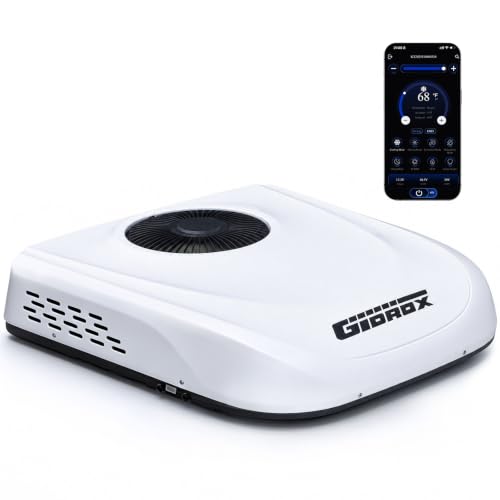
Gidrox 13,500 BTU 115V RV AC with heat pump, 43 dB claim
13,500 BTU12,000 BTU heat43 dB claim330 CFM
Check price on Amazon
Best for: 21 to 25 foot trailers wanting a properly sized heat pump.

Gidrox sizes this heat pump for 21 to 25 foot trailers, pairing 13,500 BTU of cooling with a quoted 12,000 BTU of heating. The heating figure is close to the cooling figure, which is what a genuine heat pump should deliver in mild weather and a rarity in a market full of units with a token heat function.

The maker says the heat pump saves about 65 percent of the energy of a standard heater, a comparison against resistive heat that fits the physics of reverse-cycle heating. A dual-sided outlet with a 100 degree adjustment range spreads air widely, and a claimed 43 dB suits sleeping. Airflow is listed at 330 CFM.

As always, the heating output declines as the outdoor temperature falls, and the unit is fixed to a 115V supply. Compared with the TOSOT it is smaller and better matched to modest trailers. Wash the filter monthly and watch the drainage in cold weather.

What works

  • 12,000 BTU of quoted heating close to the cooling figure
  • Maker claims about 65 percent energy saving versus resistive heat
  • Dual-sided outlet with 100 degree adjustment
  • 43 dB claim at 330 CFM

Watch out for

  • Heat pump output falls as it nears freezing
  • 13,500 BTU is small for large or sunny coaches

Spec sheet

Cooling
13,500 BTU
Heating
12,000 BTU heat pump
Airflow
330 CFM
Noise claim
43 dB
Outlet
Dual-sided, 100 degree adjustment
02
TOSOT 16,000 BTU RV AC heat pump, 43 dB claim, black
16,000 BTU12,500 BTU heat43 dB claimBlack
Check price on Amazon
Best for: Large trailers and motorhomes where bedroom noise matters.

TOSOT positions the heat pump on this 16,000 BTU unit for the transition seasons, spring and fall, when firing the furnace is overkill. It quotes 12,500 BTU of heating and says the unit works across a wide range of ambient temperatures, a claim to read as a limit and not a promise.

The 43 dB sound claim, which the maker says is 32 percent quieter than a standard RV unit, is the headline for a large unit. In a big trailer or a motorhome bedroom, that quiet is the reason to pay a premium. The black shroud suits dark roof trim.

Versus the Gidrox it has more cooling capacity and a slightly stronger heating figure for a bigger rig. A fixed-speed compressor means a soft start is wise on a generator. Check the roof gasket annually and wash the filter monthly.

What works

  • 12,500 BTU heat pump alongside 16,000 BTU cooling
  • 43 dB claim, 32 percent quieter than standard
  • Designed for transition-season heating
  • Black shroud for dark roof trim

Watch out for

  • Fixed-speed compressor surges at startup
  • Heat output falls near freezing

Spec sheet

Cooling
16,000 BTU
Heating
12,500 BTU heat pump
Noise claim
43 dB
Season use
Transition seasons
Shroud
Black
03
15,000 BTU 12V RV AC with 1,650W electric heat, 800 CFM
15,000 BTU1,650W heat800 CFMAuto defrost
Check price on Amazon
Best for: Buyers who want a heat pump with a backup element and big airflow.

This listing combines a heat pump label, a 1,650 watt electric heating element and an automatic defrost function for cold-weather operation, with a quoted 800 CFM of airflow, the highest in this guide. The defrost feature matters because a heat pump in cool damp air builds frost on its outdoor coil.

The listing mixes terms, so read the specification sheet before buying: a 15,000 BTU unit with a 12V label and a 1,650 watt element draws far more than a typical 12V system can supply, so confirm the actual power input. The airflow figure suggests a strong fan in a large cabin, and the element gives a reliable backup in colder air.

Where the Gidrox is concerned, this one offers an electric backup and airflow, but the electrical story is less clear. Check wiring and documentation before buying, and keep the coil and drain clear.

What works

  • Automatic defrost function for cold air
  • 1,650W electric element as a cold backup
  • 800 CFM airflow is the highest here
  • 15,000 BTU suits larger rigs

Watch out for

  • Listing is unclear about the real power input
  • Element draws a very large current

Spec sheet

Cooling
15,000 BTU
Heating
1,650W electric element
Airflow
800 CFM
Defrost
Automatic function
Voltage class
12V
04
Gidrox 12,000 BTU 48V DC RV AC with heat pump
12,000 BTU11,000 BTU heat48V DC300W sleep
Check price on Amazon
Best for: 48V battery conversions that want efficient heat without an inverter.

Forty-eight volts is the interesting number: a 48V system draws a quarter of the current of a 12V system for the same power, so cables are thin and voltage drop is small. Gidrox pairs that with a heat pump quoting 11,000 BTU of heating and 12,000 BTU of cooling, and says the sleep mode uses only 300 watts overnight.

The maker says the heat pump saves about 75 percent of the energy of a standard heater, and runs from the battery with no inverter. A brushless fan and sound insulation give a quoted 40 dB in sleep mode. The catch is obvious: you need a 48V battery system, which is common in some high-end conversions and bus builds but unusual in a standard trailer.

Compared with the 115V Gidrox it trades shore power for battery independence. Wire it per the maker's sheet, use a proper fuse and a low-voltage cutoff, and check terminals each season.

What works

  • 48V draws a quarter of the current of 12V
  • 11,000 BTU heat pump with a 300W sleep draw claim
  • Maker claims about 75 percent energy saving versus heaters
  • 40 dB sleep mode claim

Watch out for

  • Needs a 48V battery system
  • Uncommon outside conversion and bus builds

Spec sheet

Cooling
12,000 BTU
Heating
11,000 BTU heat pump
Voltage
48V DC
Sleep draw claim
About 300W
Sleep noise claim
40 dB
05
15,000 BTU 115V RV AC with heat, dual-rotary compressor, R32
15,000 BTUDual rotaryR32500 m3/h
Check price on Amazon
Best for: Mid-size and larger trailers wanting a smooth compressor and big airflow.

A dual-rotary compressor uses two rotors that balance each other, reducing vibration and allowing smoother operation than a single-rotor type. This 115V unit pairs that with R32 refrigerant and an airflow of 500 cubic meters per hour, a large figure for a rooftop box.

The maker says it works directly with campground power and household power and offers one-click switching between Fahrenheit and Celsius. At 15,000 BTU it covers mid-size and larger trailers, and the heat function gives warmth in mild weather. The listing gives little on heating capacity or noise, so check the sheet.

Compared with the TOSOT it has a more sophisticated compressor on paper but less published detail. A fixed-speed rating is not stated, so ask about startup current. Wash the filter and check the roof seal yearly.

What works

  • Dual-rotary compressor reduces vibration
  • R32 refrigerant
  • 500 cubic meters per hour airflow
  • Runs on campground or household power

Watch out for

  • Thin published detail on heating and noise
  • Brand support is limited

Spec sheet

Cooling
15,000 BTU
Compressor
Dual rotary
Refrigerant
R32
Airflow
500 cubic meters per hour
Voltage
115V
06
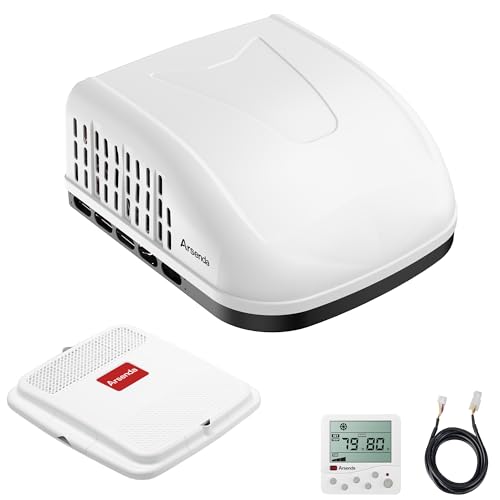
Arsenda 18,000 BTU rooftop RV AC with heat pump, 50 dB
18,000 BTUHeat pump50 dB claim115V plus 12V
Check price on Amazon
Best for: Large rigs wanting big capacity and a heat pump at a modest price.

Arsenda's 18,000 BTU unit is the biggest heat pump in the guide, with a quoted 50 dB and a standard non-ducted fit. It is aimed at large trailers and fifth wheels that want capacity and mild-weather heat for less than an established brand costs.

The unit needs both 115V AC and 12V DC to operate, so the control board depends on a healthy house battery. A big fixed-speed compressor means a heavy startup surge, and a soft start or a strong pedestal is wise. The 50 dB claim is louder than the TOSOT's 43 dB.

Compared with the Gidrox it offers more cooling and less documentation about the heating figure. Check the 12V feed after any battery work and wash the filter monthly.

What works

  • 18,000 BTU is the largest heat pump here
  • 50 dB noise claim
  • Non-ducted standard roof fit
  • Lower cost than established brands

Watch out for

  • Heavy startup surge from a big compressor
  • Needs 115V AC and 12V DC together

Spec sheet

Capacity
18,000 BTU
Heating
Heat pump
Noise claim
50 dB
Power
115V AC plus 12V DC
Duct type
Non-ducted

Spec sheet decoder

What the numbers on the box really mean

The specs manufacturers lead with, translated into what they tell you about real-world performance.

Heating BTU

The unit's heating capacity at mild outdoor temperatures, which falls as it gets colder.

Watch forGidrox 13,500 BTU quotes 12,000 BTU of heat; the TOSOT quotes 12,500 BTU.

Defrost function

A cycle that reverses the system to melt frost on the outdoor coil in cool damp air.

Watch forThe 15,000 BTU 12V-label unit lists automatic defrost; others do not.

Voltage class

115V needs shore power or a generator, while 12V and 48V run from batteries with different current needs.

Watch forThe 48V Gidrox draws a quarter of the current of a 12V unit for the same power.

CFM or m3/h airflow

The volume of air the fans move. More airflow helps distribute heat.

Watch forThe listings use different units, 330 CFM, 800 CFM and 500 m3/h, so convert before comparing.

Energy saving claim

A maker comparison between heat pump heating and resistive heating, typically 65 to 75 percent less energy.

Watch forThe claim holds in mild weather and shrinks near freezing.

Methodology

How We Evaluated These RV Air Conditioners with Heat Pumps

Heating capacity

We compared quoted heating against cooling, from the Gidrox 13,500 BTU's 12,000 BTU of heat to the 48V unit's 11,000 BTU. A genuine heat pump has heating near its cooling rating. We treated all figures as mild-weather numbers.

Cold-weather features

We looked for defrost functions, backup elements and published operating ranges. The 15,000 BTU unit scored for its automatic defrost and element. Others were credited for transition-season design.

Power system

We matched voltage class, 115V, 12V or 48V, to likely use. Battery units were judged on wiring demands. Dual-power units were flagged for needing a 12V feed.

Noise and airflow

We compared 40 to 50 dB maker claims and airflow in CFM and cubic meters per hour. A heat pump runs long, so quiet counted. We converted airflow units for comparison.

Documentation

We considered how clearly each listing described heat, power and defrost. Clear specifications scored higher. Mixed or vague listings were marked down.

Decision guide

How to Choose the Right RV Air Conditioners with Heat Pumps

By Rig Size

SituationPickWhy
21 to 25 ft trailerGidrox 13,500 BTUSized heat pump
Large trailer or motorhomeTOSOT 16K16,000 BTU, 43 dB
Large fifth wheelArsenda 18K18,000 BTU heat pump
Mid-size trailer, smooth compressor15,000 BTU dual-rotaryDual-rotary and R32

By Budget

SituationPickWhy
Lowest outlay, largeArsenda 18KCapacity per price
Mid-range, sizedGidrox 13,500 BTUHeating near cooling
Mid-range, quietTOSOT 16K43 dB claim
Higher, battery systemGidrox 48V48V DC

Shore Power vs Battery

Shore power

The Gidrox 13,500 BTU, TOSOT, Arsenda and dual-rotary units run from a pedestal or generator and cool larger rigs.

Battery

The 48V Gidrox runs from batteries with thin cable but needs a 48V system. It cools smaller spaces.

Shore power for trailers; battery for conversions with 48V banks.

Cold-Weather Behavior

SituationPickWhy
Cool damp mornings15,000 BTU with auto defrostDefrost and element
Mild spring and fallTOSOT 16KTransition-season design
Efficient mild heatGidrox 13,500 BTU12,000 BTU heat claim
Real freezing weatherUse a furnaceHeat pumps fade

For Spring and Fall Camping Specifically

Look for

Heating close to cooling BTU, a quiet claim and a clear drain path. Pre-warm the cabin before waking.

In this comparison

The Gidrox 13,500 BTU and the TOSOT fit best. The Gidrox claims 65 percent energy saving versus a standard heater.

When to Spend More

Spend more if

You camp in shoulder seasons often or sleep under the unit. The TOSOT and Gidrox repay in quiet and efficiency.

Save if

You camp mostly in summer. The Arsenda gives capacity for less.

Ownership

Maintenance schedule

The upkeep that decides whether this machine lasts two seasons or ten.

TaskIntervalWhy it matters
Wash filterMonthly in seasonA heat pump moves air through the same coil in both modes. A clogged filter hurts heating and cooling.
Check drain pathBefore cold weatherDefrost water must drain. A frozen drain can crack the pan, so clear leaves and debris from the drain holes in the base and confirm water runs freely when you pour a cup into the pan.
Inspect roof sealEach springCracked sealant leaks cold air in winter and water in summer.
Check 12V or 48V connectionsEvery seasonBattery-powered units draw high current. A loose lug runs hot.
Test heat mode in autumnStart of cold seasonA failed reversing valve is easier to find early. Compare vent temperature with the maker's claim.

FAQ

Frequently Asked Questions

How cold can an RV heat pump work?

Output falls steadily as the air nears freezing, and the unit spends more time in defrost cycles. Treat the quoted heating as a mild-weather number and plan on a furnace for colder nights. A thermometer at the vent in the first cool morning of the season tells you what your unit really delivers, and that figure is the one to plan around.

Is a heat pump cheaper to run than a heater?

In mild weather, yes. Makers claim 65 to 75 percent less energy than resistive heat, and the physics supports a large saving. The advantage shrinks in the cold. The saving is largest when the heat pump runs steadily at a gentle speed, and smallest when a cold, damp night forces constant defrost cycles.

Can a heat pump replace a furnace?

Not in freezing weather. It complements a furnace, covering spring and fall mornings and saving propane. Think of it as the first stage of heating, with the furnace as the second stage that takes over when the outdoor temperature drops.

Why does my heat pump make water?

In heating mode it defrosts the outdoor coil periodically, which melts ice into water. A clear drain path prevents freezing and leaks. If you see a puddle under the unit in cold weather, that is usually normal defrost water, but a puddle inside the coach is a sign of a blocked pan or a failed seal.

What does 48V mean for an RV air conditioner?

The unit runs from a 48V battery system, drawing a quarter of the current of a 12V unit for the same power. It needs a 48V system, which is uncommon in standard trailers.

Do heat pump models cost much more?

They usually cost more than a cooling-only unit of the same size, because they carry a reversing valve and a more capable coil. The payback comes in propane and furnace runtime, and it is slow if you camp mostly in summer. For a rig that lives in spring and fall conditions, the saving shows up quickly in fuel and in the quiet of not lighting a furnace.

Bottom line

The short version

Browse more rv air conditioners with heat pumpson Amazon →
James Miller, Lead Machine Editor

About the author

James Miller

Lead Machine Editor, MachineFanatic

James Miller leads MachineFanatic's buying guides, turning spec sheets, manuals and owner feedback into clear verdicts on power tools, outdoor power equipment, shop machines and kitchen machines.

More from James →

Keep reading

Related guides