
Amazon affiliate links - we earn a commission.Affiliate disclosure

Buying guide · 13 min read · Updated 2026-11-07

Best RV Generators (2026)

Six RV generators compared by rated watts, fuel type, noise and weight, from a quiet inverter for a small trailer to a 4,500 watt unit for large rigs.

James MillerBy James MillerLead Machine Editor6 machines comparedSpec-sheet verified
Best RV Generators

At a glance

Our top picks

Side by side

Spec comparison

An RV generator has one job that never changes: keep the air conditioner and the battery charger running when the campground has no power. Everything else, from noise to fuel type to weight, is a trade against that single demand.

The market splits into quiet inverter machines and cheaper open-frame ones, and into gasoline-only and dual fuel designs. This guide ranks six machines that cover the common rigs and explains where each one stops being enough.

Before you buy

6 Criteria to Look For Before Buying a RV Generator

  1. 01

    Air conditioner and rig size

    A 13,500 BTU roof unit needs 2,500 to 3,000 watts to start and 1,500 to run. The Westinghouse 5000 at 3,900 rated and PowerSmart 4300 at 3,500 running cover one, while two need the WEN 6800 at 5,100 rated. Count your roof units before anything else, and check each nameplate for its running amps, since an older 15,000 BTU unit can draw noticeably more than a newer 13,500 BTU one. A soft start kit cuts the starting surge and is the cheapest way to let a smaller generator carry an air conditioner.

  2. 02

    Inverter versus open frame

    An inverter converts to DC and back for clean power and a throttle that follows load. The WEN GN5600 open frame gives 4,500 running watts for less money but louder. For a campground with quiet hours, choose inverter, because a fixed-speed open frame at 70 dBA or more at the pad is the machine neighbors complain about first. Power quality also matters if the RV has a modern converter, TV board or CPAP.

  3. 03

    Gasoline versus dual fuel

    Propane stores for years and suits an RV that already carries it. The Westinghouse 5000 and WEN 6800 are dual fuel, losing about 10 percent of output on propane. Gasoline-only units like the PowerSmart 4300 are simpler, with fewer fittings that can leak or stiffen, and they cost less. If you rarely store the machine for long, the simplicity may outweigh the propane benefit.

  4. 04

    Runtime claims

    The PowerSmart claims 12 hours at quarter load and the EFURDEN 5 hours at half load. A number with no load basis is meaningless. Halve any claim for real air conditioner use, and expect even less in hot weather when the compressor runs almost continuously. Carry a spare can so a mid-trip refuel does not become a drive to town.

  5. 05

    Weight and carrying

    Larger machines need a ramp or a truck. Open frames like the GN5600 are heavy. Check your storage method before buying, and measure the bay or rack, since several of these frames are wider than they look in the photos. A machine that does not fit its storage place ends up riding in the cabin, which is neither safe nor pleasant.

  6. 06

    Safety shutoffs

    A CO sensor, like the WEN 6800's Watchdog, shuts the engine down if gas builds up. It does not replace outdoor placement. Low oil protection stops a run but protects the engine, and a sudden shutdown is a prompt to check the dipstick, not to restart it repeatedly. Never remove or bypass these sensors.

Detailed reviews

The 6 best rv generators, explained

01
Westinghouse 5000 Peak Watt Dual Fuel Inverter, Remote Start
3900 rated wattsDual fuelRemote startUnder 3% THD
Check price on Amazon
Best for: Most RV owners who want output, clean power and convenience from one machine.

The Westinghouse earns first place by doing many things competently. It delivers 3,900 rated watts, which is enough for a 13,500 BTU air conditioner plus normal loads, and it adds a propane option, remote start and a rotating display showing fuel level, output, runtime and voltage. Distortion is under 3 percent, so a laptop or CPAP is safe.

The design is an inverter with a telescoping handle and wheels, so it moves like a small suitcase. The remote key fob lets you start it from inside the coach. Propane drops the output, as it does for every dual fuel unit, so read the manual for the figure before you rely on it for an air conditioner.

Upkeep is typical for a modern inverter. Change the oil after the first 20 hours, run on propane now and then to keep the regulator supple, and keep the starter battery charged. Compared with the iGen4000DF in this family it adds 600 rated watts, which is the reason to buy this one. In practice that margin is what lets the microwave run while the compressor cycles, instead of tripping the overload light every time someone makes coffee.

What works

  • 3,900 rated watts covers one air conditioner and more
  • Remote key fob start
  • Gasoline or propane operation
  • Display shows runtime and voltage

Watch out for

  • Propane lowers the output
  • Not enough for two air conditioners

Spec sheet

Peak watts
5,000
Rated watts
3,900
Fuel
Gasoline or propane
Outlets
5-20R, TT-30R, two USB
Display
Rotating LED data center
02
PowerSmart 4300 Watt Inverter Generator, 12 Hour Runtime
3500 running watts1.9 gal tank12 h at 25%Under 3% THD
Check price on Amazon
Best for: Buyers who want a gasoline inverter with long light-load runtime at a low cost.

PowerSmart's pitch is long runtime at a modest cost. A 1.9 gallon tank claims up to 12 hours at a quarter load, and 3,500 running watts is enough for one air conditioner and a few appliances. The under 3 percent distortion rating suits electronics.

It is gasoline only, so it lacks the propane flexibility of the Westinghouse. That keeps cost down and complexity low, which is exactly why it is the value choice. The brand is newer, so verify the warranty.

A quarter load claim means lights and chargers, not an air conditioner, so expect fewer hours under a heavy load. Rated watts fall 400 short of the Westinghouse 5000, and so does the price. Run the carburetor dry before storage and change the oil early. Because the tank is small and the brand is newer, carry a spare plug and filter and keep the manual where you can find it.

What works

  • 1.9 gallon tank claims 12 hours at quarter load
  • 3,500 running watts for one air conditioner
  • Under 3 percent THD for electronics
  • Lower cost than the major brands

Watch out for

  • Gasoline only
  • Newer brand with limited support

Spec sheet

Starting watts
4,300
Running watts
3,500
Tank
1.9 gallons
Runtime
Up to 12 hours at 25% load
Power quality
Under 3% THD
03
EFURDEN 4300W Inverter Generator, 30A RV Ready, USB-C
3300 running wattsUnder 2% THD5 outletsUSB-C QC 3.0
Check price on Amazon
Best for: RVs full of electronics that run the generator a few hours a day.

The cleanest power in the lineup comes from this unit: under 2 percent distortion, with a USB-C QC 3.0 port and a 30 amp outlet. A trailer full of electronics benefits from that waveform.

It runs five hours at half load on the listing, shorter than the PowerSmart's claim, so it suits owners who run it for a few hours a day rather than overnight. At 3,300 running watts it covers one air conditioner with care.

The brand has a thin support network, so register the warranty. A quick oil check and a clear set of vents before each run is the whole routine. Compared with the PowerSmart 4300, it adds cleaner power and charging ports but gives less runtime. Owners who use it as a daytime charger for batteries and devices, rather than a night-long unit, get the best of it.

What works

  • Under 2 percent THD is very clean
  • USB-C QC 3.0 and USB ports
  • 30 amp outlet plus two 20 amp outlets
  • Compact inverter body

Watch out for

  • Five hours at half load is short
  • Limited brand support

Spec sheet

Starting watts
4,300
Running watts
3,300
Power quality
Under 2% THD
Runtime
5 hours at 50% load
Outlets
30A, two 20A, USB, USB-C
04
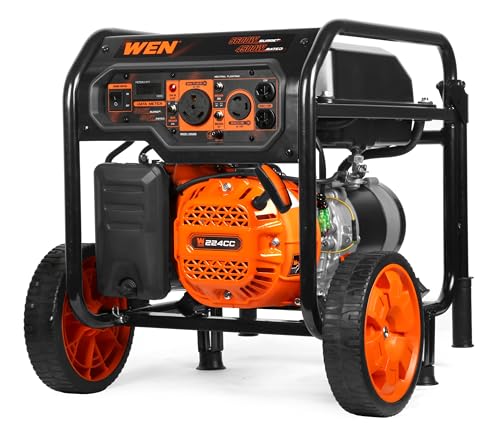
WEN GN5600 5600 Watt Generator, Transfer Switch and RV Ready
4500 running watts224cc engine4.3 gal tank12.5 h at half load
Check price on Amazon
Best for: Owners who want capacity, runtime and home backup at a modest cost.

This is the conventional workhorse: a 224cc open-frame engine making 4,500 running watts, a 4.3 gallon tank and a claimed 12.5 hours at half load. A wheel and handle kit makes it movable, and it is both transfer switch and RV ready.

It is louder than any inverter and gives dirtier power, so it suits owners who prioritize capacity and cost over quiet. The 4,500 running watts beats every inverter here except the WEN 6800, and is enough for an air conditioner plus a microwave.

It serves as home backup too, which is a bonus for a dual-use buyer. Keep the oil full, store the fuel stable and run it monthly. It adds 600 rated watts and a bigger tank over the Westinghouse 5000, but without quiet or remote start. A neighbor at the next site will hear it clearly, so use it where rules and distance allow, and keep it on a level pad so the oil sensor reads correctly.

What works

  • 4,500 running watts for large loads
  • 4.3 gallon tank claims 12.5 hours at half load
  • Transfer switch and RV ready
  • Wheel and handle kit included

Watch out for

  • Much louder than an inverter
  • Dirtier power for electronics

Spec sheet

Starting watts
5,600
Running watts
4,500
Engine
224cc
Tank
4.3 gallons
Runtime
Up to 12.5 hours at half load
05
WEN 6800 Watt Dual Fuel RV Ready Inverter, CO Watchdog
5100 rated watts224cc engineCO Watchdog240V output
Check price on Amazon
Best for: Large rigs with two air conditioners that want inverter quiet.

The WEN 6800 is where an RV owner goes when 3,900 watts is not enough. At 5,100 rated on gasoline and 4,500 on propane it can run two air conditioners with some care, and it is still an inverter, so noise is moderate.

The CO Watchdog shuts the engine off if carbon monoxide builds up, and the bonded-neutral 240 volt configuration allows low-power vehicle charging. These are practical extras for a large rig.

It is heavy, so plan a ramp or a truck. That is 1,200 more rated watts than the Westinghouse 5000. Run it monthly and keep the oil full. A machine with 5,100 rated watts working at 70 percent load for hours runs hot, so give it space on all sides and never box it in with a cover while it runs.

What works

  • 5,100 rated watts handles two air conditioners
  • CO Watchdog shutoff
  • Dual fuel with 4,500 rated watts on propane
  • 240V output for vehicle charging

Watch out for

  • Heavy for casual carrying
  • Costs more than the 4,000 watt class

Spec sheet

Gas output
6,800 surge, 5,100 rated
Propane output
6,000 surge, 4,500 rated
Engine
224cc dual fuel
Safety
WEN Watchdog CO shutoff
Extra
Bonded-neutral 240V output
06
Westinghouse iGen4000DF 4000 Peak Watt Dual Fuel Inverter
3300 rated wattsDual fuelRemote startUnder 3% THD
Check price on Amazon
Best for: Small to mid trailers that want remote start and propane in a lighter frame.

This version of the iGen4000DF adds remote start to the recoil model, so a trailer owner can fire it from the couch. At 3,300 rated watts it suits a single air conditioner rig with modest extras.

It shares the data center, clean power and propane option of the bigger sibling in a lighter frame. That makes it easier to lift into a bumper rack.

It costs more than the recoil version, and the 3,300 rated watts is tight with an air conditioner and microwave. Run it monthly and keep the battery charged. A trailer owner who lifts it onto a bumper rack should confirm the rack rating first, since a falling generator on a highway is a serious hazard.

What works

  • Remote start included
  • Gasoline or propane operation
  • Under 3 percent THD
  • Lighter than the 5000 watt sibling

Watch out for

  • 3,300 rated watts is tight with a microwave
  • Costs more than the recoil version

Spec sheet

Peak watts
4,000
Rated watts
3,300
Fuel
Gasoline or propane
Start
Remote and electric
Outlets
5-20R, TT-30R, two USB

Spec sheet decoder

What the numbers on the box really mean

The specs manufacturers lead with, translated into what they tell you about real-world performance.

Rated watts

Continuous output the machine holds. This is the number to compare with the sum of the appliances you expect to run together.

Watch forThe Westinghouse 5000 lists 3,900, the WEN 6800 5,100.

Starting watts

Short surge for motors. It lasts a second or two, so it helps a compressor start but cannot carry a load.

Watch forThe GN5600 lists 5,600 starting, 4,500 running.

THD

Waveform cleanliness, measured as how far the output departs from a perfect sine wave. A lower percentage is gentler on sensitive circuit boards.

Watch forThe EFURDEN states under 2 percent.

Runtime basis

The load at which hours are quoted. A claim at quarter load will look far better than the same machine at full load.

Watch forThe GN5600 states 12.5 hours at half load.

Transfer switch ready

An outlet that can feed a house transfer switch. It is useful when the same machine doubles as home backup during an outage.

Watch forThe GN5600 lists it.

Methodology

How We Evaluated These RV Generators

Rig fit

We compared rated watts to common rigs. The Westinghouse 5000 suits one air conditioner, the WEN 6800 two. We assumed a 13,500 BTU roof unit as the benchmark load and added a microwave and a battery charger on top.

Fuel options

Dual fuel and propane output were considered. The WEN 6800 gives 4,500 on propane, a drop of about 600 watts from gasoline, and that loss was weighed against machines that publish no propane number at all.

Noise and power quality

Inverter designs scored higher than open frame. The EFURDEN under 2 percent THD led, with the Westinghouse and PowerSmart units at under 3 percent close behind. Open-frame output without a published figure was treated as the weakest option for electronics.

Runtime honesty

Listings with a load basis scored higher. The GN5600 figure of 12.5 hours at half load is a useful one, and the EFURDEN five hours at half load shows how wide the spread is between tank sizes.

Ownership

Based on owner feedback patterns, we weighed brand support and parts. Westinghouse and WEN scored well, since both publish manuals, part numbers and service contacts that make a repair possible far from home.

Decision guide

How to Choose the Right RV Generators

By Rig Size

SituationPickWhy
Typical travel trailer, one air conditionerWestinghouse 50003,900 rated watts, remote start
Small trailer, tight budgetPowerSmart 43003,500 running watts, long runtime
Electronics-heavy rigEFURDEN 4300Under 2 percent THD
Large rig, two air conditionersWEN 68005,100 rated watts
Capacity and home backupWEN GN56004,500 running watts

By Budget

TierPickWhy
Lowest cost per wattWEN GN5600Open frame
Low to midPowerSmart 4300Long runtime inverter
MidEFURDEN 4300Clean power
Upper midWestinghouse iGen4000DFRemote start and dual fuel
HighestWEN 6800Largest output

Inverter vs Open Frame

Inverter (Westinghouse, WEN 6800, PowerSmart)

Quiet, clean and efficient at light load, with an engine that slows down at night when only a fridge and lights run. The Westinghouse 5000 adds remote start, and the PowerSmart 4300 adds a long quarter-load runtime.

Open frame (WEN GN5600)

Higher output per cost and home backup, but louder with dirtier power, and a fixed engine speed that burns the same fuel at light load as at heavy load. It is the right tool for a driveway and a storm, and a compromise at a quiet campground.

Choose inverter for campgrounds; choose open frame for capacity and cost.

Fuel Preference

PreferencePickWhy
Propane as a main fuelWEN 68004,500 rated watts on propane
Propane with remote startWestinghouse 5000Dual fuel and key fob
Gasoline only, low costPowerSmart 4300Simple and cheap
Small dual fuelWestinghouse iGen4000DFLighter frame
Gasoline and home backupWEN GN5600Transfer switch ready

For Campground Use Specifically

Look for

Quiet inverter design, low noise at part load, and clean power. Place the machine away from neighbors, point the exhaust away from tents and windows, and set it on a rubber mat to reduce vibration carried through the ground.

In this comparison

The Westinghouse 5000 and iGen4000DF are the best fit, with the WEN 6800 for larger rigs.

When to Spend More

Spend more if

You run two air conditioners or want propane and remote start. The WEN 6800 and Westinghouse 5000 justify it, because the extra cost buys output headroom, a CO shutoff or a convenience you will use every trip.

Save if

You run light loads or camp mostly with hookups. The PowerSmart 4300 or WEN GN5600 covers it without paying for features you will not use.

Ownership

Maintenance schedule

The upkeep that decides whether this machine lasts two seasons or ten.

TaskIntervalWhy it matters
Check oilEach startSmall crankcases hold little oil and run hot. Low oil stops the run, and running low can score the cylinder wall.
Change oilAfter 20 hours, then every 50 hoursBreak-in debris collects early.
Stabilize fuelBefore storageGasoline gums jets within weeks, especially ethanol blends. Use stabilizer or run the carburetor dry before putting the machine away.
Exercise on propaneEvery 2 to 3 monthsRegulators stiffen when idle.
Charge the start batteryMonthlyRemote and electric start depend on it.

FAQ

Frequently Asked Questions

What size RV generator do I need?

One air conditioner needs about 3,500 to 3,900 rated watts. Two need around 5,000. Count your roof units and appliances, and add the starting surge of the largest compressor to the running load of everything else.

Is an inverter generator worth it for an RV?

For quiet and clean power, yes. Open frames cost less per watt but are louder.

Which is the best budget choice?

The PowerSmart 4300 is the lowest cost inverter, while the WEN GN5600 is the lowest cost per watt.

Is dual fuel worth it?

Usually, since RVs carry propane. Expect about 10 percent less output on propane, as on the WEN 6800 where 5,100 rated watts becomes 4,500, and exercise the propane side now and then so the regulator stays supple.

Can I run it at a campground?

Only where rules allow and during permitted hours. Quiet inverters are accepted more often.

Where should I place it?

Outdoors, on level ground, well away from windows and doors. Never run it in an enclosed space, a garage or a storage bay, and keep a battery-powered carbon monoxide detector inside the RV.

Bottom line

The short version

Browse more rv generatorson Amazon →
James Miller, Lead Machine Editor

About the author

James Miller

Lead Machine Editor, MachineFanatic

James Miller leads MachineFanatic's buying guides, turning spec sheets, manuals and owner feedback into clear verdicts on power tools, outdoor power equipment, shop machines and kitchen machines.

More from James →

Keep reading

Related guides