

Amazon affiliate links - we earn a commission.Affiliate disclosure

Buying guide · 12 min read · Updated 2026-11-07

Best RV Space Heaters (2026)

Six electric space heaters for RVs compared across fan, tower, wall and compact designs, with notes on amp draw, thermostats and 30 amp service limits.

James MillerBy James MillerLead Machine Editor6 machines comparedSpec-sheet verified
Best RV Space Heaters

At a glance

Our top picks

Side by side

Spec comparison

An RV space heater is a plug-in electric heater that supplements the furnace. It earns its place because it uses shore power instead of propane, starts instantly and can be moved to wherever you are sitting.

Most RV owners buy one for the same few reasons: the furnace is loud, propane is running low, or one room stays colder than the rest. The right choice depends less on brand than on how many amps your pedestal supplies and where the heater will actually stand.

Before you buy

6 Criteria to Look For Before Buying a RV Space Heater

  1. 01

    Start with your amp service

    A 30 amp RV supplies about 3,600 watts shared by everything. A 1500 watt heater draws about 12.5 amps, a 1200 watt step about 10 and a 900 watt step about 7.5. The Xtreme and the Amazon Basics 900 watt step both leave room for the air conditioner, while a full 1500 watt heater plus the microwave will trip the breaker faster than most people expect.

  2. 02

    Thermostat beats manual switching

    A thermostat cycles the element to hold a temperature, which lowers the average draw. The DREO Atom One adds ECO and a 12 hour timer, and the Lasko adds a thermostat and remote. Units without one need you to switch steps by hand, which is fine for an evening and tiresome for a week.

  3. 03

    Shape and stability

    A moving RV is a tough place for a tall heater. The Lasko tower is 23 inches high, while the Xtreme sits low with a wide base. Pick a shape that stays put on your floor, and secure it before driving. A rubber mat under any heater is a cheap way to stop it creeping.

  4. 04

    Airflow reach

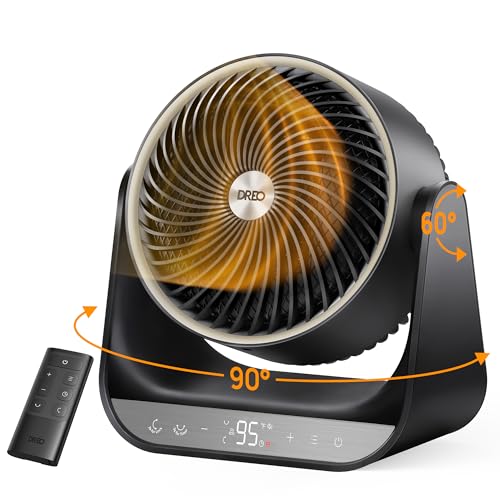
    In a long RV a single-axis sweep may not reach the bedroom. The DREO Whole Room unit sweeps 60 degrees vertically and 90 horizontally at 12 feet per second. Wider coverage means fewer cold pockets, and fewer pockets mean you can set the thermostat lower and still feel comfortable.

  5. 05

    Wet areas need rated heaters

    A standard heater does not belong in a bathroom. The DREO wall heater lists IP24 and an ALCI plug, which suit a splash zone. Never carry a portable unit into a wet room.

  6. 06

    Noise near sleeping spaces

    Fan heaters run mid-40s decibels or higher, and cheap motors get louder with dust. Maker figures for quiet operation are claims, so treat them as a comparison and not a promise. A brushless design or lower step reduces it. Keep the heater a few feet from your pillow, and clean the grille before you judge the noise.

Detailed reviews

The 6 best rv space heaters, explained

01
DREO Atom One 1500W Heater with ECO Mode and 12H Timer
1500W PTCECO mode12H timer70 degree sweep
Check price on Amazon
Best for: Daily RV heating where thermostat and timer features earn their keep.

DREO's Atom One drives a 1500 watt PTC ceramic element with a thermostat, a remote and an ECO mode that eases the heat level as the cabin reaches your target. That last feature is the practical edge in an RV: it keeps the heater from running at full power once the small space is warm, and it protects your breaker by lowering the average draw. A 70 degree oscillating head spreads the warmth across a typical living area.

The maker lists an ETL-listed protection system covering tip-over and overheat conditions. Versus the Amazon Basics ceramic unit in this roundup it costs more and adds the timer, remote and ECO logic, while the basic output of 1500 watts is identical. If you only want a boost for a few minutes, the extra features will go unused.

On a 30 amp service the high setting draws about 12.5 amps, which is most of what a shared circuit can spare. Vacuum the intake grille monthly and store it upright in a cabinet when you travel. Change the remote battery before winter so the timer is available when you need it. Owners who set a bedtime schedule and an automatic shutoff tend to be happier than those who rely on memory, and the breaker thanks them as well.

What works

  • ECO mode lowers average draw as the cabin warms
  • 12 hour timer and remote suit bedtime use
  • 70 degree sweep spreads warmth
  • ETL-listed protection system

Watch out for

  • High setting draws about 12.5 amps
  • Features cost more than a basic unit
  • Fan noise rises as dust builds

Spec sheet

Element
1500W PTC ceramic
Efficiency mode
ECO auto-adjust
Timer
12 hours
Sweep
70 degrees
Safety
ETL-listed Shield360 protection
02
Xtreme Heaters 600/1200W RV and Cabin Heater, White
600W/1200WTop air intakeLow stable baseTip-over protection
Check price on Amazon
Best for: Small electrical systems and tight spaces where wall placement matters.

Xtreme Heaters makes this unit for boats, cabins and RVs and says so in the engineering: air enters from the top so you can push the back against a wall, and the low, wide base resists tipping when the floor moves. Its two steps are 600 and 1200 watts, chosen for small electrical systems rather than for the biggest number on a box.

At 1200 watts it draws about 10 amps, which leaves a couple more amps free on a 30 amp circuit than a 1500 watt heater does. The 600 watt step draws about 5 amps and holds a small cabin gently overnight. Against the DREO it has no thermostat or remote, so you manage the temperature by switching steps.

It is also the simplest unit here, and that simplicity helps in storage and repair. Keep the top intake clear of lint and avoid stacking items on it. Test the tip-over shutoff at the start of each season. A heater this plain rewards a simple routine: wipe it, check the cord, and tuck it behind the dinette bench where it cannot be kicked.

What works

  • Top intake allows flush wall placement
  • 1200W peak draws about 10 amps
  • Low stable base resists sliding and tipping
  • Built for boats and RVs

Watch out for

  • No thermostat or remote
  • Lower peak heat than 1500W units
  • Basic controls

Spec sheet

Power steps
600W and 1200W
Draw at 1200W
About 10 amps
Intake
Top, sits flush to a wall
Base
Low and stable
Safety
Tip-over shutoff
03
Lasko 23 Inch Oscillating Ceramic Tower Heater with Remote
1500W ceramic5,118 BTU23 inch towerThermostat
Check price on Amazon
Best for: Corners and narrow aisles where a tall, slim unit fits best.

Lasko's tower puts an elongated 1500 watt ceramic element into a 23 inch cabinet and quotes 5,118 BTU. The long element heats quickly, and the oscillating head sweeps it across the room. A thermostat and remote let you set it from the couch.

A tower's footprint is small, which suits corners and narrow aisles. The cost of that tall, narrow shape is stability, so it needs more care in a rig that moves. Next to the DREO Atom One it offers a different shape, not different heat.

Secure it in transit and never run it while driving. Wipe the front grille with a dry cloth. Keep an eye on the base, since a tower only stays safe on a level surface. If you park on a slope with the jacks down, put a level shim or fold-out table under it, or choose a low heater for that spot instead.

What works

  • Slim tower saves floor space
  • Long element heats quickly
  • Thermostat and remote included
  • Oscillating head spreads heat

Watch out for

  • Tall shape tips more easily on a moving floor
  • Full 12.5 amp draw on high
  • Needs strapping for travel

Spec sheet

Power
1500W ceramic element
Output
5,118 BTU
Height
23 inches
Control
Thermostat and remote
Oscillation
Yes
04
DREO Whole Room Heater with 3D Oscillation
1500W PTC60 degree vertical sweep90 degree side sweep12 ft/s airflow
Check price on Amazon
Best for: Long RV living areas where airflow needs to reach the far end.

This DREO adds a vertical sweep of 60 degrees to a horizontal sweep of 90, so the airflow moves in two axes instead of one. The goal is to mix the air in the room rather than just push it from one point, and in a long, narrow RV that helps warmth reach the far end. Airflow is listed at 12 feet per second from a 1500 watt PTC element.

The two-second claim describes how fast the element starts to blow warm air, which is typical of PTC. Overheat shutoff, tip-over protection and flame-retardant housing are listed. Against the Atom One, it concentrates on coverage rather than thermostat features.

The extra motors add complexity, so keep the intake clean and listen for new noises each season. Store it upright and padded in a closet corner. Use a lower step when other appliances are running, and run it on the highest speed only to pull the chill out of the cabin first thing. After that, a lower speed with the sweep on does the same work with less noise.

What works

  • 3D sweep mixes the air in two axes
  • 12 ft/s airflow reaches distant seats
  • Overheat and tip-over protection
  • PTC element warms in seconds

Watch out for

  • Two oscillation motors add wear points
  • Full 12.5 amp draw on high
  • Thermostat features are less central

Spec sheet

Element
1500W PTC ceramic
Vertical sweep
60 degrees
Horizontal sweep
90 degrees
Airflow
12 ft/s
Warm-up claim
2 seconds
05
Amazon Basics 1500W Ceramic Heater with Thermostat
1500W/900W/fanThermostat3 lbOverheat protection
Check price on Amazon
Best for: Budget shoppers who want a light, simple heater.

Amazon Basics offers a compact ceramic heater with 1500, 900 and fan-only settings and a thermostat dial. It weighs about 3 pounds and measures 7.5 by 6.3 by 9.5 inches, small enough for a shelf or a cupboard. The 900 watt step is the setting to use on a shared RV circuit, drawing about 7.5 amps.

Overheat and tip-over protection are standard, along with a power indicator. Against the Xtreme it is cheaper and lighter, but it has a normal intake design that needs clearance behind it. A dial thermostat swings a few degrees, so expect a bit of cycling.

Small units stow easily in a bin, and the cord wraps loosely without strain. Wipe the grille and check the cord for kinks and cracks. Use it as a quick supplement, not as a whole-cabin plan. It is a fine spare to keep in a storage bay, because it takes almost no room and costs little to replace.

What works

  • 900W step draws about 7.5 amps
  • 3 pound body stows easily
  • Thermostat dial included
  • Fan-only mode for summer

Watch out for

  • Dial thermostat is less precise
  • Intake needs clearance behind it
  • No remote or timer

Spec sheet

Power steps
1500W, 900W, fan only
Weight
About 3 lb
Footprint
7.5 x 6.3 x 9.5 in
Control
Thermostat dial
Safety
Overheat and tip-over
06
DREO Smart Wall Heater with ALCI Plug and IP24 Rating
Wall mountedALCI plugIP24 ratedAlexa control
Check price on Amazon
Best for: RV bathrooms and kitchenettes where moisture is a concern.

This DREO is a wall-mounted PTC heater built for bathrooms, with an ALCI plug, 5VA flame-retardant materials and an IP24 splash rating. An ALCI plug cuts power when it detects a leakage current, which is the extra safety layer you want near water. A touch panel, remote and app give you three ways to control it.

Fixed on the wall, it frees the floor and cannot tip over on the road. The RV bath is often the coldest room, so a dedicated heater there makes sense. Beside the portable units, you give up flexibility but gain safety in a damp room.

Mount it on solid structure rather than thin paneling. Dust the intake each season, using a soft brush. Check the plug test button regularly, as the maker's instructions advise, and wipe the front panel with a barely damp cloth rather than spraying cleaner near the controls.

What works

  • ALCI plug adds leakage protection
  • IP24 rating tolerates splashes
  • Wall mount frees floor space
  • Touch panel, remote and app control

Watch out for

  • Fixed in one place
  • Needs solid wall mounting
  • Smart features depend on Wi-Fi

Spec sheet

Mount
Wall mounted
Plug
ALCI plug
Protection
IP24, 5VA flame-retardant
Control
Touch panel, remote and app
Voice
Works with Alexa

Spec sheet decoder

What the numbers on the box really mean

The specs manufacturers lead with, translated into what they tell you about real-world performance.

Wattage steps

Steps set the power levels available and the amps drawn. Lower steps leave breaker headroom.

Watch forXtreme offers 600 and 1200 watts, and Amazon Basics offers 900 and 1500.

Sweep angle

Oscillation angle shows how widely the airflow is spread. It does not change heat output.

Watch forThe Atom One sweeps 70 degrees, and the Whole Room sweeps 90 horizontally.

ALCI plug

An ALCI plug detects leakage current and cuts power. It is a protective measure for wet areas.

Watch forThe DREO wall heater lists an ALCI plug.

BTU rating

BTU measures heat. Every 1500 watt resistance heater makes about 5,100 BTU per hour.

Watch forLasko quotes 5,118 BTU, which matches the physics.

ECO mode

ECO mode adjusts output toward a target temperature. It lowers the average draw.

Watch forThe DREO Atom One lists ECO.

Methodology

How We Evaluated These RV Space Heaters

Electrical fit

We compared wattage steps with a 30 amp RV service. The Xtreme at 1200 watts and the Amazon Basics at 900 watts score best for sharing. The 1500 watt units need headroom.

Control quality

We looked at thermostats, ECO routines, timers and remotes. The DREO Atom One leads, and the Xtreme trails because it has none of these.

Stability on the road

We judged the shape and base for a moving floor. Low, wide units and wall mounts scored highest. The tall tower scored lower.

Coverage

We compared sweep angles and airflow figures. The DREO Whole Room's 3D sweep reaches furthest. A single point heater scored lower for long layouts.

Safety listing

We checked tip-over, overheat and leakage protections in each listing. Owner feedback patterns on warm plugs and rattling fans informed the cautions. We did not credit features a listing left out.

Decision guide

How to Choose the Right RV Space Heaters

By Floor Plan

SituationPickWhy
Long, narrow trailerDREO Whole Room3D sweep carries warmth to the far end.
Standard living areaDREO Atom OneECO and timer hold the cabin steady.
Tight aisle or cornerLasko towerSlim footprint.
BathroomDREO Smart Wall HeaterALCI plug and IP24 rating.

By Budget

Budget tierPickWhy
LowestAmazon Basics 1500WPlain and inexpensive.
Lower to middleXtreme 600/1200WRV-oriented low-draw design.
MiddleLasko towerRemote and thermostat.
HigherDREO Atom OneECO, timer and remote.

Tower vs Compact Box

Tower

The Lasko stands tall and slim, so it takes little floor space but tips more easily. It suits a fixed corner in a rig that rarely bounces.

Compact box

The Amazon Basics and Xtreme sit low with a wide base, which resists tipping. They take more floor area but are safer in transit.

Full-timers can use a tower, and frequent travelers should prefer a low box.

By Control Preference

PreferencePickWhy
ECO and timerDREO Atom OneAutomatic output trim and 12 hour timer.
Remote and thermostatLasko towerSimple remote control.
App and voiceDREO Smart Wall HeaterAlexa and app.
Switch onlyXtreme 600/1200WTwo steps, nothing else.

For Shared 30 Amp Circuits Specifically

Look for

Choose a unit with a step at or below 1200 watts, and avoid running the air conditioner at the same time. Plug directly into the outlet.

In this comparison

The Xtreme at 1200 watts and the Amazon Basics at 900 watts fit best. The DREO units work if you stay on their lower modes.

When to Spend More

Spend more if

You heat daily or want precise control. The DREO Atom One and Whole Room earn their cost in daily use.

Save if

You need only an occasional boost. The Amazon Basics or Xtreme does the job.

Ownership

Maintenance schedule

The upkeep that decides whether this machine lasts two seasons or ten.

TaskIntervalWhy it matters
Dust the intakeMonthly in useLint restricts airflow and adds noise. A brush clears it.
Check the plugEach seasonA warm plug points to a bad connection. Replace the heater if it discolors.
Test the tip-over switchStart of seasonA tilted unit should cut power. It confirms the safety switch works.
Inspect wall mountsTwice a yearRoad vibration loosens screws. Tighten them before travel.
Store in a binBetween tripsA bin protects the fan and cord. Coil the cord loosely.

FAQ

Frequently Asked Questions

What size heater does an RV need?

The usual rule is about 10 watts per square foot, so 1500 watts covers roughly 150 square feet. Smaller cabins can use 600 to 1200 watts, and a well-insulated van may need even less. Poor windows and no skirting raise the demand sharply.

Will a space heater trip my RV breaker?

It can when combined with an air conditioner or microwave, since those appliances pull most of what a 30 amp service can supply. Turn them off, or drop the heater to a lower step, before you reach for the reset button. A 1500 watt heater draws about 12.5 amps on a 30 amp service.

Is an electric heater cheaper than propane?

It depends on local electricity and propane prices, and on how efficiently your furnace burns. On campground hookups the electricity may be included, which makes it the easy choice, and you save the propane for the nights you are off-grid. On campground hookups the electricity may be included, which makes it the easy choice.

Do I need a thermostat?

It is strongly worth having, and the cheapest efficiency upgrade available. A thermostat cycles the element and keeps the average draw lower.

Can I use one in the bathroom?

Only a heater rated for splashes, such as the DREO wall unit with IP24 and an ALCI plug. Never use a standard portable heater in a wet area.

Can I leave it on overnight?

Use a unit with tip-over and overheat protection and keep three feet from bedding. Never leave a heater running when you leave the RV.

Bottom line

The short version

Browse more rv space heaterson Amazon →
James Miller, Lead Machine Editor

About the author

James Miller

Lead Machine Editor, MachineFanatic

James Miller leads MachineFanatic's buying guides, turning spec sheets, manuals and owner feedback into clear verdicts on power tools, outdoor power equipment, shop machines and kitchen machines.

More from James →

Keep reading

Related guides