
Amazon affiliate links - we earn a commission.Affiliate disclosure

Buying guide · 15 min read · Updated 2026-11-06

Best Propane Space Heaters for RV (2026)

Six propane heaters compared on BTU output, runtime, oxygen sensors and ventilation needs for RVs, vans and campers, with CO alarm and moisture advice.

James MillerBy James MillerLead Machine Editor6 machines comparedSpec-sheet verified
Best Propane Space Heaters for RV

At a glance

Our top picks

Side by side

Spec comparison

MachineOutputHeated areaRuntimeSafetyFuel
Mr. Heater Portable Buddy 9,000 BTU Radiant HeaterBest OverallMr. Heater Portable Buddy 9,000 BTU Radiant Heater4,000 or 9,000 BTU per hourApproximately 225 sq ft5.4 h low, 2.4 h high on a 1 lb cylinderLow oxygen shutoff, tip-over shutoffn/a
Mr. Heater Big Buddy Midnight Series 18,000 BTUBest for Larger RigsMr. Heater Big Buddy Midnight Series 18,000 BTU4,000, 9,000 and 18,000 BTUUp to 450 sq ftUp to 96 h on low with a 20 lb tankSelf-extinguishing, low oxygen and tip-over shutoffTwo 1 lb cylinders or 20 lb tank with hose
Mr. Heater Little Buddy 3,800 BTU Radiant HeaterBest for Tiny SpacesMr. Heater Little Buddy 3,800 BTU Radiant Heater3,800 BTU per hourUp to 95 sq ftn/aTip-over and low oxygen shutoffOne 1 lb propane cylinder
ProCom 10,000 BTU Ventless Blue Flame HeaterBest Wall-MountedProCom 10,000 BTU Ventless Blue Flame Heater10,000 BTU maximumUp to 500 sq ft (maker figure)n/an/an/a
WELLUCK 18,000 BTU Portable Cabinet Propane HeaterBest Mobile CabinetWELLUCK 18,000 BTU Portable Cabinet Propane Heater6,000, 12,000 and 18,000 BTUn/aUp to 69 h on low with 20 lb tankODS and tip-over protection20 lb tank with QCC hose and regulator
ProCom 20,000 BTU Ventless Blue Flame HeaterBest for Oversized SpacesProCom 20,000 BTU Ventless Blue Flame Heater20,000 BTU maximumUp to 950 sq ft (maker figure)n/an/an/a

A propane space heater for an RV is a supplemental source that warms a small space without using battery power, which is why campers like them for cold mornings and power outages. The buying problem is that RV interiors are small, and most heaters are sized for larger rooms, so the box number is usually too much heat and too much moisture.

This guide explains how to size a heater to an RV's volume, what oxygen depletion sensors do and do not protect against, and how fuel consumption and ventilation change the decision. Start with the picks above for the shortlist, then read the reviews below to match a heater to your rig, your tank setup and the rules of your campground and jurisdiction.

Before you buy

6 Criteria to Look For Before Buying a Propane Space Heater for RV

  1. 01

    BTU sized to the space

    A small RV interior is roughly 100 to 250 square feet, and in mild cold needs only a few thousand BTU. The Mr. Heater Little Buddy at 3,800 BTU is rated for about 95 square feet, the Portable Buddy for 225 square feet and the Big Buddy for up to 450 square feet. Oversizing makes the heater cycle on high, overheating the space and wasting fuel. Choose a heater with a low setting near 4,000 BTU, and a lower BTU is better for tight rigs.

  2. 02

    Oxygen depletion sensor and what it does not do

    An oxygen depletion sensor shuts the heater off if oxygen in the room falls below a threshold. It does not detect carbon monoxide, despite what some listings say, as in the ProCom listing. Every heater here also needs a battery-powered CO alarm in the RV, because incomplete combustion can create CO before oxygen drops. The Buddy heaters and the WELLUCK include an oxygen sensor and a tip-over switch.

  3. 03

    Moisture from vent-free combustion

    Burning propane produces water, about 1.6 pounds of water for every pound of propane. An 18,000 BTU heater burning for an hour makes roughly 1.4 pounds of water, which condenses on cold windows and walls and can lead to mold. Crack a vent or window to move the humid air out, or run a small dehumidifier. Vent-free heaters are a bigger moisture problem in a small, tight RV than in a house.

  4. 04

    Fuel and runtime

    A 1 pound cylinder holds about 21,600 BTU. The Portable Buddy on high at 9,000 BTU lasts about 2.4 hours, and on low about 5.4 hours. A 20 pound tank with a hose stretches that: Mr. Heater quotes up to 96 hours on low for the Big Buddy and WELLUCK quotes 69 hours. For overnight use, plan on a 20 pound tank and the right hose, not a stack of 1 pound cylinders.

  5. 05

    Rules, ratings and restrictions

    Vent-free heaters carry labels that restrict where they can be used. The Big Buddy listing says indoor use is not approved in Canada or Massachusetts, and vent-free wall heaters are often not allowed in recreational vehicles. Many campgrounds, RV makers and insurers have their own rules. Read the label and the manual, and check local rules, before using any of these in a camper.

  6. 06

    Ignition and safety design

    Electronic or push-button ignition, a tip-over shutoff and a stable base reduce the chances of an accident in a small, moving space. The Mr. Heater models and the WELLUCK include tip-over protection, and the WELLUCK adds a dedicated ignition setting that purges air before lighting. A wide stable base matters in a camper where the floor shifts under you. Use only the authorized hoses and filters.

Detailed reviews

The 6 best propane space heaters for rv, explained

01
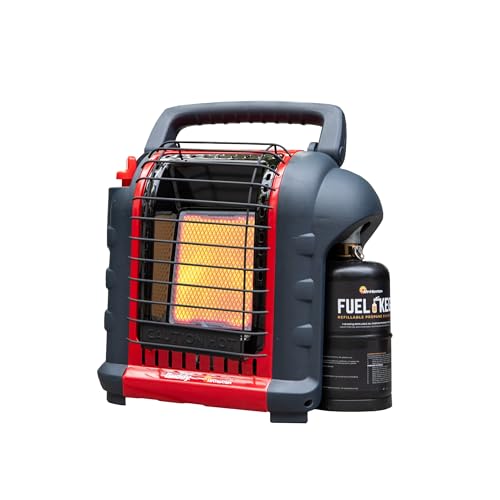
Mr. Heater Portable Buddy 9,000 BTU Radiant Heater
4,000 or 9,000 BTUAbout 225 sq ftODS and tip-over shutoff1 lb cylinder
Check price on Amazon
Best for: RV owners who want a small, cylinder-fed backup heater for a camper under about 225 square feet.

The Portable Buddy is the sensible heater for a small RV because its output matches the volume of the space. A camper interior of 100 to 250 square feet needs only a few thousand BTU to stay warm in mild cold, and the Buddy's 4,000 BTU low setting is closer to that than the 18,000 BTU units here. On high it puts out 9,000 BTU, enough to take the chill off a cold morning. It runs on a single 1 pound propane cylinder, and the maker quotes 5.4 hours on low and 2.4 hours on high.

The trade is cylinder consumption. Two and a half hours on high from a 1 pound cylinder is expensive heat, and you will want the optional Buddy hose and a 20 pound tank for overnight use. Compared with the Big Buddy it has half the high output and no fan, but it is lighter and cheaper. Compared with the Little Buddy at 3,800 BTU, it gives more than twice the high output for a modest size increase.

The safety design uses a pilot oxygen sensor that shuts the heater off if oxygen drops and a tip-over switch. These do not detect carbon monoxide, so a battery CO alarm in the RV is not optional. Vent-free heaters also add moisture, so crack a window. The maker lists indoor use, but check the manual and local rules for restrictions on recreational vehicles. Use only authorized accessories.

What works

  • Low setting of 4,000 BTU suits a small camper interior
  • Oxygen depletion sensor and tip-over switch are built in
  • Runs on a 1 pound cylinder with no electricity
  • Maker rates it for indoor and outdoor use

Watch out for

  • High setting uses a 1 lb cylinder in about 2.4 hours
  • No CO sensor, so a separate CO alarm is required
  • Adds moisture indoors, which causes window condensation

Spec sheet

Output
4,000 or 9,000 BTU per hour
Heated area
Approximately 225 sq ft
Runtime
5.4 h low, 2.4 h high on a 1 lb cylinder
Safety
Low oxygen shutoff, tip-over shutoff
Settings
Low and high
Use rating
Indoor and outdoor, per maker
02
Mr. Heater Big Buddy Midnight Series 18,000 BTU
4,000, 9,000, 18,000 BTUUp to 450 sq ftBuilt-in fan96 h on low (20 lb)
Check price on Amazon
Best for: Owners of larger RVs and toy haulers, or anyone camping in cold weather who wants overnight fuel capacity.

The Big Buddy is the upgrade when a camper is large, or when the weather is truly cold. It offers three settings at 4,000, 9,000 and 18,000 BTU and, per Mr. Heater, heats up to about 450 square feet. A built-in fan circulates the warm air, and electronic ignition starts it with a push of a button. With a 20 pound tank and the optional hose, the maker quotes up to 96 hours on low, which makes overnight use easy without swapping cylinders.

The trade is oversizing. At 18,000 BTU it is far more heat than most RV interiors can use, and the fan needs a power source, which adds a small draw. For a 25 foot travel trailer, the low and medium settings are what you will use, so the Big Buddy's value is the fuel economy at those settings with a big tank. Compared with the Portable Buddy, it doubles the high output and adds the fan. Compared with the ProCom 10,000 BTU, it is portable instead of wall-mounted.

The maker states indoor use is not approved in Canada or Massachusetts, so verify your jurisdiction. The Life Safety System includes self-extinguishing protection, a low oxygen shutoff and a tip-over shutdown. It does not detect carbon monoxide, so run a CO alarm. Moisture is a factor, so provide ventilation, and use only the authorized hose and filter.

What works

  • Three heat settings from 4,000 to 18,000 BTU
  • Maker quotes up to 96 hours on low with a 20 lb tank
  • Built-in fan moves warm air through the space
  • Electronic ignition lights with a push of a button

Watch out for

  • Eighteen thousand BTU is far more than a small RV needs
  • Indoor use is not approved in Canada or Massachusetts
  • Hose and fuel filter are sold separately for a 20 lb tank

Spec sheet

Output
4,000, 9,000 and 18,000 BTU
Heated area
Up to 450 sq ft
Fuel
Two 1 lb cylinders or 20 lb tank with hose
Runtime
Up to 96 h on low with a 20 lb tank
Ignition
Electronic push-button
Safety
Self-extinguishing, low oxygen and tip-over shutoff
Restriction
Indoor use not approved in Canada or Massachusetts
03
Mr. Heater Little Buddy 3,800 BTU Radiant Heater
3,800 BTUAbout 95 sq ft1 lb cylinder8 in round stand
Check price on Amazon
Best for: Van dwellers and small camper owners who need a minimal heater for a bunk or a cab.

The Little Buddy is the pick for a van, a camper cab or a sleeping nook rather than a whole camper. It outputs a single setting of 3,800 BTU and heats up to about 95 square feet according to the maker, so it takes the edge off a small bunk space without cooking you. Its 8 inch round stand uses very little floor, and the unit connects directly to a 1 pound propane cylinder.

The limits are plain. With one output and no thermostat, it cannot back off, so you cycle it by hand. Compared with the Portable Buddy, it matches the Buddy's low setting of 4,000 BTU but gives no extra capacity for a cold morning. A 1 pound cylinder holds about 21,600 BTU, so at 3,800 BTU the heater runs roughly five and a half hours, which suits a few hours before bed but not an overnight run without a hose.

It has a tip-over switch and an automatic low oxygen shutoff, and a one-button ignition. It does not have a CO sensor, so a CO alarm is a must. Like all vent-free heaters, it makes moisture, and burning a pound of propane produces about 1.6 pounds of water. Crack a window, and do not sleep with it running in a closed space.

What works

  • Quiet single setting suits a small sleeping area
  • Eight inch base takes very little floor space
  • Automatic low oxygen shutoff and tip-over switch
  • Connects directly to a 1 lb cylinder with no hose

Watch out for

  • Single output with no way to turn the heat down
  • A 1 lb cylinder lasts about 5.5 hours at 3,800 BTU
  • Heats only about 95 square feet by the maker's figure

Spec sheet

Output
3,800 BTU per hour
Heated area
Up to 95 sq ft
Fuel
One 1 lb propane cylinder
Ignition
One-button
Footprint
8 in round stand
Safety
Tip-over and low oxygen shutoff
04
ProCom 10,000 BTU Ventless Blue Flame Heater
10,000 BTUUp to 500 sq ft (maker)Thermostat controlWall mount or feet
Check price on Amazon
Best for: Cabin, garage or toy hauler owners who want a thermostat-controlled, wall-mounted heater.

The ProCom blue flame heater is a fixed, thermostat-controlled alternative to the Buddy line. It produces up to 10,000 BTU, uses a thermostat with high, medium and low settings, and mounts on a wall with the included hardware or stands on base feet. It needs no electricity, which is appealing in an RV when the battery is low. The maker lists a 500 square foot heating area, a number that is optimistic for a camper with poor insulation.

The design is a vent-free blue flame heater. That means combustion products, including moisture and trace carbon monoxide, are released into the room, so these units are designed with a pilot oxygen depletion sensor. The listing's claim that the sensor shuts the heater off if carbon monoxide is detected overstates what an ODS does. It senses low oxygen, and a CO alarm is still needed. Compared with the Portable Buddy, it has a thermostat but needs a connection to a propane supply, so it is a more permanent installation.

Vent-free wall heaters are often not permitted in RVs and manufactured homes, so check the label and the manual before you install one. It makes sense in a garage, a shop or a cabin. If you plan to use it in a camper, confirm it is rated for that use and run a CO alarm and fresh air.

What works

  • Thermostat holds temperature without constant adjustment
  • Wall mount or feet gives flexible placement
  • Needs no electricity to run
  • ANSI certified with a pilot oxygen sensor

Watch out for

  • Vent-free wall heaters may not be permitted in RVs
  • Maker's 500 sq ft figure is optimistic for a camper
  • Releases moisture and combustion products indoors

Spec sheet

Output
10,000 BTU maximum
Heated area
Up to 500 sq ft (maker figure)
Control
High, medium, low thermostat
Mounting
Wall mount or base feet
Ignition
Push button with pilot ODS
Certification
ANSI certified
05
WELLUCK 18,000 BTU Portable Cabinet Propane Heater
6,000, 12,000, 18,000 BTU69 h on low (20 lb)Four caster wheelsODS and tip-over shutoff
Check price on Amazon
Best for: Toy hauler and workshop users who need a mobile, wheeled heater with a big runtime on a 20 lb tank.

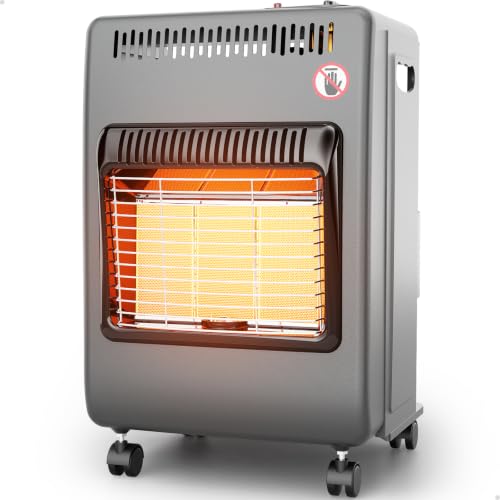
The WELLUCK is a cabinet-style heater on wheels, designed for garages, patios and job sites, and it earns a place here as the choice for a large toy hauler or a camper with a garage space. It offers three output settings at 6,000, 12,000 and 18,000 BTU and, with a 20 pound tank and its QCC hose with a built-in regulator, the maker quotes up to 69 hours on the lowest setting.

The minimum setting is the problem for a small RV. Its low of 6,000 BTU is half again higher than the Portable Buddy's 4,000 BTU low, so it will overheat a small camper quickly. Compared with the Big Buddy, it has a lower minimum than 9,000 but no fan, and with wheels it moves around a space. Compared with the Little Buddy, it is a bigger and heavier machine and not meant for a van.

It folds flat to about 15 centimeters for storage and has four swivel casters, two with brakes. A dedicated ignition setting purges air before lighting to prevent a flare-up. It has an oxygen depletion sensor and tip-over protection, but, as with every heater here, it has no CO sensor and the listing says to use it only in well-ventilated spaces. This is a lesser-known brand, so check warranty terms.

What works

  • Dedicated ignition setting purges air before lighting
  • Folds to about 15 cm thin and rolls on casters
  • Up to 69 hours on low with a 20 lb tank
  • QCC hose with built-in regulator is included per listing

Watch out for

  • Lowest setting of 6,000 BTU is too hot for a small camper
  • Lesser-known brand with limited service history
  • No fan to move warm air around the space

Spec sheet

Output
6,000, 12,000 and 18,000 BTU
Runtime
Up to 69 h on low with 20 lb tank
Ignition
Dedicated ignition setting purges air
Mobility
Four swivel casters, two locking
Fuel
20 lb tank with QCC hose and regulator
Safety
ODS and tip-over protection
06
ProCom 20,000 BTU Ventless Blue Flame Heater
20,000 BTUUp to 950 sq ft (maker)Thermostat controlWall mount or feet
Check price on Amazon
Best for: Large toy haulers, garages and workshops where 20,000 BTU is justified.

This larger ProCom is included to show where the size line sits, not as a camper heater. At 20,000 BTU the maker says it heats up to 950 square feet. That is more than most RV interiors can use by a wide margin: a 30 foot travel trailer is roughly 200 square feet. The unit has the same thermostat, wall-mount or feet layout and pilot oxygen sensor as the 10,000 BTU model.

Its place is a fifth wheel garage, a large toy hauler or a workshop attached to a camper lot. Compared with the Big Buddy's 18,000 BTU top setting, it offers a thermostat and wall mounting but no portability. Compared with the ProCom 10,000 BTU, it doubles output, but a thermostat that cycles a 20,000 BTU burner will make a small space swing between hot and cold.

It is vent-free, so combustion moisture and exhaust enter the space. The same cautions apply: it is not a substitute for the RV's own vented furnace, vent-free wall heaters may not be permitted in recreational vehicles, and a CO alarm and ventilation are essential. Check the label and the manual, and consider a smaller heater for a camper.

What works

  • Thermostat control with three heat settings
  • Heats a large space per the maker's 950 sq ft figure
  • Wall-mount hardware and base feet included
  • Pilot oxygen sensor and ANSI certification

Watch out for

  • Twenty thousand BTU is oversized for nearly all campers
  • Vent-free design may not be allowed in an RV
  • Fixed placement, so it cannot move with you

Spec sheet

Output
20,000 BTU maximum
Heated area
Up to 950 sq ft (maker figure)
Control
High, medium, low thermostat
Mounting
Wall mount or base feet
Ignition
Push button with pilot ODS
Certification
ANSI certified

Spec sheet decoder

What the numbers on the box really mean

The specs manufacturers lead with, translated into what they tell you about real-world performance.

BTU per hour

A measure of heat output. One BTU is the heat to raise a pound of water one degree Fahrenheit.

Watch forHeated-area figures such as 500 or 950 square feet assume a well-insulated, tall space, not an RV.

ODS

An oxygen depletion sensor shuts off the gas if oxygen levels fall too low.

Watch forIt is not a carbon monoxide sensor. The ProCom listing claims otherwise.

Radiant vs blue flame

A radiant heater glows a ceramic or metal face to warm objects and people directly. A blue flame heater warms the air convectively.

Watch forRadiant heat feels stronger on you than the BTU suggests, and blue flame is better at heating the whole room.

Runtime on 1 lb cylinder

The time a 1 pound propane cylinder lasts, which depends on the setting.

Watch forThe Portable Buddy's 2.4 hours on high is short. Plan for a 20 pound tank.

Vent-free

A heater that releases its combustion products into the room rather than outdoors.

Watch forIt adds moisture and relies on room air. Provide fresh air and a CO alarm.

Methodology

How We Evaluated These Propane Space Heaters for RV

Output matched to RV volume

We compared BTU settings against a typical RV interior of 100 to 250 square feet. The Little Buddy at 3,800 BTU, the Portable Buddy at 4,000 and 9,000, and the Big Buddy at 4,000 to 18,000 were treated as best fit. Units whose low setting was 6,000 BTU or more were penalized.

Safety features

We looked for an oxygen depletion sensor, tip-over shutoff, ignition design and self-extinguishing materials. We also noted where a listing overstated what a sensor does.

Fuel and runtime

We compared quoted runtimes, such as 5.4 hours on low from a 1 pound cylinder for the Portable Buddy and 96 hours on a 20 pound tank for the Big Buddy. A heater that cannot easily connect to a larger tank was rated lower for overnight use.

Use-rating and restrictions

We noted maker restrictions, including the Big Buddy's Canada and Massachusetts limitation, and the common prohibition of vent-free wall heaters in RVs. Items without clear ratings were flagged.

Portability and placement

We compared weight, stands, wall mounts and wheels. The Buddy heaters sit on the floor, the ProCom heaters wall mount, and the WELLUCK rolls.

Decision guide

How to Choose the Right Propane Space Heaters for RV

By RV Size

Pick the heater from the space you are heating.

RV or spaceRecommended pickWhy
Van or cab, up to about 95 sq ftMr. Heater Little Buddy3,800 BTU single setting
Small travel trailer, up to about 225 sq ftMr. Heater Portable Buddy4,000 BTU low, 9,000 BTU high
Larger trailer or fifth wheel, up to about 450 sq ftMr. Heater Big Buddy4,000 to 18,000 BTU with fan
Toy hauler garageWELLUCK 18,000 BTU6,000 to 18,000 BTU on casters
Fixed thermostat, cabin or garageProCom 10,000 BTUThermostat and wall mount
Very large workshop or garageProCom 20,000 BTU20,000 BTU, 950 sq ft per maker

By Budget

Relative tiers only.

Budget tierRecommended pickWhy
LowestMr. Heater Little BuddySimplest, smallest
LowMr. Heater Portable BuddyTwo heat settings
Low to midProCom 10,000 BTUThermostat control
MidMr. Heater Big BuddyFan and 20 lb tank hookup
Mid to upperWELLUCK 18,000 BTUWheels and big tank runtime
UpperProCom 20,000 BTULargest output

Portable Radiant vs Fixed Blue Flame

Two ways to heat a space with propane.

Portable radiant

The Mr. Heater Little Buddy, Portable Buddy and Big Buddy warm people and objects directly and sit on the floor. They are easy to store and use a 1 pound cylinder or a hose to a 20 pound tank.

Fixed blue flame

The ProCom 10,000 and 20,000 BTU units heat the air, hold a thermostat setting and mount on a wall. They are better for a garage or cabin and often not permitted in RVs.

Choose portable radiant for a camper or van. Choose fixed blue flame for a cabin, garage or workshop.

By Fuel Setup

How you will supply the propane.

Fuel setupRecommended pickWhy
1 lb cylinders onlyMr. Heater Little BuddyDirect connection
1 lb cylinders for short runsMr. Heater Portable Buddy5.4 h on low
20 lb tank for overnightMr. Heater Big BuddyUp to 96 h on low
20 lb tank with regulator hoseWELLUCK 18,000 BTUUp to 69 h on low
RV or cabin propane supplyProCom 10,000 BTUFixed connection

For Safe Sleeping Specifically

Look for

A battery CO alarm in the sleeping area, a heater with an oxygen sensor and tip-over shutoff, and fresh air. Do not run a vent-free heater while sleeping in a sealed space.

In this comparison

The Mr. Heater Portable Buddy and Big Buddy have both the oxygen sensor and tip-over shutoff. Use the lowest setting and crack a window. The RV's built-in vented furnace is the safer way to heat overnight.

When to Spend More

Spend more if

You camp in cold weather or need overnight heat. The Mr. Heater Big Buddy gives low-setting economy with a 20 lb tank and a fan.

Save if

You only need a bit of warmth for a few hours. The Little Buddy and Portable Buddy cover that with a 1 lb cylinder.

Ownership

Maintenance schedule

The upkeep that decides whether this machine lasts two seasons or ten.

TaskIntervalWhy it matters
Inspect hoses and fittings for leaksBefore each season and each connectionA brushed soapy water solution on fittings shows bubbles from a leak. Propane leaks are a fire and asphyxiation hazard in a small space.
Replace the hose and regulatorPer the maker, often every 5 to 10 yearsRubber hoses crack with age. Use only authorized accessories, as the makers warn.
Clean dust from the burner and pilotEach seasonDust and spider webs block the pilot and cause poor combustion. A soft brush and low-pressure air help.
Test the CO alarmMonthlyA battery alarm is the only device that detects CO in the RV. Replace the battery yearly and the unit per its date.
Check the tip-over switchEach seasonFollow the manual's test steps. A stuck switch could fail to shut off on a fall.
Store tanks upright and securedAlwaysCylinders must stay upright, strapped and away from heat. Do not store them inside the cabin.

FAQ

Frequently Asked Questions

Is it safe to use a propane heater inside an RV?

It is a judgment call with real risks. Mr. Heater rates the Buddy line for indoor use, but vent-free heaters produce moisture and can produce carbon monoxide, and some jurisdictions and campgrounds restrict them. If you use one, run a battery CO alarm, crack a window, use the lowest setting and never leave it running while you sleep. The RV's vented furnace is the safer main heat source.

Does the oxygen depletion sensor protect against carbon monoxide?

No. An ODS shuts the heater off when oxygen falls below a threshold. Carbon monoxide can form from incomplete combustion before oxygen is low, which is why a CO alarm is required. Some listings blur this, but the sensor and the alarm are different safety devices.

How much propane will a heater use?

A 1 pound cylinder holds about 21,600 BTU. At 9,000 BTU an hour that lasts about 2.4 hours, and at 4,000 BTU about 5.4 hours. A 20 pound tank holds about 430,000 BTU, so on low it lasts days. Burn rate rises with the setting, so use the lowest that keeps the RV comfortable.

Why are my RV windows wet when the heater runs?

Burning propane produces about 1.6 pounds of water for every pound burned, and a vent-free heater releases it into the room. The water condenses on cold surfaces. Crack a window or roof vent, and consider a small dehumidifier. Persistent condensation can cause mold.

What size heater do I need for a 25 foot travel trailer?

A 25 foot trailer is roughly 150 to 200 square feet. In mild cold, 4,000 to 9,000 BTU is plenty. The Portable Buddy's low and high settings cover it, while an 18,000 BTU unit is oversized and will cycle between too hot and too cold.

Can I run a propane heater at high altitude?

Altitude reduces the oxygen available for combustion, and oxygen depletion sensors may trip more often above about 7,000 feet. Makers often publish altitude limits and some require a different orifice. Check the manual for your heater.

Bottom line

The short version

Browse more propane space heaters for rvon Amazon →
James Miller, Lead Machine Editor

About the author

James Miller

Lead Machine Editor, MachineFanatic

James Miller leads MachineFanatic's buying guides, turning spec sheets, manuals and owner feedback into clear verdicts on power tools, outdoor power equipment, shop machines and kitchen machines.

More from James →

Keep reading

Related guides