
Amazon affiliate links - we earn a commission.Affiliate disclosure

Buying guide · 13 min read · Updated 2026-11-07

Best 1500 Watt Space Heaters for RV (2026)

Six 1500W electric space heaters for RVs compared on amp draw, tip-over protection, noise claims and tower versus milkhouse design on a 30 amp rig.

James MillerBy James MillerLead Machine Editor6 machines comparedSpec-sheet verified
Best 1500 Watt Space Heaters for RV

At a glance

Our top picks

Side by side

Spec comparison

MachinePowerSafetyCertification
DREO Quiet 1500W oscillating ceramic heater with remoteBest OverallDREO Quiet 1500W oscillating ceramic heater with remote1500W (12.5 A at 120V)Tip-over, overheat, child lock, V0 flame retardantn/a
FOHERE 1500W PTC ceramic heater, ETL listed, 32 dB claimBest Compact Quiet ClaimFOHERE 1500W PTC ceramic heater, ETL listed, 32 dB claim1500W PTC ceramicOverheat and tip-over protectionETL
Lasko 751320 23 in ceramic tower heater, 1500W, remoteBest Tower HeaterLasko 751320 23 in ceramic tower heater, 1500W, remote1500W ceramicn/aETL
Dr Infrared DR-968 1500W quartz and PTC heaterBest Dual-Heat DesignDr Infrared DR-968 1500W quartz and PTC heater1500Wn/an/a
BEYOND HEAT 1500W milkhouse heater with thermostatBest Utility HeaterBEYOND HEAT 1500W milkhouse heater with thermostatFan only, 1300W, 1500WTip-over switch, overheat protectionn/a
shinic 1500W milkhouse heater, tilt-ball tip-over switchBest Tilt-Switch Protectionshinic 1500W milkhouse heater, tilt-ball tip-over switchHigh 1500W, low 1300W, fan360 degree tilt-ball tip-over, overheat protectionETL listed

A 1500 watt electric space heater is the standard way to add heat to a plugged-in RV. It adds warmth quickly, needs no fuel or ventilation, and costs far less than a built-in heating system.

The wattage is nearly the same on every model, so the useful differences are how safely the heater shuts itself off, how loud the fan is, how the airflow is shaped and how much electrical headroom your rig actually has.

Before you buy

6 Criteria to Look For Before Buying a 1500 Watt Space Heater for RV

  1. 01

    Amp budget

    A 1500 watt heater draws 12.5 amps at 120 volts, which is 42 percent of a 30 amp service. The Dr Infrared lists 12.5 A directly and milkhouse units at 1300W draw about 10.8 amps. Add the fridge, converter and lights before turning on a second big load. Running the air conditioner and heater together is an obvious mistake, but microwave plus heater trips just as often. A rule of thumb is to keep continuous load under 80 percent of the breaker rating, which is 24 amps on a 30 amp service.

  2. 02

    Safety features

    Look for tip-over shutoff and overheat protection plus ETL or UL listing. The shinic lists a 360 degree tilt-ball switch and the DREO lists eight safety features. Never use a heater without these. A certification mark means a lab certified the design, not that the unit is immune to misuse. Child locks and flame-retardant housings, as on the DREO, add extra margin in a household with pets or kids.

  3. 03

    Element type

    PTC ceramic, as in the FOHERE and DREO, self-limits temperature, while the Dr Infrared adds an infrared quartz tube. Radiant quartz warms people directly. Milkhouse heaters use fan-forced coils. Radiant heat can feel warm at lower air temperature, which suits drafty rigs. A fan-forced milkhouse heater warms the room faster but dries the air more.

  4. 04

    Noise

    FOHERE claims 32 dB and Dr Infrared 39 dB, while milkhouse fans are louder. Brushless DC fans, as in the DREO, last longer and run quieter. Sleeping next to a loud fan is a daily irritation. Noise claims are best case on low settings. A heater with a quiet low setting and a thermostat will cycle on and off, so the average noise is lower than the peak.

  5. 05

    Size and tip risk

    A 23 inch tower like the Lasko has a narrow footprint but a higher center of gravity. A low milkhouse heater is stable but wide. RVs move and floors flex, so choose stability. Wedge or strap a tower if the rig sways. Check also that the base does not wobble on carpet.

  6. 06

    Cord and outlet

    Plug directly into the wall, never an extension cord. A warm plug is a warning sign. Use a GFCI outlet if available. Cheap extension cords melt before breakers trip. Many RV outlets are on shared 15 or 20 amp circuits, so know which breaker feeds the one you use.

Detailed reviews

The 6 best 1500 watt space heaters for rv, explained

01
DREO Quiet 1500W oscillating ceramic heater with remote
1500W70 deg oscillationBrushless fanRemote
Check price on Amazon
Best for: Bedroom or living-area use where quiet matters.

The DREO pairs a 1500 watt ceramic element with a brushless DC fan, 70 degree oscillation and a remote control. Brushless fans run quieter and last longer than the brushed motors in cheaper heaters, which matters when the heater sits next to your bed. The listing highlights eight safety features, including tip-over protection, overheat protection, a child lock and V0 flame-retardant material.

The downside is that 1500 watts is 12.5 amps at 120 volts, so it takes a big slice of a 30 amp RV service. Oscillation spreads heat but also uses the fan more. It sits in the upper-middle price tier. Compared with the FOHERE, it is larger and more feature-rich; compared with the milkhouse heaters, it is quieter but less rugged.

Ownership is simple. Vacuum the intake grille monthly, keep the heater on a hard level surface and plug it directly into the wall outlet. Do not run it on an extension cord, and stagger it with the microwave and water heater element. Place it where a door cannot hit it.

What works

  • Brushless DC fan runs quietly
  • 70 degree oscillation spreads heat
  • Multiple safety protections
  • Remote control included

Watch out for

  • 12.5 A is heavy on a 30 A rig
  • Upper-middle price tier
  • Lighter build than a milkhouse heater

Spec sheet

Power
1500W (12.5 A at 120V)
Element
Hyperamics ceramic
Fan
Brushless DC motor
Oscillation
70 degrees
Safety
Tip-over, overheat, child lock, V0 flame retardant
02
FOHERE 1500W PTC ceramic heater, ETL listed, 32 dB claim
1500W PTCETL listed32 dB claim24H timer
Check price on Amazon
Best for: Small spaces and bedside use on a budget.

FOHERE is an ETL-certified 1500 watt PTC ceramic heater with a thermostat, ECO mode and a 24 hour timer. PTC elements self-limit their temperature, which reduces overheating risk, and an ECO mode can cut average draw once the room is warm. The listing claims 32 dB operation, though that is a maker figure.

It sits in the lowest price tier of the group, which is the argument for it. The small size means less heat spread than a tower, and a timer is a safety convenience for bedtime. Compared with the DREO, it lacks the remote and oscillation; compared with the Dr Infrared, it is simpler.

Ownership is simple: keep the grille clean and plug directly into a wall outlet. Check the cord and plug for warmth after the first hour. ECO mode is useful once the room is warm. A 24 hour timer is a genuine safety aid if you tend to fall asleep with the heater running.

What works

  • ETL certified
  • Timer and ECO mode
  • Lowest price tier
  • Self-limiting PTC element

Watch out for

  • Small footprint spreads less heat
  • 32 dB is a maker claim
  • No remote

Spec sheet

Power
1500W PTC ceramic
Certification
ETL
Noise
32 dB claimed
Modes
Thermostat, ECO, 24-hour timer
Safety
Overheat and tip-over protection
03
Lasko 751320 23 in ceramic tower heater, 1500W, remote
1500W23 in towerRemoteETL certified
Check price on Amazon
Best for: Narrow floor space in a living area.

The Lasko is a 23 inch ceramic tower with wide oscillation, a remote with heat, oscillation and timer controls and a cool-touch housing. The self-regulating ceramic element and overheat protection are ETL certified. A tower footprint is narrow, which suits tight RV floor space.

Towers are taller and easier to knock over than low heaters, though the tip-over shutoff mitigates it. It sits in the middle of the price range. Compared with the DREO, it is a conventional design with a proven brand; compared with the milkhouse units, it is more attractive and quieter but less rugged.

Ownership requires vacuuming the intake and keeping it on a level hard floor. Secure it where a slamming door or a dog cannot topple it. A nonslip mat helps. The remote includes timer control, which shuts the heater off before you wake at night. Keep it away from the slide-out path.

What works

  • Narrow tower footprint
  • Remote with timer
  • Cool-touch housing
  • ETL certified

Watch out for

  • Taller body is easier to knock over
  • Middle price tier
  • 12.5 A draw like every 1500W heater

Spec sheet

Power
1500W ceramic
Height
23 inches
Control
Remote with timer and oscillation
Certification
ETL
Housing
Cool-touch
04
Dr Infrared DR-968 1500W quartz and PTC heater
1500WQuartz + PTC12.5 A12-hour timer
Check price on Amazon
Best for: Owners who like radiant heat on their legs and feet.

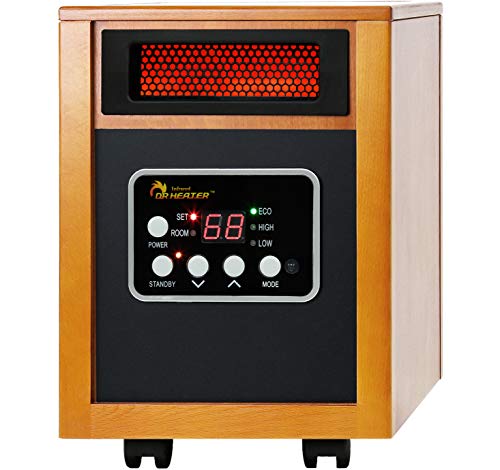
Dr Infrared uses a dual-heating system that combines an infrared quartz tube and a PTC element. Infrared heat warms people and objects directly, which can feel warmer at lower air temperatures, while the PTC element warms the air. The listing states 12.5 amps outright, a useful number for planning a 30 amp load, and claims 39 dB noise with a 12-hour automatic shutoff.

Quartz tubes glow hot, so keep clear of fabrics and children. It sits in the top price tier of the group, and the housing is plain. Compared with the DREO, it heats more directly; compared with the FOHERE, it adds the quartz element and costs more.

Ownership is routine. Keep the intake clean and the area around the glowing tube clear. The quartz tube is the part that gets hot, so keep it away from curtains.

What works

  • Quartz plus PTC dual heating
  • 12.5 A stated plainly
  • 12-hour automatic shutoff
  • IR remote control

Watch out for

  • Hot glowing tube needs clearance
  • Top price tier
  • 39 dB is a claim

Spec sheet

Power
1500W
Heating
Infrared quartz tube plus PTC
Current
12.5 A listed
Noise
39 dB claimed
Timer
12-hour automatic shutoff
05
BEYOND HEAT 1500W milkhouse heater with thermostat
1500W3 power levelsTip-over switchMetal case
Check price on Amazon
Best for: Basements, bays and work areas where noise matters less.

BEYOND HEAT sells a milkhouse-style utility heater with three power levels (fan only, 1300W and 1500W), an adjustable thermostat, a tip-over switch and heavy-duty construction. The 1300 watt setting draws about 10.8 amps, which saves a little current. Milkhouse heaters are built for garages and workshops and tolerate abuse well.

The tradeoff is noise and looks. The fan is typically louder than a bedroom-quiet unit, and the metal case runs hot. It sits in the lower-middle tier. Compared with the shinic, it is nearly identical; compared with the DREO, it is cruder but tougher.

Ownership is easy. Clean the fan screen and run it on the 1300W setting when you can. The fan-only setting is a handy summer extra. Place it on a hard surface, never on carpet that can block the base vents.

What works

  • Fan-only, 1300W and 1500W levels
  • Adjustable thermostat
  • Heavy-duty construction
  • Lower-middle price tier

Watch out for

  • Louder fan
  • Case runs hot
  • Utility look

Spec sheet

Power
Fan only, 1300W, 1500W
Thermostat
Adjustable
Safety
Tip-over switch, overheat protection
Housing
Heavy-duty material
Type
Milkhouse utility heater
06
shinic 1500W milkhouse heater, tilt-ball tip-over switch
1500WTilt-ball switchETL listed3 settings
Check price on Amazon
Best for: Budget buyers who want a rugged heater with clear safety listing.

shinic highlights an improved internal tilt-ball switch for instant 360 degree tip-over protection, an adjustable rotary thermostat and three settings at 1500W, 1300W and fan only. ETL listing and overheat protection round out the safety story. The simple rotary dial is easy to use without reading a manual.

Like all utility heaters, it is louder than a bedroom unit. It sits in the lower tier. Compared with the BEYOND HEAT, it adds a clear tip-over claim and ETL listing; compared with the Lasko, it is rougher but cheaper.

Ownership is minimal. Keep the grille clean, keep the area clear and use a dedicated wall outlet. A dedicated outlet avoids overloading a shared circuit. Keep it on a flat floor away from a bed skirt.

What works

  • 360 degree tilt-ball switch
  • ETL listed
  • Simple rotary thermostat
  • Lower price tier

Watch out for

  • Louder than bedroom heaters
  • Utility styling
  • Case gets hot

Spec sheet

Power
High 1500W, low 1300W, fan
Thermostat
Adjustable rotary
Safety
360 degree tilt-ball tip-over, overheat protection
Certification
ETL listed
Type
Utility heater

Spec sheet decoder

What the numbers on the box really mean

The specs manufacturers lead with, translated into what they tell you about real-world performance.

Watts to amps

Divide by 120; 1500W is 12.5 A. A 1300W step draws 10.8 A.

Watch forDr Infrared lists 12.5 A.

ETL listing

Third-party safety certification. It is a safety listing, not a performance rating.

Watch forFOHERE, Lasko, shinic list it.

PTC

Self-limiting ceramic element.

Watch forFOHERE and DREO.

Tip-over switch

Cuts power if the heater falls. Look for a tilt-ball or mechanical switch.

Watch forshinic uses a tilt ball.

dB claim

Maker-measured noise.

Watch for32 dB FOHERE, 39 dB Dr Infrared.

Methodology

How We Evaluated These 1500 Watt Space Heaters for RV

Electrical load

We converted 1500W to 12.5 A and noted heaters with a 1300W step, which drops to about 10.8 A. Electrical headroom is the quiet constraint in any RV.

Safety

We credited ETL listing and tip-over protection. Safety features are not optional.

Noise

We compared 32 and 39 dB claims against louder utility fans. Real noise is higher than a claim.

Stability

We weighed tower height against low-slung milkhouse bodies. RV floors move. We also noted that a heater with a wide base is harder to knock over in a moving rig.

Value

We judged tiers from FOHERE to Dr Infrared. We favored heaters with a lower-power step because they leave headroom.

Decision guide

How to Choose the Right 1500 Watt Space Heaters for RV

By Where You Use It

Where the heater sits decides noise tolerance and stability, which matter more than small differences in wattage.

SituationPickWhy
BedroomDREO QuietBrushless fan
Small bedsideFOHERE32 dB claim
Narrow floor spaceLasko towerSlim footprint
Bay or garageBEYOND HEAT or shinicRugged
Radiant leg warmthDr InfraredQuartz tube

By Budget

Tiers are relative and shift with sales. Extra spend mostly buys quiet and convenience.

TierPickWhy
LowestFOHEREBasic
LowshinicRugged
Lower-midBEYOND HEATThree levels
MiddleLaskoRemote
UpperDREO or Dr InfraredQuiet or radiant

Ceramic vs Milkhouse

The main design split is between quiet ceramic heaters made for living rooms and rugged fan-forced milkhouse heaters made for workshops. Each side has a real place in an RV.

Ceramic

DREO, FOHERE and Lasko are quieter and tidier but lighter in build. They also look better in a living area and tend to have remotes and timers.

Milkhouse

BEYOND HEAT and shinic are tougher and louder. They suit bays, basements and workshop corners where the fan noise does not matter.

Quiet living spaces favor ceramic; work areas favor milkhouse. You can also keep one of each: a quiet ceramic for sleeping and a milkhouse for the bay.

By Electrical Headroom

Your electrical headroom sets the real limit, not the heater. On a 30 amp service, a second large appliance can trip the breaker.

HeadroomPickWhy
Tight 30 ABEYOND HEAT at 1300W10.8 A
ModerateAny 1500W12.5 A
Shore 50 ADr InfraredDual heat

For Winter Camping Specifically

Look for

Thermostat, safe shutoff and amp headroom. Also look for a timer so the heater does not run all night.

In this comparison

The DREO and Lasko cover thermostat and remote; the shinic handles rough use. Add window covers to hold the heat longer.

When to Spend More

Spend more if

Quiet matters, pointing to the DREO. That premium buys brushless motors and remote control.

Save if

You just need heat, pointing to the FOHERE or shinic.

Ownership

Maintenance schedule

The upkeep that decides whether this machine lasts two seasons or ten.

TaskIntervalWhy it matters
Vacuum intakeMonthly in useDust blocks airflow. A clean intake keeps the element cooler.
Inspect cord and plugEach useA warm plug signals a bad connection. Replace the cord if the insulation is brittle.
Test tip-over switchSeasonalA stuck switch defeats safety. Tilt it gently to hear the switch click.
Check outletSeasonalWorn outlets heat up.
Store clean and dryOff seasonDust and moisture shorten life. Wrap the cord loosely, not tightly around the body.

FAQ

Frequently Asked Questions

Can I run it on a 30 amp RV?

Yes, with care. 12.5 A is a big share. Stagger loads and watch the breaker. Turn the heater on first, then add other loads one at a time.

Is it safe to leave on overnight?

Use a heater with timer and tip-over protection, and keep clear of bedding. Many owners prefer to turn heaters off while asleep. A heater with a built-in timer is safer for sleeping.

What is the price range?

Tiers run from FOHERE to DREO. Prices change, so check listings. The premium models buy quiet, not more heat.

Ceramic or milkhouse?

Ceramic for quiet, milkhouse for toughness. Both work with a thermostat. Ceramic suits living areas, milkhouse suits work bays.

Can I use an extension cord?

No. Plug directly into the wall. Extension cords are a common cause of heater fires.

Do I need a CO alarm?

Electric heaters make no CO but an alarm is wise with propane. Smoke and CO alarms are cheap insurance in any RV.

Bottom line

The short version

Browse more 1500 watt space heaters for rvon Amazon →
James Miller, Lead Machine Editor

About the author

James Miller

Lead Machine Editor, MachineFanatic

James Miller leads MachineFanatic's buying guides, turning spec sheets, manuals and owner feedback into clear verdicts on power tools, outdoor power equipment, shop machines and kitchen machines.

More from James →

Keep reading

Related guides