
Amazon affiliate links - we earn a commission.Affiliate disclosure

Buying guide · 12 min read · Updated 2026-11-07

Best RV Space Heaters with Thermostat (2026)

Six RV space heaters with real thermostats compared: digital sensors, dial controls, wall-mount and milkhouse designs, with notes on cycling and 30 amp loads.

James MillerBy James MillerLead Machine Editor6 machines comparedSpec-sheet verified
Best RV Space Heaters with Thermostat

At a glance

Our top picks

Side by side

Spec comparison

A thermostat turns a space heater from a device you babysit into one that manages itself. It senses the room, cuts the element when the target is reached and brings it back when the temperature drops.

In an RV that matters twice over. A small cabin overshoots quickly, so a heater without control swings between stuffy and cold, and a controlled heater also draws far less on average. The quality of the thermostat decides how well that works.

Before you buy

6 Criteria to Look For Before Buying a RV Space Heater with Thermostat

  1. 01

    Digital versus dial thermostats

    A mechanical dial may swing three to five degrees around its setting, while a digital sensor, as in the DREO, holds closer to the target. In a small RV that difference is the line between comfortable and stuffy. If you sleep with the heater on, prefer digital, and expect to pay a modest premium for it. Cheap dials are not dangerous, only vague, and a few degrees of swing is enough to wake some people.

  2. 02

    Cycling and fan noise

    A thermostat cycles the element, and in a fan heater the fan may start and stop with it. Frequent starts wake light sleepers. A wider hysteresis or a heater with ECO regulation, like the Ambiora, cycles less often. Ask whether the listing mentions a gentle low step too, since a heater that can run steadily on a low setting avoids the clicking altogether.

  3. 03

    Where the sensor sits

    The thermostat reads the air near the heater, which may be warmer than where you sit. A wall-mounted unit near the ceiling reads high and may shut off too early. Place portable heaters in the middle of the cabin, away from direct drafts. A heater tucked behind the sofa measures a temperature nobody lives in.

  4. 04

    Amps on a 30 amp service

    The TMHEI offers 750, 1000 and 1500 watts, drawing about 6.3, 8.3 and 12.5 amps. The Good Housekeeping at 750 watts draws about 6.3. A thermostat lowers the average draw, but the peak still counts for the breaker, so plan around the worst moment, which is the heater starting while the air conditioner compressor kicks in.

  5. 05

    Mounting and placement

    Ambiora can mount on a wall, a hook or a desk, and the Good Housekeeping is wall only. Fixed mounts cannot tip, but they need solid anchoring. Portable units need a level, hard surface.

  6. 06

    Build for the environment

    A milkhouse unit like the BEYOND HEAT tolerates rough use in a bay or toy hauler. A bedroom ceramic is quieter but less rugged. Match the build to where the heater will live, and do not buy a bedroom ceramic for a bay that sees mud and tools.

Detailed reviews

The 6 best rv space heaters with thermostat, explained

01
DREO 1500W Heater with Digital Thermostat and 34 dB Claim
1500W PTCDigital thermostat34 dB claimETL certified
Check price on Amazon
Best for: Daily RV heating where a tight set point and quiet running matter.

This DREO pairs a 1500 watt PTC ceramic element with a digital thermostat and a fan wheel that uses oblique airflow to cut turbulence and noise. The maker quotes 34 decibels, a claim you should treat as a lower bound, and lists ETL certification with V0 flame-retardant plastics. A digital sensor holds the room closer to the set point than a mechanical dial does.

A tight set point is what saves electricity, because the element cycles off as soon as the target is reached. It also keeps the fan from alternating between loud and silent, which is what wakes sleepers. Alongside the Amazon Basics dial model in this roundup, the extra cost buys accuracy and a quieter fan.

On high it draws about 12.5 amps, so plan the circuit. Set the thermostat two or three degrees under your comfort limit and let the stored warmth in the cabin do the rest. Vacuum the grille monthly, since dust is the main cause of rising fan noise. A second habit worth building is to park the heater where the thermostat reads the middle of the cabin, not the cold air sliding under a door, which otherwise keeps it running far longer than needed.

What works

  • Digital sensor holds a tight set point
  • Oblique airflow fan keeps noise low
  • ETL certified with V0 flame-retardant plastics
  • 70 degree sweep spreads warmth

Watch out for

  • High setting draws about 12.5 amps
  • Noise figure is a maker claim
  • Costs more than dial-thermostat units

Spec sheet

Element
1500W PTC ceramic
Thermostat
Digital
Noise claim
34 dB
Airflow
Oblique fan wheel, 70 degree sweep
Safety
ETL certified, V0 flame retardant
02
Ambiora 1500W PTC Heater with ECO Thermostat and 12H Timer
1500W PTCECO thermostat12H timer3 mounting options
Check price on Amazon
Best for: Owners who want to move between wall, hook and desktop placement.

Ambiora's heater offers three ways to place it: screwed to the wall, hung on a built-in hook or sat on a desktop. The 1500 watt PTC element pairs with a high-speed turbo fan, and the maker claims warm air in about three seconds. An ECO mode regulates temperature by adjusting power, which is a more refined approach than simply cycling on and off.

A 12 hour timer and a remote complete the control set. The flexible mounting is the attraction for RVs: the same heater can live on a wall in winter and sit on a shelf elsewhere. Next to the DREO, it has a less proven brand and a turbo fan that is likely to be louder at high speed.

If you wall mount it, anchor it to a stud or backing plate and leave clearance on all sides. Dust the intake each season. Refresh the remote battery before cold weather. If you use the timer, check it against the clock on the first night, because owners sometimes mistake the timer setting for the temperature setting and wake to a cold cabin.

What works

  • Three mounting options in one heater
  • ECO mode regulates output
  • 12 hour timer and remote
  • PTC element warms in seconds

Watch out for

  • Turbo fan is likely louder on high
  • Less established brand
  • Full 12.5 amp draw on high

Spec sheet

Element
1500W PTC ceramic
Thermostat
ECO regulation
Timer
12 hours
Mounting
Wall mount, hook or desktop
Warm-up claim
3 seconds
03
Good Housekeeping 750W Wall-Mount Heater with Thermostat and Remote
750WWall mountDigital displayCool-touch housing
Check price on Amazon
Best for: Small cabins and bathrooms that need steady low-draw warmth.

This 750 watt wall-mount heater has a thermostat, a remote and an easy-to-read digital display, with overheat protection and a cool-touch housing. At about 6.3 amps it sits comfortably on a shared 30 amp circuit. The wall mount keeps it off the floor.

A 750 watt heater suits a small bedroom, a bath or a van-sized cabin, not a long trailer. Cool-touch housing matters in a tight space where you might brush the unit. Against the DREO, it has less output and less reach but a much lower draw.

Since it hangs on a wall, locate studs or use proper anchors. Keep curtains clear and leave a hand of space above and beside it, because a wall unit that is crowded by cabinetry will cut out early. Wipe the display with a dry cloth. The licensed brand name on the box says nothing about the maker, so register the heater and keep the paperwork, since support runs through the actual manufacturer.

What works

  • 750W draws only about 6.3 amps
  • Digital display and remote
  • Cool-touch housing
  • Wall mount frees floor space

Watch out for

  • 750W is limited for larger spaces
  • Fixed mounting needs installation
  • Brand name is a licensed label

Spec sheet

Power
750W
Draw
About 6.3 amps
Mount
Wall mount
Display
Digital readout
Safety
Overheat protection, cool-touch housing
04
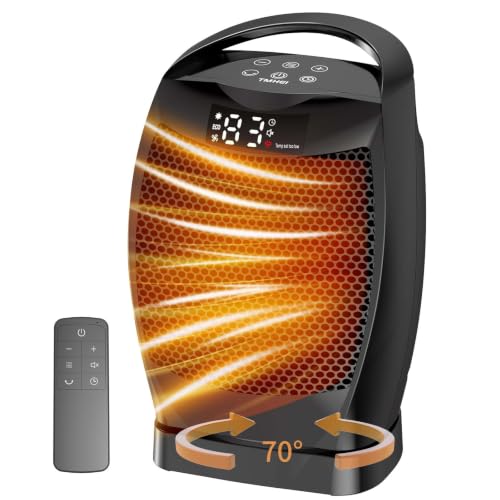
TMHEI 750W/1000W/1500W PTC Heater with Thermostat and Remote
750/1000/1500WTouch buttonsThermostatCarry handle
Check price on Amazon
Best for: Owners who want a clear power ladder plus a thermostat.

TMHEI's PTC ceramic heater offers three power levels, 750, 1000 and 1500 watts, plus a thermostat and remote. Touch-sensitive buttons and a built-in carry handle make it easy to use and move. The housing is flame-retardant.

Three steps give you a ladder for shared circuits: 750 watts draws about 6.3 amps and 1000 watts about 8.3. A thermostat on top of stepped output is a strong combination, because it lets you pick a step and then let the thermostat do the cycling. Beside the Ambiora, it lacks mounting flexibility but has a clearer power ladder.

Touch buttons can be fiddly with gloves, so use the remote in cold weather. Wipe the panel gently. Store it with the cord coiled loosely and the remote taped to the side or tucked in a labelled bag. When the weather turns truly cold, run it on the middle step with the thermostat set around the high sixties, which holds a small cabin well without ever asking the breaker for the full amount.

What works

  • Three steps from 750W to 1500W
  • Thermostat and remote included
  • Built-in carry handle
  • Flame-retardant housing

Watch out for

  • Touch buttons are fiddly with gloves
  • Less known brand
  • No mounting option

Spec sheet

Power steps
750W, 1000W, 1500W
Control
Touch buttons and remote
Thermostat
Built in
Handle
Built-in carry handle
Housing
Flame-retardant
05
BEYOND HEAT 1500W Milkhouse Heater with Thermostat
Fan/1300W/1500WMetal housingThermostatTip-over switch
Check price on Amazon
Best for: Toy haulers, bays and workshop areas that see rough use.

A milkhouse heater is a utility fan heater with a metal case, designed for barns, shops and tough environments. This one offers fan-only, 1300 watt and 1500 watt settings with a thermostat and a tip-over switch. The heavy-duty casing handles the knocks that a plastic heater would not.

It is blunt and loud compared with a bedroom ceramic unit, because the fan is a utility blower. That makes it better for a storage bay, a garage-style toy hauler or a cold wet utility space than for a sleeping area. The 1300 watt step is only slightly gentler than 1500.

Set it on a stable base and keep it clear of anything flammable. Check the cord and plug each season. Do not run it where it can take a splash unless it is rated for it. In a toy hauler it can sit on the garage floor and warm the sleeping area through the door, which is a use the plastic bedroom units handle poorly.

What works

  • Heavy-duty housing survives rough use
  • Thermostat holds the set point
  • Fan-only mode for summer airflow
  • Tip-over switch included

Watch out for

  • Loud for a bedroom
  • 1300W step barely lowers the draw
  • Bulky for small cabins

Spec sheet

Settings
Fan only, 1300W, 1500W
Draw at 1500W
About 12.5 amps
Housing
Heavy-duty material
Control
Thermostat
Safety
Tip-over switch
06
Lasko 23 Inch Oscillating Tower Heater with Thermostat and Remote
1500W ceramic5,118 BTUThermostatRemote
Check price on Amazon
Best for: Corner placement in a living area with a remote and a set-once thermostat.

Lasko's tower heater uses an elongated 1500 watt ceramic element, quotes 5,118 BTU and holds the temperature you set. The remote lets you change it from across the room. The oscillating head spreads the warmth across the cabin.

The maker's selling line is that you set the temperature once and the unit keeps the room there, which is exactly the job of a thermostat. A tall, narrow shape fits corners but tips more easily, which matters in a rig that moves. Set against the TMHEI, it offers a single power level and a classic design.

Secure the tower for travel, and never run it while driving. Dust the grille monthly. Keep it on a level, hard surface, and leave the front clear of throw pillows. A set-once thermostat is only as good as the airflow it gets.

What works

  • Thermostat holds the set temperature
  • Remote controls it from across the room
  • Slim tower fits corners
  • Oscillating head spreads warmth

Watch out for

  • Tall shape tips on a moving floor
  • Only one power level
  • Needs strapping for travel

Spec sheet

Power
1500W ceramic
Output
5,118 BTU
Thermostat
Set once and hold
Control
Remote
Form
23 inch oscillating tower

Spec sheet decoder

What the numbers on the box really mean

The specs manufacturers lead with, translated into what they tell you about real-world performance.

Thermostat type

Digital thermostats use a sensor and a microcontroller, while dials use a bimetal strip. Digital is more accurate.

Watch forDREO and Good Housekeeping have digital displays, and the Lasko uses a set-once control.

ECO mode

ECO mode adjusts output toward a target instead of just switching on and off. It reduces overshoot, the swing past your target that makes a small cabin feel stuffy.

Watch forAmbiora lists an ECO thermostat.

Wattage steps

Steps set the peak draw. Lower steps work with the thermostat to hold gentle temperatures.

Watch forTMHEI offers 750, 1000 and 1500 watts.

Timer

A timer shuts off the heater after a set period. It limits unattended running.

Watch forAmbiora lists 12 hours.

Housing

Metal casings resist impacts and heat, which helps if the heater gets knocked by luggage. Plastic is lighter and quieter.

Watch forBEYOND HEAT uses heavy-duty material, while the others use flame-retardant plastics.

Methodology

How We Evaluated These RV Space Heaters with Thermostat

Thermostat quality

We compared digital sensors, ECO regulation and set-once controls. The DREO and Ambiora lead on regulation, and the Lasko follows. This comes from the listings and owner feedback patterns about temperature swing.

Load options

We compared wattage steps against a 30 amp circuit. The TMHEI and Good Housekeeping offer the gentlest options, while the BEYOND HEAT keeps near-full draw.

Placement flexibility

We rated mounting options and footprint. Ambiora's three mounts stand out, and the tower scored lower for stability on the road.

Noise

We looked at fan design and noise claims. Maker figures were treated as claims, and utility blowers scored lower for bedrooms.

Safety listing

We confirmed tip-over and overheat protection and noted ETL certification on the DREO. Where a listing was silent, no credit was given.

Decision guide

How to Choose the Right RV Space Heaters with Thermostat

By Where It Will Live

SituationPickWhy
Bedroom with a light sleeperDREO 1500WDigital thermostat and quiet fan.
Wall in a small cabinGood Housekeeping 750WLow draw and a cool-touch housing.
Wall, hook or shelfAmbiora 1500WThree mounting options.
Toy hauler or bayBEYOND HEAT milkhouseRugged housing.

By Budget

Budget tierPickWhy
LowestGood Housekeeping 750WSmall and inexpensive.
Lower to middleTMHEI 750/1000/1500WPower ladder with a thermostat.
MiddleLasko towerEstablished brand and remote.
HigherDREO 1500WDigital precision and a quiet fan.

Fan Heater vs Utility Heater

Fan heater

The DREO, TMHEI and Ambiora warm quickly and run quietly enough for living areas. They use lightweight plastic housings.

Utility heater

The BEYOND HEAT milkhouse uses a heavy-duty casing and a louder blower. It suits bays and workshops.

Choose a fan heater for living spaces and a utility heater for rough areas.

By Thermostat Style

PreferencePickWhy
Digital set pointDREO 1500WDigital sensor.
ECO regulationAmbiora 1500WAdjusts power toward target.
Set once and forgetLasko towerThermostat plus remote.
Step and holdTMHEIChoose a step and let the thermostat cycle.

For Overnight Use Specifically

Look for

Choose a precise thermostat, a quiet fan and a timer, and test the whole setup for one evening before relying on it for a cold night. Set it a couple of degrees low and keep clear of bedding, since the cabin will creep upward as the night goes on.

In this comparison

The DREO and Ambiora suit overnight use best. The Good Housekeeping is a quiet low-draw alternative for a small bedroom.

When to Spend More

Spend more if

You use the heater nightly and want a tight set point. The DREO's sensor and quiet fan justify the cost.

Save if

You need only occasional warmth. The Good Housekeeping or TMHEI covers it.

Ownership

Maintenance schedule

The upkeep that decides whether this machine lasts two seasons or ten.

TaskIntervalWhy it matters
Dust the intakeMonthly in useLint restricts airflow and distorts the sensor reading. A brush clears it.
Check the sensor openingEach seasonA blocked sensor makes the thermostat misread. Keep it clear of dust and cloth, and do not cover the heater with a blanket or towel to speed up drying, which both blocks the sensor and creates a fire risk.
Inspect the plugEach seasonA warm plug signals a poor connection. Replace the unit if it discolors.
Tighten wall mountsTwice a yearVibration loosens screws. Check anchors before travel, especially on wall units that carry the whole weight of the case on two or three screws.
Swap remote batteriesYearlyWeak cells cause missed commands. Keep a spare set in the same drawer as the remote.

FAQ

Frequently Asked Questions

Does a thermostat save electricity?

Yes, in nearly every case. It cuts the element once the target is reached, so the average draw is lower than continuous running. Savings are largest in a small, well-sealed cabin. A drafty rig keeps the element running, so seal the gaps as well.

How accurate are heater thermostats?

Digital sensors hold closer than dials, which may swing three to five degrees. The sensor reads air near the heater, not at your seat.

Will a thermostat stop my breaker from tripping?

It lowers the average draw but not the peak. When the element is on, a 1500 watt heater still draws about 12.5 amps.

Can I use a thermostat heater overnight?

Use a unit with tip-over and overheat protection and a timer, and keep three feet from bedding.

Why does my heater keep clicking?

It is cycling on and off to hold the set point. Moving the heater away from drafts and raising the setting slightly can reduce it. A cleaned intake also helps, since a blocked one makes the unit overheat and trip its own protection.

What is a milkhouse heater?

It is a metal-cased utility fan heater built for barns and shops. It is rugged and loud, so it suits bays more than bedrooms, and it usually costs less than a decorated bedroom unit.

Bottom line

The short version

Browse more rv space heaters with thermostaton Amazon →
James Miller, Lead Machine Editor

About the author

James Miller

Lead Machine Editor, MachineFanatic

James Miller leads MachineFanatic's buying guides, turning spec sheets, manuals and owner feedback into clear verdicts on power tools, outdoor power equipment, shop machines and kitchen machines.

More from James →

Keep reading

Related guides