
Amazon affiliate links - we earn a commission.Affiliate disclosure

Buying guide · 13 min read · Updated 2026-11-25

Best RV Water Heaters for Camper Vans (2026)

Five compact water heaters for camper vans and small coaches, judged on direct-fit cabinets, 6 gallon tanks, tankless swaps and 12V draw in tight spaces.

James MillerBy James MillerLead Machine Editor5 machines comparedSpec-sheet verified
Best RV Water Heaters for Camper Vans

At a glance

Our top picks

A camper van is a hard place for a water heater. Floor space is measured in inches, the cabinet around the heater is often built to a single model, and the owner usually does the work in a driveway with hand tools.

That is why fit matters more than anything else on the spec sheet. A heater that drops into an existing opening is worth more than one with a bigger burner that needs a saw. Here we weigh five options on direct fit, tank size, tankless trade-offs and the 12V supply a van can realistically offer.

Before you buy

6 Criteria to Look For Before Buying a RV Water Heater for Camper Vans

  1. 01

    Direct-fit or cutout work

    A direct-fit unit drops into the existing opening and avoids carpentry, while a tankless may need trimming and sealing. The Suburban SAW6D and SAW6DEL are described as direct-fit with no cabinet modifications. In a van, the saved hours are worth more than a larger burner you cannot place. Take a phone photo of the old heater, its label and the surrounding cabinet before you buy, and compare it with the dimensions in the listing so there are no surprises on installation day.

  2. 02

    Tank size and shower math

    Six gallons covers a short shower for two people when mixed with cold water, but not back-to-back showers. The SAW6DEL and SAW6D are both 6 gallon steel tanks. If your van holds a small fresh water tank, six gallons of hot water is also a reasonable match to what you can carry. A van with a 10 gallon fresh tank and a 6 gallon heater tank sends a lot of water through a shower, so the real limit is often fresh water rather than hot water.

  3. 03

    12V supply and battery bank

    A van runs on a modest house battery, often under 200 amp hours. A tank igniter draws very little, while a tankless fan and board draw more through a shower. The MapleGrace and ORBEK need steady 12V. Check voltage under load and size wire for the run. A thin lead stretched across a long van can drop a volt or more, and low voltage is the most common reason an otherwise healthy heater fails to light.

  4. 04

    Exhaust path and ventilation

    A heater needs fresh air and a clear way to vent exhaust to the outside. In a van, storage gear can block a vent, and a closed door can reduce airflow. Keep the area around the exterior door clear, and install a carbon monoxide alarm inside the van. Do not run the heater while the van is parked in a closed garage, and never leave it firing while you sleep unless the alarm is working and the exhaust path is clear.

  5. 05

    Weight and balance

    A filled steel tank adds roughly 50 pounds with water, and in a van that weight affects handling. A tankless unit weighs less in service. Place heavy items low and near the axle where you can. Weigh the heater location against the other heavy things in the van, such as batteries, water tanks and tools, so that the load stays balanced.

  6. 06

    Winterizing in a small space

    Vans see freezing nights more often than a house does. A tank can be drained and bypassed, and a tankless needs a full exchanger drain. Carry a short drain checklist and a small bottle of compressed air if you winter in the cold. Open the low-point drain, the hot tap and the pressure relief valve to let air in, and leave them open until spring.

Detailed reviews

The 5 best rv water heaters for camper vans, explained

01
Suburban SAW6DEL 6-gallon direct-fit DSI heater
6 gallon steelDirect fitDSI12V relay
Check price on Amazon
Best for: Van conversions that need a drop-in 6 gallon tank without carpentry.

The SAW6DEL is built as a direct-fit replacement: the listing stresses that no cutout modification or interior cabinet work is needed. That is the feature a van owner values most, because the opening in a conversion is rarely generous. The tank is a porcelain-lined steel design, the ignition is direct spark and the L in the model name signals a 12V relay for switching the electric element from inside.

What you give up is that six gallons is small and steel needs care. A couple can shower sensibly, but a family will run out, and a porcelain-lined tank still depends on an anode rod and regular flushing. It also depends on 12V for ignition, which is a real consideration in a van with a modest battery bank and solar charging.

Ownership is simple and low risk. Check the anode each year, flush sediment, and keep a spare fuse and a small set of hand tools aboard. If the heater lives in a cargo bay under the bed, make sure the exhaust path and the door remain clear of storage gear, since blocked venting is a common van mistake. A cheap trick is to leave a visible tag on the exterior door latch that reminds you to open any awning or rear door before lighting the heater, so exhaust is never trapped against the body.

What works

  • Direct-fit design avoids cutout modifications
  • 12V relay controls the electric element from inside
  • Porcelain-lined steel tank with direct spark ignition
  • Widely stocked parts and service knowledge

Watch out for

  • Six gallons is tight for more than two people
  • Needs 12V DC and a healthy battery to light
  • Steel tank needs anode checks and flushing

Spec sheet

Tank
6 gallon porcelain-lined steel
Ignition
Direct spark
Fit
Direct fit, no cutout changes
Control
12V relay for the element
Model code
5322A
02
Suburban SAW6D 6-gallon direct-fit DSI heater
6 gallon steelDirect fitDSICode 5320A
Check price on Amazon
Best for: Van owners who want the plainest direct-fit tank and little electrical complexity.

The SAW6D is the same direct-fit design as the SAW6DEL, without the relay. It is a six gallon porcelain-lined steel heater with direct spark ignition and the same promise of a swap with no cabinet changes. For a van that runs on propane and shore power sparingly, the plainer model is one less electrical component to worry about.

Be aware that the SAW6D is a gas-first design, so if you want the electric element controlled from inside, you want the SAW6DEL instead. Owners who camp often at hookups will miss that, and owners who rarely plug in will not. The tank has the same size limits as the other 6 gallon models in this lineup.

Care is the standard Suburban routine: anode, flush, burner tube and a bypass for winterizing. If you are replacing a failed unit, photograph the old wiring and gas fittings before disconnecting anything, since vans often have compact, nonstandard routing. Vans are also built by many different conversion shops, so the previous installer may have used a nonstandard fitting or a creative bracket that you will want to understand before it comes apart.

What works

  • Direct-fit replacement with no cabinet modifications
  • Direct spark ignition with no standing pilot
  • Fewer electrical parts than the relay version
  • Porcelain-lined steel tank with an anode

Watch out for

  • No inside switch for an electric element
  • Six gallons limits shower length
  • Requires 12V for ignition

Spec sheet

Tank
6 gallon porcelain-lined steel
Ignition
Direct spark
Fit
Direct fit, no cabinet work
Energy
Propane, DSI
Model code
5320A
03
Atwood Dometic WH-6GA 6-gallon gas water heater
6 gallonGasDometic AtwoodPart 94001BP
Check price on Amazon
Best for: Replacing an existing Atwood or Dometic 6 gallon unit with a like-for-like swap.

The WH-6GA is the Atwood and Dometic 6 gallon gas heater under part number 94001BP. The listing carries little detail, so treat it as a like-for-like replacement for an existing Atwood or Dometic unit rather than a feature-rich upgrade. If your van already has that brand in the cabinet, the match of door and flue is the main reason to choose it.

The downside is that sparse documentation leaves buyers guessing about ignition type, anode needs and any electric option. Confirm the model suffix against your old unit and the seller's description before ordering. It is not a direct-fit design for Suburban cabinets, so a mismatch means work.

If it fits, ownership is plain: flush each spring, bypass for winter and keep the burner clean. Ask the seller for a spec sheet so you know what ignition and tank material you are getting, and keep that sheet with the van papers. A short spec sheet in the glove box has saved more than one owner an hour at a parts counter when the part number on the unit has worn away.

What works

  • Part-number match for existing Dometic and Atwood units
  • Six gallon capacity for compact spaces
  • Gas operation with a simple design
  • Familiar brand family for service

Watch out for

  • Listing has very little detail
  • Not a direct fit for Suburban cabinets
  • Ignition and electric options must be confirmed

Spec sheet

Capacity
6 gallon
Energy
Gas
Brand
Atwood and Dometic
Part number
94001BP
Use
Camper and RV replacement
04
MapleGrace 55,000 BTU propane tankless RV heater
55,000 BTUTanklessCSA certifiedAltitude noted
Check price on Amazon
Best for: Van owners who want cabinet space back and accept a tankless project.

MapleGrace offers a 55,000 BTU propane tankless heater with CSA certification, a bright LED display with touch control and mentions of anti-freeze and high-altitude capability. For a van, the point is volume: a tankless unit removes the tank from a cabinet and returns that space for storage. The multiple fail-safe protections named in the listing are the right features for an appliance in a small, enclosed vehicle.

The catch is that a van is a harsh power environment. A tankless needs steady 12V for the fan and board, adequate flow and a clear exhaust path, and the exhaust in a van has little room around it. It also needs a complete drain before cold nights, which is a habit rather than a feature.

Treat it as a project: measure the cutout, confirm the door size, check exhaust clearances and route the gas line carefully. Verify the anti-freeze claim with the maker and still plan to drain the unit when temperatures fall. A freeze-protection feature typically uses a small heating cycle that depends on power, so it does not protect a van parked unplugged with a dead battery for a week.

What works

  • Frees the volume a tank would occupy
  • CSA certification and multiple fail-safes
  • LED display and touch panel
  • Anti-freeze and altitude features noted

Watch out for

  • Needs steady 12V and adequate flow
  • Exhaust clearance in a van is tight
  • Winter draining is still necessary

Spec sheet

Burner
55,000 BTU propane
Certification
CSA
Control
LED display, touch panel
Altitude
High altitude noted
Freeze
Anti-freeze feature in listing
05
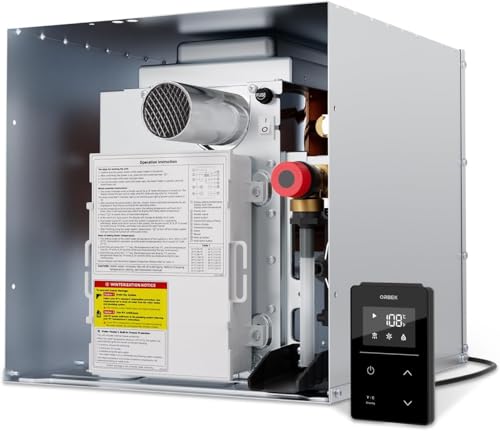
ORBEK 60,000 BTU propane tankless RV heater
60,000 BTUTankless12V DCAltitude mode
Check price on Amazon
Best for: Mountain-traveling van owners with strong power and a larger cutout.

ORBEK builds its tankless heater around a 60,000 BTU burner, an oxygen-free copper exchanger and a high-altitude suitability mode, with the door panel sold separately in black or white. For a van that crosses mountain passes, that mode is relevant, and the copper exchanger transfers heat quickly. It is a larger burner than the MapleGrace, which helps in cold weather.

The tradeoff is size and power. A 60,000 BTU tankless in a van needs a strong gas supply and a careful exhaust, which can be hard in a conversion. It also pairs the 12V draw of a fan and board with a small battery bank. A tank like the SAW6DEL asks less of the electrical system.

Plan the install on paper first. Check the opening, the door panel you order, the regulator and the battery supply. Drain the heat exchanger for winter and keep the manual in the van. Because a conversion can put a large burner close to bedding, upholstery and wiring, a quick check for heat discoloration around the cabinet after the first long shower is time well spent.

What works

  • Oxygen-free copper heat exchanger
  • High-altitude suitability mode
  • 60,000 BTU burner for cold inlet water
  • Door panel color is selectable

Watch out for

  • Larger burner is demanding for a van gas system
  • Door panel sold separately
  • 12V draw is higher than a tank igniter

Spec sheet

Burner
60,000 BTU propane
Power
12V DC
Exchanger
Oxygen-free copper
Altitude
Suitability mode
Door
Black or white panel sold separately

Spec sheet decoder

What the numbers on the box really mean

The specs manufacturers lead with, translated into what they tell you about real-world performance.

Direct fit

A replacement built to match an existing cutout and mounting. It removes the need to cut or reframe the cabinet.

Watch forSAW6D and SAW6DEL are both listed as direct-fit.

L suffix

On Suburban models, L denotes a 12V relay for controlling the electric element from inside. It does not change tank size.

Watch forOnly the SAW6DEL carries it here.

Porcelain-lined steel

A steel tank with a glass-like lining that resists rust. It relies on an anode rod for protection.

Watch forInspect the anode each year.

Tankless BTU

Burner output that heats water live. Larger numbers allow a bigger temperature rise.

Watch forMapleGrace lists 55,000 BTU and ORBEK lists 60,000 BTU.

CSA certification

A safety listing for gas appliances, which matters for enclosed vehicles. It does not describe performance.

Watch forMapleGrace lists CSA.

Methodology

How We Evaluated These RV Water Heaters for Camper Vans

Fit in tight spaces

We looked for direct-fit language and compact dimensions. The Suburban SAW6D and SAW6DEL scored best because the listing says no cutout changes are needed. A heater that needs carpentry lost points, since a van owner pays for that work in hours, not dollars. We also checked whether the listing gives dimensions, because fit claims without numbers are hard to trust.

Electrical load

We considered what each heater asks of a small battery bank, from a tank igniter to a tankless fan and board. A lower continuous draw scored higher for van use, because most conversions rely on a battery bank and a few solar panels rather than a generator. We also noted wiring sizes where listings gave them.

Safety in enclosed spaces

We weighed certifications and fail-safes, since a van has little room for error. CSA listings and clear exhaust requirements counted in a unit favor. We also looked for fail-safes such as flame-out and overheat shutoffs, which are the features that matter when a heater shares a small cabin with a sleeping person.

Capacity versus footprint

We compared 6 gallon tanks to tankless units that free space. We treated the tradeoff as personal to the owner, depending on whether storage or reserve matters more. Some owners value the reserve of a tank on a cold morning, while others value the extra shelf more than the reserve.

Parts and support

We looked at brand reach and spec documentation. The Suburban and Dometic lines have wide parts availability, while newer brands depend on shipped parts.

Decision guide

How to Choose the Right RV Water Heaters for Camper Vans

By Cabinet

SituationPickWhy
Existing Suburban 6 gallon cabinetSuburban SAW6DELDirect fit with an inside element switch
Same cabinet, minimal electronicsSuburban SAW6DDirect fit without the relay
Existing Dometic or Atwood cabinetWH-6GAPart-number match
Want to remove the tankMapleGrace 55,000 BTUTankless frees volume

By Budget

TierPickWhy
LowestWH-6GAPlain replacement
Low to midMapleGrace 55,000 BTUTankless at a lower tier
MidSuburban SAW6DDirect-fit tank
UpperSuburban SAW6DELDirect fit with a relay

Tank vs Tankless in a Van

Tank

The SAW6DEL, SAW6D and WH-6GA store six gallons and need little power. They fill a cabinet and add weight.

Tankless

The MapleGrace and ORBEK free space and give endless hot water, but need steady 12V, a clean exhaust and a careful winter drain.

Pick a tank for simplicity and low power; pick tankless only if cabinet space is the pressing problem.

Power Axis

PreferencePickWhy
Smallest battery bankSuburban SAW6DIgniter only
Shore power sometimesSuburban SAW6DELElement with inside relay
Solar-rich vanMapleGrace 55,000 BTUCan feed a tankless fan
Mountain passesORBEK 60,000 BTUAltitude mode

For Weekend Vanlifers Specifically

Look for

A heater that fits without work and runs on a small battery. Short showers and a six gallon tank suit most weekends.

In this comparison

The Suburban SAW6D drops into an existing cabinet and needs only an igniter's worth of power, while the SAW6DEL adds an inside switch.

When to Spend More

Spend more if

You live in the van or camp in cold weather. The SAW6DEL's relay and the ORBEK's burner reduce day-to-day friction.

Save if

You camp occasionally and shower briefly. The SAW6D or the WH-6GA is enough.

Ownership

Maintenance schedule

The upkeep that decides whether this machine lasts two seasons or ten.

TaskIntervalWhy it matters
Inspect the anode rodEvery yearA steel tank relies on it for protection. Replace at about three quarters consumed.
Flush the tankEvery springSediment lowers recovery and causes noise. Drain, flush and refill.
Check exhaust and doorEach tripStored gear can block the vent. Keep the area clear and confirm the flame is blue.
Test the CO alarmEach tripA van is a small enclosed space. Test the alarm and replace its battery on a schedule, and replace the whole alarm at the date printed on its back, since sensors age out even when the battery is fresh.
Drain for winterBefore freezing weatherWater in a tank or exchanger can freeze. Bypass and drain fully.

FAQ

Frequently Asked Questions

Which heater fits a camper van best?

A direct-fit 6 gallon tank like the Suburban SAW6DEL or SAW6D is the easiest swap because no cutout work is needed. A tankless frees space but asks more of the power and exhaust systems. If you are unsure, start with the tank, because it is the lowest-risk path and the easiest to service on the road.

Is six gallons enough?

For one or two people taking short showers, yes. A navy-style shower stretches it further. A family will want a larger tank or a tankless, but in a van the cabinet usually decides the matter before the family does.

Can I run it on solar?

A tank igniter draws very little, so a solar-charged bank handles it easily. A tankless fan and board draw more, so size the battery and wire for it.

Do I need a carbon monoxide alarm?

Yes. Any gas appliance in a small enclosed space needs one. Test it often and replace it on schedule.

What does the L in SAW6DEL mean?

It denotes a 12V relay that lets you switch the electric element from inside the van. It does not change tank size.

Can I use a residential mini tank?

A residential 120V mini tank is not an RV gas appliance, and it needs a 120V outlet. It can work for a sink in a stationary setup but is not a replacement for a gas heater.

Bottom line

The short version

Browse more rv water heaters for camper vanson Amazon →
James Miller, Lead Machine Editor

About the author

James Miller

Lead Machine Editor, MachineFanatic

James Miller leads MachineFanatic's buying guides, turning spec sheets, manuals and owner feedback into clear verdicts on power tools, outdoor power equipment, shop machines and kitchen machines.

More from James →

Keep reading

Related guides