


Amazon affiliate links - we earn a commission.Affiliate disclosure

Buying guide · 12 min read · Updated 2026-11-13

Best Solar Generators for RV Camping (2026)

Six solar generators for RVs and camper vans, from a 292Wh weekender to a 3,840Wh house-battery replacement, sorted by what you actually plug in.

James MillerBy James MillerLead Machine Editor6 machines comparedSpec-sheet verified
Best Solar Generators for RV Camping

At a glance

Our top picks

Side by side

Spec comparison

RV owners ask a battery to do three different jobs: keep a camper van alive for a weekend, run the refrigerator and fans in a trailer, or stand in for house power in a larger coach. Each job wants a different size of machine, and buying one tier too large costs money and cargo space.

This guide sorts six solar generators by the camper they suit best. We looked at tank size, outlet type, how the unit takes charge from panels, a vehicle alternator or a campground hookup, and how awkward each one is to live with every day.

Before you buy

6 Criteria to Look For Before Buying a Solar Generator for RV Camping

  1. 01

    Match tank size to the camper

    A van with a laptop and lights lives happily on the Jackery 300's 292Wh, while a trailer with a compressor fridge needs the 1,024Wh class like the Jackery 1000 v2. Coaches that run microwaves and air conditioners want the 3,000Wh-plus tier, such as the Bluetti Elite 300 or ABOK Ark3600.

  2. 02

    Native RV outlet and 12V output

    A TT-30 receptacle means a 30 amp trailer inlet plugs straight in, which the Bluetti Elite 300 offers. Its 12V/30A DC port also feeds 12V lights and fridges without inverter losses. Buyers often forget that converting 12V to 120V and back wastes 10 to 15 percent.

  3. 03

    How the battery refills

    Solar, wall power and the vehicle alternator are three different refill paths. The ABOK Ark3600 bundle brings a 500W alternator charger, while the EcoFlow Delta 3 Max does zero to 80 percent in about 1.13 hours from AC. Pick the path that matches your day: driving, hookups or sun.

  4. 04

    Continuous watts against appliances

    A 1,500W Jackery 1000 v2 runs a coffee maker but not a 13,500 BTU air conditioner. The EcoFlow's 3,400W X-Boost and the HomePower 3600 Plus's 3,600W handle bigger loads. Add up the labels of the real appliances and leave 20 percent headroom.

  5. 05

    Weight and where it lives

    The Jackery 300 weighs 7.5 pounds and moves like a bag of groceries, while the 3,000Wh-plus units are two-person lifts. A battery you cannot get into the cargo bay gets left at home. Measure the compartment and the doorway before you order.

  6. 06

    Panel size in the kit

    A 40W panel with the Jackery 300 only trickles, while two 200W panels with the Bluetti Elite 300 add about 800Wh on a good day. Real panel output runs 60 to 80 percent of the label. Plan for twice the panel area you think you need if you boondock for days.

Detailed reviews

The 6 best solar generators for rv camping, explained

01
Jackery Solar Generator 1000 v2 with 200W Solar Panel
1,024Wh LiFePO41,500W AC3,000W surge10ms UPS
Check price on Amazon
Best for: Trailer and van owners who want one dependable battery for a refrigerator, fans and electronics.

Most RVers want something they can carry in one hand and forget about, and this kit lands almost exactly there. A kilowatt-hour tank and a 1,500W inverter run a 12V-style compressor refrigerator, lights, a fan and phone charging for more than a day, while the 3,000W surge covers the occasional blender or hair dryer. The included 200W panel is the right size to roughly match that load on a sunny day.

Two things set it apart from the cheaper stations further down. Recharge from a wall outlet takes about 50 minutes to full, so a lunch stop at a hookup resets it. And the 10ms switchover means that, plugged into shore power, it behaves like a small UPS if the campground supply dips. Next to the Jackery 300 kit it holds about three and a half times the energy, which is the difference between two nights and a long weekend of modest use.

Store it inside the cabin, not in a hot rooftop box, keep the AC inverter off between uses and top the battery up every few months. The LiFePO4 pack tolerates abuse better than older lithium-ion, but it still lasts longest at moderate charge and temperature.

What works

  • 1,024Wh tank with a fast 50-minute wall charge
  • 1,500W output runs small kitchen appliances
  • 10ms switchover works like a small UPS
  • Single-person carry for its capacity

Watch out for

  • Cannot run a rooftop air conditioner
  • 200W panel refills the tank slowly on cloudy days
  • Single 120V circuit only

Spec sheet

Capacity
1,024Wh
Rated AC output
1,500W
Surge
3,000W
Wall recharge
About 50 minutes
Included panel
200W
02
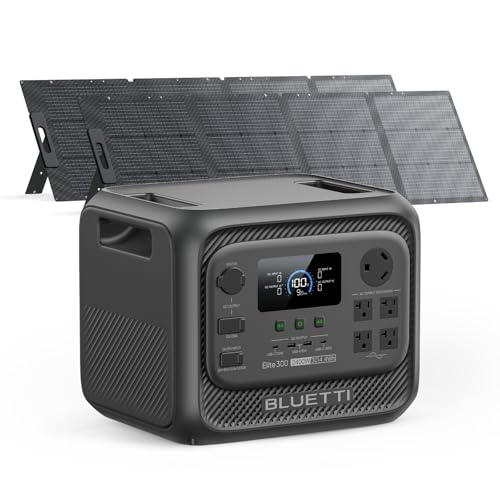
BLUETTI Elite 300 Solar Generator with 2x200W Panels
3,014Wh LFP2,400W ACTT-30 outlet12V/30A DC port
Check price on Amazon
Best for: Trailer owners with a 30 amp inlet who want a drop-in battery replacement for shore power.

The Elite 300 is the one station here designed around RV wiring rather than camping gear. It carries a dedicated TT-30 outlet, the 30 amp plug found on most trailers, plus a 12V/30A DC output that can feed 12V fridges and lights without an inverter conversion. That saves you an adapter and avoids the loss of converting 12V to 120V and back again.

Capacity is 3,014Wh with 2,400W of output and a 4,800W surge, which is enough for a refrigerator, a microwave and a single small air conditioner for a limited stretch. Against the ECOFLOW Delta 3 Max it gives up about 1,000W of output but holds roughly 960Wh more energy, which is the better trade if you boondock.

Because it is a compact 3kWh box, mounting matters. Strap it in the vehicle so it cannot slide, keep the vents clear, and avoid charging below freezing. The two 200W panels refill the tank slowly, so most owners add a 12V alternator charger or a larger folding array later.

What works

  • Native TT-30 outlet suits 30 amp trailers
  • 12V/30A DC port feeds 12V gear efficiently
  • 3,014Wh tank in a compact chassis
  • 4,800W surge starts small air conditioners

Watch out for

  • Only 400W of included solar for a 3kWh tank
  • 2,400W rated output is limited for large coaches
  • Heavy for casual carrying

Spec sheet

Capacity
3,014Wh
Rated AC output
2,400W
Surge
4,800W
RV outlet
TT-30
Included panels
2 x 200W
03
EcoFlow DELTA 3 Max with 220W Bifacial Solar Panel
2,048Wh3,400W X-Boost1.13h to 80%10ms UPS
Check price on Amazon
Best for: RVers who cook with electric appliances and hit hookups often enough to value quick recharging.

This is the high-power middle option. The inverter reaches 3,400W using EcoFlow's X-Boost mode, which lowers the output voltage slightly to run resistive loads above the nominal rating, so a toaster oven or a space heater that would trip a 1,800W machine can run here. Charging is its other strength: the listing quotes zero to 80 percent in about 1.13 hours.

The 220W panel is bifacial, meaning it also collects light reflected from the ground, which helps a lot on white gravel or snow but little on dark asphalt. At 2,048Wh the tank is double the Jackery 1000 v2 and roughly two-thirds of the Bluetti, so it fills the gap for owners who cook electrically.

In ownership terms, treat X-Boost as a convenience not a free lunch: heating loads on a 2kWh tank drain it in well under an hour. Keep the intake clear, update the app firmware and store it half charged.

What works

  • 3,400W X-Boost runs heating appliances
  • Fast zero to 80 percent charging
  • Bifacial panel adds ground-reflected light
  • Switches to battery in under 10ms

Watch out for

  • 2,048Wh drains quickly under heating loads
  • X-Boost output is not true 120V behavior
  • Bifacial gain depends heavily on the ground surface

Spec sheet

Capacity
2,048Wh
Rated AC output
3,400W X-Boost
Fast charge
0 to 80% in 1.13h
Included panel
220W bifacial
Switchover
Under 10ms
04
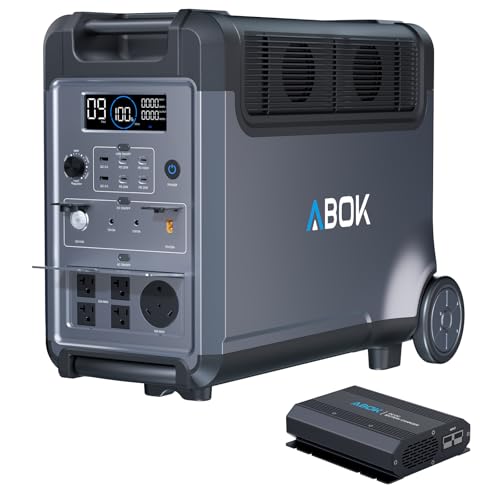
ABOK Ark3600 3,840Wh with 500W Alternator Charger
3,840Wh LiFePO43,600W AC500W alternator inputExpands to 11.5kWh
Check price on Amazon
Best for: Larger trailers and motorhomes that want drive-time recharging and a big, expandable tank.

The thing that makes this listing special is the 500W alternator charger in the bundle, which lets the tow vehicle or motorhome engine refill the battery while you drive. On long travel days that is worth more than a small folding panel, since a few hours of driving can put several hundred watt-hours into the bank without needing sun.

The station itself is a 3,840Wh, 3,600W LiFePO4 unit with a quoted 4,500W peak in this variant, and expansion up to 11,520Wh. It is the largest tank in the lineup, so it suits a travel trailer or small motorhome acting as a house battery replacement. Solar is not included in this bundle, so you would add panels separately.

The alternator charger needs a proper, fused cable run from the starting battery, and the install is the tricky part: wire gauge and fuse sizing matter at 500W. Have a technician check the run, and ask whether the charger works with your vehicle's smart alternator before buying.

What works

  • 500W alternator charger refills while driving
  • 3,840Wh is the largest tank here
  • Expandable to 11,520Wh
  • 3,600W output handles most coach appliances

Watch out for

  • No solar panels in this bundle
  • Alternator wiring is a real install job
  • Smaller brand with fewer owner reports

Spec sheet

Capacity
3,840Wh
Rated AC output
3,600W
Peak output
4,500W
Alternator charger
500W included
Expansion
Up to 11,520Wh
05
Jackery HomePower 3600 Plus with 2x200W Solar Panels
3,584Wh LFP3,600W ACExpands to 21kWhParallel to 7,200W
Check price on Amazon
Best for: Owners who want a single battery that scales and also serves the house.

The HomePower 3600 Plus is a home backup battery that also makes sense in a big coach. It gives 3,600W from one unit and doubles to 7,200W in parallel, with expansion packs to 21kWh. For an RV owner who plans to keep the rig for years and might want the same battery to ride through a house outage, that headroom is the pitch.

The listing describes a plug-and-play route into a house through a manual transfer switch, which is rare in this size class. On the road it behaves like a larger-capacity ABOK Ark3600, without the alternator charger or TT-30 port, but with a longer-established brand behind it.

It is heavy, so install it where it will live. Do not put it in a sealed compartment that gets hot, check the vents each season, and keep two 200W panels positioned out of shade, since a long cable run to a sunny spot beats a panel on the shaded roof.

What works

  • Parallel and expansion paths to 7,200W and 21kWh
  • Transfer-switch route to house backup
  • Heat-resistant LFP cell design
  • Large, established support network

Watch out for

  • Heavy for a casual camper
  • No RV outlet or alternator charger listed
  • Highest cost of the lineup for what a trailer needs

Spec sheet

Capacity
3,584Wh
Rated AC output
3,600W
Parallel output
7,200W
Expansion
Up to 21kWh
Included panels
2 x 200W
06
Jackery Solar Generator 300 with 40W Solar Panel
292Wh LiFePO4300W AC7.5 lb weight100W USB-C PD
Check price on Amazon
Best for: Van and tent-trailer campers who power phones, lights and laptops.

For a small camper van or tent-trailer that only needs phones, laptops, LED lights and a fan, this is the right size. It weighs 7.5 pounds, carries 292Wh, and offers two AC outlets, a 100W USB-C port, two USB-A ports and a 120W car port. The LiFePO4 chemistry is quoted at over 4,000 charge cycles, which is long life for a small unit.

It will not run a compressor refrigerator for a full night, though. 292Wh times 0.85 gives about 250Wh usable, and a typical 12V fridge uses 300Wh a day. The 40W panel gives a trickle, useful for topping up a phone and laptop, not for the fridge.

Upkeep is minimal: wipe the case, store it half charged, and switch the AC inverter off when you are only using USB ports, since USB-C is more efficient than going through the inverter.

What works

  • 7.5 pounds, easy to move around
  • 100W USB-C PD charges laptops efficiently
  • 4,000-plus cycle LiFePO4 chemistry
  • Pure sine wave AC outlets

Watch out for

  • Cannot carry a refrigerator overnight
  • 40W panel is only a trickle charger
  • 300W limit rules out kitchen appliances

Spec sheet

Capacity
292Wh
Rated AC output
300W
Weight
7.5 lb
USB-C
100W PD
Cycle life
4,000+

Spec sheet decoder

What the numbers on the box really mean

The specs manufacturers lead with, translated into what they tell you about real-world performance.

Wh (watt-hours)

The size of the tank. Divide by your load and multiply by about 0.85 for runtime.

Watch forThe Jackery 300 holds 292Wh while the ABOK Ark3600 holds 3,840Wh, a 13-fold spread.

Rated vs surge watts

Rated is what the inverter sustains, surge is a moment of startup headroom for motors.

Watch forThe Jackery 1000 v2 lists 1,500W rated and 3,000W surge, the EcoFlow Max 3,400W under X-Boost.

TT-30 outlet

A 30 amp, 120V RV receptacle that trailers use for shore power. It limits you to 3,600W at the plug.

Watch forThe Bluetti Elite 300 includes one and the ABOK Ark3600 kits list one as well.

UPS switchover time

How fast the unit switches to battery when wall power drops. Under 20ms usually keeps electronics alive.

Watch forThe Jackery 1000 v2 claims 10ms and the EcoFlow Max claims under 10ms.

Alternator charging

A DC-to-DC charger that takes power from the vehicle while driving. It adds range on travel days.

Watch forOnly the ABOK Ark3600 bundle here includes a 500W charger.

Methodology

How We Evaluated These Solar Generators for RV Camping

Fit for common RV types

We grouped the six stations by the RV they suit: van, trailer, coach. The Jackery 300 for a van, the Jackery 1000 v2 for a trailer, and the 3,000Wh class for a coach. We weighted fit above raw capacity.

RV-specific connections

We checked for TT-30 outlets, 12V DC ports and alternator charging, which are what separate an RV battery from a camping one. The Bluetti Elite 300 and ABOK Ark3600 stood out here. Units that need adapters lost points.

Refill options

We compared the three refill paths. The EcoFlow Max charges to 80 percent in about 1.13 hours, the ABOK adds drive-time charging, and the Jackery kits lean on bundled solar.

Portability

We considered weight and form, since a battery you can't carry stays behind. The 7.5-pound Jackery 300 won clearly, while the 3,000Wh machines scored lower.

Ownership and support

We used owner feedback patterns and the spec sheets, rather than personal ownership. Established ecosystems from Jackery, EcoFlow and Bluetti scored higher for firmware and parts than the newer ABOK.

Decision guide

How to Choose the Right Solar Generators for RV Camping

By Type of RV

RVPickWhy
Camper van or tent trailerJackery Solar Generator 3007.5 pounds, covers phones and laptops
Travel trailer with a compressor fridgeJackery Solar Generator 1000 v21,024Wh, 50-minute wall charge
30 amp trailer inletBLUETTI Elite 300Native TT-30 outlet, 3,014Wh
Electric cooking on the roadEcoFlow DELTA 3 Max3,400W X-Boost output
Large trailer or small motorhomeABOK Ark3600 with alternator charger3,840Wh and drive-time charging

By Budget

TierPickWhy
Lowest costJackery Solar Generator 300Cheap, light, lasts years
MidJackery Solar Generator 1000 v2Best capacity per carried pound
Upper midEcoFlow DELTA 3 MaxFast charging and heating loads
PremiumJackery HomePower 3600 PlusExpansion to 21kWh and house backup

Solar vs Alternator Charging

Solar

The Jackery kits and the Bluetti Elite 300 kit all arrive with panels, which makes them silent and fuel-free but dependent on weather. Two 200W panels give roughly 800Wh on a good day.

Alternator

The ABOK Ark3600 bundle refills at up to 500W while you drive. A four-hour drive can restore close to 2,000Wh, no sun required.

Choose solar if you stay put for days, alternator charging if you move every day or two.

12V Native vs 120V Inverter Loads

PreferencePickWhy
Mostly 12V lights and fridgeBLUETTI Elite 30012V/30A DC output avoids conversion loss
Mostly USB and laptopsJackery Solar Generator 300100W USB-C PD is efficient
Mixed household gearJackery Solar Generator 1000 v21,500W pure sine AC output
Heating appliancesEcoFlow DELTA 3 MaxX-Boost reaches 3,400W

For Running a Refrigerator Specifically

Look for

Look for at least 1,000Wh of storage and a pure sine wave inverter. A compressor fridge uses about 300 to 600Wh a day, and the startup surge is short but real.

In this comparison

The Jackery 1000 v2 handles it for close to two days without solar, and the 200W panel can keep it going indefinitely in good sun. The Jackery 300 can only bridge a few hours.

When to Spend More

Spend more if

You live in the rig or want air conditioning off-grid. The Bluetti Elite 300 and ABOK Ark3600 move you into the 3,000Wh class, and the HomePower 3600 Plus adds expansion.

Save if

You camp a few weekends a year with electric hookups. The Jackery 300 or 1000 v2 covers that without paying for capacity you will not use.

Ownership

Maintenance schedule

The upkeep that decides whether this machine lasts two seasons or ten.

TaskIntervalWhy it matters
Charge to about 50 percent for storageBefore long storageLiFePO4 cells age slowest at moderate charge. Top up every two to three months.
Check vents and fansEvery seasonDust blocks airflow and shortens full-load runtime on the larger units.
Inspect solar cables and connectorsEach tripPinched cables and loose MC4 or DC connectors lose power as heat.
Inspect the alternator cable and fuseTwice a yearA 500W DC charge run needs correct gauge and a fuse close to the starting battery.
Keep it out of hot compartmentsAlwaysHeat above about 100 degrees shortens battery life on every chemistry, LFP included.

FAQ

Frequently Asked Questions

How big a solar generator do I need for a camper?

Add up daily watt-hours: a compressor fridge uses 300 to 600Wh, lights and phones another 100 to 200Wh. That points to the 1,024Wh Jackery 1000 v2 class for most trailers, with the 292Wh Jackery 300 sufficient for vans with light loads.

Can any of these run an RV air conditioner?

The 3,000Wh-plus units like the Bluetti Elite 300 and ABOK Ark3600 can for a few hours. Smaller units cannot start the compressor, and none replaces a generator for all-day cooling.

Is a built-in TT-30 outlet worth it?

If your trailer has a 30 amp shore cord, yes. It removes an adapter and keeps the connection solid. Without one you can use an adapter, but verify its rating.

Do I need an alternator charger?

Only if you travel often and rarely sit in the sun. The ABOK bundle's 500W charger replenishes the battery on the road, while solar is better for long stays.

Can I use the battery while it charges?

Most of these support pass-through use. It adds heat and some cell wear, so do not rely on it as a constant mode on a hot day.

Will these work in cold weather?

They discharge fine in the cold but should not be charged below freezing. Keep them in the cabin on winter trips and let them warm up before plugging in a charger.

Bottom line

The short version

Browse more solar generators for rv campingon Amazon →
James Miller, Lead Machine Editor

About the author

James Miller

Lead Machine Editor, MachineFanatic

James Miller leads MachineFanatic's buying guides, turning spec sheets, manuals and owner feedback into clear verdicts on power tools, outdoor power equipment, shop machines and kitchen machines.

More from James →

Keep reading

Related guides