

Amazon affiliate links - we earn a commission.Affiliate disclosure

Buying guide · 12 min read · Updated 2026-11-13

Best Solar Generators for Your House (2026)

Five solar generators for house outages, from a 1,024Wh essentials unit to a 5,040Wh split-phase battery, with honest load math for real homes.

James MillerBy James MillerLead Machine Editor6 machines comparedSpec-sheet verified
Best Solar Generators for Your House

At a glance

Our top picks

Side by side

Spec comparison

Powering a house from a portable battery is a question of priorities. Nobody expects a plug-in unit to run every circuit, so the real work is deciding which handful of loads matter during an outage and sizing a machine that carries them without drama.

We looked at five solar generators that make sense for a home, from a compact essentials unit up to a large split-phase battery. Each is judged on usable energy, how it connects to household wiring, and how well it handles recharging from panels during a multi-day outage.

Before you buy

6 Criteria to Look For Before Buying a Solar Generator for Your House

  1. 01

    List your critical loads

    A refrigerator uses 100 to 200W running but 3 times that at startup, a sump pump 800 to 1,200W, and a furnace blower around 500W. Add them up before you pick a machine. The DELTA 3 Classic's 1,800W covers a refrigerator, router and lights, while the Jackery 5000 Plus's 7,200W also covers a well pump.

  2. 02

    Energy for the outage length

    A 600W average load drains the Elite 200 V2's 2,080Wh in roughly three hours, but the Jackery 5000 Plus lasts closer to seven. Multiply your average draw by the hours you want to ride through, then divide by 0.85 for inverter losses.

  3. 03

    120V or split phase

    Well pumps, dryers and ranges often need 240V. The Oscal PowerMax 6000 and the Jackery 5000 Plus offer it, while the DELTA Pro, Elite 200 V2 and DELTA 3 Classic are 120V. Do not buy a 120V unit for a 240V pump.

  4. 04

    Connecting to the panel

    Plugging appliances into extension cords works for essentials, but backfeeding a home panel needs a transfer switch or interlock installed by an electrician. Skipping it is a real safety risk for utility workers and for your house wiring. Budget for installation.

  5. 05

    Solar recharge during an outage

    The Oscal accepts 2,400W of solar and ships with 1,200W of panels, while the Jackery 5000 Plus ships with 400W. Real panel output is 60 to 80 percent of label. A larger array turns a multi-day outage from a countdown into a routine.

  6. 06

    Standby draw and UPS behavior

    An inverter that stays on burns power with no load; the Elite 200 V2 lists about 10W standby. A claimed 10ms UPS function keeps computers on, but it only matters if you leave the unit plugged in and charged.

Detailed reviews

The 6 best solar generators for your house, explained

01
Jackery Solar Generator 5000 Plus with 2x200W Panels
5,040Wh LiFePO47,200W AC120/240VExpands to 60kWh
Check price on Amazon
Best for: Homeowners who want a battery that can feed a panel for a multi-day outage.

Large home appliances are what this machine is built for. At 7,200W rated with a 14,400W surge and support for both 120V and 240V, it can run a well pump, a refrigerator, a gas furnace blower and a window air conditioner at once, and it can feed a home through a transfer switch the way a generator would. The 5,040Wh tank is large enough that a typical essentials load of 1.5 to 2kW lasts a long evening.

Its big advantage over a gas generator is silence and zero fuel logistics, and the listing says it expands to 60kWh with extra batteries and accepts both high and low voltage panels. The weak point is the standard 400W of panels: refilling 5,040Wh from 400W of real-world panel output takes several days, so you plan to charge from the grid between outages or add a bigger array.

Store it in a dry indoor spot such as a garage or basement, check the vent screens each season, and keep it around half charged if it will sit for months. Test the transfer switch under load once a year so you know it works before the storm arrives.

What works

  • 7,200W output with 120/240V for home panels
  • 5,040Wh carries essentials for days
  • Expandable to 60kWh with extra packs
  • Accepts both high and low voltage panels

Watch out for

  • Two 200W panels refill slowly
  • Very heavy, two-person lift
  • Needs a proper transfer switch install

Spec sheet

Capacity
5,040Wh
Rated AC output
7,200W
Surge
14,400W
Voltage
120V and 240V
Expansion
Up to 60kWh
02
EcoFlow DELTA Pro 3,600Wh Power Station, 120V 3,600W
3,600Wh LFP3,600W ACExpandable output1.8h at 240V
Check price on Amazon
Best for: Homeowners who want a mature platform with fast recharge and broad accessory support.

The DELTA Pro has been a home-backup staple for years, and that history shows in the ecosystem around it. A 3,600Wh LFP battery with 3,600W of output, expandable to 4,500W with an accessory, runs a refrigerator, a freezer, internet gear, lights and a microwave together. Recharge is the other story: the listing quotes about 1.8 hours from a 240V outlet and 2.7 hours from a standard circuit.

That quick recharge matters in a multi-day outage because you can charge fast when grid power flickers back, then run on battery again. Compared with the Jackery 5000 Plus it carries about 1,440Wh less energy and produces half the output, but it is a lot easier to move and has a wider range of accessories and third-party transfer-kit support.

Keep it somewhere dry and cool, vacuum the fan inlets once a season and run it under a moderate load every few months. A watt meter on each appliance tells you which circuits can share the battery.

What works

  • Quick charging from 240V in under two hours
  • 3,600W output powers several essentials
  • Mature accessory and transfer-kit ecosystem
  • LFP cells rated for long cycle life

Watch out for

  • Listed as 120V, so one leg of a home panel
  • Heavy at this capacity
  • Older design than the newest rivals

Spec sheet

Capacity
3,600Wh
Rated AC output
3,600W
Expanded output
Up to 4,500W
240V charge
About 1.8 hours
Wall charge
About 2.7 hours
03
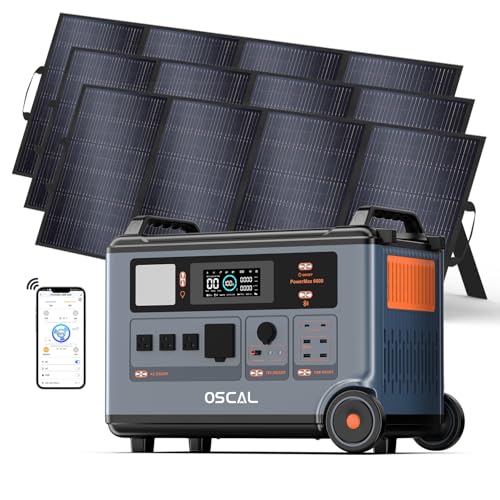
OSCAL PowerMax 6000 with 3x400W Solar Panels
3,600Wh LiFePO46,000W 120/240V2,400W solar input9,000W surge
Check price on Amazon
Best for: Homes that need 240V now and want a large included solar array to refill it.

The PowerMax 6000 appeals to anyone who needs 240V for a well pump or a clothes dryer but cannot justify the largest battery on the market. It delivers 6,000W split-phase from a 3,600Wh tank, so you can start big motors but must budget energy carefully, because those loads drain a 3.6kWh pack in an hour or two.

Its best feature is solar: 2,400W of input and three 400W panels in the kit mean a sunny day can nearly refill the tank, something the Jackery 5000 Plus cannot do with its 400W kit. For a home with a ground-mount array spot, that closes the loop in a multi-day outage.

The panels are big, so plan where they will sit and how to anchor them in wind. Check connectors each season and keep the unit indoors, away from damp walls.

What works

  • Split-phase output for 240V loads
  • 2,400W solar input refills in a day
  • Three 400W panels in the kit
  • 9,000W surge handles pump startup

Watch out for

  • 3,600Wh limits runtime with heavy loads
  • Large panels need real yard space
  • Newer brand, less support history

Spec sheet

Capacity
3,600Wh
Rated AC output
6,000W
Surge
9,000W
Solar input
2,400W
Included panels
3 x 400W
04
BLUETTI Elite 200 V2 with 2x200W Solar Panels
2,080Wh LFP2,600W AC3,900W surge10W standby
Check price on Amazon
Best for: Homes whose essentials draw under 800W and who want solar included.

This is the sensible middle of the lineup. 2,080Wh and 2,600W of output run a refrigerator, a chest freezer, a router and a sump pump together, and the listing notes standby consumption of about 10W, so it does not bleed charge while it waits. The kit includes two 200W panels and lists a full solar recharge in about five and a half hours of good sun.

Compared with the DELTA Pro it holds 1,520Wh less energy but is far lighter and less awkward in a hall closet. Against the DELTA 3 Classic it has twice the capacity and 800W more output at a moderate premium. It fills the sweet spot for a household whose critical loads add up to about 600W continuous.

The cells use an automotive-grade LiFePO4 chemistry with a claimed long life. Keep it indoors, run a quick discharge test each season and cycle the battery from 20 percent to 90 percent now and then to keep the monitoring accurate.

What works

  • 2,080Wh and 2,600W for a moderate footprint
  • Low 10W standby draw
  • Two 200W panels refill in a day
  • Lighter and easier to place than 3kWh units

Watch out for

  • Cannot run 240V appliances
  • 2,080Wh runs out quickly under heavy load
  • No transfer switch listed in the kit

Spec sheet

Capacity
2,080Wh
Rated AC output
2,600W
Surge
3,900W
Standby draw
About 10W
Included panels
2 x 200W
05
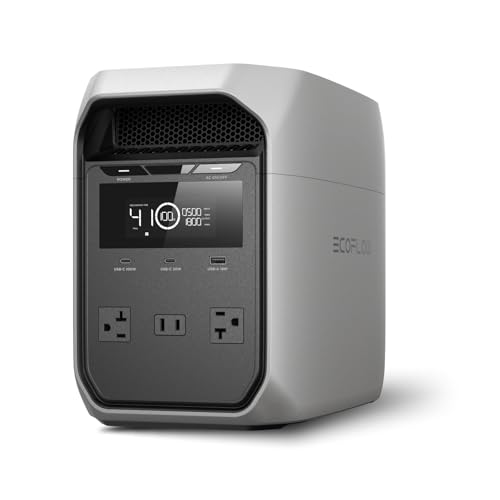
EcoFlow DELTA 3 Classic 1,024Wh, 1,800W AC
1,024Wh1,800W AC3,600W surge10ms UPS
Check price on Amazon
Best for: Renters and apartment owners who want a fast-charging essentials battery.

For a household that only wants the refrigerator, router, phones and a lamp alive during an outage, this small, fast-charging unit is enough. 1,024Wh with 1,800W of output keeps a typical refrigerator running for about a day. The listing claims a 10ms UPS switchover, so a modem and desktop PC will not drop when the grid fails.

Its strength is recharge speed, about 45 minutes to 80 percent from the wall, which means short grid windows do real work. It lacks the capacity for pumps or air conditioners, and it does not have the DELTA Pro's expansion path, so treat it as a first step.

It weighs a fraction of the big units, so it lives in a closet and moves with you. A watt meter on the refrigerator tells you its true consumption, and storing the unit half charged keeps the battery healthy.

What works

  • Fast zero to 80 percent in 45 minutes
  • 10ms UPS keeps routers and PCs running
  • 1,800W output with X-Boost
  • Compact enough for any closet

Watch out for

  • 1,024Wh covers about one day of a refrigerator
  • Cannot run well pumps or central air
  • No parallel expansion path

Spec sheet

Capacity
1,024Wh
Rated AC output
1,800W
Surge
3,600W with X-Boost
Fast charge
0 to 80% in 45 minutes
USB-C output
100W
06
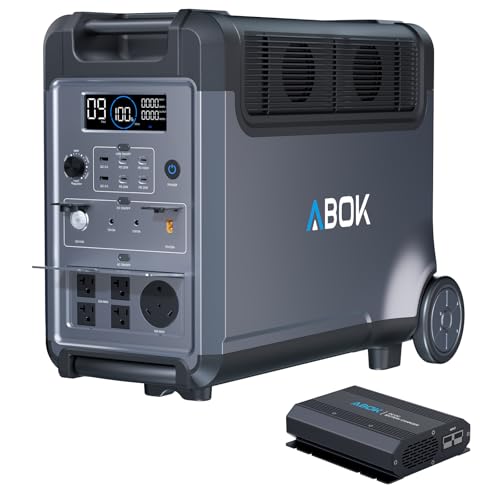
ABOK Ark3600 3,840Wh with 500W Alternator Charger
3,840Wh LiFePO43,600W AC4,500W peakExpands to 11.5kWh
Check price on Amazon
Best for: Households that want to start with one battery and add storage over time.

Fifteen output ports and a 3,840Wh tank make the Ark3600 a household hub rather than a single-purpose box. The listing says the 3,600W inverter supports almost all household appliances, and extra batteries lift capacity to 11,520Wh, so you can buy one now and add storage later without replacing the inverter.

The odd extra in this listing is a 500W alternator charger, which matters at home only if you have a vehicle to idle in a prolonged outage: a truck or car can top the battery up when the sun is absent. Against the DELTA Pro it holds 240Wh more energy and has a similar 3,600W output, though it is a newer platform with fewer third-party transfer kits.

Plan where the expansion packs will sit before you buy, since stacking heavy batteries on a garage shelf is a safety issue. Keep the vents clear, and run it under load a few times a year so the battery management system stays calibrated.

What works

  • 3,840Wh tank with expansion to 11,520Wh
  • 15 output ports run many small devices
  • 500W alternator charger as a backup refill
  • 3,600W rated output at a moderate size

Watch out for

  • No solar panels in this bundle
  • Newer platform with fewer transfer-kit options
  • Single 120V leg only

Spec sheet

Capacity
3,840Wh
Rated AC output
3,600W
Peak output
4,500W
Ports
15
Expansion
Up to 11,520Wh

Spec sheet decoder

What the numbers on the box really mean

The specs manufacturers lead with, translated into what they tell you about real-world performance.

Split-phase output

Two 120V legs that combine to 240V for pumps and dryers. It matches household panel wiring.

Watch forOnly the Jackery 5000 Plus and Oscal PowerMax 6000 list it in this group.

Rated AC watts

The sustained output the inverter holds. It limits how many appliances run at once.

Watch forFrom 1,800W on the DELTA 3 Classic to 7,200W on the Jackery 5000 Plus.

Surge watts

A short startup ceiling for motors and compressors. It is not extra continuous capacity.

Watch forThe Elite 200 V2 lists 3,900W against 2,600W rated, a 1.5 ratio.

Solar input limit

The maximum panel wattage the station can take at once. It caps recharge speed in an outage.

Watch forThe Oscal accepts 2,400W while the Elite 200 V2 reaches a full solar recharge in about 5.5 hours.

Expandability

Extra battery packs add runtime without extra inverter wattage. Not every model supports it.

Watch forThe Jackery 5000 Plus lists expansion to 60kWh while the DELTA 3 Classic has none.

Methodology

How We Evaluated These Solar Generators for Your House

Home-backup suitability

We judged whether each machine can sensibly serve a house: output, voltage and how it connects. The Jackery 5000 Plus and Oscal PowerMax 6000 earned the highest marks for 240V support. 120V-only units were scored for essentials use.

Runtime for real loads

We modeled a refrigerator, router and lights at about 300W average. The DELTA 3 Classic's 1,024Wh covers that for about three hours of full load, while the Jackery 5000 Plus runs it for over 14.

Recharge in an outage

We compared solar input limits and included panels. The Oscal's 2,400W input and 1,200W of panels beat the 400W kits of the Jackery and Bluetti.

Safety and install path

We looked for transfer-switch support and safe connection routes, since backfeeding a panel improperly is dangerous. The Jackery and EcoFlow ecosystems offer clearer paths than the newer brands.

Ownership and weight

We used the spec sheets and owner feedback patterns to rate how awkward each unit is to live with. The DELTA 3 Classic is easy to move, while the Jackery 5000 Plus needs a permanent spot.

Decision guide

How to Choose the Right Solar Generators for Your House

By What You Need Running

SituationPickWhy
Refrigerator, router, lampsEcoFlow DELTA 3 Classic1,024Wh with fast charging
Refrigerator, freezer, sump pumpBLUETTI Elite 200 V22,080Wh and 2,600W
Home panel via transfer switchJackery Solar Generator 5000 Plus7,200W at 120/240V
240V well pumpOSCAL PowerMax 60006,000W split-phase
Multiple fast recharges from the wallEcoFlow DELTA Pro1.8 hours at 240V

By Budget

TierPickWhy
EntryEcoFlow DELTA 3 ClassicSmallest and cheapest in the group
MidBLUETTI Elite 200 V2Includes two 200W panels
Upper midEcoFlow DELTA ProMature ecosystem
PremiumJackery Solar Generator 5000 PlusWhole-home capacity

Plug-In vs Transfer Switch

Plug-in appliances

Run extension cords to the refrigerator and a few outlets. The DELTA 3 Classic and Elite 200 V2 are built for this and need no electrician. It is cheap and flexible, but you manage cords.

Transfer switch

A switch lets the Jackery 5000 Plus or Oscal PowerMax 6000 feed chosen circuits through the panel. It is the right way to run a furnace blower or a well pump.

Choose plug-in for refrigerator-only needs, transfer switch when hardwired loads matter.

Short Outage vs Multi-Day Outage

PreferencePickWhy
A few hours, quick rechargeEcoFlow DELTA 3 Classic45 minutes to 80 percent
One or two daysEcoFlow DELTA Pro3,600Wh with fast recharge
Several days with solarOSCAL PowerMax 60002,400W of solar input
Long storms, big loadsJackery Solar Generator 5000 Plus5,040Wh, expandable

For a Well Pump Specifically

Look for

Look for 240V output and a surge rating at least three times the pump's running watts. A half-horsepower pump runs around 1,000W and starts near 3,000W.

In this comparison

The Oscal PowerMax 6000 and the Jackery 5000 Plus are the only two with 240V. The Jackery's 14,400W surge gives the most headroom.

When to Spend More

Spend more if

Your home has a well, a furnace blower or medical equipment. Step up to the Jackery 5000 Plus or the Oscal PowerMax 6000 for the 240V and the bigger tank.

Save if

You only need a refrigerator and communication gear. The DELTA 3 Classic or the Elite 200 V2 does that.

Ownership

Maintenance schedule

The upkeep that decides whether this machine lasts two seasons or ten.

TaskIntervalWhy it matters
Exercise the battery under loadEvery three monthsRunning a real load confirms the inverter and cells still perform. It also catches a fault before the storm does.
Test the transfer switch or interlockOnce a yearSwitch contacts can stick or corrode. A test under load confirms safe operation.
Store at 50 to 60 percent chargeDuring long storageModerate charge lengthens LiFePO4 life. Top up every few months.
Clean fan inletsEvery seasonDust reduces airflow and limits full-load runtime.
Inspect solar connectorsBefore storm seasonCorroded or loose connectors lose power and heat up.

FAQ

Frequently Asked Questions

Can a solar generator power a whole house?

Not in the way a standby generator can. The Jackery 5000 Plus can feed chosen circuits for days, but central air and electric ranges would drain it in hours. Plan around essentials.

Do I need a transfer switch?

If you want circuits like a furnace blower or a well pump on battery, yes, installed by an electrician. For a refrigerator and lights, extension cords work.

Which is the best value for a house?

The EcoFlow DELTA 3 Classic is the lowest cost for a refrigerator and router, and the Bluetti Elite 200 V2 adds capacity and panels for a moderate step up. Both are sensible first buys.

Is peak power the figure that matters?

No. Rated watts decide what runs together, and surge only covers a fraction of a second. The Jackery 5000 Plus's 14,400W surge is useful headroom, but 7,200W is its real limit.

How do I recharge in a long outage?

Use solar, and a larger array helps. The Oscal's 1,200W kit refills far faster than the 400W kits. Between storms, recharge from the grid when it returns.

Are these safe indoors?

LiFePO4 stations produce no exhaust and run indoors, unlike gas generators. Give them airflow and keep them away from water and heat.

Bottom line

The short version

Browse more solar generators for your houseon Amazon →
James Miller, Lead Machine Editor

About the author

James Miller

Lead Machine Editor, MachineFanatic

James Miller leads MachineFanatic's buying guides, turning spec sheets, manuals and owner feedback into clear verdicts on power tools, outdoor power equipment, shop machines and kitchen machines.

More from James →

Keep reading

Related guides