

Amazon affiliate links - we earn a commission.Affiliate disclosure

Buying guide · 12 min read · Updated 2026-11-13

Best Solar Generators with a 30 Amp Plug (2026)

Six 3,000Wh-class solar generators sized for a 30 amp circuit, with notes on TT-30 and L14-30 plugs, adapters and the 24 amp continuous rule.

James MillerBy James MillerLead Machine Editor6 machines comparedSpec-sheet verified
Best Solar Generators with a 30 Amp Plug

At a glance

Our top picks

Side by side

Spec comparison

A plug rating is a promise about wiring rather than a feature of the battery. It tells you how much current the connector and cable can carry, and it decides which appliance, RV inlet or generator inlet box the battery can reach without an adapter.

This guide ranks six large solar generators by how closely their output matches a mid-sized RV-style circuit, which ones list a native connector and which need an adapter. We separate genuine battery power from the generator cords and inlet boxes that clutter the search results.

Before you buy

6 Criteria to Look For Before Buying a Solar Generator with a 30 Amp Plug

  1. 01

    Amps, volts and watts

    A 30 amp, 120V circuit carries up to 3,600W, but the continuous limit is 80 percent, or 24 amps and 2,880W. The Elite 300's 2,400W sits under that and the 3,600W units reach it. Do not assume a 30 amp plug means you can draw 30 amps all day.

  2. 02

    Which 30 amp plug

    TT-30 is the RV plug, with one hot, one neutral and a ground, rated 120V. L14-30 is a locking 120/240V generator plug. They look similar but are not interchangeable, and many listings quietly omit which one they carry. Check the receptacle's shape: TT-30 has one straight blade, one angled blade and a round ground.

  3. 03

    Native outlet or adapter

    The Elite 300 lists a native TT-30, while the Jackery and Pecron units rely on adapters or standard household outlets. A cheap thin adapter is a common failure point at 2,880W, so buy a rated one.

  4. 04

    Energy for the load

    A 30 amp trailer running a 13,500 BTU air conditioner at about 1,300W, a fridge and a few lights uses roughly 1,700W. A 3,072Wh unit lasts about 1.5 hours at full load, while the ABOK's 3,840Wh lasts nearly two.

  5. 05

    Surge for air conditioners

    A rooftop compressor can pull 2,500 to 3,000W for a moment. The Elite 300's 4,800W and the Jackery HomePower 3000's 7,200W cover that, while the Explorer 2000 v2 relies on a 2,200W rating plus surge.

  6. 06

    Recharge while connected

    A 30 amp site is useless if the battery cannot refill. The Pecron recharges in about two hours from an 1,800W input and the Jackery 2000 v2 reaches 80 percent in 66 minutes. A slow charger leaves you short on the next day.

Detailed reviews

The 6 best solar generators with a 30 amp plug, explained

01
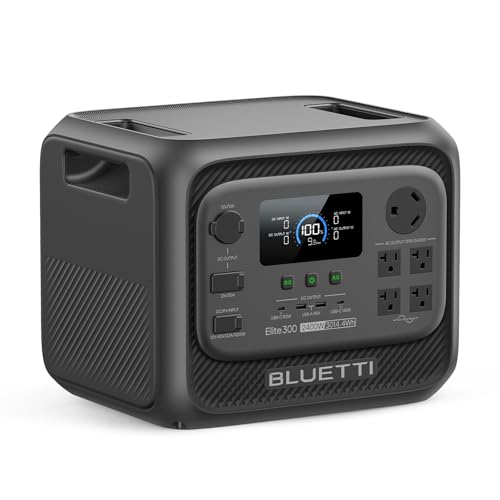
BLUETTI Elite 300 Power Station, 3,014Wh 2,400W with TT-30
3,014Wh LFP2,400W ACTT-30 outlet12V/30A DC
Check price on Amazon
Best for: Trailer and cabin owners who want a native 30 amp plug in a compact box.

The Elite 300 is the cleanest answer to the question because the plug is built in. It carries a dedicated TT-30 RV outlet, the same 30 amp connector found on most trailers and pedestals, so a coach or a trailer shore cord plugs in with no adapter between the battery and the load. A 12V/30A DC port sits beside it for 12V fridges and lights.

Rated output is 2,400W, which is 20 amps at 120V and comfortably under the 24 amp continuous limit of a 30 amp circuit, so the plug is never the bottleneck. The 4,800W surge starts an air conditioner or a well pump. The listing says the box is about 59 percent smaller than traditional large stations, which makes it easier to stow than the 3,600W units in this guide.

Compared with the ABOK Ark3600 it has 826Wh less energy and 1,200W less output, but it takes up much less room. Keep the intake clear, charge it above freezing, and leave it around half charged if it sits for months. Because the TT-30 is a locking-style twist-free blade plug, seat it fully and check it is not hanging off the unit's weight.

What works

  • Built-in TT-30 outlet needs no adapter
  • 12V/30A DC port for RV fridges and lights
  • 2,400W stays inside the 24 amp continuous limit
  • Compact for 3kWh of storage

Watch out for

  • 2,400W cannot fill a 30 amp circuit
  • Smaller tank than the 3,840Wh ABOK
  • Panels are a separate purchase unless you buy the kit

Spec sheet

Capacity
3,014Wh
Rated AC output
2,400W
Surge
4,800W
RV outlet
TT-30
DC output
12V at 30A
02
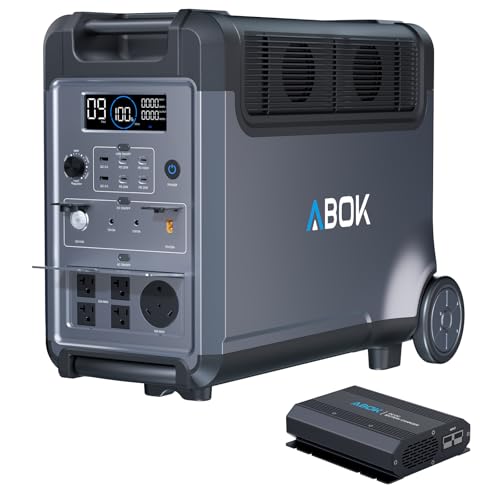
ABOK Ark3600 3,840Wh with 500W Alternator Charger
3,840Wh LiFePO43,600W AC4,500W peakTT-30 family
Check price on Amazon
Best for: Larger loads and long stays where a 3,600W inverter and a big tank both matter.

At 3,600W the Ark3600 is the first unit here that can deliver the full wattage a 30 amp 120V circuit allows, since 30 amps at 120 volts is exactly 3,600 watts. That is also a warning: the National Electrical Code treats continuous loads as 80 percent of the breaker rating, so 2,880W is the sustained figure to plan around. The sister listings of this model advertise a TT-30 RV port, while this bundle's emphasis is the 500W alternator charger.

The tank is 3,840Wh, expandable up to 11,520Wh, and 15 output ports mean most household and camp devices can plug in without a strip. Put beside the Jackery HomePower 3000 it holds 768Wh more and adds the alternator charger, but it is a younger platform.

Install it where the vents are clear, wire the alternator charger with a proper fuse close to the starting battery, and check the connectors annually. Confirm the outlet list on the exact listing you buy before relying on a particular plug. Think of it as the bigger of the two 3,600W choices if you also want to charge from the vehicle.

What works

  • 3,600W output reaches the full 30 amp circuit
  • 3,840Wh tank with expansion to 11,520Wh
  • 500W alternator charger included
  • 15 output ports

Watch out for

  • Outlet types vary between listings of this model
  • Heavy for casual moving
  • Younger platform with fewer owner reports

Spec sheet

Capacity
3,840Wh
Rated AC output
3,600W
Peak output
4,500W
Ports
15
Expansion
Up to 11,520Wh
03
Jackery HomePower 3000 with 2x200W Solar Panels
3,072Wh LFP3,600W AC7,200W surge20ms UPS
Check price on Amazon
Best for: Buyers who want 3,600W with panels included and are comfortable using an adapter.

This kit shows what 3,600W looks like in a plug-and-play package: a 3,072Wh LFP battery, a 7,200W surge and two 200W solar panels in the same box. That pairing makes it the quickest way to a working 30 amp system, though you will still need an adapter or a cord rated for the connector you actually have.

The listing claims a UL-certified UPS function that transfers in 20 milliseconds or less, so it can sit between the wall and a home circuit. Compared with the Elite 300 it has 58Wh more energy, 1,200W more output and two panels, but it is bulkier and does not list a native 30 amp RV outlet.

Treat the 3,600W figure as a short-term ceiling and plan sustained loads under 2,880W. Check the connector adapter's rating, store the battery at moderate charge and re-aim the panels through the day. If you buy it for a trailer, measure the storage bay first, since the case is deeper than the Elite 300.

What works

  • 3,600W output with 7,200W surge
  • Two 200W panels included
  • 20ms UPS function for home circuits
  • Well-supported brand and app

Watch out for

  • No native 30 amp outlet listed
  • Bulkier than the Elite 300
  • Needs a rated adapter for a 30 amp inlet

Spec sheet

Capacity
3,072Wh
Rated AC output
3,600W
Surge
7,200W
Switchover
20ms or less
Included panels
2 x 200W
04
Jackery HomePower 3600 Plus Power Station, 3,584Wh
3,584Wh LFP3,600W ACParallel to 7,200WExpands to 21kWh
Check price on Amazon
Best for: Owners who want a 30 amp solution today and room to grow into a larger system.

The HomePower 3600 Plus is the one to choose if the 30 amp plug is today's need and a bigger system is tomorrow's. It delivers 3,600W alone, doubles to 7,200W when paralleled and expands to 21kWh, so the same investment can later feed a 50 amp service or a house panel through a manual transfer switch.

The cell design uses a heat-resistant ceramic membrane that the listing describes as heat-resistant to 302 degrees Fahrenheit, which is reassuring for garage and RV bay storage. Compared with the HomePower 3000 it holds 512Wh more energy at a similar footprint and has no panels.

As with all 3,600W units, the 30 amp plug is not the limit but the 24 amp continuous guideline is, so size your loads accordingly. Keep the vents clear, test the transfer switch if you use one, and store half charged. A manual transfer switch install is a half-day electrician job, so budget for it before the storm season.

What works

  • Paralleling and expansion paths up to 21kWh
  • Heat-tolerant ceramic membrane LFP cells
  • 3,584Wh at 3,600W
  • Transfer-switch route for house circuits

Watch out for

  • No panels in this listing
  • No native RV outlet listed
  • Costs more than the HomePower 3000

Spec sheet

Capacity
3,584Wh
Rated AC output
3,600W
Parallel output
7,200W
Expansion
Up to 21kWh
Cell design
Ceramic membrane LFP
05
PECRON F3000LFP 3,072Wh 3,600W Power Station
3,072Wh LiFePO43,600W AC6 AC outlets2h wall charge
Check price on Amazon
Best for: Households that want many outlets and fast wall recharging at 3,600W.

The F3000LFP is the connector-rich option. Six AC outlets and a 3,600W inverter mean several appliances can plug in directly rather than sharing one circuit through an adapter, and the listing says it can power 13 devices at once. Wall charging is quick: zero to full in about two hours from an 1,800W input.

At 3,072Wh it matches the Jackery HomePower 3000 for energy and rating, and the charging path is arguably better, though the brand has a shorter support history. A 30 amp RV outlet is not stated in the portion of the listing we reviewed, so check the full outlet list before buying for a 30 amp inlet.

Use it where you want many outlets rather than a single high-current plug. Keep the unit ventilated, avoid charging below freezing and store it around half charged. Two USB-C ports at 100W PD each let two laptops charge without touching the inverter.

What works

  • Six AC outlets plus USB-C and car ports
  • Zero to full in about two hours
  • 3,600W continuous output
  • LiFePO4 for long cycle life

Watch out for

  • 30 amp outlet not confirmed in the listing
  • Shorter support history than major brands
  • Heavy at 3kWh

Spec sheet

Capacity
3,072Wh
Rated AC output
3,600W
AC outlets
6
Wall recharge
0 to 100% in about 2 hours
USB-C
2 ports, 100W PD
06
Jackery Explorer 2000 v2 with 2x200W Solar Panels
2,042Wh LiFePO42,200W AC39.5 lb20ms UPS
Check price on Amazon
Best for: Smaller trailers and cabins that want a 30 amp-friendly unit under 40 pounds.

Not everyone needs the full 3,600W a 30 amp circuit allows, and this unit proves it. At 2,200W it draws about 18 amps at 120V, comfortably within a 30 amp plug's continuous rating, and at 39.5 pounds it is the easiest unit here to carry.

The kit includes two 200W panels and recharges to 80 percent in 66 minutes from the wall. The energy is 2,042Wh, about two-thirds of the 3,000Wh class, so it suits shorter stays or a trailer that uses a fridge, lights and one small air conditioner for a few hours.

Because it lacks a 30 amp-specific outlet you would use a cord with an adapter. Check the adapter's rating, keep the vents clear and store the battery at moderate charge. Its handles and weight make it the unit you can still lift in a pinch.

What works

  • 2,200W stays well inside a 30 amp circuit
  • 39.5 pounds is easy to move
  • Two 200W panels included
  • 80 percent charge in 66 minutes

Watch out for

  • No native 30 amp outlet
  • 2,042Wh limits air conditioning runtime
  • Less output than the 3,600W units

Spec sheet

Capacity
2,042Wh
Rated AC output
2,200W
Weight
39.5 lb
Included panels
2 x 200W
AC recharge
80% in 66 minutes

Spec sheet decoder

What the numbers on the box really mean

The specs manufacturers lead with, translated into what they tell you about real-world performance.

30A circuit limit

A 30 amp breaker at 120V allows 3,600W peak and 2,880W continuous. Exceeding it trips the breaker or heats the cable.

Watch forOnly the 3,600W units here can reach the limit; the Elite 300 stops at 2,400W.

TT-30 outlet

The 120V, 30 amp RV receptacle. It is not the same as a 240V generator inlet.

Watch forThe Elite 300 lists one; other units here need confirmation or an adapter.

Surge watts

A brief ceiling for startup. It helps with compressors, not continuous load.

Watch forThe Jackery 3000 lists 7,200W against 3,600W rated.

12V/30A DC output

A direct low-voltage output for RV lights and fridges. It avoids inverter conversion losses.

Watch forThe Elite 300 has one; most others here do not.

Expansion capacity

Extra battery packs add runtime without changing the inverter rating.

Watch forThe Jackery 3600 Plus expands to 21kWh and the ABOK to 11,520Wh.

Methodology

How We Evaluated These Solar Generators with a 30 Amp Plug

Match to a 30 amp circuit

We compared each unit's rated output to the 3,600W limit and the 2,880W continuous guideline. The 3,600W units match the limit, and the Elite 300 at 2,400W has margin.

Plug and connector clarity

We rated how clearly each listing states its outlet types. The Elite 300 names a TT-30, while others require adapters.

Usable energy at 30 amp loads

We estimated runtime at a 1,700W trailer load with a 0.85 factor. The ABOK gave about two hours, the Elite 300 about 1.5.

Recharge capability

We looked at wall charging speed and panel inclusion. The Pecron's two-hour full charge and the Jackery kits' panels scored well.

Ownership

We used listing details and owner feedback patterns for weight, support and expansion, not our own ownership.

Decision guide

How to Choose the Right Solar Generators with a 30 Amp Plug

By Connector

SituationPickWhy
Trailer shore cord with TT-30 plugBLUETTI Elite 300Native TT-30 outlet
Many household outlets at oncePECRON F3000LFPSix AC outlets
Willing to use a rated adapterJackery HomePower 30003,600W with panels
Future 50 amp or house backupJackery HomePower 3600 PlusParallel to 7,200W
Lightest optionJackery Explorer 2000 v239.5 pounds

By Budget

TierPickWhy
LowestJackery Explorer 2000 v2Smaller tank, panels included
Low-midPECRON F3000LFP3,600W at a modest premium
MidJackery HomePower 30003,600W with panels
UpperBLUETTI Elite 300Native TT-30 and compact size
PremiumABOK Ark3600 or HomePower 3600 PlusBiggest tanks and expansion

2,400W vs 3,600W

2,400W class

The Elite 300 draws about 20 amps at full output, staying within the continuous limit with no thought. It is the sensible, compact choice for a trailer with one air conditioner.

3,600W class

The ABOK, Jackery and Pecron units can fill a 30 amp circuit to the limit. Pick them if you run a microwave and an air conditioner together.

Choose 2,400W for simplicity and size, 3,600W for headroom and bigger loads.

Native Outlet vs Adapter

PreferencePickWhy
No adaptersBLUETTI Elite 300TT-30 and 12V/30A DC built in
Adapter and spare outletsPECRON F3000LFPSix household outlets
Adapter plus panelsJackery HomePower 3000Panels in the box
Adapter and expansionJackery HomePower 3600 PlusGrows to 21kWh

For an RV Air Conditioner Specifically

Look for

Look for 3,000W or more of surge and at least 3,000Wh of storage. A 13,500 BTU unit pulls about 1,300W running and 2,500W at start.

In this comparison

The Elite 300 and Jackery 3000 clear the surge easily. The ABOK's 3,840Wh gives the longest run time on a hot afternoon.

When to Spend More

Spend more if

You live full time on a 30 amp rig or want expansion. The ABOK Ark3600 or HomePower 3600 Plus supply the energy.

Save if

You camp occasionally. The Jackery Explorer 2000 v2 runs a trailer for a night.

Ownership

Maintenance schedule

The upkeep that decides whether this machine lasts two seasons or ten.

TaskIntervalWhy it matters
Replace thin adapters with rated onesBefore each seasonA cheap adapter at 2,880W heats and melts at the pins. Use 30 amp rated parts only.
Inspect plug pins and socketsBefore each tripDiscolored or loose pins signal high resistance. Replace the cord before it fails.
Charge to about 50 percent for storageLong storageCalendar ageing is worst at a full state of charge, so a half-full pack survives a long winter better. Top up every few months.
Clean vents and fansEvery seasonA clogged intake limits how long the inverter can hold full load.
Test the transfer switch if installedYearlyContacts can corrode, and a switch that sticks is worse than none.

FAQ

Frequently Asked Questions

Can a solar generator power a 30 amp RV?

Yes for limited loads. A 3,600W unit can match the circuit's peak, but batteries of 3,000Wh run a full 30 amp load for under two hours. Most owners run a fridge, lights and one air conditioner. Cooking loads like a kettle count against the same 2,880W budget.

What is the difference between TT-30 and L14-30?

TT-30 is a 120V, 30 amp RV plug. L14-30 is a locking 120/240V generator plug. They are not interchangeable, so match the plug to your inlet.

Do I need a 30 amp outlet on the battery?

Not strictly. A rated adapter from a household outlet works, but a native TT-30, as on the Bluetti Elite 300, removes a failure point.

Which is the best value for a 30 amp RV?

The Jackery HomePower 3000 gives 3,600W and panels for a moderate price, while the Elite 300 adds the native plug and a smaller size. Value depends on whether you prize wattage or convenience.

Does the plug rating mean the battery can supply 30 amps?

No. The plug describes what the connector can carry, not what the inverter can supply. The Elite 300 supplies about 20 amps at full output. Use a watt meter to read the real draw before assuming the plug is the limit.

Are generator cords and inlet boxes the same as a solar generator?

No. Those are wiring accessories for a gas generator. A solar generator is a battery with an inverter, so look for capacity and output ratings.

Bottom line

The short version

Browse more solar generators with a 30 amp plugon Amazon →
James Miller, Lead Machine Editor

About the author

James Miller

Lead Machine Editor, MachineFanatic

James Miller leads MachineFanatic's buying guides, turning spec sheets, manuals and owner feedback into clear verdicts on power tools, outdoor power equipment, shop machines and kitchen machines.

More from James →

Keep reading

Related guides