

Amazon affiliate links - we earn a commission.Affiliate disclosure

Buying guide · 12 min read · Updated 2026-11-13

Best Solar Generators for a 30 Amp RV Plug (2026)

Six solar generators that suit a 30 amp RV shore cord, from a 292Wh trailer starter to 3,840Wh TT-30 batteries, with real runtime math for travel trailers.

James MillerBy James MillerLead Machine Editor6 machines comparedSpec-sheet verified
Best Solar Generators for a 30 Amp RV Plug

At a glance

Our top picks

Side by side

Spec comparison

Travel trailers and small motorhomes use a shore cord that ends in a particular plug, and the plug decides whether a battery can slot into the coach's existing wiring. Getting that connection right matters more than a few extra watt-hours.

This guide starts with the RV rather than the battery: what the coach actually draws, which batteries have a native connector and what to expect from each in a real afternoon at camp. The six machines range from a van-friendly starter to the largest unit that still behaves sensibly on a standard trailer.

Before you buy

6 Criteria to Look For Before Buying a Solar Generator for a 30 Amp RV Plug

  1. 01

    What your trailer draws

    A typical 30 amp trailer uses a compressor fridge at 60 to 150W, LED lights at 30W, a 13,500 BTU air conditioner at 1,300W and a microwave at 1,000W. The 2,400W Elite 300 runs any two of those, the 1,500W Jackery 1000 v2 skips the air conditioner. Add the converter's charging draw if the trailer batteries are low, since it can add 200 to 400W.

  2. 02

    TT-30 or adapter

    The Elite 300 and ABOK Ark3600 kits list a TT-30 outlet, so the coach's cord plugs in. The Jackery models rely on an adapter, which should be rated for 30 amps and short in length. A flimsy adapter is a common melt point at 2,880W.

  3. 03

    Air conditioner start

    A rooftop compressor pulls about 2,500W at start, so the inverter surge must exceed that. The Elite 300's 4,800W and the Jackery 3000's 7,200W clear it, while the Jackery 1000 v2's 3,000W surge cannot cover the load for long.

  4. 04

    12V side of the trailer

    Trailers run lights, a water pump and a fridge on 12V through a converter. The Elite 300's 12V/30A DC output can feed that directly, avoiding inverter and converter losses that can cost 10 to 15 percent.

  5. 05

    Solar kit size

    Two 200W panels make roughly 1,200Wh on a good day, three make about 1,900Wh. The ABOK kit's 600W suits a long boondock, while the Elite 300's 400W covers a refrigerator and lights.

  6. 06

    Where it lives in the rig

    A 3,000Wh battery weighs 60 pounds or more, so it should sit low and near the axle, strapped down. The Jackery 300 can go anywhere, the ABOK needs a dedicated spot. Check tongue weight if you carry it in the front. Also leave an air gap around the case for the cooling fan.

Detailed reviews

The 6 best solar generators for a 30 amp rv plug, explained

01
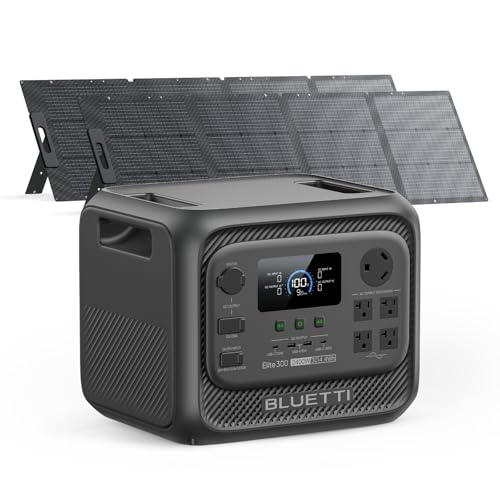
BLUETTI Elite 300 Solar Generator with 2x200W Panels
3,014Wh LFP2,400W ACTT-30 outlet2x200W panels
Check price on Amazon
Best for: Travel trailer owners who want the connector, the panels and the capacity in one kit.

If one box could be designed for a trailer shore cord, this is it. A dedicated TT-30 receptacle takes the coach's cord straight from the battery, a 12V/30A DC port can feed the trailer's 12V circuits and the kit adds two 200W panels so a camp stay has a refill path from day one. That is the whole electrical story of a modest trailer in one purchase.

Output is 2,400W with 4,800W of surge. A typical trailer afternoon, a 13,500 BTU air conditioner at about 1,300W plus a refrigerator and lights, draws roughly 1,600W, so the inverter is not strained, while the 3,014Wh tank lasts about 1.6 hours at that rate and several hours if you only cool in bursts. Compared with the ABOK Ark3600 it is smaller and lighter, and the panel kit gives it a real solar identity.

Place it low and strapped in, keep the vents clear and do not charge below freezing. The two panels give roughly 300W of real output, so plan an extra panel or an alternator charger for long stays. If your trailer's converter charges the house batteries from the shore cord, expect the Elite 300 to feed that load as well, so factor an extra 100 to 300W while the batteries fill.

What works

  • TT-30 outlet plugs the shore cord in directly
  • 12V/30A DC port serves trailer 12V gear
  • Two 200W panels included
  • Compact for 3,014Wh

Watch out for

  • Panels refill slowly relative to the 3kWh tank
  • 2,400W cannot run everything at once
  • Heavy enough for a two-handed carry

Spec sheet

Capacity
3,014Wh
Rated AC output
2,400W
Surge
4,800W
RV outlet
TT-30
Included panels
2 x 200W
02
ABOK Ark3600 3,840Wh with 3x200W Panels and TT-30 Port
3,840Wh LiFePO43,600W ACTT-30 port3x200W panels
Check price on Amazon
Best for: Larger trailers and long boondocking stays that need serious energy and solar.

Where the Elite 300 is compact, the Ark3600 kit is generous. A TT-30 port, 3,840Wh, 3,600W of output and three 200W panels make it the biggest all-in-one for a 30 amp coach. On a trailer that means the air conditioner, the microwave and the refrigerator can all be live together, with the caveat that 3,600W is the circuit's peak and sustained loads should stay under about 2,880W.

The listing claims up to 3,500W of combined AC and solar input, with a zero to 80 percent charge in about 1.1 hours under ideal conditions, so a hookup afternoon fully resets it. With 600W of panels it can refill about 1,900Wh on a clear day, about 60 percent more than the Elite 300's kit.

The price of that capability is size and weight. Confirm the storage bay dimensions before buying, mount the unit so it cannot slide and inspect the TT-30 receptacle regularly for heat marks. Keep the vents clear in a warm compartment. Owners also note that large-capacity units run their fans louder under heavy load, so a bay with an open vent beats a sealed cupboard.

What works

  • 3,840Wh tank is the largest in the group
  • TT-30 port and 3,600W inverter
  • 600W of panels in the kit
  • Expandable up to 11,520Wh

Watch out for

  • Bulky and heavy for a small trailer
  • Smaller owner community
  • Three panels need ground or roof space

Spec sheet

Capacity
3,840Wh
Rated AC output
3,600W
Peak output
7,200W
RV port
TT-30
Combined input
Up to 3,500W
03
Jackery HomePower 3600 Plus with 2x200W Panels
3,584Wh LFP3,600W ACExpands to 21kWhParallel 7,200W
Check price on Amazon
Best for: Owners who want one battery for the RV now and the house or a bigger coach later.

This kit is for the RV owner whose rig is part of a bigger plan. A single unit supplies 3,600W for a 30 amp coach, a second in parallel gives 7,200W, and expansion packs reach 21kWh, which would run a 50 amp coach and a house. The listing also describes a transfer-switch path into a home, so one battery can serve the trailer on weekends and the house in a storm.

The heat-resistant ceramic membrane cells are a quiet selling point in a hot cargo bay. There is no native RV outlet listed, so you would plug the shore cord in through an adapter or the right household outlet. Compared with the Elite 300 it holds 570Wh more but lacks the TT-30 convenience.

Treat it as the long-term purchase. Install it where it will live, check its firmware occasionally, keep the vents clear and top it up every few months in storage. If you add a second unit later, make sure the trailer's inlet and wiring can take 7,200W before you rely on it.

What works

  • Expandable to 21kWh
  • Parallel pair reaches 7,200W
  • Heat-tolerant ceramic membrane LFP
  • Transfer-switch route for house backup

Watch out for

  • No native RV outlet listed
  • Two panels refill slowly
  • Highest cost for a 30 amp trailer

Spec sheet

Capacity
3,584Wh
Rated AC output
3,600W
Parallel output
7,200W
Expansion
Up to 21kWh
Included panels
2 x 200W
04
Jackery Solar Generator 1000 v2 with 200W Solar Panel
1,024Wh LiFePO41,500W AC3,000W surge50-min charge
Check price on Amazon
Best for: Smaller trailers that run a fridge, lights and electronics without air conditioning.

Plenty of 30 amp trailers never need the full 3,600W. A compressor refrigerator, lights, a fan, a laptop and a coffee maker add up to around 800W peak, and this unit's 1,500W inverter handles that with ease. The 1,024Wh tank gives a day of that kind of use and the 200W panel offsets a good part of it.

There is no TT-30 outlet, so you connect the trailer through a cord and adapter to one of the two AC outlets, or run only the appliances you care about directly. It cannot start a roof air conditioner, so it suits milder weather and shorter stays.

Its big selling point is the 50 minute full recharge, which means one lunch stop at a hookup resets it. Compared with the Elite 300 it has a third of the energy, but it weighs far less and costs far less. Keep it inside the cabin and store it around half charged. For a weekend trip, charging it fully before you leave and using the panel to top up is a routine that works well.

What works

  • 50-minute full recharge from the wall
  • 1,500W handles kitchen appliances
  • Light enough for one person
  • 200W panel included

Watch out for

  • Cannot run a rooftop air conditioner
  • No native 30 amp outlet
  • 1,024Wh covers about a day of light use

Spec sheet

Capacity
1,024Wh
Rated AC output
1,500W
Surge
3,000W
Included panel
200W
Recharge
About 50 minutes
05
Jackery HomePower 3000 with 2x200W Solar Panels
3,072Wh LFP3,600W AC7,200W surge20ms UPS
Check price on Amazon
Best for: Budget-conscious owners who already have a good adapter and want 3,600W.

Sometimes the right trailer battery is the plain one. The HomePower 3000 gives you 3,600W, a 7,200W surge and two 200W panels without any RV-specific port, which is how it undercuts units that carry the TT-30 badge. If you already own a good adapter, the connector is not worth paying a premium for.

It behaves well with air conditioners thanks to the big surge figure, and the claimed UPS switchover of 20 milliseconds or less lets it sit between a hookup and the coach as a buffer. Against the HomePower 3600 Plus it holds 512Wh less and is easier to justify for a single trailer.

Buy a heavy-duty adapter rated for 30 amps, strap the unit down and keep it ventilated. Store it around half charged between trips. Its flatter, wider case suits under-bench storage better than a tall box.

What works

  • 3,600W with 7,200W surge
  • Two 200W panels included
  • 20ms UPS function
  • No premium for a native RV port

Watch out for

  • No TT-30 outlet listed
  • 3,072Wh is mid-size
  • Needs a good adapter for the shore cord

Spec sheet

Capacity
3,072Wh
Rated AC output
3,600W
Surge
7,200W
Switchover
20ms or less
Included panels
2 x 200W
06
Jackery Solar Generator 300 with 40W Solar Panel
292Wh LiFePO4300W AC7.5 lb100W USB-C PD
Check price on Amazon
Best for: Teardrop and pop-up owners who only need electronics and lights.

A 30 amp plug is overkill for the loads this unit handles, but it earns a place for teardrop and pop-up owners who want just enough. At 7.5 pounds and 292Wh it covers lights, phones, a laptop and a small fan for a night or two, and it will never tax the trailer's wiring.

It cannot run a fridge, a microwave or an air conditioner, and the 40W panel is only a trickle. Compared with the 1,024Wh Jackery 1000 v2 it holds less than a third of the energy.

Its value is as a second battery: keep it for the tent, the patio and the car, and leave the big unit for the trailer. Store it at moderate charge and keep the AC off when you only need USB. It also doubles as a bedside battery for a CPAP with no heated humidifier, using under 50Wh a night.

What works

  • 7.5 pounds, easy to carry
  • 100W USB-C PD charges laptops efficiently
  • 4,000-plus cycle LiFePO4
  • Pure sine wave AC outlets

Watch out for

  • Cannot run any trailer appliance
  • 40W panel is a trickle
  • Not a shore cord replacement

Spec sheet

Capacity
292Wh
Rated AC output
300W
Weight
7.5 lb
USB-C
100W PD
Included panel
40W

Spec sheet decoder

What the numbers on the box really mean

The specs manufacturers lead with, translated into what they tell you about real-world performance.

TT-30

The standard 120V, 30 amp RV plug found on trailers. A battery with this outlet connects without adapters.

Watch forThe Elite 300 and the ABOK Ark3600 kit list one.

12V/30A DC output

A direct low-voltage output for RV 12V circuits that avoids inverter conversion.

Watch forThe Elite 300 includes it.

Surge watts

A brief ceiling for motor and compressor startups.

Watch forThe Elite 300 lists 4,800W and the HomePower 3000 lists 7,200W.

Combined AC plus solar input

The total charging power when wall and sun are used together.

Watch forThe ABOK lists up to 3,500W.

UPS switchover

How quickly the unit moves to battery when shore power drops.

Watch forThe Jackery 3000 claims 20ms and the 1000 v2 claims 10ms.

Methodology

How We Evaluated These Solar Generators for a 30 Amp RV Plug

RV connection

We checked which units list a TT-30 outlet or 12V/30A DC port. The Elite 300 and ABOK Ark3600 scored highest; the rest rely on adapters.

Trailer load coverage

We modeled a trailer afternoon at 1,600W and a night of fridge and lights at 150W. The ABOK's 3,840Wh gives about two hours of afternoon cooling.

Solar in the kit

We compared panel wattage in each listing. The ABOK's 600W beat the Elite's and Jackery's 400W, while the Jackery 300's 40W is only a trickle.

Surge for starts

We looked at surge ratings against compressor starts. The Jackery 3000's 7,200W gave the most margin.

Ownership

We drew on the spec sheets and owner feedback patterns for weight, support and expansion, not personal use.

Decision guide

How to Choose the Right Solar Generators for a 30 Amp RV Plug

By Trailer Size

TrailerPickWhy
Teardrop or pop-upJackery Solar Generator 3007.5 pounds, electronics only
Small trailer, no air conditionerJackery Solar Generator 1000 v21,500W and 50-minute recharge
Mid-size trailer with air conditionerBLUETTI Elite 300 kitTT-30, 4,800W surge
Large trailer, long staysABOK Ark3600 kit3,840Wh and 600W panels
Trailer plus house backupJackery HomePower 3600 PlusExpansion to 21kWh

By Budget

TierPickWhy
LowestJackery Solar Generator 300Small and cheap
Low-midJackery Solar Generator 1000 v2Fast recharge, panel included
MidJackery HomePower 30003,600W with panels
UpperBLUETTI Elite 300 kitTT-30 and panels
PremiumABOK Ark3600 or HomePower 3600 PlusCapacity and expansion

Native RV Port vs Adapter

Native port

The Elite 300 and ABOK kits connect the coach cord directly, removing a failure point. You pay a premium for it but save the adapter hassle.

Adapter route

The Jackery units are cheaper per watt and are fine with a rated adapter. They suit owners who already have a decent cord.

Choose native for convenience, adapter for savings.

Panels vs Plugging In

PreferencePickWhy
Mostly campgrounds with hookupsJackery Solar Generator 1000 v250-minute recharge
Mostly boondockingABOK Ark3600 kit600W of panels
Mix of bothBLUETTI Elite 300 kitPanels and fast wall charging
Travel days onlyJackery HomePower 3600 PlusAdd an alternator charger

For Hot-Weather Camping Specifically

Look for

Look for at least 3,000Wh and a surge rating above 4,000W. A 13,500 BTU unit uses 1,300W, so a 3,000Wh battery gives about two hours of continuous cooling.

In this comparison

The ABOK Ark3600 is the one that can cool for a long afternoon. The Elite 300 can run in bursts, and the 1,500W Jackery cannot.

When to Spend More

Spend more if

You camp off grid for days in hot weather. The ABOK Ark3600 kit or the HomePower 3600 Plus gives the energy.

Save if

You camp at powered sites and need the battery for outages. The Jackery 1000 v2 or HomePower 3000 does that.

Ownership

Maintenance schedule

The upkeep that decides whether this machine lasts two seasons or ten.

TaskIntervalWhy it matters
Inspect the TT-30 plug and receptacleBefore each tripLook for discoloured pins or a loose fit, which signal heat from resistance at 2,000W-plus loads.
Strap the battery downEvery tripA 60-pound battery sliding in a tow vehicle damages itself and the rig. Use ratchet straps rather than bungees, and check them after the first fifty miles.
Charge to about 50 percent for storageLong storageStorage at the top of the range accelerates cell wear; mid-range is the gentler resting point.
Clean and check panelsEach campDust and misaligned panels cost output.
Update firmware and verify settingsTwice a yearUpdates tune charging profiles and protection. Keep a record of the version so you can tell whether a problem began after an update.

FAQ

Frequently Asked Questions

Which solar generator works with a 30 amp RV?

Units with a TT-30 outlet, like the BLUETTI Elite 300 and the ABOK Ark3600 kit, plug straight in. Others work through a rated adapter.

Can I run my RV air conditioner on a solar generator?

For a few hours on the largest units. The ABOK's 3,840Wh gives about two hours of cooling, and smaller units are limited to bursts. A soft-start device helps. A soft-start kit on the roof unit cuts the starting surge by roughly half, which makes mid-size batteries far more usable.

Which is the best value for a trailer?

The Jackery 1000 v2 for small trailers without air conditioning, and the HomePower 3000 for 3,600W. The Elite 300 kit is the convenience pick.

Do I need a transfer switch in an RV?

No. You plug the shore cord into the battery instead of a pedestal. A transfer switch matters in a house, not a trailer. Just make sure any 12V charger inside the trailer is not backfeeding the battery.

How many panels do I need?

Divide your daily watt-hours by 4 to 5 sun hours and by 0.7. A coach using 2,500Wh a day needs about 800W of panels. Mount them where shade from the awning will not cross them.

Is it safe to leave the battery in the trailer in winter?

Yes if it is partly charged, but do not charge below freezing. Bring it indoors if the trailer sits in deep cold. A battery stored in a heated space keeps its capacity better through winter.

Bottom line

The short version

Browse more solar generators for a 30 amp rv plugon Amazon →
James Miller, Lead Machine Editor

About the author

James Miller

Lead Machine Editor, MachineFanatic

James Miller leads MachineFanatic's buying guides, turning spec sheets, manuals and owner feedback into clear verdicts on power tools, outdoor power equipment, shop machines and kitchen machines.

More from James →

Keep reading

Related guides