
Amazon affiliate links - we earn a commission.Affiliate disclosure

Buying guide · 13 min read · Updated 2026-11-13

Best Solar Generators with a 50 Amp Outlet (2026)

Six solar generators with 120/240V output that can serve a 50 amp outlet, with honest notes on 14-50 receptacles, adapters and real continuous amps.

James MillerBy James MillerLead Machine Editor6 machines comparedSpec-sheet verified
Best Solar Generators with a 50 Amp Outlet

At a glance

Our top picks

Side by side

Spec comparison

A fifty amp outlet is built for two hot legs, which means it expects 240 volts, and most portable batteries only make 120. That mismatch is the reason this category is full of misleading listings, and it is the first thing to settle before comparing any specs.

We looked for solar generators that genuinely offer split-phase or paralleled 240V output, and we dropped generator cords, inlet boxes and gas inverter units that crowd the search results. The six that remain are ranked by how cleanly they deliver the voltage, the energy and the solar input a real outlet job needs.

Before you buy

6 Criteria to Look For Before Buying a Solar Generator with a 50 Amp Outlet

  1. 01

    Voltage before plug shape

    A 50 amp outlet can be a 120/240V receptacle or a single-leg connection. The Apex 300, P5000 Plus and Oscal PowerMax 6000 output 240V, the Helios 3600 does as a pair, while the Ark3600 and Pecron are 120V only. The plug fits either way, so check the voltage listing. A labelled breaker panel at the outlet tells you whether the circuit is truly 240V.

  2. 02

    Real amps at 240V

    Amps equal watts divided by volts. The Oscal's 6,000W at 240V is 25 amps, a paired Helios 3600's 7,200W is 30 amps, and the P5000 Plus's 3,600W is 15 amps. A true 50 amp supply is 12,000W, so none of these fills the circuit.

  3. 03

    Continuous load rule

    Electrical codes treat continuous loads as 80 percent of the breaker, so a 50 amp circuit is planned for 40 amps. You are unlikely to approach that with a battery, but cables and adapters must still be rated for the amps you do draw.

  4. 04

    Energy for 240V loads

    A 240V dryer uses 3,000 to 5,000W and drains a 3,600Wh battery in under an hour. The P5000 Plus's 5,120Wh gives a meaningfully longer run, and stacking the Apex 300 to 8.3kWh adds more.

  5. 05

    Solar input for refilling

    The Oscal accepts 2,400W of solar, the P5000 Plus 1,000W and the ABOK 2,000W. A bigger input only helps if you own the panels, so compare it with the array you plan to buy. Real output is 60 to 80 percent of nameplate.

  6. 06

    Adapters and cables

    Moving from a battery to a 14-50 receptacle usually means an adapter or a custom cord. Use 6 gauge or heavier cable for 50 amp runs and avoid thin adapters. A cheap, undersized cable is a heat hazard. Keep the cord short, since voltage drop on a long thin run wastes watts.

Detailed reviews

The 6 best solar generators with a 50 amp outlet, explained

01
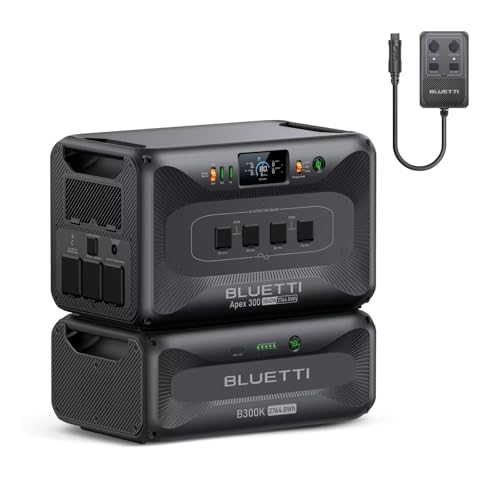
BLUETTI Apex 300 with B300K Battery and Hub D1, 2,764.8Wh
2,764.8Wh LFP3,840W AC120V/240V togetherStackable 2 to 3 units
Check price on Amazon
Best for: Owners who want 240V now and the freedom to add batteries later.

The Apex 300 is modular in a way the others are not. A single unit offers 120V and 240V output at the same time, so a 14-50 style outlet and ordinary 120V sockets can both be live, and the listing says two or three units can be paralleled to reach 5.5 to 8.3kWh. That makes it easy to start small and grow, without replacing the inverter.

The bundle here adds the B300K battery and a DC hub with a 50A Anderson port, two cigarette lighter ports, two DC5521 ports and USB-C and USB-A, which is a useful low-voltage center for an RV or a van. At 3,840W it holds more output per unit than the 3,600W boxes, though its single-unit tank is smaller than the P5000 Plus's 5,120Wh.

The tradeoff is complexity. A stacked system needs correct cabling and the right hub, and you should read the manual before the first outage. Keep the stack cool and dry, store the batteries around half charged and check each connector for tightness every season. Because the hub and battery arrive as separate pieces, lay out the cabling on a bench first and label every connector before you stack anything.

What works

  • Simultaneous 120V and 240V output
  • Stacks to 5.5 to 8.3kWh
  • DC hub with a 50A Anderson port
  • 3,840W rated output per unit

Watch out for

  • Stacked systems need careful setup
  • 2,764.8Wh is modest on its own
  • Costs rise quickly with each module

Spec sheet

Capacity
2,764.8Wh
Rated AC output
3,840W
Voltage
120V and 240V simultaneously
Stacking
2 to 3 units, 5.5 to 8.3kWh
DC hub
50A Anderson port
02
EcoVolt P5000 Plus 5,120Wh 120/240V Power Station
5,120Wh LiFePO43,600W AC120/240V5,000W surge
Check price on Amazon
Best for: Buyers who want a big 240V-capable battery without the household-brand price.

The P5000 Plus pairs a big 5,120Wh tank with dual-voltage output, and it does so without the premium of the household brands. Five AC outlets, 3,600W of continuous power and a 5,000W surge cover most 240V jobs, though the 3,600W rating means a full 50 amp load is out of reach.

Charging is generous: an 1,800W AC input and up to 1,000W of solar mean a good day of sun nearly refills a quarter of the tank, and the listing says it uses automotive-grade LiFePO4. Against the Oscal PowerMax 6000 it holds 1,520Wh more energy but produces 2,400W less, a trade that favors long runs over big starts.

Brand history is thin, so treat the first weeks as a burn-in: run real loads, watch the fans and keep the receipt. Place it on a dry, solid surface, keep the vents clear and store it half charged. Its 1,000W solar input makes a ground-mount array of five to six panels worth considering if the unit lives at a cabin.

What works

  • 5,120Wh tank with 120/240V output
  • 5,000W surge for motor starts
  • 1,000W solar input
  • Five AC outlets

Watch out for

  • 3,600W continuous cannot fill a 50 amp outlet
  • Brand has a short track record
  • Heavy and bulky

Spec sheet

Capacity
5,120Wh
Rated AC output
3,600W
Surge
5,000W
AC outlets
5
Solar input
1,000W
03
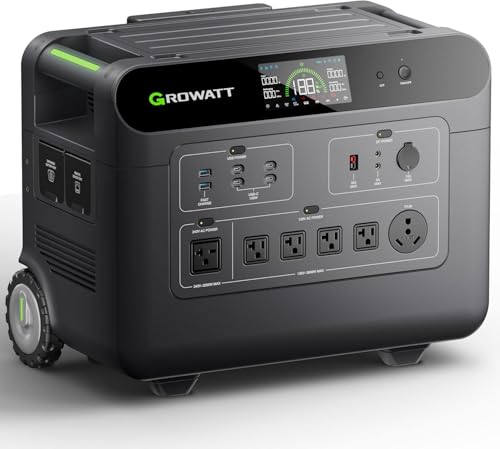
GROWATT HELIOS 3600 3,600Wh LFP, 240V/7,200W Parallel
3,600Wh LFP3,600W AC7,200W at 240V pairedExpands to 36kWh
Check price on Amazon
Best for: Home and cabin owners who want to build a 240V system from two identical units.

Growatt is a name from the solar-inverter industry, and the Helios reflects it. One unit delivers 3,600W; connect two in parallel and the listing says you get 240V at 7,200W, which can run heavy appliances like an air conditioner or a dryer. That is a cleaner route to a true 50 amp-class load than any single 120V box.

The sub-15ms EPS function switches critical loads to battery quickly, and the cold-start technology helps charging in low temperatures. The listing's claim of up to 15 hours of power for daily home devices is a reminder that this is a home backup design first.

Compared with the Apex 300 it needs two units for 240V, so cost doubles, but its capacity ceiling of 36kWh is far higher. Plan for a flat, ventilated spot for both units, label the cables and test the pair under load before the season. Treat the two units as a matched pair, and replace or service them together so their firmware and battery health stay aligned.

What works

  • Two paired units give 240V at 7,200W
  • Expandable to 36kWh
  • Fast EPS switchover under 15ms
  • Cold-start support for low temperatures

Watch out for

  • You must buy two units for 240V
  • Less accessory support than major brands
  • Heavy pair to move

Spec sheet

Capacity
3,600Wh
Rated AC output
3,600W
Paired output
240V at 7,200W
Switchover
Under 15ms EPS
Expansion
Up to 36kWh
04
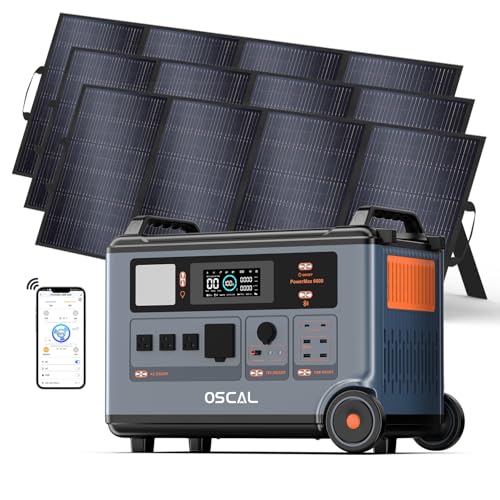
OSCAL PowerMax 6000 with 3x400W Panels, 6,000W 120/240V
3,600Wh LiFePO46,000W 120/240V2,400W solar input9,000W surge
Check price on Amazon
Best for: Buyers who want high 240V output and a big solar array in one purchase.

This is the highest-output single box here, with 6,000W at 120/240V and a 9,000W surge. At 240V that is 25 amps, half of what a 50 amp outlet can carry, but far more than any other unit can supply from one chassis. Four AC outlets and the split-phase inverter let a dryer, an air conditioner and a well pump run from one machine.

The listing quotes 2,400W of solar input and a full charge in about 1.44 hours using wall plus solar together, and three 400W panels come in the kit. The tank is the weak link at 3,600Wh, which empties in about an hour under a heavy load.

Set the panels up on the ground, where they can be tilted and cleaned, and confirm the unit sits in a dry, ventilated spot. Check the connectors seasonally. Against the P5000 Plus you get nearly double the output but 1,520Wh less energy. The four AC outlets are enough for a pump, a dryer and a few small loads, but spread them across both legs.

What works

  • 6,000W at 120/240V from one box
  • 2,400W solar input and panels included
  • 9,000W surge handles heavy starts
  • Four AC outlets

Watch out for

  • 3,600Wh empties quickly under heavy load
  • Panels are large and heavy
  • Newer brand with limited history

Spec sheet

Capacity
3,600Wh
Rated AC output
6,000W
Surge
9,000W
Solar input
2,400W
Outlets
4 AC
05
ABOK Ark3600 3,840Wh with 400W Solar Panel
3,840Wh LiFePO43,600W AC2,000W solar inputExpands to 11.5kWh
Check price on Amazon
Best for: Buyers who need a heavy 120V feed to a 50 amp outlet and want a big tank.

Not every 50 amp outlet needs 240V. Some, like an EV charger or an RV on one leg, need only a heavy 120V feed, and for that the Ark3600 is a capable and economical choice. It delivers 3,600W continuously with 4,500W peak, and the 3,840Wh tank is larger than the Apex 300's.

The listing quotes 2,000W of solar input and a 400W panel in the box, and expansion to 11,520Wh. It makes no 240V claim, so this is a one-leg unit and you should not buy it for a dryer or a well pump.

Use it with a correctly rated 50 amp adapter, and do not pull more than 2,880W continuously through it. Check the vents and cables each season and keep the battery partly charged in storage. Because it is a single-leg design, balance matters little, which makes it simpler than a split-phase setup.

What works

  • 3,840Wh tank with expansion to 11,520Wh
  • 3,600W output on a single leg
  • 2,000W solar input
  • Panel included in this listing

Watch out for

  • No 240V output
  • 400W panel is a modest start
  • Newer platform with fewer owner reports

Spec sheet

Capacity
3,840Wh
Rated AC output
3,600W
Peak output
4,500W
Solar input
2,000W
Expansion
Up to 11,520Wh
06
PECRON F3000LFP 3,072Wh 3,600W Power Station
3,072Wh LiFePO43,600W AC6 AC outlets2h wall charge
Check price on Amazon
Best for: People who want fast recharging and many outlets for a heavy single-leg load.

The F3000LFP is here as the honest option for anyone whose 50 amp outlet only needs a strong 120V feed. It delivers 3,600W of pure sine output through six AC outlets, so several appliances plug in directly, and the listing says it powers 13 devices at once, including refrigerators and heavy-duty appliances.

Its best trait is recharge speed: zero to full in about two hours from an 1,800W wall input, which is quicker than the larger tanks in this guide. At 3,072Wh it holds 768Wh less than the ABOK Ark3600 and has no 240V claim, so it cannot run a dryer or a pump.

Use a properly rated adapter between its outlet and a 50 amp receptacle, and keep sustained loads under about 2,880W. Rest it at half charge, keep the intake clear and top it up every few months.

What works

  • Zero to full in about two hours
  • Six AC outlets plus USB-C and car ports
  • 3,600W continuous output
  • LiFePO4 chemistry for long life

Watch out for

  • No 240V output
  • Smaller tank than the ABOK Ark3600
  • Shorter support history than major brands

Spec sheet

Capacity
3,072Wh
Rated AC output
3,600W
AC outlets
6
Wall recharge
0 to 100% in about 2 hours
Voltage listed
120V

Spec sheet decoder

What the numbers on the box really mean

The specs manufacturers lead with, translated into what they tell you about real-world performance.

Split-phase output

Two 120V legs forming 240V, as a 50 amp RV or range outlet expects.

Watch forThe Apex 300, P5000 Plus and Oscal 6000 offer it, and the Helios 3600 as a pair.

Amps from watts

Divide continuous watts by voltage. It shows how much of a 50 amp circuit you actually use.

Watch forThe Oscal's 6,000W at 240V is 25A, the P5000 Plus's 3,600W is 15A.

Paired output

Two units combined to produce higher voltage or wattage.

Watch forThe Helios 3600 gives 240V at 7,200W as a pair; the Apex 300 stacks two or three.

Solar input watts

The most panel power the station accepts at once.

Watch forThe Oscal lists 2,400W and the P5000 Plus 1,000W.

Stackable capacity

Extra battery modules that add watt-hours.

Watch forThe Apex 300 stacks to 8.3kWh, the Helios 3600 to 36kWh.

Methodology

How We Evaluated These Solar Generators with a 50 Amp Outlet

Voltage honesty

We checked whether each unit truly lists 240V or paired 240V output. The Apex 300, P5000 Plus and Oscal passed, the Helios needs a pair, and the ABOK and Pecron failed.

Share of a 50 amp circuit

We converted rated watts to amps at 240V. A paired Helios 3600 fills about 60 percent of the circuit, the Oscal 50 percent and the P5000 Plus 30 percent.

Energy and expansion

We compared tank sizes and growth paths. The P5000 Plus tops the single-unit group, while the Apex 300 and Helios 3600 win on modularity.

Solar compatibility

We considered solar input limits and included panels. The Oscal and ABOK lead on input, the P5000 Plus on its 1,000W input.

Ownership

We used listing details and owner feedback patterns for support and weight, not our own ownership. We also noted whether replacement battery modules are likely to stay available.

Decision guide

How to Choose the Right Solar Generators with a 50 Amp Outlet

By What the Outlet Powers

LoadPickWhy
RV with both legsOSCAL PowerMax 60006,000W at 120/240V
Electric dryer or rangeOSCAL PowerMax 60006,000W split-phase
EV level 2 chargingEcoVolt P5000 Plus5,120Wh at 240V
Modular growthBLUETTI Apex 300Stack two or three units
One-leg heavy 120V feedABOK Ark3600 with 400W panel3,600W on one leg

By Budget

TierPickWhy
LowestABOK Ark3600Big tank, 120V only
Low-midEcoVolt P5000 Plus240V and 5,120Wh
MidGROWATT HELIOS 3600 pairPaired 240V
UpperOSCAL PowerMax 6000High output, panels included
PremiumBLUETTI Apex 300Stack to 8.3kWh, 240V and 120V

Single Box vs Two Paired Units

Single box

The Oscal and P5000 Plus give 240V from one chassis. It is simpler to set up and wire, but you cannot split the load between two places.

Paired units

The Helios 3600 pair and the stacked Apex 300 give modular 240V. You can start with one and scale, but each module adds cost and cabling.

Choose a single box for simplicity and a pair or stack if you plan to grow.

Voltage Needed

PreferencePickWhy
True 240V, both legs liveOSCAL PowerMax 6000120/240V output
240V and 120V at onceBLUETTI Apex 300Simultaneous voltages
Single 120V legABOK Ark3600Simple and cheaper
240V only from a pairGROWATT HELIOS 3600Parallel connection

For EV Charging Specifically

Look for

Look for 240V output and a tank above 5kWh. A level 2 EV charger on a 50 amp outlet draws about 7,000W at full speed, so you will need a charger set to a lower amp limit.

In this comparison

The P5000 Plus has the biggest tank here and 240V. A 15 amp charge adds roughly 12 miles of range per hour, so expect a slow top-up.

When to Spend More

Spend more if

You need a true 240V supply for a dryer, a pump or an RV. The Oscal or a paired Helios 3600 gives the output.

Save if

You only need heavy 120V. The ABOK Ark3600 does it for less.

Ownership

Maintenance schedule

The upkeep that decides whether this machine lasts two seasons or ten.

TaskIntervalWhy it matters
Verify voltage with a multimeterBefore first useA quick reading confirms 240V between the hot legs and 120V from each to neutral. Write the reading on a tag attached to the cord for future reference.
Inspect 14-50 adapters and cordsBefore each useHeavy gauge cords carry the current safely, and scorched pins signal trouble.
Store batteries at 50 percentLong storageLiFePO4 cells age slowest at moderate charge.
Clean vents and fansEach seasonLarge inverters move a lot of air, and dust shortens full-load runtime.
Torque-check stacked connectionsYearlyStacked modules rely on tight connectors, and loose ones heat up.

FAQ

Frequently Asked Questions

Does a 50 amp plug mean the solar generator can supply 50 amps?

No. The plug describes the connector, not the battery. A paired Helios 3600 supplies about 30 amps at 240V, the Oscal 25 amps.

Do I need 240V for a 50 amp outlet?

For a dryer, range or a full RV, yes. A 120V station can feed one leg of an RV or a heavy 120V appliance, but it cannot run 240V loads. If you are unsure which your outlet is, read the label on the breaker and the receptacle before buying.

Which is the best value with 240V?

The EcoVolt P5000 Plus offers 240V and 5,120Wh at a lower cost than a paired Helios 3600. The Oscal adds output and panels. Neither is a casual purchase, so match the choice to how often you will actually use 240V.

Can these charge an electric vehicle?

Slowly. A 15 amp level 2 charge from the P5000 Plus delivers about 3,600W. It is a top-up solution, not a replacement for a wall charger. Check your car's onboard charger limit, which often caps lower than the outlet.

Are generator cords and inlet boxes included?

No. Those are accessories for gas generators and are not solar generators. Buy a cord rated for your outlet separately.

How many batteries do I need to stack?

Add up the daily watt-hours of your 240V loads. A 2,765Wh Apex 300 supports a few hours of a dryer, while three stacked units reach about 8.3kWh. Stacking also gives you redundancy, since a single module can still run alone if another needs service.

Bottom line

The short version

Browse more solar generators with a 50 amp outleton Amazon →
James Miller, Lead Machine Editor

About the author

James Miller

Lead Machine Editor, MachineFanatic

James Miller leads MachineFanatic's buying guides, turning spec sheets, manuals and owner feedback into clear verdicts on power tools, outdoor power equipment, shop machines and kitchen machines.

More from James →

Keep reading

Related guides