
Amazon affiliate links - we earn a commission.Affiliate disclosure

Buying guide · 12 min read · Updated 2026-11-13

Best Solar Generators That Plug into a 50 Amp Cord (2026)

Six solar generators that can feed a 50 amp cord, ranked by voltage, adapter path and real amps, from a 6,000W split-phase box to a 2,048Wh Anker.

James MillerBy James MillerLead Machine Editor6 machines comparedSpec-sheet verified
Best Solar Generators That Plug into a 50 Amp Cord

At a glance

Our top picks

Side by side

Spec comparison

Searching for a battery with a fifty amp plug mostly turns up cords, adapters and tiny power banks, none of which is the thing you want. The plug is the last link in a chain: a battery that makes the right voltage, an inverter that can supply the current and a cable that does not become the weak point.

This guide follows that chain from the battery outward. We rank six solar generators by how much real power they can push into a heavy cord, what adapter path each one needs, and how honest each listing is about voltage and output.

Before you buy

6 Criteria to Look For Before Buying a Solar Generator That Plug into a 50 Amp Cord

  1. 01

    What the cord actually carries

    A 50 amp cord can carry up to 12,000W across two legs, but the battery decides the real figure. The Oscal supplies 6,000W, the Jackery 5000 Plus 7,200W, the Anker C2000 Gen 2 2,400W and the ABOK 3,600W. Never size to the plug.

  2. 02

    TT-30 to 14-50 adapters

    A TT-30 outlet fed through a 14-50 adapter limits the coach to 30 amps at 120V, or 3,600W, and the adapter has to be rated for it. The ABOK Ark3600 kit uses this route. A thin or damaged adapter at 2,880W heats quickly.

  3. 03

    Split phase vs single leg

    A 50 amp RV or sub-panel expects two legs. The Oscal, Jackery 5000 Plus and a paired Helios 3600 supply them; the Anker, ABOK and Jackery 1000 v2 supply one. On one leg, half the coach's outlets and one air conditioner may stay dead.

  4. 04

    Cable gauge and length

    Fifty amps needs 6 gauge copper over short runs. A longer run or lighter gauge loses power as heat and drops voltage. Keep the cord under 25 feet and inspect the plugs for discolouring after a long load. Strain relief at the battery end prevents the cord from loosening the outlet.

  5. 05

    Energy for plug-in loads

    At 2,000W a 3,840Wh ABOK lasts about 1.6 hours, the 5,040Wh Jackery 2.1 hours and the 2,048Wh Anker 52 minutes. Most owners run intermittent loads, so duty cycle matters as much as the wattage.

  6. 06

    Recharge and solar path

    A battery that cannot refill quickly is just a longer outage. The Anker recharges in about 58 minutes, the Oscal accepts 2,400W of solar and the ABOK combines up to 3,500W. Check how the panels connect to the station.

Detailed reviews

The 6 best solar generators that plug into a 50 amp cord, explained

01
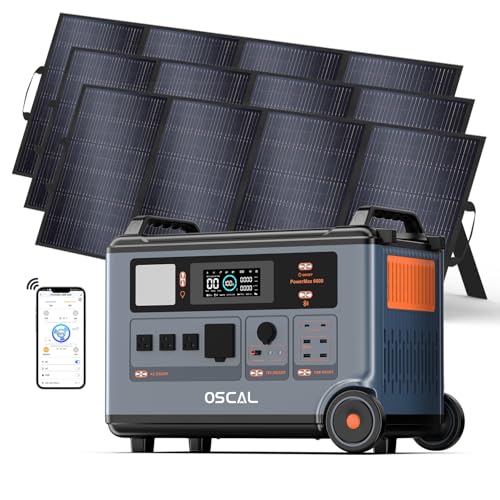
OSCAL PowerMax 6000 with 3x400W Panels, 6,000W 120/240V
3,600Wh LiFePO46,000W 120/240V9,000W surge2,400W solar input
Check price on Amazon
Best for: Buyers who need real split-phase power at the end of a heavy cord.

Start with the number that matters most for a heavy cord: 6,000W at 120/240V. At 240 volts that is 25 amps per leg-pair, half the capacity of a 50 amp plug and more than any other single box here can offer. It means a cord feeding a split-phase RV panel or a workshop sub-panel actually gets two live legs, not a pretend connection.

The kit pairs that inverter with three 400W panels and a 2,400W solar input, so a bright day can refill most of the 3,600Wh tank in a few hours. The listing puts a full charge at about 1.44 hours when wall power and solar combine. The limit is the tank: heavy loads drain 3,600Wh in about an hour, so this is a high-power, short-duration machine.

Expect to buy or build a proper adapter lead between the battery's outlet and a 50 amp receptacle, and use heavy gauge cable. Keep the unit dry and ventilated, anchor the big panels well and check the connectors every season. A good habit is to test the whole chain at low load first, then step up to the heavy appliances one at a time.

What works

  • 6,000W at 120/240V from a single box
  • Three 400W panels in the kit
  • 2,400W solar input refills quickly
  • 9,000W surge for motor starts

Watch out for

  • 3,600Wh empties fast under heavy load
  • Big panels are awkward to place
  • Newer brand with limited history

Spec sheet

Capacity
3,600Wh
Rated AC output
6,000W
Surge
9,000W
Solar input
2,400W
AC outlets
4
02
Jackery Solar Generator 5000 Plus with 2x200W Panels
5,040Wh LiFePO47,200W AC120/240V14,400W surge
Check price on Amazon
Best for: Owners who want the biggest tank and a long-term expansion path.

Where the Oscal is about power, the 5000 Plus is about endurance with power to spare. Seven thousand two hundred watts at 240 volts is about 30 amps, so the cord carries a respectable 60 percent of a 50 amp circuit's rating, and the 5,040Wh tank holds more than the Oscal by 1,440Wh.

The two 200W panels in the kit are a starter set, and the unit accepts both high and low voltage panels so you can bring a better array later. The listing's claim of 13 days of backup for essentials gives a sense of the tank, and expansion to 60kWh shows the platform's ceiling. The price is the highest here, and so is the weight.

Plug the cord in through a rated 240V adapter and keep the unit somewhere with air movement. Check the connectors and the cord's temperature after the first long run and store the battery around half charged. If the unit will serve a cabin, choose a mounting spot above any flood line and keep the cord run short.

What works

  • 7,200W at 120/240V
  • 5,040Wh and expandable to 60kWh
  • 14,400W surge
  • Accepts high and low voltage panels

Watch out for

  • Highest cost and weight here
  • Starter panels refill slowly
  • Needs a proper adapter for a 50 amp cord

Spec sheet

Capacity
5,040Wh
Rated AC output
7,200W
Surge
14,400W
Voltage
120V and 240V
Expansion
Up to 60kWh
03
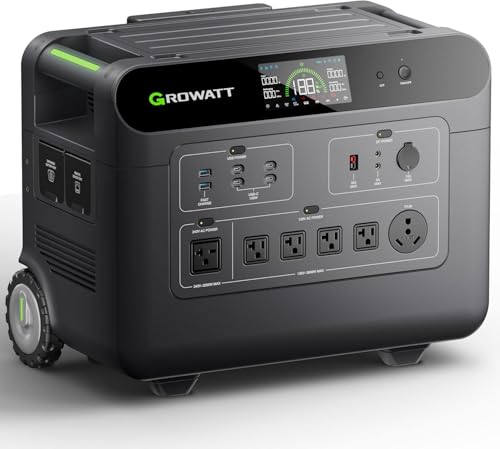
GROWATT HELIOS 3600 3,600Wh LFP, 240V/7,200W Parallel
3,600Wh LFP3,600W AC240V pair at 7,200WExpands to 36kWh
Check price on Amazon
Best for: Buyers who want to start with one unit and grow into 240V.

A single Helios 3600 is a 3,600W, 120V machine, but the listing describes a parallel connection of two units that yields 240V at 7,200W, which is how it reaches the plug's voltage. That makes it a build-as-you-go option: one unit powers a single leg now, a second turns the pair into a 240V source later.

Growatt comes from the inverter industry and the specification list shows it, with a sub-15ms EPS switchover and cold-start technology for charging in low temperatures. Each unit holds 3,600Wh, and expansion to 36kWh is possible. The cost is that 240V requires two boxes, so the upfront price doubles.

Treat the pair as a system: use the matching parallel cable, place both on the same bench, and test them together under a real load. Against the Oscal it spreads weight over two lighter boxes, which is easier to carry. Because the pair shares the load, losing one unit still leaves a working 120V system, a resilience single big boxes lack.

What works

  • Two units give 240V at 7,200W
  • Expands up to 36kWh
  • Fast EPS switchover
  • Cold-start support

Watch out for

  • Two units needed for 240V
  • Smaller accessory ecosystem
  • Costs double for the full pair

Spec sheet

Capacity
3,600Wh
Rated AC output
3,600W
Paired output
240V at 7,200W
Switchover
Under 15ms
Expansion
Up to 36kWh
04
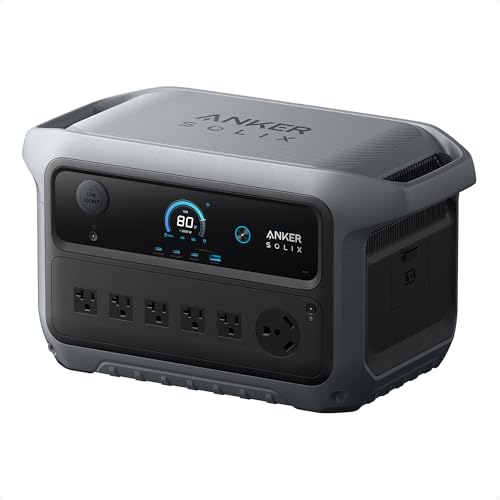
Anker SOLIX C2000 Gen 2, 2,048Wh 2,400W Power Station
2,048Wh LiFePO42,400W AC58-minute chargeCompact
Check price on Amazon
Best for: Travelers who want a quick-charging battery for a single leg of a 50 amp rig.

Anker's C2000 Gen 2 is a refreshingly honest machine for a smaller job. It delivers 2,400W from a 2,048Wh LiFePO4 tank and recharges fully in about 58 minutes, which makes it a strong match for a 50 amp cord that will only ever carry one leg's worth of power. A trailer with a refrigerator, lights, a microwave and a roof air conditioner on soft-start will run on it for a short stretch.

The listing makes no 240V claim, so it feeds a single 120V leg. That is fine for many RVs where the main loads sit on one side, but not for a dryer or a well pump. Compared with the Oscal it has a third of the output and a little over half the energy, and it is much lighter.

Plan on an adapter between its outlet and a 50 amp inlet, and keep the load under about 2,000W continuous. Half charge in storage, and nothing blocking the vents. Its compact size also makes it practical to carry into a basement bay or a closet without help.

What works

  • Full recharge in about 58 minutes
  • 2,400W output from a compact box
  • LiFePO4 chemistry for long life
  • Established brand support

Watch out for

  • 120V only, no split phase
  • 2,048Wh is a modest tank
  • No panels in this listing

Spec sheet

Capacity
2,048Wh
Rated AC output
2,400W
Full charge
About 58 minutes
Chemistry
LiFePO4
Voltage listed
120V
05
ABOK Ark3600 3,840Wh with 3x200W Panels and TT-30 Port
3,840Wh LiFePO43,600W ACTT-30 port3x200W panels
Check price on Amazon
Best for: RVers who want a 50 amp coach to run on one leg using a simple adapter.

This box approaches a 50 amp plug from below: it has a TT-30 RV port, so the standard route is a TT-30 to 14-50 adapter that lets a 50 amp RV cord draw from a 30 amp source. The adapter does not magically add current, so the coach is limited to 3,600W on one leg, but it is simple, common and works.

The tank is 3,840Wh with 7,200W of peak output, and three 200W panels come in the kit. That gives roughly 1,900Wh a day in good sun, which is solid for a boondocking weekend. The listing says combined AC and solar input can reach 3,500W, and a zero to 80 percent charge takes about 1.1 hours under ideal conditions.

Use an adapter rated for 30 amps and do not exceed about 2,880W continuous. Strap it down, keep the vents clear and store it half charged. Compared with the Anker C2000 Gen 2 it holds nearly twice the energy and adds panels. Strain-relieve the adapter so the weight of the coach cord does not pull on the receptacle.

What works

  • TT-30 port supports a simple 14-50 adapter route
  • 3,840Wh tank with expansion to 11,520Wh
  • 600W of panels in the kit
  • Fast combined AC and solar input

Watch out for

  • Limited to 3,600W on one leg
  • Adapter pairs add a failure point
  • Bulky for a small coach

Spec sheet

Capacity
3,840Wh
Rated AC output
3,600W
Peak output
7,200W
RV port
TT-30
Included panels
3 x 200W
06
Jackery Solar Generator 1000 v2 with 200W Panel
1,024Wh LiFePO41,500W AC3,000W surge50-min charge
Check price on Amazon
Best for: Light-draw coaches that only need a battery for essentials.

A 50 amp plug on a 1,500W box is mostly a convenience for owners whose coach draws very little. If your rig runs a compressor fridge, lights, a fan and some electronics, this unit covers it with room to spare, and the 200W panel offsets a share of the daily draw.

It cannot start a rooftop air conditioner or run a microwave and a kettle at once, so treat the plug as a connection, not a promise. The 50 minute full recharge from the wall and 10ms switchover make it a good partner for a campground hookup lunch stop.

Its weight lets one person carry it. Use a rated adapter, keep the load under about 1,200W and store it half charged. Against the Anker C2000 Gen 2 it has half the energy and two-thirds of the output. Owners who add a second 200W panel later roughly double its daily harvest and make it a self-sufficient fridge battery.

What works

  • Light and easy to carry
  • 50-minute wall recharge
  • 200W panel included
  • 10ms UPS-style switchover

Watch out for

  • Cannot run a rooftop air conditioner
  • 1,500W limits kitchen use
  • Not a true 50 amp supply

Spec sheet

Capacity
1,024Wh
Rated AC output
1,500W
Surge
3,000W
Included panel
200W
Recharge
About 50 minutes

Spec sheet decoder

What the numbers on the box really mean

The specs manufacturers lead with, translated into what they tell you about real-world performance.

Split-phase 120/240V

Two 120V legs that sum to 240V, which a 50 amp panel expects.

Watch forThe Oscal and Jackery 5000 Plus list it; the Helios 3600 offers it as a pair.

Amps per leg

Continuous watts divided by 120V for each leg. It shows the real current on the cord. Cable and adapter ratings are set by this number, not by the plug shape.

Watch forThe ABOK's 3,600W is 30 amps on one leg, the Anker's 2,400W is 20 amps.

TT-30 outlet

The 30 amp RV receptacle that most 14-50 adapters connect to.

Watch forThe ABOK Ark3600 kit lists one.

Peak output

A short surge allowance for compressors.

Watch forThe Jackery 5000 Plus lists 14,400W, the Oscal 9,000W.

Solar input

The maximum panel power accepted at once.

Watch forThe Oscal accepts 2,400W, the ABOK up to 3,500W combined.

Methodology

How We Evaluated These Solar Generators That Plug into a 50 Amp Cord

Voltage match

We judged whether each unit supplies both legs a 50 amp plug expects. The Oscal and Jackery 5000 Plus passed, the Helios needs a pair, and the rest are single leg.

Real amps

We converted rated watts to amps. The Jackery's 7,200W is about 30 amps at 240V, the Oscal's 6,000W is 25, and the ABOK's 3,600W is 30 on one leg.

Adapter path

We checked how each unit gets to the cord. The ABOK's TT-30 gives a direct route, while others rely on custom or adapter leads. We counted every extra adapter as a potential failure point.

Energy and refill

We compared tank size with solar input. The Jackery's 5,040Wh led on storage, the Oscal's 2,400W input led on harvest.

Ownership

We used listing details and owner feedback patterns for weight and support, not our own use.

Decision guide

How to Choose the Right Solar Generators That Plug into a 50 Amp Cord

By Coach Setup

SituationPickWhy
Both legs must workOSCAL PowerMax 60006,000W at 120/240V
Long stay, big tankJackery Solar Generator 5000 Plus5,040Wh and 7,200W
Grow into 240V laterGROWATT HELIOS 3600Pair for 240V at 7,200W
One leg, quick chargingAnker SOLIX C2000 Gen 258-minute full charge
TT-30 adapter path with panelsABOK Ark3600 kitTT-30 port and 600W of panels

By Budget

TierPickWhy
LowestJackery Solar Generator 1000 v2Light-duty essentials
Low-midAnker SOLIX C2000 Gen 22,400W, fast recharge
MidABOK Ark3600 kitBig tank, panels included
UpperOSCAL PowerMax 6000Split-phase with panels
PremiumJackery Solar Generator 5000 PlusCapacity and expansion

One Leg vs Both Legs

One leg

The Anker C2000 Gen 2, ABOK Ark3600 and Jackery 1000 v2 feed a single 120V circuit. It is cheaper and lighter, and fine if the main loads share a leg.

Both legs

The Oscal, Jackery 5000 Plus and a Helios 3600 pair feed both. It costs more and weighs more, but the coach panel behaves as designed.

Choose one leg for simplicity and both legs for full coach use.

Adapter Route

PreferencePickWhy
Straight TT-30 to 14-50ABOK Ark3600 kitTT-30 on the unit
Custom 240V leadOSCAL PowerMax 6000Split-phase outlets
Household outlet to 50 amp inletAnker SOLIX C2000 Gen 2Simple 120V feed
Modular parallel cableGROWATT HELIOS 3600Pair connection

For Weekend Camping Specifically

Look for

Look for 2,000Wh or more, a fast recharge and panels you can deploy easily. A weekend usually needs 2,000 to 4,000Wh with moderate cooling.

In this comparison

The ABOK kit's 3,840Wh and 600W of panels cover a weekend, while the Anker C2000 Gen 2's quick recharge suits hookup hops.

When to Spend More

Spend more if

You want both legs and a long stay. The Oscal or Jackery 5000 Plus delivers.

Save if

You camp lightly and want a plug connection. The Jackery 1000 v2 or Anker C2000 Gen 2 does it.

Ownership

Maintenance schedule

The upkeep that decides whether this machine lasts two seasons or ten.

TaskIntervalWhy it matters
Inspect plugs and adaptersBefore each tripHeat discolouration on pins signals resistance. Replace any adapter that has softened. Carry a spare adapter on trips so a failure does not end the stay.
Check cable gauge and lengthOnceLong thin cords drop voltage and heat up under load.
Store at half chargeLong storageLiFePO4 cells last longest at moderate charge.
Clean ventsEvery seasonDust limits how long the inverter can hold full load.
Test under loadTwice a yearA real run with a watt meter confirms the unit still delivers its rating.

FAQ

Frequently Asked Questions

Can a solar generator power a 50 amp RV?

Only partly. The Jackery 5000 Plus delivers up to 7,200W against the 12,000W a 50 amp plug allows, and smaller units far less. You choose the loads to keep alive.

Do I need a special adapter?

Usually yes. A TT-30 to 14-50 adapter is common, but it limits you to 30 amps. A true 240V feed needs a split-phase unit and a purpose-built lead. Always confirm the adapter's amp rating on the label, not just the plug shape.

Which is the best value?

The Anker C2000 Gen 2 delivers fast charging and 2,400W at a moderate cost, and the Jackery 1000 v2 is the cheapest sensible option for light coaches. Neither replaces a generator for all-day cooling.

Are the generator cords in the search results solar generators?

No. Cords, inlet boxes and adapters are accessories. A solar generator is a battery with an inverter, and you still need the right cable.

Can I run both air conditioners?

Not for long. Two rooftop units pull about 2,600W running and more at start. The Oscal can start them but a 3,600Wh tank lasts under two hours. A soft-start device on one unit cuts its surge by about half.

Is it safe to use an adapter at full load?

Only if it is rated for the current. Use heavy-duty adapters and check for heat during the first long run. If an adapter ever feels warm to the touch, stop and reduce the load.

Bottom line

The short version

Browse more solar generators that plug into a 50 amp cordon Amazon →
James Miller, Lead Machine Editor

About the author

James Miller

Lead Machine Editor, MachineFanatic

James Miller leads MachineFanatic's buying guides, turning spec sheets, manuals and owner feedback into clear verdicts on power tools, outdoor power equipment, shop machines and kitchen machines.

More from James →

Keep reading

Related guides