
Amazon affiliate links - we earn a commission.Affiliate disclosure

Buying guide · 12 min read · Updated 2026-11-13

Best Solar Panels Under $75 (2026)

Six solar panels under $75, mostly 100W 12V modules plus one foldable USB panel, compared on cell type, frame, controller kits and RV fit.

James MillerBy James MillerLead Machine Editor6 machines comparedSpec-sheet verified
Best Solar Panels Under $75

At a glance

Our top picks

Side by side

Spec comparison

This price band is where single-panel solar becomes useful rather than symbolic. A hundred-watt class module can run lights, a vent fan, a router and phone charging for a small camper or a garden shed, provided it is sized against the battery it feeds.

Most listings quote the same headline wattage, so the useful differences live in cell generation, frame or frameless construction, whether a controller is bundled, and how easy the panel is to mount. We sorted the options by those practical differences instead of by claimed efficiency alone.

Before you buy

6 Criteria to Look For Before Buying a Solar Panel Under $75

  1. 01

    Rigid or foldable format

    A fixed rigid panel gives the best watts and life per dollar, and it suits a roof, a shed or a fence. A foldable panel like the MESUVIDA 60W is a travel tool: it gives up wattage and durability for portability. Pick by where the panel will sit most of its life, because a foldable bolted to a roof will fail early.

  2. 02

    Controller bundled or not

    A charge controller sits between the panel and battery to prevent overcharge. The Sanpyl kit bundles one, while the HQST, STAR, Rvpozwer and JJN do not. A bundled basic controller is fine for a small lead-acid battery, but a lithium battery needs a lithium profile and an MPPT unit extracts more energy.

  3. 03

    12V or 24V panel class

    The STAR is a 24V class panel, while the HQST and JJN are 12V class. A 24V panel on a basic PWM controller can waste much of its output, so it demands an MPPT controller. Check your controller's maximum input voltage before buying either type.

  4. 04

    Cell generation

    N-type cells with 16 to 18 busbars, as in the STAR and Rvpozwer, hold output in heat and shade better than 9BB or 10BB cells in the HQST and JJN. The difference shows up over years, not in the first month. If the lineup is within a few watts of each other, take the newer cell.

  5. 05

    Footprint and mounting

    The HQST measures about 31.8 by 27.5 inches, a size built to fit around vents. Long-format panels are cheaper to mount in a row but harder on a short roof. Measure the clear area, then add room for ventilation and cable entry.

  6. 06

    Documentation and support

    A stated wind rating and a recognised brand matter when something fails in year two. The HQST lists 2400Pa and 5400Pa and the JJN 2100Pa, while the Rvpozwer offers few details. For a roof install, paperwork and a reachable seller are worth a small step in price.

Detailed reviews

The 6 best solar panels under $75, explained

01
HQST 100W 12V Compact Monocrystalline Panel
100W9BB Grade A+IP6531.8 x 27.5 in
Check price on Amazon
Best for: RV, van and shed owners who want a compact, well-rated 100W starting panel.

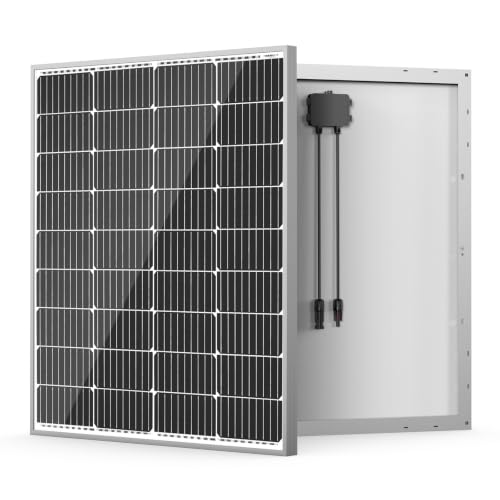
HQST has given this panel a nearly square body instead of the long rectangle most hundred-watt modules use, and the listing says it is about eleven percent smaller than a traditional unit. That shape helps on a van or trailer roof where the space is boxed in by vents and a skylight. The cells are 166mm Grade A+ with 100 percent electroluminescence inspection, which is a quality-control step that catches microcracks before shipping.

Its compromise is cell generation: nine busbars and a stated 23 percent efficiency are a rung below the N-type designs in the STAR and Rvpozwer panels. In real use that shows up as slightly faster decay and a bit less shade tolerance, not as a visible day-one gap. Wind and snow ratings of 2400Pa and 5400Pa match the standard rigid-module benchmark, which gives reassurance for a roof mount.

Ownership is straightforward. It is a bare panel, so budget a controller, MC4 extension leads and a fuse; the HQST name makes warranty claims easier than with no-name sellers. Bolt it through the pre-drilled frame holes with a sealant such as Dicor on each penetration and inspect the seal every spring.

What works

  • Square body fits cramped roof layouts
  • Cells carry 100 percent electroluminescence inspection
  • 2400Pa wind and 5400Pa snow loading stated
  • Established brand makes warranty claims simpler

Watch out for

  • Nine busbar cells trail the N-type panels on shade tolerance
  • Controller and cabling are separate purchases

Spec sheet

Rated power
100W
Cell design
166mm Grade A+, 9 busbar
Size
31.8 x 27.5 x 1.18 in
Wind and snow load
2400Pa and 5400Pa
Sealing
IP65 connectors and box
02
Sanpyl 100W 12V Panel Kit with Controller
100W23% cellsController includedIP67
Check price on Amazon
Best for: First-time buyers who want a panel, controller and device ports in one purchase.

This kit solves the problem that stops many first-time buyers: it includes a controller with USB, Type C and DC outputs, so the panel can feed a battery and charge devices without extra parts. Sanpyl lists a 23 percent conversion rate and an anti-corrosive aluminum frame, and the junction box and connectors are rated IP67. For someone who has never wired a solar system, getting everything in one box removes the biggest source of mistakes.

The downside is the controller. Bundled units at this level are usually basic regulators rather than MPPT trackers, and they lose a share of the energy that a better controller would capture. Next to the HQST 100W, which is panel only, the Sanpyl trades controller quality for convenience, and it will not suit a lithium bank unless the controller has that profile.

In year three, expect the weak link to be the clamp or ring terminals rather than the glass. Re-torque the connections once a season, keep the controller shaded and ventilated, and replace it with a proper MPPT unit if you ever expand to a second panel. Until then the kit is a sensible way to learn how a solar charging circuit behaves.

What works

  • Controller with USB, Type C and DC ports is included
  • IP67 junction box and connectors for outdoor use
  • 23 percent cell efficiency is competitive for the class
  • Removes the guesswork of matching parts

Watch out for

  • Bundled controller is likely basic and not MPPT
  • Upgrading to a larger system means replacing parts

Spec sheet

Rated power
100W
Listed efficiency
23 percent
Controller outputs
USB, Type C, DC
Sealing
IP67 junction box and plugs
Format
Portable monocrystalline kit
03
STAR 100W 24V Frameless N-Type Solar Panel
100WN-type 25%Frameless24V
Check price on Amazon
Best for: Buyers with an MPPT controller who want N-type cells and a dust-shedding frameless build.

Instead of an aluminum rim, STAR uses a frameless Cleanedge design that lets rain and dust slide off the lower edge. The listing claims a fifteen percent power gain over normal panels from that lack of dust-trapping lip, which is a vendor figure and should be read as a best case. It also advertises 25 percent N-type cells and ETL, ISO9001 and CE certifications, which is a stronger paper trail than most panels at this cap.

The catch is the 24V rating. A 24V class panel produces higher voltage than a 12V module, so it needs an MPPT controller or a 24V system to work well; a basic PWM controller will waste a lot of its potential. Compared with the HQST 100W it is the better panel on paper but harder for a beginner to wire correctly.

Frameless glass-on-glass panels are lighter on the edges but more prone to chipping if dropped, so handle and ship it carefully. Mount it with rubber-backed clamps rather than point loads, wipe it a couple of times a season, and treat it as a fit for a system where you already own or plan to buy an MPPT controller.

What works

  • Frameless edge lets debris run off the panel
  • 25 percent N-type cells for slower aging
  • ETL, ISO9001 and CE certifications are listed
  • Strong choice for shaded, dusty or snowy sites

Watch out for

  • 24V class needs a controller that handles higher input voltage
  • Glass edges are more exposed than a framed module

Spec sheet

Rated power
100W
Cell efficiency
25 percent
Frame
Frameless Cleanedge design
Voltage class
24V
Certifications listed
ETL, ISO9001, CE
04
Rvpozwer 100W 18BB N-Type Solar Panel
100W18BB N-typeIP68 box25% cells
Check price on Amazon
Best for: DIY installers who want 18BB N-type cells and accept a lesser-known brand.

Eighteen busbars and N-type silicon give this panel the most advanced cell layout among the framed 100W options here. The extra busbars shorten the path each current carrier travels, so output holds up better when a cell cracks or a shadow crosses the panel. The junction box is rated IP68, and the module glass is described as cured, weather-resistant solar glass.

There is little brand history behind the Rvpozwer name, so you are leaning on the spec sheet and the seller's return policy. Compared with the HQST 100W it offers better cells but a thinner support network, which matters if a panel fails after the first year. It also ships as a bare module, so a controller must be bought separately.

For an installer who values efficiency per dollar, it is the closest thing to a premium panel at this cap. Inspect it on arrival for scratches or loose junction box covers, wire it with 10 AWG or 12 AWG leads for runs over ten feet, and keep a photograph of the label in case the listing disappears.

What works

  • 18 busbar N-type layout resists cracking and shade
  • IP68 junction box for wet climates
  • 25 percent cell efficiency listed
  • Standard 12V compatibility for battery charging

Watch out for

  • Brand has a short track record for support
  • No controller or mounting hardware included

Spec sheet

Rated power
100W
Cell design
N-type, 18 busbar
Listed efficiency
25 percent
Junction box
IP68
Intended use
RV and marine
05
JJN 100W 10BB Monocrystalline Solar Panel
100W10BB cells23% claim2100Pa wind
Check price on Amazon
Best for: Straightforward 12V installs where a plain, rigid 100W panel is all that is needed.

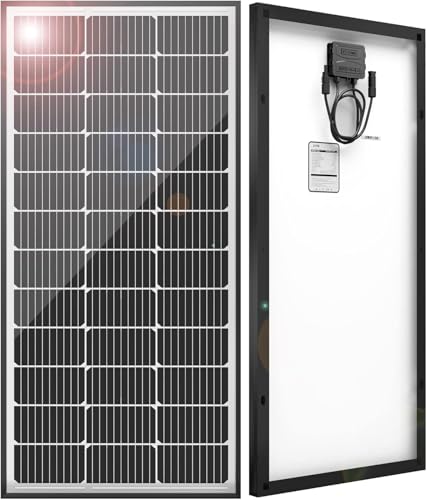
JJN keeps things simple: Grade A+ monocrystalline cells with ten busbars, a black aluminum frame, and a stated 2100Pa wind and snow rating. The black frame looks tidy on a dark roof and runs a little cooler than a bare finish in direct sun. It is a standard hundred-watt rectangle, which makes it easy to fit to existing brackets.

Its weaker point is documentation. The wind rating is slightly below the 2400Pa on the HQST, and the cell design is a generation behind the 18BB Rvpozwer. It is the least differentiated panel here, which is exactly why it suits buyers who want a plain, predictable module without added features.

Expect a trouble-free life if the install is sound. Pre-drill the frame, use stainless fasteners, and seal every hole. If you tilt it on an adjustable bracket, aim it south in the northern hemisphere and re-check the angle at the changes of season.

What works

  • Plain rigid design with no gimmicks
  • 10 busbar Grade A+ mono cells
  • Black frame stays discreet on a dark roof
  • Wind and snow rating stated for planning

Watch out for

  • Wind rating trails the HQST at 2400Pa
  • Cell generation is behind the N-type panels

Spec sheet

Rated power
100W
Cell design
Grade A+ mono, 10 busbar
Listed efficiency
23 percent
Frame
Black corrosion-resistant aluminum
Wind load
Up to 2100Pa
06
MESUVIDA 60W Foldable Solar Charger with USB-C
60WUSB-C PD 45W3.9 lb5 ports
Check price on Amazon
Best for: Campers and hikers who need to charge phones and a small battery on the move.

Every other pick here is a fixed panel; the MESUVIDA is the one to carry. At 3.9 pounds and roughly 15.7 by 16.7 inches folded, it fits a daypack, and its five ports include MC4, DC, two USB-A and a USB-C that supports 45W power delivery. That mix lets it charge a phone directly in a campsite or feed a small power station through the MC4 lead.

Limits are physical. Sixty watts is well below the hundred-watt panels, and foldable panels with fabric-backed cells lose output faster to heat and flexing than glass panels. USB charging also depends on the panel receiving steady sun; a passing cloud can make a phone stop and restart charging.

For ownership, fold along the seams only, keep the pouch for storage, and wipe the surface after dust or sand. Do not leave it face-up on a hot car dash for days. It is a great way to keep devices alive on a trip, though it is not a permanent roof solution.

What works

  • Folds to about the size of a small bag at 3.9 lb
  • USB-C port supports 45W power delivery
  • Five outputs including MC4 for power stations
  • Works without any controller for USB devices

Watch out for

  • Only 60W, well under the 100W fixed panels
  • Foldable fabric cells age faster than glass modules

Spec sheet

Rated power
60W
USB-C output
PD 45W
Ports
MC4 18V, DC, 2 USB-A, USB-C
Weight
3.9 lb
Folded size
about 15.7 x 16.7 in

Spec sheet decoder

What the numbers on the box really mean

The specs manufacturers lead with, translated into what they tell you about real-world performance.

Busbars (9BB to 18BB)

Busbars collect current across each cell. More lines mean less power lost when a cell cracks or is shaded.

Watch forRvpozwer lists 18BB, JJN 10BB, HQST 9BB.

N-type vs P-type

N-type silicon suffers less initial light-induced loss and handles heat better. It generally lasts longer in the field.

Watch forSTAR and Rvpozwer list N-type; HQST and JJN do not.

Wind and snow load in Pa

This is the pressure a panel frame is rated to survive. 2400Pa wind and 5400Pa snow is the common standard.

Watch forHQST states 2400Pa and 5400Pa, JJN 2100Pa.

IP rating

Ingress protection for the junction box and connectors. IP65 resists jets of water, IP67 and IP68 survive immersion.

Watch forRvpozwer lists IP68, Sanpyl IP67, HQST IP65.

USB-C PD wattage

Power delivery negotiates voltage so a laptop or tablet can charge. A 45W port can refill a phone quickly but only slowly charge a laptop.

Watch forMESUVIDA's USB-C is 45W, but the panel itself is only 60W.

Methodology

How We Evaluated These Solar Panels Under $75

Cell and busbar construction

We read each spec sheet for cell chemistry and busbar count. The Rvpozwer's 18BB N-type layout ranks above the HQST's 9BB cells on paper. We treated this as a durability and shade-tolerance factor rather than a day-one output factor.

Bundled versus separate electronics

We checked what each listing includes. The Sanpyl comes with a controller, ports and DC outputs, while the others are bare. We scored completeness for beginners separately from panel quality.

Mechanical ratings

We compared stated wind and snow loads and ingress ratings. HQST names 2400Pa and 5400Pa; JJN names 2100Pa. A named number was treated as stronger evidence than a general waterproof claim.

Fit and mounting

We compared footprint and format, from the HQST's compact square body to the long rectangle on the JJN. We also considered whether a panel needed a bracket kit and whether it was fixed or foldable.

Brand and seller trail

We weighed how established the brand is, since a panel failure in year two depends on support. HQST and STAR have longer records than Rvpozwer. We did not use customer rating numbers in scoring.

Decision guide

How to Choose the Right Solar Panels Under $75

By Install Location

SituationPickWhy
Van or trailer roof with tight spaceHQST 100WCompact square footprint
Shed or fence with a MPPT controllerSTAR 100WFrameless N-type and 24V class
Camper where wiring is new to youSanpyl 100W kitController and ports are included
Tent, hike or boat on the moveMESUVIDA 60WFolds to 3.9 lb with USB-C

By Budget

Spend levelPickWhy
Lowest in this lineupSanpyl 100W kitIncludes controller and ports
Low with a standard panelJJN 100WPlain 10BB panel for a simple install
Mid within the capHQST 100WBetter paperwork and compact size
Top of the capSTAR 100WN-type frameless build

Fixed Panel vs Foldable Panel

Fixed rigid

The HQST, STAR, Rvpozwer, JJN and Sanpyl are made to sit in place for a decade. They give the most watts and the longest life per dollar, but they need a bracket and a permanent mount.

Foldable

The MESUVIDA 60W trades roughly forty percent of the wattage for being able to move. It charges phones directly and a small station through MC4, but it is a poor fit for a roof.

Mount a rigid panel if the system will stay put; take the MESUVIDA if you move camp.

Basic Controller vs MPPT

Controller pathPickWhy
Basic controller, small batterySanpyl 100W kitBundled regulator is adequate
MPPT controller, 12V batteryHQST 100W12V class panel works with either type
MPPT controller, 24V bankSTAR 100W24V class needs MPPT to perform
MPPT with lithiumRvpozwer 100WN-type cells pair well with MPPT

For RV Rooftops Specifically

Look for

A compact footprint, a stated wind rating and a sealant plan for the screw holes. Roof vibration and heat soak punish weak frames, so documentation counts.

In this comparison

The HQST 100W fits tight roofs and states both loads. Where space is generous, the STAR 100W frameless panel sheds dust best.

When to Spend More

Spend more if

You need more than about 300Wh a day or want to run a fridge. One 100W panel like the HQST only yields 200Wh to 300Wh in good sun, so a larger system is needed.

Save if

You only run lights, a fan and phones. The JJN or Sanpyl will handle that with no added cost.

Ownership

Maintenance schedule

The upkeep that decides whether this machine lasts two seasons or ten.

TaskIntervalWhy it matters
Wash the glassEvery 2 to 3 monthsDust cuts output by a few percent and bird droppings can create hot spots. Use water and a soft sponge.
Check roof sealantEach springSealant dries and cracks with heat cycles. A small gap can let water into the roof core.
Inspect MC4 connectorsEvery 6 monthsLoose connectors arc and melt. Press them until they click and check for discoloration.
Verify controller settingsAfter any battery changeA controller set for the wrong battery chemistry will under or overcharge. Confirm the profile when you swap chemistries.
Fold and store the portable panelAfter each tripFabric-backed panels crease and crack if stored under weight. Keep it in its pouch away from heat.

FAQ

Frequently Asked Questions

Is a 100W panel enough for an RV?

For lights, a fan and phone charging, yes. A 100W panel yields roughly 200Wh to 300Wh in good sun, which will not run an air conditioner or a heavy fridge.

Do I need MPPT or is PWM fine?

For one small 12V panel PWM is acceptable. MPPT gets roughly 20 to 30 percent more energy in cool or low light, which matters most on 24V panels like the STAR.

Frameless or framed, which lasts longer?

A framed panel survives knocks better, while a frameless one sheds dust and snow. Both can last a decade if mounted carefully.

Can I link two of these panels together?

Yes, in parallel for 12V panels or series for higher voltage. Check the controller's maximum input and use proper fuses on parallel runs.

Will a bigger cap buy me better solar panels?

It buys more watts and N-type cells, not a fundamentally different panel. A higher cap adds wattage and features such as bifacial cells.

Do prices stay the same?

No, they change often. The $75 cap reflects listing prices when this guide was updated.

Bottom line

The short version

Browse more solar panels under $75on Amazon →
James Miller, Lead Machine Editor

About the author

James Miller

Lead Machine Editor, MachineFanatic

James Miller leads MachineFanatic's buying guides, turning spec sheets, manuals and owner feedback into clear verdicts on power tools, outdoor power equipment, shop machines and kitchen machines.

More from James →

Keep reading

Related guides