
Amazon affiliate links - we earn a commission.Affiliate disclosure

Buying guide · 14 min read · Updated 2026-11-19

Best Solar Powered Air Conditioners for RVs (2026)

Six RV air conditioners matched to solar arrays: watt-hour budgets, panel sizing math, 12V draw claims and which units suit a battery and panel system.

James MillerBy James MillerLead Machine Editor6 machines comparedSpec-sheet verified
Best Solar Powered Air Conditioners for RVs

At a glance

Our top picks

Side by side

Spec comparison

A solar air conditioner is not a machine with a solar badge on it. It is an ordinary efficient unit, paired with a battery bank and an array sized to cover what it drinks, and the arithmetic of that pairing matters far more than the brand on the shroud.

Start from the power budget. How many watt-hours the unit pulls per hour, how many hours you want cooling and how much sun your campsite gets decide the size of the array and the bank. We rank the field by how clearly each machine states its draw, how efficiently it holds a setpoint and what kind of system it expects.

Before you buy

6 Criteria to Look For Before Buying a Solar Powered Air Conditioner for RVs

  1. 01

    Do the watt-hour math first

    Multiply the unit's average watts by the hours you want cooling. The Gidrox quotes about 350 watts, so six hours is roughly 2,100 watt-hours, while the Countrymod's 0.3 kWh per hour gives 1,800. Divide by about four and a half peak sun hours and a loss factor of around 0.75 to get panel watts, which lands near 500 to 600 watts of array for six hours of cooling. Do this before you pick a unit.

  2. 02

    Stated draw versus guesswork

    Units that state their draw let you size honestly. The Countrymod gives 300 to 900 watts, Outequip implies about 700 watts from its 8 hours on 480 amp-hours, and the EROMMY and RecPro give nothing. A missing figure means you must measure it yourself with a shunt or a clamp meter, and size generously until you do.

  3. 03

    Battery bank size

    Panels cannot produce the power you need at the moment of peak heat, so the bank carries the load. A 100 amp-hour lithium bank holds roughly 1,280 watt-hours, which is only a few hours at 350 watts. The Outequip's claim of 8 hours used a 480 amp-hour bank. Plan the bank for the hours you want cooling after sundown.

  4. 04

    12V versus inverter-fed

    A 12V unit like the Gidrox runs straight from the bank, while a household-voltage unit like the TURBRO or RecPro needs an inverter that wastes some energy and adds a standby load. For a solar rig that difference is real panel watts. Choose 115V only when the cabin is too big for a 12V unit and the system is large.

  5. 05

    Heat pump for winter solar

    Winter brings the fewest sun hours and the longest nights, so efficient heat matters. A heat pump such as the Gidrox's 9,000 BTU, quoted at about 65 percent less energy than a standard heater, is far kinder to a solar rig than a resistive element. It still weakens in real cold, so keep a diesel or propane heater.

  6. 06

    Charge controller and panel layout

    The air conditioner is only one load. A good MPPT charge controller, panels wired to match its input voltage and a layout that avoids shading by vents and fans make the difference between a theoretical and a real array. Tilt panels for the season if the rig is parked, and keep them clean.

Detailed reviews

The 6 best solar powered air conditioners for rvs, explained

01
Countrymod 12V DC 10,000 BTU RV AC, 300 to 900W inverter
10,000 BTU300 to 900W0.3 kWh/hApp control
Check price on Amazon
Best for: Solar vans that want a stated draw to size panels against.

A solar plan starts with a number, and the Countrymod gives two: a power range of 300 to 900 watts and an energy claim near 0.3 kilowatt-hours per hour. Turn the second into panel arithmetic: six hours of cooling is about 1,800 watt-hours, and with roughly four and a half peak sun hours a day and normal system losses, that wants an array in the neighborhood of 500 watts, ignoring everything else the rig uses.

The 900 watt peak matters for the inverter-free wiring and the battery's discharge rating, and the app lets you schedule cooling when the panels are producing. At 10,000 BTU it suits vans and small campers. A 45 to 55 dB noise claim is the loosest in this guide.

Beside the Gidrox it states a range but a looser noise figure. Use heavy cable, a fuse and a low-voltage cutoff, and keep the panels clean.

What works

  • States a 300 to 900 watt operating range
  • About 0.3 kWh per hour claim is easy to size against
  • App control for scheduling around sun hours
  • Inverter modulation avoids hard cycling

Watch out for

  • 45 to 55 dB claim is the loosest here
  • 900 watt peaks need heavy wiring

Spec sheet

Capacity
10,000 BTU
Power range
300 to 900W
Energy claim
About 0.3 kWh per hour
Noise claim
45 to 55 dB
Control
App
02
Gidrox 12V 12,000 BTU RV AC with heat pump, 43 dB claim
12,000 BTU9,000 BTU heat350W average claim40 dB sleep
Check price on Amazon
Best for: Four-season solar vans that need efficient heat and cooling.

With an average draw quoted near 350 watts, this Gidrox lets you do the panel math directly: six hours of cooling is about 2,100 watt-hours, which an array of roughly 600 watts can replace on a good sun day, before bank losses. That is demanding for a van roof, so the realistic plan is to run the unit in the afternoon peak and rely on bank reserve for evening.

It adds a heat pump quoted at 9,000 BTU, and the maker says it uses about 65 percent less energy than a standard heater, which matters for winter solar where sun hours are fewest. A brushless fan and sound insulation give a 40 dB sleep mode claim.

Compared with the Countrymod it has a clear sleep noise and a heat pump but no stated peak. Fit a low-voltage cutoff, use heavy cable and keep the panels tilted for winter.

What works

  • Quoted average draw near 350 watts
  • 9,000 BTU heat pump with about 65 percent energy saving claim
  • 40 dB sleep mode claim
  • True 12V with no inverter

Watch out for

  • No stated peak draw
  • Winter sun hours limit what panels can supply

Spec sheet

Cooling
12,000 BTU
Heating
9,000 BTU heat pump
Average draw claim
About 350W
Sleep mode claim
40 dB
Savings claim
About 65% less energy than standard heaters
03
EROMMY 12V RV AC with heat pump, 10,000 BTU, 49 dB
10,000 BTU6,120 BTU heat49 dB claimBrushless
Check price on Amazon
Best for: Value-minded solar vans that accept some sizing guesswork.

EROMMY pairs 10,000 BTU of cooling with a 6,120 BTU heat pump on 12V, using a brushless fan and brushless blower in a structure aimed at low consumption. The listing does not give an average draw, so a solar owner has to size conservatively: assume a few hundred watts and budget generously.

The 49 dB indoor claim is moderate, and auto swing airflow spreads the discharge across a small cabin. For a solar rig the heat pump is the attractive feature, since resistive heat would swamp a modest array.

Compared with the Gidrox it has less capacity and no stated average draw. Treat it as the value pick and log the actual amp draw with a shunt during the first week, then size the array to that real number. Use a fuse and a low-voltage cutoff.

What works

  • 6,120 BTU heat pump instead of resistive heat
  • Brushless fan and blower motors
  • 49 dB indoor noise claim
  • Auto swing airflow

Watch out for

  • No average draw figure to size panels against
  • Less cooling than the 12,000 BTU Gidrox

Spec sheet

Cooling
10,000 BTU
Heating
6,120 BTU
Noise claim
49 dB indoors
Fans
Brushless fan and blower
Voltage
12V DC
04
Outequip 12V 10,000 BTU low-profile rooftop AC, 480Ah claim
10,000 BTU12V DC15 min pull-downLow profile
Check price on Amazon
Best for: Buyers who want a plain runtime statement to size against.

Outequip states a runtime against a specific bank: about 8 hours of cooling on a 480 amp-hour battery. That is a useful yardstick, because 480 amp-hours at 12 volts is roughly 5,760 watt-hours, which puts the average draw near 700 watts under the maker's conditions, well above the 350 watt claims of other units.

Treat it as a data point: a solar plan built around this unit needs more panels and a bigger bank than one built around the Gidrox. The unit cools a cabin in about 15 minutes by the maker's claim, and its UV-stabilized housing and zinc-coated condenser suit roof exposure.

It is the budget way into 12V cooling and the one that tells you plainly what it costs to run. Size the array and bank to the 700 watt figure, fit a cutoff and keep the condenser clean.

What works

  • States 8 hours on a 480Ah bank
  • About 15 minute pull-down claim
  • UV-stabilized housing and zinc-coated condenser
  • Low-profile roof unit

Watch out for

  • Implied draw is higher than other 12V units
  • Needs a large bank and array to run for long

Spec sheet

Capacity
10,000 BTU
Pull-down claim
About 15 minutes
Runtime claim
8 hours on a 480Ah bank
Housing
UV-stabilized ABS, EPDM gasket
Condenser
Zinc-coated
05
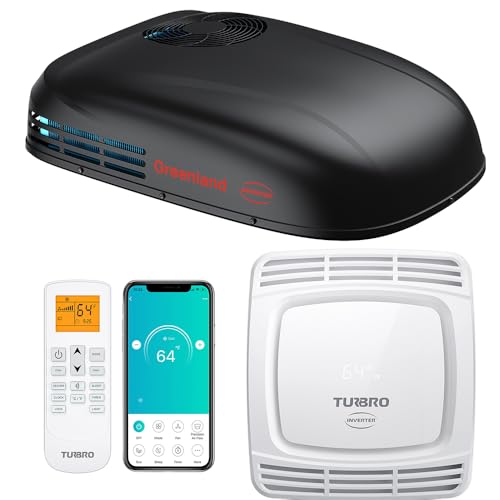
TURBRO inverter 13.5K non-ducted heat pump, 10 in thick
13,500 BTUInverterHeat pump10 in thick
Check price on Amazon
Best for: Large lithium and inverter systems cooling a full trailer.

A household-voltage unit only makes sense in a solar system with a large lithium bank and a big inverter, and the TURBRO is the one to choose in that case. Its inverter compressor, claimed to be up to 30 percent more efficient than non-inverter systems, modulates its speed to hold a setpoint, so the draw during the cruise is far below the startup value.

It gives 13,500 BTU of cooling and a heat pump in a unit about 10 inches thick, with fan and dry modes. Inverter losses are the cost: a 115V unit run through an inverter wastes some of the battery's energy as heat before it makes any cold.

It cools a trailer, which the 12V units cannot, but it needs a serious system behind it. Size the inverter for the startup, keep panels clean and wash the filter monthly.

What works

  • Inverter compressor with up to 30 percent efficiency claim
  • 13,500 BTU cools a full trailer
  • About 10 in thick profile
  • Heat pump included

Watch out for

  • Inverter losses waste some battery energy
  • Needs a large bank, inverter and array

Spec sheet

Capacity
13,500 BTU
Compressor
Inverter
Efficiency claim
Up to 30% over non-inverter
Thickness
10.0 in
Heating
Heat pump
06
RecPro RV 15K heat pump ducted or non-ducted, 110-120V
15,000 BTUHeat pump55.4 dB claimLow amp draw
Check price on Amazon
Best for: Big inverter systems that want a conventional ducted-or-not unit.

RecPro pitches this 15,000 BTU unit's low amp draw as suitable for off-grid and solar use, a claim worth reading as relative: low for a 15,000 BTU household-voltage compressor, not low next to a 12V inverter unit. It is the pick for an owner who already has a large inverter and bank and wants a conventional unit.

The ducted or non-ducted fit means one model suits many existing ceilings, and a built-in heat pump adds mild-weather warmth. A 55.4 dB noise claim is moderate. The listing gives no amp figure, so measure the running current with a clamp meter before sizing the array.

Compared with the TURBRO it has a fixed-speed compressor and a bigger capacity. Use a soft start with an inverter to avoid a startup spike, and wash the filter monthly.

What works

  • Low amp draw positioned for off-grid and solar
  • Ducted or non-ducted application
  • Built-in heat pump
  • 55.4 dB noise claim

Watch out for

  • No amp figure in the listing
  • Fixed-speed start stresses an inverter

Spec sheet

Capacity
15,000 BTU
Duct type
Ducted or non-ducted
Heating
Built-in heat pump
Noise claim
55.4 dB
Positioning
Low amp draw for off-grid and solar

Spec sheet decoder

What the numbers on the box really mean

The specs manufacturers lead with, translated into what they tell you about real-world performance.

kWh per hour

Kilowatt-hours per hour equals average power in kilowatts. It converts directly to watt-hours of battery per hour.

Watch forThe Countrymod's 0.3 equals 300 watts on average; its peak is 900.

Peak sun hours

A day's sunshine expressed as hours of full-intensity sun, used to size panels. It is lower in winter.

Watch forFour and a half is a typical planning figure, but your latitude and season change it.

Amp-hours and watt-hours

Amp-hours times volts equals watt-hours. A 480 amp-hour 12V bank holds about 5,760 watt-hours.

Watch forOutequip's 8 hours on 480 Ah implies about 700 watts average.

Inverter loss

Energy lost converting battery power to household voltage, plus a standby load.

Watch forThe TURBRO and RecPro need an inverter; the 12V units do not.

Heat pump saving claim

A maker comparison between heat pump heat and resistive heat, usually 65 percent or more less energy.

Watch forThe saving shrinks in cold air, which is when winter solar needs it most.

Methodology

How We Evaluated These Solar Powered Air Conditioners for RVs

Draw transparency

We rewarded units that state average or peak watts, led by the Countrymod's 300 to 900 watts and the Gidrox's 350 watt average. The Outequip's runtime claim let us estimate its draw. Units with no figure were marked down.

Efficiency per watt-hour

We compared compressor type and power path, favoring inverter 12V designs and noting inverter loss for 115V units. A unit that holds a setpoint at low speed uses less energy. Heat pumps scored over resistive heat.

System demands

We estimated the array and bank each unit implies. The Outequip's 480 Ah claim implies the largest bank. We flagged startup surges for inverter-fed units.

Winter practicality

We considered heat pump capacity and efficiency for low-sun months. The Gidrox's 9,000 BTU heat pump and the EROMMY's 6,120 BTU led. All were noted as limited in real cold.

Noise and control

We compared 40 to 55 dB claims and app control for scheduling around sun hours. Quiet claims scored in sleeping zones. App scheduling earned credit for solar users.

Decision guide

How to Choose the Right Solar Powered Air Conditioners for RVs

By Array Size

SituationPickWhy
About 400 watts of panelsEROMMY 10,000 BTUModest cooling and heat pump
About 600 watts of panelsGidrox 12,000 BTU350 watt average claim
Large array, big bankOutequip 10,000 BTUNeeds the 700 watt budget
Very large array and inverterTURBRO 13.5KInverter efficiency

By Budget

SituationPickWhy
Lowest outlayOutequip 10,000 BTUBasic 12V cooling
Mid-range, stated rangeCountrymod 10,000 BTU300 to 900W stated
Mid-range heat pumpEROMMY 10,000 BTUHeat pump on 12V
Premium system unitTURBRO 13.5KInverter heat pump

12V Unit vs Inverter-Fed Unit

12V unit

The Countrymod, Gidrox, EROMMY and Outequip run straight from the bank and avoid inverter loss. They cool vans and small campers.

Inverter-fed unit

The TURBRO and RecPro cool a full trailer but waste energy in the inverter and need a large system.

12V for vans and small rigs; inverter-fed only with a big lithium and inverter system.

Season

SituationPickWhy
Summer afternoonsCountrymod 10,000 BTUStated draw and app scheduling
Spring and fallGidrox 12,000 BTUEfficient heat pump
Winter solarEROMMY 10,000 BTUHeat pump, low load
Trailer in summerRecPro 15KLow amp for its size

For Weekend Solar Camping Specifically

Look for

A stated draw, app scheduling and a unit that fits a modest array and bank. Pre-cool while panels produce.

In this comparison

The Countrymod's app and range suit weekend use. The Gidrox's 350 watt average claim makes sizing simple.

When to Spend More

Spend more if

You live in the rig or camp in all seasons. The Gidrox and TURBRO repay in efficiency.

Save if

You camp occasionally. The Outequip or EROMMY does the job with a smaller system.

Ownership

Maintenance schedule

The upkeep that decides whether this machine lasts two seasons or ten.

TaskIntervalWhy it matters
Clean panelsMonthly in dusty campsDust can cut panel output by a noticeable fraction, which means less power for the air conditioner. A soft brush and water restore it.
Check battery and cutoffEvery seasonA bank run flat by an air conditioner ages fast. A working low-voltage cutoff protects the investment.
Inspect DC terminalsEvery seasonHigh-current lugs loosen with vibration. A warm terminal wastes the energy you worked to collect.
Wash filterEvery 3 to 4 weeksA clogged filter makes the unit run longer, drawing more watt-hours.
Log actual drawStart of each seasonA shunt reading or a clamp meter check confirms the real draw. Maker claims drift from your cabin's reality.

FAQ

Frequently Asked Questions

How many solar panels do I need to run an RV air conditioner?

It depends on draw and hours. A unit averaging 350 watts for six hours uses about 2,100 watt-hours, which wants roughly 500 to 600 watts of panels on a good sun day. Real needs vary with season and shade, and a roof with vents and fans leaves less room for panels than the math assumes, so ground-mounted panels are a common fix at a long camp.

Can I run an air conditioner directly from panels?

Not practically. The hours you need cooling are the hottest, and panels cannot supply the starting and running power directly without a bank to buffer it.

Is a 12V unit better for solar than a 115V unit?

Usually yes, because it avoids inverter loss and standby draw. A 115V unit only makes sense with a large lithium bank, a big inverter and a big array.

How big a battery bank do I need?

At least several hundred amp-hours for real use. A 100 amp-hour lithium bank holds roughly 1,280 watt-hours, only a few hours at 350 watts. Outequip's 8 hours claim used a 480 amp-hour bank.

Does a heat pump help in winter solar?

Yes, because it uses far less energy than a resistive heater. It still weakens in real cold, and winter sun hours are short, so keep a diesel or propane heater.

What is the cheapest way to cut air conditioning load?

Insulate and shade. Reflective window covers, parking in shade and sealing gaps cut the load more cheaply than any extra panel, and a roof vent fan run at night pulls out the heat the cabin stored during the day so the compressor starts the next afternoon from a lower baseline.

Bottom line

The short version

Browse more solar powered air conditioners for rvson Amazon →
James Miller, Lead Machine Editor

About the author

James Miller

Lead Machine Editor, MachineFanatic

James Miller leads MachineFanatic's buying guides, turning spec sheets, manuals and owner feedback into clear verdicts on power tools, outdoor power equipment, shop machines and kitchen machines.

More from James →

Keep reading

Related guides