
Amazon affiliate links - we earn a commission.Affiliate disclosure

Buying guide · 13 min read · Updated 2026-11-28

Best Stand Mixers Under $500 (2026)

Stand mixers under $500 compared on drive design, dough capacity, bowl size and build, from a belt-driven 6.5 qt bread machine to 7.5 qt tilt-heads.

James MillerBy James MillerLead Machine Editor5 machines comparedSpec-sheet verified
Best Stand Mixers Under $500

At a glance

Our top picks

Side by side

Spec comparison

At this budget a stand mixer stops being a toy and becomes a dough tool, but only if the drive design is right. The biggest split is between tilt-head machines that drive the beater from above and bottom-drive machines that spin the bowl from underneath, and that split decides how much dough each can really handle.

Quart ratings on the box overstate real dough capacity, and rated watts vary between brands, so gearing and drive design matter more than numbers. This guide ranks mixers that sit under the cap at listing prices when it was updated. Prices move, so check the live listing and the manual's flour limit before you commit.

Before you buy

6 Criteria to Look For Before Buying a Stand Mixer Under $500

  1. 01

    Drive design for dough

    Tilt-head mixers drive the beater from above, which creates leverage that flexes the head under stiff dough. Bottom-drive machines like the Bosch Universal Plus and NutriMill Artiste push dough against a fixed column, so they handle far more flour. The Bosch states up to 14 loaves and the NutriMill an 8 lb batch. If bread is the goal, this single choice matters more than wattage or bowl size. Tilt-heads such as the VEVOR and Aucma are better read as batter machines.

  2. 02

    Real dough capacity

    A bowl's quart rating overstates the dough it can knead, and the 7.5 qt on the 800 W unit will not take 7.5 quarts of dough. The maker's flour weight limit is the number to find. Stiff dough strains a tilt-head long before the bowl is full. Keep the batch below half the stated limit and run at the lowest speed. Buyers who read the quart number as a dough number end up with a hot motor and a stalled hook.

  3. 03

    Bowl material

    The Bosch uses a lightweight BPA-free plastic bowl, while the VEVOR uses SUS304 stainless and the Aucma uses stainless with handles. Stainless is durable and does not scratch, but it is heavier and can dent. Plastic is light and see-through but can scratch and cloud with age. A bowl with a handle is easier to lift when full. Check that replacement bowls are sold for the model, because a lost bowl ends a mixer's life.

  4. 04

    Motor watts versus gearing

    The 800 W tilt-head lists the highest watts, but rated watts vary between brands and say little about torque. A 500 W belt-driven Bosch can outwork a plastic-geared 800 W tilt-head on dough. Metal gears outlast plastic ones, and a hot motor housing during a long knead signals strain. Compare the drive design and the maker's dough claim, not wattage alone.

  5. 05

    Speed range and control

    More speeds give finer control for meringue and whipped cream. The 800 W unit lists twelve speeds with a display, the VEVOR lists six with a pulse button, and the Aucma lists six. A knob is simple and durable, while a digital panel adds a failure point. A soft start reduces flour clouds. If you whip often, choose a model with a slow first speed.

  6. 06

    Parts, warranty and support

    At this price you are buying a machine you will own for years, so spare parts matter. Bosch has a long record of selling bowls, dough hooks and drive belts. NutriMill, VEVOR and Aucma have smaller networks, and the 800 W unit gives little support information at all. Read the warranty length and register the machine. A mixer with no source of replacement hooks becomes waste after one broken part. Before buying, search the model name together with words like replacement bowl, dough hook and drive belt, and note how many sellers actually stock each part. Ask what happens if the motor fails in year two, since a repair quote that exceeds half the purchase cost usually ends in a landfill. The Bosch and NutriMill share a common bottom-drive layout, so accessories for that style are easier to find than parts for a one-off tilt-head. Keep the box and receipt for the first year, because a mixer that arrives with a wobbling head or a noisy gear train is far easier to return than to repair. Also check whether the warranty covers a plastic housing crack, which is the most frequent failure on budget machines used for dough.

Detailed reviews

The 5 best stand mixers under $500, explained

01
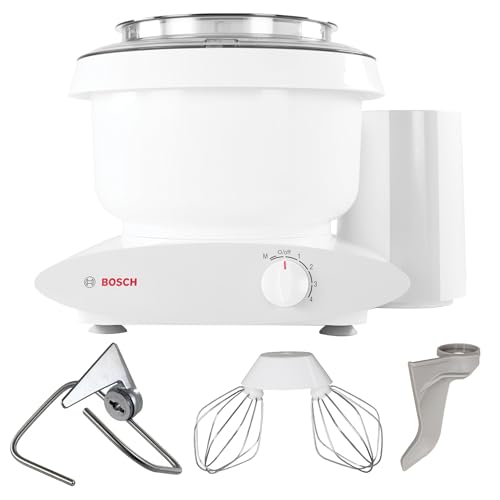
Bosch Universal Plus 6.5 qt 500W belt-drive mixer bundle
6.5 qt bowl500 WBelt driveUp to 14 loaves
Check price on Amazon
Best for: Serious bread bakers who knead several loaves at a time.

The Universal Plus is a different animal from the tilt-head mixers, because the drive sits under the bowl and a belt-driven transmission delivers torque to a tall central column. The maker states it can knead up to 14 loaves of dough at once, a claim that comes from the low, wide bowl and the way dough is pushed against the column instead of a hook swinging overhead. Dual beaters give a whipping action that handles as little as one egg white.

The bowl is lightweight BPA-free plastic with an easy-grip handle and a removable drive shaft for cleaning. That plastic is a tradeoff against a stainless bowl, because it can scratch and cloud over years, but it also keeps the weight down. Against the NutriMill Artiste below, which uses a similar bottom-drive layout, the Bosch is the original design, and the belt drive is the main reason to choose it for bread. The VEVOR is bigger on paper but is a tilt-head that will not match the Bosch for stiff dough.

Ownership is mostly about the belt and the bowl: keep the bowl dry, remove the drive shaft to clean it and do not exceed the stated flour limit. The listing is a bundle that includes a dough hook extender, which helps with small batches.

What works

  • Belt-driven bottom drive built for stiff dough
  • Stated capacity of up to 14 loaves of dough
  • Removable drive shaft for easy cleaning
  • Dual beaters whip small amounts like one egg white

Watch out for

  • Plastic bowl can scratch and cloud over time
  • Tall central column is awkward for small batches

Spec sheet

Bowl
6.5 qt plastic, BPA free
Motor
500 W, belt-driven
Drive
Bottom drive, bowl on pedestal
Dough claim
Up to 14 loaves stated
Includes
Wire whips, dough hook, extender
02
NutriMill Artiste 6.5 qt 500W bottom-drive stand mixer
6.5 qt bowl500 WBottom drive8 lb dough batch
Check price on Amazon
Best for: Bakers who want a bottom-drive dough machine at a modest premium.

NutriMill takes the bottom-drive route too, with a 500 watt motor that delivers power directly through the base. The maker says this outperforms tilt-heads, and the logic is sound: a motor that pushes dough against a fixed column does not have to resist the leverage of an overhead hook. A stated dough batch of eight pounds is a more modest claim than the Bosch, and a more believable one for a home kitchen.

The listing includes an easy-open cover, an extended-length dough hook and wire whips, which makes it a complete package. Compared with the Bosch, the Artiste targets the same buyer and offers a similar capacity at a different brand name, so the choice rests on parts availability and warranty. Compared with the Aucma tilt-head, it is easier to knead in because the head does not lift and lock.

Ownership follows the bottom-drive pattern. Keep flour out of the base, wipe the column after each batch and avoid overfilling. The extended hook is the part to inspect first if you ever hear a rattle.

What works

  • Direct bottom drive resists dough leverage
  • Includes an easy-open bowl cover
  • Extended-length dough hook for small batches
  • Stated 8 lb dough batch is a believable figure

Watch out for

  • Brand has a smaller parts and support network
  • Tall column makes small batches awkward

Spec sheet

Bowl
6.5 qt with easy-open cover
Motor
500 W
Drive
Direct bottom drive
Dough claim
Batches of 8 lb stated
Includes
Dough hook, wire whips, cover
03
VEVOR 7.4 qt 500W tilt-head stand mixer, 6 speeds
7.4 qt bowl500 W6 speeds + pulseSUS304 bowl
Check price on Amazon
Best for: Large-batch cookie and cake bakers who prefer a stainless bowl.

VEVOR sells the biggest tilt-head bowl in this lineup, 7.4 quarts of SUS304 stainless steel, with a 500 watt motor, six speeds, a pulse control and a splash guard. The knob interface is simple, which suits anyone who finds a digital panel fussy. For batters and large cookie batches the capacity is excellent.

Tilt-head leverage is still the limit. The head flexes under a heavy dough load, so the 7.4 quart bowl is better read as room for batters than for stiff dough. Against the Bosch, you get a larger bowl and a stainless finish but a weaker drive for bread. Against the 800 watt unit below, the motor is lower on paper and the speed range is shorter.

Ownership is simple. Hand wash the bowl, store the whisk and hook inside it and keep the batch under half the flour limit for dough. A heavy tilt-head at this size needs a firm counter, so check the rubber feet.

What works

  • Largest stainless bowl in the group at 7.4 qt
  • Simple knob control with pulse function
  • Splash guard included in the kit
  • 500 W motor has headroom for heavy batters

Watch out for

  • Tilt head flexes under stiff dough loads
  • Only six speeds limits fine whipping control

Spec sheet

Bowl
7.4 qt SUS304 stainless
Motor
500 W
Speeds
6 plus pulse
Control
Simple knob
Style
Tilt head with splash guard
04
800W 7.5 qt 12-speed digital tilt-head stand mixer
7.5 qt bowl800 W12 speedsDigital display
Check price on Amazon
Best for: Buyers who want a large bowl with a digital readout of speed.

This unbranded-feeling machine leads on the spec sheet, with an 800 watt motor, a 7.5 quart bowl and twelve speeds shown on a digital display. The planetary action reaches 360 degrees around the bowl for scratch-free mixing. A splash guard keeps flour in the bowl at low speed.

The 800 watt figure is the highest in the group, but rated watts are inconsistent across brands and say little about gearing. Against the Bosch's 500 watt belt drive, the tilt-head delivers more numbers and less dough capability in practice. Against the VEVOR, it gives finer speed control, since twelve speeds beat six for whipping.

Ownership needs caution. Little is stated about the gear train or the warranty, so keep the receipt and avoid stiff dough. Run it at low speeds for kneading and let it rest.

What works

  • Highest stated motor wattage at 800 W
  • Digital display shows the speed setting
  • Twelve speeds suit whipping and folding
  • Splash guard included in the box

Watch out for

  • Gear train and warranty are poorly documented
  • Large tilt head flexes with stiff dough

Spec sheet

Bowl
7.5 qt
Motor
800 W
Speeds
12, digital display
Action
360 degree planetary
Extras
Splash guard
05
Aucma 6.5 qt 660W tilt-head stand mixer
6.5 qt bowl660 W6 speedsCopper motor
Check price on Amazon
Best for: Budget-minded bakers who want a large bowl at the lowest cost.

Aucma is the lowest-cost route to a 6.5 quart bowl in this group. It pairs a 660 watt pure copper motor with six speeds and a stainless bowl with handles. The tilt head swings up to release the bowl and attachments.

It sits between the VEVOR and the Bosch on bowl size, though it lacks the Bosch's drive design. If you want bread dough capability, the Bosch or NutriMill is the better pick, and if you want the cheapest large bowl, the Aucma wins. ABS housing keeps the weight down and the vibration up.

Keep the load below half the stated flour limit and run dough at low speed. Spare attachments are difficult to source.

What works

  • Cheapest 6.5 qt bowl in the group
  • 660 W copper motor with six speeds
  • Stainless bowl with side handles
  • Tilt head makes bowl changes simple

Watch out for

  • ABS housing vibrates and walks at speed
  • Weaker drive design than the bottom-drive picks

Spec sheet

Bowl
6.5 qt stainless
Motor
660 W copper
Speeds
6 optimized speeds
Housing
ABS plastic
Style
Tilt head

Spec sheet decoder

What the numbers on the box really mean

The specs manufacturers lead with, translated into what they tell you about real-world performance.

Bottom drive vs tilt-head

A bottom drive turns the dough against a fixed column, while a tilt-head swings a beater from above. Bottom drive handles more dough.

Watch forThe Bosch and NutriMill are bottom-drive, and the VEVOR, Aucma and 800 W unit are tilt-heads.

Bowl quarts

Quarts state bowl volume, not dough capacity. Real dough capacity is about half.

Watch forThe 800 W unit lists 7.5 qt and the VEVOR 7.4 qt, but neither is a dough machine.

Motor watts

Watts state electrical draw, not torque at the hook. Gearing and winding decide real power.

Watch forThe 800 W unit lists 800 W and the Bosch lists 500 W.

Belt-driven transmission

A belt transmits torque smoothly and absorbs shock, which suits dough. It wears and is replaceable.

Watch forOnly the Bosch states a belt-driven transmission.

Speeds and pulse

More speeds give finer control, and a pulse button gives short bursts.

Watch forThe 800 W unit lists 12 speeds, and the VEVOR lists 6 plus pulse.

Methodology

How We Evaluated These Stand Mixers Under $500

Drive design

We sorted the five machines by bottom-drive or tilt-head layout, since that sets dough capability. The Bosch and NutriMill led. Tilt-heads scored as batter machines.

Stated dough capacity

We read the maker's flour or loaf claims against the bowl size. The Bosch at up to 14 loaves and the NutriMill at 8 lb set the range. Quart ratings were discounted.

Motor and build

We compared stated wattage, motor type and housing material. The Aucma lists a copper motor and ABS housing. The 800 W unit scored cautiously for thin gearing detail.

Speed control

We compared speed counts, pulse buttons and displays. The 800 W unit at 12 speeds led. The VEVOR's simple knob scored for durability.

Parts and support

We considered brand parts networks and warranty clarity. Bosch led for belts and bowls. Smaller brands scored cautiously.

Decision guide

How to Choose the Right Stand Mixers Under $500

By Baking Use

SituationPickWhy
Several loaves of bread a weekBosch Universal PlusA belt-driven bottom drive built for dough
Whole grain and large dough batchesNutriMill ArtisteA direct bottom drive with a stated 8 lb batch
Cookies and cakes in big batchesVEVOR 7.4 qtThe largest stainless bowl and a 500 W motor
Meringue and fine whipping800 W 7.5 qt digitalTwelve speeds with a display

By Budget

Budget tierPickWhy
Lowest outlayAucma 6.5 qtThe cheapest large bowl in the group
MiddleVEVOR 7.4 qtA big stainless bowl at a moderate cost
Near the capBosch Universal PlusThe best dough machine for the money

Bottom-Drive vs Tilt-Head

Bottom drive

The Bosch and NutriMill push dough against a column, which resists leverage. They knead several loaves but are awkward for tiny batches.

Tilt-head

The VEVOR, Aucma and 800 W unit are easy to access and good for batters. Their heads flex with stiff dough.

Bread bakers pick the Bosch, and batter bakers pick the VEVOR.

Bowl and Build

PreferencePickWhy
Stainless bowlVEVOR 7.4 qtSUS304 stainless does not scratch or cloud
Light plastic bowlBosch Universal PlusA lightweight BPA-free bowl with a grip handle
Bowl coverNutriMill ArtisteAn easy-open cover is included
Splash guard800 W 7.5 qt digitalA splash guard keeps flour in at low speed

For Whole Grain Bread Specifically

Look for

A bottom drive, a real dough claim and metal gears. Whole grain dough is dense and stiff, so a tilt-head will strain.

In this comparison

The Bosch and NutriMill are the credible choices. The Aucma and 800 W unit should be limited to a single small loaf.

When to Spend More

Spend more if

You bake bread weekly. The Bosch earns its premium with belt drive and a stated 14 loaf capacity.

Save if

You mix batters. The Aucma or VEVOR gives a large bowl at lower cost.

Ownership

Maintenance schedule

The upkeep that decides whether this machine lasts two seasons or ten.

TaskIntervalWhy it matters
Clean the drive shaftAfter each dough batchDried dough in the shaft makes it hard to remove. Lift it out and wash it.
Wipe the base and columnAfter each useFlour dust works into vents and seals. A damp cloth is enough.
Check the belt or gearingYearlyA belt wears and slips on heavy dough. Replace it at the first sign of slipping.
Inspect the bowlEvery few monthsCracks in plastic bowls and dents in stainless bowls affect fit. Replace a damaged bowl.
Rest the motorAfter 5 minutes of kneadingMotors overheat on stiff dough. Let the housing cool.

FAQ

Frequently Asked Questions

Is a bottom-drive mixer better than a tilt-head?

For bread dough, yes, because the drive resists leverage. For batters and whipping, a tilt-head is easier to use. The Bosch and NutriMill are bottom-drive and the rest here are tilt-heads.

How much should I spend on a stand mixer?

The models here sit under the $500 cap at listing prices when the guide was updated, and prices move. More money buys drive design and parts support. Batter bakers can spend less.

How long do these mixers last?

A belt-driven Bosch can last many years with replaceable belts and bowls. Plastic-geared tilt-heads wear sooner under dough. Keep batches below the flour limit.

Do 800 watts beat 500 watts?

Not necessarily. Gearing and drive design decide real kneading power. A 500 W belt-driven machine can outwork an 800 W tilt-head on dough.

Can I knead whole wheat dough in a tilt-head?

Only in small batches at low speed. The head flexes and the motor heats up. Use a bottom-drive machine for regular whole grain bread.

Is a plastic bowl a problem?

It is lighter and cheaper, but it can scratch and cloud over years. Stainless lasts longer but is heavier. Check that a replacement bowl is sold.

Bottom line

The short version

Browse more stand mixers under $500on Amazon →
James Miller, Lead Machine Editor

About the author

James Miller

Lead Machine Editor, MachineFanatic

James Miller leads MachineFanatic's buying guides, turning spec sheets, manuals and owner feedback into clear verdicts on power tools, outdoor power equipment, shop machines and kitchen machines.

More from James →

Keep reading

Related guides