
Amazon affiliate links - we earn a commission.Affiliate disclosure

Buying guide · 13 min read · Updated 2026-11-25

Best Tankless RV Water Heaters (2026)

Five on-demand RV water heaters compared on retrofit effort, door size, burner rating and winter handling, from 42,000 BTU budget units to a 66,000 BTU model.

James MillerBy James MillerLead Machine Editor5 machines comparedSpec-sheet verified
Best Tankless RV Water Heaters

At a glance

Our top picks

Side by side

Spec comparison

A tankless RV water heater trades stored water for a burner that fires only when a tap opens. The upside is endless hot water and a smaller footprint than a tank. A weakness is that everything has to work in the first few seconds: flow, gas, spark, fan and exhaust.

That makes retrofit planning more important than the brochure. Door size, exhaust spacing, battery health and how you drain the unit before freezing weather decide whether a tankless conversion feels like an upgrade or a repair job. This guide ranks five units on those practical points.

Before you buy

6 Criteria to Look For Before Buying a Tankless RV Water Heater

  1. 01

    Mixing tank or no mixing tank

    A small buffer volume evens out temperature when flow changes, which is the difference between a smooth shower and a cold sandwich. The FOGATTI InstaShower 9 Pro includes one, while the 8 Plus and the RVPart Pro rely on the burner alone. If your rig has a weak or cycling pump, the buffer helps. If you shower at a steady flow, the difference is smaller. Owners often notice it most when a toilet fills or a second sink opens, because the sudden drop in flow can briefly starve a bare burner of the water it needs to hold its setpoint.

  2. 02

    Burner capacity for your climate

    Burner size sets the temperature rise at a given flow. The 66,000 BTU 9 Pro and 61,000 BTU generic unit lead, the RVPart Pro sits at 60,000 BTU and the VEVOR is at 42,000 BTU. A warm-climate couple can live with 42,000 BTU; a family in winter needs 60,000 or more. Do not buy on the largest number alone, because exhaust and gas supply must support it. A 66,000 BTU burner on a marginal regulator behaves like a 40,000 BTU one, and a long gas hose with small fittings has the same effect.

  3. 03

    Cutout and door options

    Most coaches have a 15 by 15 inch opening, but older rigs vary. The 8 Plus offers three door sizes, and the 9 Pro, VEVOR and generic 61,000 BTU unit use 15 by 15 inch doors. Measure the opening and compare the exhaust clearance before ordering. A tight fit usually means trimming, sealing and weather-proofing work, and a loose fit lets rain and wasps into the cabinet. Photograph the old unit, its gas inlet and its flue before you pull it, so you can match them when the new one goes in.

  4. 04

    Altitude behavior

    Thin air reduces burner output, so heaters that state a rating matter above a few thousand feet. The 8 Plus lists readiness to about 9,800 feet and the generic 61,000 BTU unit states stable operation to the same height. Check that the maker names the altitude and whether a mode or a jet change is needed.

  5. 05

    12V draw and fan type

    Fans and boards need steady power, and long showers add up on a small battery bank. The RVPart Pro uses a brushless fan, which draws less current than a brushed one. Verify battery health and wire gauge before you swap, because a poor ground or voltage drop makes a good unit act broken. A heater that runs fine in the driveway on shore power can sulk at a remote site where the battery sits at 12.2 volts and the lead is undersized.

  6. 06

    Winter drain procedure

    A tankless exchanger holds little water but it can still split from a hard freeze. Every unit here needs a complete drain and a bypass plan. Write the steps and keep them in the cabinet, since the most common tankless failure is not a defect but a missed winterizing step. If you live where a surprise freeze is possible, a low-point drain and a quick-connect blow-out fitting make the job a two-minute habit instead of a chore you postpone.

Detailed reviews

The 5 best tankless rv water heaters, explained

01
FOGATTI InstaShower 9 Pro 66,000 BTU tankless with mixing tank
66,000 BTUMixing tank15x15 inch doorPropane
Check price on Amazon
Best for: Owners who want smooth temperature and a modern retrofit in a standard cutout.

The 9 Pro is the third generation of the InstaShower line and the most capable FOGATTI here, with a 66,000 BTU burner and a built-in mixing tank. That tank acts as a small buffer, so the temperature at the shower head wanders less when a faucet elsewhere opens or closes. The maker describes it as an easy retrofit with a 15 by 15 inch door, which matches the cutout many coaches already carry.

The mixing tank is also the reason to pick it over the 8 Plus. A bare tankless unit can swing from warm to cold when flow changes, while this design smooths the result. The tradeoff is a more complex machine with more parts to fail, and it still needs 12V power, steady propane pressure and a fully drained exchanger before freezing weather.

In ownership, treat it like a small appliance with a service routine. Check the exhaust screen each spring, descale the exchanger if your water is hard and confirm the regulator keeps pressure under load. A written winterizing checklist matters more here than on a tank, because a cracked exchanger is an expensive lesson.

What works

  • Built-in mixing tank steadies temperature swings
  • 66,000 BTU burner for strong output
  • 15 x 15 inch retrofit design
  • Latest generation of a well-known tankless line

Watch out for

  • More components than a simple tankless
  • Needs steady propane pressure and 12V power
  • Heat exchanger must be drained fully in winter

Spec sheet

Burner
66,000 BTU propane
Mixing tank
Built in
Door
15 x 15 inch retrofit
Generation
Third generation InstaShower
Power
12V DC
02
FOGATTI InstaShower 8 Plus propane tankless, 3 door sizes
12V DCAltitude ready3 door sizesPropane
Check price on Amazon
Best for: Mountain campers with a non-standard cutout.

The InstaShower 8 Plus is the middle child of the FOGATTI family, listed as ready for altitude up to about 9,800 feet and available with three door size options. That combination makes it useful when your cutout is not quite standard and when you camp in the mountains. The maker also claims that it keeps heating for a long stretch without stopping, which is a statement about continuous operation rather than a measured result.

One limit is that it lacks the built-in mixing tank of the 9 Pro, so temperature steadiness depends more on how your plumbing and faucets behave. It is also an older generation, which can mean a lower burner rating than the newest model. If you want the smoothest shower, the 9 Pro is the better fit, and if you want the most flexible door options, the 8 Plus is.

Expect the usual tankless homework: confirm the opening, check the flue clearance, run a trial before a trip and drain the exchanger in winter. Keep the manual, because door and gasket sizes differ across the three options.

What works

  • Three door sizes for odd cutouts
  • Listed as ready for roughly 9,800 feet
  • 12V DC ignition and controls
  • Established FOGATTI tankless lineage

Watch out for

  • No built-in mixing tank
  • Older generation than the 9 Pro
  • Winter drain procedure is mandatory

Spec sheet

Fuel
Propane
Power
12V DC
Altitude
Rated to about 9,800 feet
Doors
Three size options
Color
Black
03
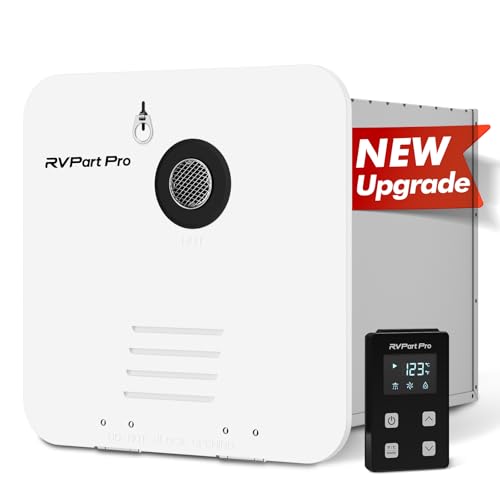
RVPart Pro 60,000 BTU propane tankless with remote
60,000 BTURemoteBrushless fanCopper exchanger
Check price on Amazon
Best for: Owners who like remote setpoint control and a quieter fan.

The RVPart Pro pairs a 60,000 BTU burner with an oxygen-free copper heat exchanger, a brushless fan and a remote, all behind a white door. The brushless fan is the detail that matters on a small battery bank, since it draws less current than a brushed motor and tends to run quieter. The remote lets you change the setpoint without standing at the panel.

The real cost is that 60,000 BTU is a mid-tier burner, a notch below the 65,000 and 66,000 BTU units in this guide. In winter or at higher flow rates the temperature rise is smaller, so it suits a milder climate or a lighter shower habit. The brand is newer than Suburban and Dometic, so replacement parts arrive by shipping rather than from a local counter.

Treat the remote as a convenience, not a safety device, and keep the wall panel accessible. Verify that the door color and size match your coach, descale in hard water and drain fully before winter.

What works

  • Brushless fan reduces current and noise
  • Remote control for setpoint changes
  • Oxygen-free copper heat exchanger
  • 60,000 BTU burner in a standard door

Watch out for

  • Burner is a step below the 65,000 BTU class
  • Newer brand with shipped parts
  • Remote adds a battery to maintain

Spec sheet

Burner
60,000 BTU
Exchanger
Oxygen-free copper
Fan
Brushless
Control
Remote included
Door
White
04
61,000 BTU propane tankless RV heater, 15x15 white door
61,000 BTU12V DC9,800 ft ratingWhite door
Check price on Amazon
Best for: Budget-focused mountain campers who need a 15 inch class door.

This unbranded-looking model packs a 61,000 BTU burner, a built-in control panel and a statement of stable operation at altitudes up to 9,800 feet. It uses a 15 by 15 inch white door and 12V DC power, which are the standard conditions for most replacements. The listing frames it as the choice for mountain trips.

The tradeoff with a less recognized label is support. Setup instructions, parts and warranty handling vary, so check the seller before you commit. It also lacks the mixing tank of the FOGATTI 9 Pro and the remote of the RVPart Pro, so you get the basics of a tankless heater with an altitude claim.

Use it where you value burner headroom over extras. Check regulator pressure, keep the exhaust path clear and drain the exchanger before freezing. If you do hit a problem, a documented parts list and an easy contact point matter more than the marketing.

What works

  • 61,000 BTU burner with altitude claim
  • Standard 15 x 15 inch door
  • Built-in control panel
  • 12V DC power with no standing pilot

Watch out for

  • Less recognized brand and support
  • No mixing tank or remote
  • Parts and warranty depend on the seller

Spec sheet

Burner
61,000 BTU
Power
12V DC
Altitude
Stable to about 9,800 feet
Door
15 x 15 inch, white
Control
Built-in panel
05
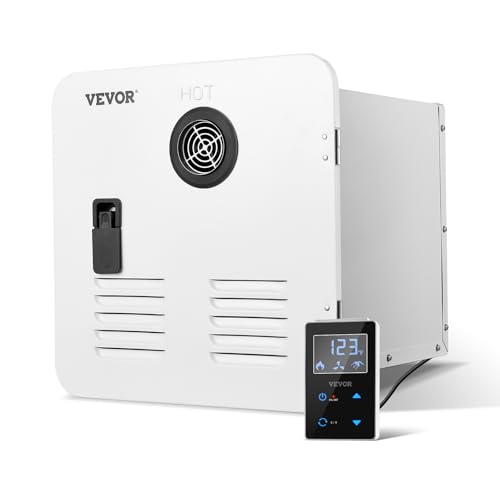
VEVOR 42000 BTU propane tankless RV heater
42,000 BTULED touch panelSegmented burnerWhite door
Check price on Amazon
Best for: Mild-climate couples testing tankless without a big commitment.

VEVOR lists this 42,000 BTU propane heater with a 15 by 15 inch white door and touch controls. Segmented combustion adjusts burner stages as the season changes, and the LED panel makes setpoint changes straightforward. As the lowest-output heater here, it is the entry point for owners who want to try on-demand heating.

The tradeoff is temperature rise. A 42,000 BTU burner can raise water less than the 60,000 to 66,000 BTU units, so cold inlet water in winter will stretch it. That is fine for a couple in a warm climate and a poor choice for a large family traveling in snow.

The usual rules apply. Confirm door and exhaust fit, keep the battery healthy, descale if the water is hard and drain fully before winter. If you outgrow it, the larger VEVOR variant keeps the same door size, which simplifies an upgrade.

What works

  • Lowest burner rating, easy on gas use
  • Touch panel and LED display
  • 15 x 15 inch door fits common cutouts
  • Segmented combustion adapts to the season

Watch out for

  • Smaller temperature rise in cold weather
  • Thinner support network
  • Not ideal for large households

Spec sheet

Burner
42,000 BTU
Door
15 x 15 inch, white
Control
LED touch panel
Combustion
Segmented
Use
Everyday RV travel

Spec sheet decoder

What the numbers on the box really mean

The specs manufacturers lead with, translated into what they tell you about real-world performance.

Mixing tank

A small buffer volume that blends hot and cold water to smooth the output. It reduces temperature swings when flow changes.

Watch forOnly the InstaShower 9 Pro in this lineup includes one.

BTU

BTU is the burner heat output per hour. Higher output allows a bigger temperature rise at the same flow.

Watch forCompare 42,000, 60,000, 61,000 and 66,000 BTU units against your winter inlet temperature.

Altitude rating

Maker statement of the elevation where combustion stays stable. It is a design claim, not a guarantee at every site.

Watch forThe 8 Plus and the 61,000 BTU unit both cite about 9,800 feet.

Brushless fan

A motor without brushes that wears less and draws less current. It is generally quieter.

Watch forRVPart Pro lists a brushless fan.

Door size

The exterior panel that sets the cutout you need. Replacements must match or require modification.

Watch forThe 8 Plus offers three sizes while others list 15 x 15 inch.

Methodology

How We Evaluated These Tankless RV Water Heaters

Retrofit ease

We looked at door sizes and the language about drop-in replacements. Units that name several door sizes or standard 15 by 15 inch openings scored better. A retrofit that needs carpentry earns less.

Output and steadiness

We compared BTU ratings from 42,000 to 66,000 and whether a mixing tank is included. Steadiness mattered as much as peak heat. Maker figures were treated as claims, and where two listings used different test conditions we did not compare them as if they were equal. A burner with a modest number and good steadiness can beat a bigger one that hunts.

Power and noise

We considered 12V needs and fan design, noting the brushless fan on the RVPart Pro. Lower draw helps small battery banks. Noise was judged from fan type rather than decibel claims.

Altitude and climate fit

We checked which listings state altitude ratings and which depend on seasonal combustion adjustment. Mountain owners need those claims; flat-land owners care less.

Support and parts

We weighed brand recognition and seller documentation based on owner feedback patterns. Well-known lines like FOGATTI scored higher than anonymous listings, because a manual, a parts diagram and a reachable support line are part of what you are buying.

Decision guide

How to Choose the Right Tankless RV Water Heaters

By Climate

SituationPickWhy
Warm climate, short showersVEVOR 42000 BTUSmaller burner is enough
Four seasons, familyFOGATTI InstaShower 9 Pro66,000 BTU plus mixing tank
Mountain campingFOGATTI InstaShower 8 PlusRated to about 9,800 feet
Mild climate with quiet preferenceRVPart Pro 60,000 BTUBrushless fan

By Budget

TierPickWhy
LowestVEVOR 42000 BTUEntry burner
Value61,000 BTU unitHigher burner at a lower tier
MidRVPart Pro 60,000 BTURemote and brushless fan
UpperFOGATTI InstaShower 9 ProMixing tank and newest generation

With vs Without a Mixing Tank

With

The InstaShower 9 Pro buffers flow changes, so the shower stays steadier when another tap opens. It is more complex but friendlier to weak pumps.

Without

The 8 Plus, RVPart Pro, 61,000 BTU unit and VEVOR depend on the burner alone, which is simpler but more sensitive to flow swings.

Choose the buffer if your pump pulses or two people shower together; skip it for simplicity.

Door and Cutout Axis

PreferencePickWhy
Odd cutout sizesFOGATTI InstaShower 8 PlusThree door options
Standard 15 x 15 inchFOGATTI InstaShower 9 ProRetrofit design
White door match61,000 BTU unitWhite 15 x 15 inch door
Control from insideRVPart ProRemote included

For Full-Timers Specifically

Look for

A strong burner, a steady output and a parts route that does not stall. Winter use makes burner size and drain discipline critical.

In this comparison

The FOGATTI InstaShower 9 Pro combines 66,000 BTU with a mixing tank, which suits daily showers better than the VEVOR 42000 BTU.

When to Spend More

Spend more if

You shower daily or travel in cold weather. The 9 Pro's burner and mixing tank reduce day-to-day friction.

Save if

You camp occasionally in warm weather. The VEVOR 42000 BTU gives on-demand heat without the premium.

Ownership

Maintenance schedule

The upkeep that decides whether this machine lasts two seasons or ten.

TaskIntervalWhy it matters
Clean exhaust screenEvery springInsects and debris restrict airflow and cause poor combustion. A quick brush clears the screen.
Descale heat exchangerYearly in hard waterScale narrows passages and lowers flow. A mild descaling flush restores output.
Check regulator pressureEvery yearA tired regulator starves the burner on the very first shower of the trip.
Drain and bypassBefore freezing weatherEven a small amount of water in the exchanger can crack it. Follow the maker drain steps.
Test battery voltageEach seasonFan and board need steady 12V. A weak battery makes a healthy heater seem faulty.

FAQ

Frequently Asked Questions

Is tankless worth it for an RV?

It is worth it if you want endless hot water and cabinet space and your plumbing supports good flow. It is less worth it if you have a weak pump or winterize carelessly, because the unit depends on both.

What does a mixing tank do?

It acts as a small buffer that blends hot and cold water so the temperature does not swing when flow changes. The InstaShower 9 Pro includes one.

How much BTU do I need?

A 42,000 BTU class unit suits mild climates, while 60,000 to 66,000 BTU handles most families and winter inlet water. Gas supply and exhaust must support the larger numbers.

Can I replace a tank heater myself?

Many owners can, but gas, exhaust and cabinet fit matter. Verify the door size, follow the instructions and leak-check every fitting.

What happens at high altitude?

Thin air reduces burner output, so heaters with stated altitude ratings like the 8 Plus perform better in the mountains.

Why is my water cold for a few seconds?

A tankless burner needs a moment to light and heat the exchanger, and water already in the pipes must clear. A mixing tank reduces the effect, and a short run from the heater to the shower also helps. If the delay is longer than half a minute, check for a long cold line, a restricted showerhead or a low flow that barely trips the flow sensor.

Bottom line

The short version

Browse more tankless rv water heaterson Amazon →
James Miller, Lead Machine Editor

About the author

James Miller

Lead Machine Editor, MachineFanatic

James Miller leads MachineFanatic's buying guides, turning spec sheets, manuals and owner feedback into clear verdicts on power tools, outdoor power equipment, shop machines and kitchen machines.

More from James →

Keep reading

Related guides