
Amazon affiliate links - we earn a commission.Affiliate disclosure

Buying guide · 12 min read · Updated 2026-11-13

Best 1000W Car Power Inverters (2026)

Five 1000W 12V car power inverters compared on waveform, outlet layout, fan design and battery connection, so you pick one that fits your vehicle.

James MillerBy James MillerLead Machine Editor5 machines comparedSpec-sheet verified
Best 1000W Car Power Inverters

At a glance

Our top picks

Side by side

Spec comparison

A car inverter in this size class is a real electrical appliance, not a gadget that plugs into the dashboard. It pulls far more current than any factory socket can deliver, so it has to be wired to the battery with proper cable and a fuse.

What separates a good one from a frustrating one is rarely the headline wattage. Waveform quality, cooling design, outlet spacing and the protection circuit decide whether it runs a blender, a tool charger or a small fridge without drama.

Before you buy

6 Criteria to Look For Before Buying a 1000W Car Power Inverter

  1. 01

    Waveform: pure or modified sine

    A modified sine wave is a stepped approximation of grid power, and it is fine for resistive loads like a heater or a lamp. Motors, audio gear and some laptop bricks run hotter or buzz on it. Of the five units here, the Landerpow 1000W and the Jlouneo 1000W are the pure sine designs, while the VEVOR 1000W is the only one that states modified sine. Buy pure sine if any motor or sensitive electronics is on your list.

  2. 02

    Continuous versus surge watts

    The continuous number is the real rating, and the surge number only covers a brief startup spike of a second or two. Every unit in this guide quotes 2000W peak against 1000W continuous, so none of them gains an edge there. Inrush loads such as compressors can demand two to three times running watts, so a 400W compressor fits the Landerpow comfortably but a 700W one will trip the surge limit.

  3. 03

    Battery cable and fuse size

    At 12V, 1000W draws about 90 to 100A once efficiency losses are counted. That means short, thick cables and a fuse near the battery, sized above the full-load draw. A thin cable drops volts, and the inverter can shut down on low voltage even with a healthy battery. The LCD on the 1000W LCD unit shows that sag as it happens.

  4. 04

    Outlets and USB layout

    Count the devices you actually plug in at once. The Landerpow has three AC outlets, while the Bestek and the LCD unit have two, which is enough for a laptop and a charger but not a laptop, a lamp and a tool charger. The Bestek adds an 18W USB-A port beside its 30W USB-C port, and the LCD unit's 36W USB-C port is the strongest charging port in the group.

  5. 05

    Battery type and engine state

    A starter battery is built to deliver a short burst, not to be drained. Running 1000W with the engine off will flatten it in minutes, and a low-voltage alarm near 10.5V is the warning to start the car. The VEVOR lists compatibility with lithium and AGM banks, which suits a camper with a deep-cycle battery far better than a lone starter battery.

  6. 06

    Cooling and noise

    Conversion efficiency of 85 to 92 percent means the rest becomes heat. The Landerpow quotes above 91 percent, so it wastes less than a typical unit at full load. The Bestek uses two fans, which helps cool but adds noise and a dust-trapping part. A fan that is audible inside a cab can be the deciding factor on a long drive.

Detailed reviews

The 5 best 1000w car power inverters, explained

01
Landerpow 1000W pure sine inverter, 3 AC outlets
1000W continuous2000W surgePure sine wave30W USB-C PD
Check price on Amazon
Best for: Drivers who want clean power for a laptop, tool chargers and a small appliance from one box.

Landerpow builds this unit around a pure sine output and quotes efficiency above 91 percent, which is a respectable figure for a 12V design in this class. Clean output matters more here than on a small plug-in unit, because a 1000W inverter is the one people use for motor loads such as a cordless-tool charger bank, a small compressor or a laptop brick with a sensitive power supply.

The three AC outlets are the practical differentiator. Most 1000W units in this lineup offer two, and a third lets a laptop charger, a lamp and a tool charger share the box without a power strip dangling off one socket. The 2000W surge rating is the usual double of the continuous number, so treat it as a startup allowance of a second or two rather than something you can lean on. The USB side adds a 5V/3.1A port and a 30W PD port, which covers a phone and a tablet but not a bigger laptop.

The tradeoff is that it sits near the upper end of the price tiers in this group, and it is not small. Mount it where air can reach the fan intake, keep the cable run to the battery short, and fuse the positive lead close to the terminal. After a year, the wear point is the battery clamps, so check them for heat discoloration. If you plan to run it for more than twenty minutes with the engine off, a deep-cycle battery is the better partner than the starter battery.

What works

  • True pure sine output suits motors and sensitive chargers
  • Three AC outlets avoid a power strip on the dash
  • Efficiency quoted above 91 percent keeps heat down
  • USB-C PD port charges a phone or tablet quickly

Watch out for

  • Priced near the top of this group's tiers
  • Surge figure is only a brief startup allowance
  • 30W PD is too weak for a large laptop

Spec sheet

Continuous output
1000W
Surge rating
2000W
Waveform
Pure sine
AC outlets
3
USB
5V/3.1A plus 30W PD
02
Jlouneo 1000W pure sine car inverter, 2000W peak
1000W continuous2000W peakPure sine wave12V input only
Check price on Amazon
Best for: Buyers who need pure sine output and are sure the vehicle runs a 12V system.

Jlouneo is the second pure sine option here, and the listing states plainly that it is built for 12V battery systems only. That warning is worth reading twice, because plugging it into a 24V truck system would be a quick way to destroy it. The clean output is the reason to consider it, since motor loads and electronics with active power-factor circuits run cooler on a sine wave.

Its position in the lineup is the premium end of the price tiers, the highest of the five. That makes the Landerpow the better buy if all you need is a pure sine wave, since it costs less and adds a third outlet. The Jlouneo makes sense when you find it in stock and prefer its layout, or when you want to keep two different brands in a work van for redundancy.

Ownership is straightforward. Keep the heavy battery cables short, fuse the positive lead, and mount the unit on a flat surface with clearance around the fan. Inverters of this class idle at a few watts, enough to flatten a weak battery over a long weekend, so switch it off at the remote or the unit itself when you park. Expect the cooling fan to be audible under load, and plan for that if the inverter sits in a camper bed area.

What works

  • Pure sine waveform runs motor loads more cleanly
  • Clear 12V-only design avoids ambiguity about input
  • 2000W peak covers a brief tool or fan startup
  • Suits a van, truck or boat with a 12V bank

Watch out for

  • Premium tier among the five, with no extra outlet to show for it
  • Will not run safely from a 24V system
  • Fan noise rises under heavy load

Spec sheet

Continuous output
1000W
Peak rating
2000W
Waveform
Pure sine
Input
12V DC only
Output
110V/120V AC
03
Bestek 1000W car inverter, 2 AC and PD 30W USB-C
1000W continuous2000W surge2 AC outlets30W USB-C PD
Check price on Amazon
Best for: People who charge several phones and a tablet from the vehicle and want fast USB ports built in.

Bestek puts the emphasis on charging ports, with a 30W USB-C PD port and an 18W USB-A quick charge port beside two AC outlets. For someone who lives out of a car, that is a tidy layout, since phones and a tablet never need an AC brick at all. The listing also describes two internal cooling fans and a protection chip that handles overload, short circuit and temperature.

The listing does not state the waveform, so assume modified sine and confirm before you plug in anything with a motor or a precision power supply. That caveat is what keeps it behind the Landerpow, which states a pure sine output. At 1000W continuous and 2000W surge it matches the other units on paper, so the choice comes down to ports and brand support.

Two fans mean more moving parts to clog, so blow the dust out of the vents every few months, especially if you drive on dirt roads. Keep the cables short and thick, because the draw at full load is roughly 90 to 100A from a 12V source. If the alarm sounds, believe it: a low-voltage warning near 10.5V means the battery is nearly flat and the engine should be running.

What works

  • 30W USB-C PD port charges tablets without an adapter
  • Two cooling fans help under sustained load
  • Protection circuit covers overload and over-temperature
  • Straightforward 2 outlet layout fits a console mount

Watch out for

  • Waveform is not stated, so check before running motors
  • Only two AC outlets against three on the Landerpow
  • Dual fans are another part to keep dust-free

Spec sheet

Continuous output
1000W
Surge rating
2000W
AC outlets
2
USB-C
30W PD
USB-A
18W quick charge
04
1000W LCD car power inverter, 36W USB-C, 2 AC
1000W continuous2000W peakLCD readout36W USB-C
Check price on Amazon
Best for: Owners who want a live voltage readout and fault codes while running a 12V system.

This unit earns its place with an LCD that shows input and output voltage and battery status, and it spells out fault codes such as OL for overload, HI for high voltage and LO for low voltage. That readout turns a mystery shutdown into a diagnosis. If the screen reads LO while the engine is off, you know the battery is the problem and not the inverter.

The 36W USB-C port is the strongest in this group and can run a small laptop, and a separate 5V/3A USB-A port handles a phone. The cost is two AC outlets only and no stated waveform, so it behaves as a modified sine design for planning purposes. That puts it behind the Landerpow for motors, but ahead of the VEVOR for anyone who wants to see what the battery is doing.

The display also helps with ownership. Watching input voltage drop under load tells you whether the cable gauge or a loose clamp is robbing you of volts, a common fault with long runs. Clean the battery terminals, retighten the clamps every few months and keep the vent area clear. The heavy components inside generate heat, so avoid burying it under a blanket in the cargo area.

What works

  • LCD shows voltage and fault codes for quick diagnosis
  • 36W USB-C port can power a small laptop
  • Separate 5V/3A USB-A port for a phone
  • Mid price tier among the five 1000W units

Watch out for

  • Waveform is not stated, so treat it as modified sine
  • Two AC outlets limit simultaneous use
  • No remote switch for a hidden install

Spec sheet

Continuous output
1000W
Peak rating
2000W
Display
LCD with fault codes
USB-C
36W
AC outlets
2
05
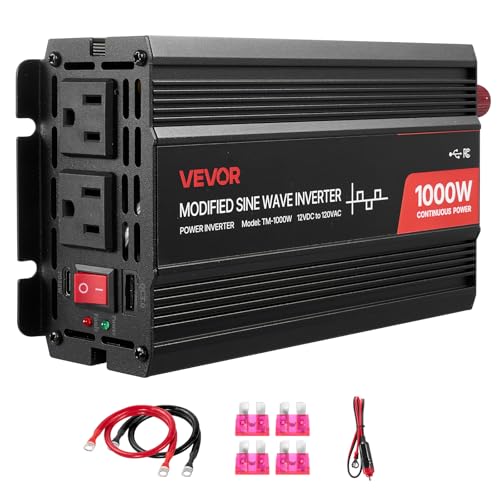
VEVOR 1000W modified sine inverter, USB and Type-C
1000W continuousModified sine waveUSB and Type-CWide battery types
Check price on Amazon
Best for: Budget buyers running heaters, lights and simple chargers, with no motor loads.

VEVOR is the budget end of this comparison, and the maker is honest that the output is modified sine. For heaters, incandescent lamps, a hot plate or a phone charger that is acceptable, since resistive loads do not care about the waveform shape. It lists compatibility with gel, sealed lead acid, lithium, flooded and AGM batteries, which is useful if you run a lithium bank in a camper.

The tradeoff shows up with anything containing a motor or an electronic power supply. Modified sine can make a fan hum, a charger run warm or a variable-speed tool misbehave. If your list includes a laptop charger, test the heat of the brick after ten minutes. That limitation is the reason the Landerpow and Jlouneo cost more, and it is a fair price for what they add.

In ownership terms the VEVOR needs the same installation discipline as the others. Use short, thick cables and a fuse near the battery, since 1000W pulls roughly 90 to 100A. Check the clamps for heat, and turn the unit off when parked. If a unit this inexpensive fails, the usual culprit is the fan or the main fuse, so keep a spare fuse of the right rating in the glovebox.

What works

  • Cheapest of the five on the price tiers
  • Wide compatibility with lead acid and lithium batteries
  • Over and under voltage protection is built in
  • USB and Type-C ports cover basic charging

Watch out for

  • Modified sine output can make motors and chargers run hot
  • Fewer comforts than the pure sine models
  • Likely louder fan than the premium units

Spec sheet

Continuous output
1000W
Waveform
Modified sine
Ports
USB, Type-C, AC
Battery types
GEL, SLA, Li, AGM, flooded
Protections
Over/under voltage, overload, short

Spec sheet decoder

What the numbers on the box really mean

The specs manufacturers lead with, translated into what they tell you about real-world performance.

Continuous watts

The load the inverter can supply for hours without overheating. Add up your devices and keep the total under about 80 percent of this number.

Watch forAll five units list 1000W, so compare waveform and ports instead.

Peak or surge watts

A short allowance for motor startup, usually two seconds or less. It is not a usable running rating.

Watch forThe 2000W figure on the Jlouneo is a startup allowance only.

Pure sine wave

An output that matches grid power. It runs motors, laptops and audio equipment cleanly and efficiently.

Watch forThe Landerpow and Jlouneo state it, while the VEVOR does not.

Conversion efficiency

How much battery power becomes AC power. Losses of 8 to 15 percent become heat and extra battery draw.

Watch forThe Landerpow quotes above 91 percent, the only efficiency figure in this lineup.

Low-voltage cutoff

The shutdown that protects the battery, typically an alarm near 10.5V and a cutoff near 10V.

Watch forThe LCD unit shows LO on screen when the battery drops too low.

Methodology

How We Evaluated These 1000W Car Power Inverters

Waveform fit

We separated units that state a pure sine output from those that state modified sine or say nothing. The Landerpow and Jlouneo score highest here, and the VEVOR is clearly labelled as modified sine. A unit with no waveform statement, like the Bestek, is scored cautiously.

Outlet and port layout

We counted AC outlets and compared USB output against what a driver actually plugs in. The Landerpow wins on three outlets, and the LCD unit wins on a 36W USB-C port. A layout that forces a power strip loses points.

Protection and diagnostics

Every unit lists protection for overload, short circuit and temperature, but only one shows fault codes on a screen. We gave credit for visibility because it shortens troubleshooting. A blind shutdown with no code is more likely to end in a warranty return.

Efficiency and cooling

Heat is wasted energy and a wear driver. We used the stated efficiency where the listing gave one, the Landerpow at above 91 percent, and treated unstated figures as typical for the class. Fan design was a secondary factor.

Ownership reality

We looked at what year two of ownership costs: clamps, fuses, fan dust and a deep-cycle battery to pair with it. A unit that clearly states its input system, like the Jlouneo, reduces the chance of a wiring mistake.

Decision guide

How to Choose the Right 1000W Car Power Inverters

By Primary Load

SituationPickWhy
Laptop, tool chargers and a small fridgeLanderpow 1000WPure sine and three outlets
Heater or hot plate onlyVEVOR 1000WResistive loads ignore waveform
Phones and tablets all dayBestek 1000W30W USB-C and 18W USB-A on board
Need to see battery voltage1000W LCD unitFault codes and voltage readout
Motor loads on a 12V systemJlouneo 1000WPure sine with a clear 12V-only design

By Budget

SituationPickWhy
Lowest cost entryVEVOR 1000WCheapest tier, modified sine
Mid tier with a readout1000W LCD unitDisplay and strong USB-C port
Mid to upper tier with fast USBBestek 1000WPD 30W and 18W ports
Upper tier, best featuresLanderpow 1000WPure sine plus three outlets
Premium tier for sine onlyJlouneo 1000WPure sine, 12V only

Pure Sine vs Modified Sine

Pure sine

Matches grid power, so motors run cooler and sensitive chargers stay quiet. The Landerpow 1000W and Jlouneo 1000W fall in this group, and they cost more. Efficiency is usually slightly better too, which saves battery.

Modified sine

A stepped waveform that is fine for lamps, heaters and basic chargers. The VEVOR 1000W is the clear example here. It can make fans hum and some chargers run hot, so match it to simple loads.

Pick pure sine if any motor or laptop is involved, and modified sine only for heaters and lights.

Engine Running vs Engine Off

SituationPickWhy
Engine running, short useBestek 1000WTwo fans handle sustained load
Engine off, camper bankVEVOR 1000WLists lithium and AGM compatibility
Want to watch the battery sag1000W LCD unitScreen shows LO before shutdown
Remote use in a vanLanderpow 1000WEfficient so less battery is wasted
Mixed loads on a deep-cycle bankJlouneo 1000WClean power with a 12V bank

For Tool Charging Specifically

Look for

Pure sine output, enough outlets for a charger bank, and efficiency high enough to avoid warm bricks. A tool charger often pulls 100 to 300W while charging, so two chargers sit comfortably inside a 1000W budget. Keep the total under 800W.

In this comparison

The Landerpow 1000W has the three outlets and the pure sine output that tool chargers like, so it is the pick for a work truck. The Jlouneo 1000W is the sine alternative if the Landerpow is out of stock.

When to Spend More

Spend more if

You run the unit every day, use it for laptops or motors, or install it in a van. The Landerpow 1000W or Jlouneo 1000W give clean power and last longer in daily service than a modified sine unit.

Save if

You only run heaters, lights or phone chargers, or you need it a few times a year. The VEVOR 1000W covers those loads at the lowest cost, and a spare fuse is the only extra you need.

Ownership

Maintenance schedule

The upkeep that decides whether this machine lasts two seasons or ten.

TaskIntervalWhy it matters
Check battery clampsEvery 3 monthsLoose or corroded clamps create heat at 90 to 100A. Re-tighten and look for discolored plastic.
Clear fan ventsEvery 3 monthsDust blocks airflow and raises temperature. A can of compressed air solves most fan complaints.
Inspect the fuseEvery 6 monthsA corroded fuse holder adds resistance. Replace the fuse with the same rating, never a larger one.
Test the low-voltage alarmOnce a yearConfirm the shutdown fires before the battery is damaged. A late alarm means the unit needs replacing.
Switch off when parkedEvery stopIdle draw drains a battery over days. Make a habit of switching the unit off at the end of use.

FAQ

Frequently Asked Questions

Can a 1000W inverter plug into the cigarette lighter?

No. A lighter socket is fused around 10 to 15A, which limits it to about 120 to 180W at 12V. A 1000W unit must connect directly to the battery with heavy cable and a fuse.

Is pure sine worth the extra cost at this size?

Yes if you run motors, laptops or audio gear. For heaters and lights, modified sine such as the VEVOR works. The more sensitive the load, the more the sine wave pays back.

How long will my battery last at 1000W?

A typical starter battery will drain in minutes at full load, so run the engine. A deep-cycle bank lasts longer, but 1000W still draws about 90 to 100A, which empties a small bank quickly.

Does a 2000W surge rating mean I can run a 2000W load?

No. Surge is a brief startup allowance of a second or two. Size every purchase to the continuous rating, which is 1000W on all five units here.

Do I need to ground the inverter?

Many larger units have a chassis ground lug, and the manual will say when to use it. Follow the instructions, and never bypass a protection device.

Why does my inverter shut off under load?

The common causes are a voltage drop in thin cable, a weak battery, or over-temperature in a blocked fan. A display like the one on the LCD unit helps pin down which.

Bottom line

The short version

Browse more 1000w car power inverterson Amazon →
James Miller, Lead Machine Editor

About the author

James Miller

Lead Machine Editor, MachineFanatic

James Miller leads MachineFanatic's buying guides, turning spec sheets, manuals and owner feedback into clear verdicts on power tools, outdoor power equipment, shop machines and kitchen machines.

More from James →

Keep reading

Related guides