
Amazon affiliate links - we earn a commission.Affiliate disclosure

Buying guide · 12 min read · Updated 2026-11-13

Best 500W Car Power Inverters (2026)

Five 500W car power inverters compared on waveform, battery-clamp versus lighter-plug use, built-in fuses and USB-C charging, with honest notes on real output.

James MillerBy James MillerLead Machine Editor5 machines comparedSpec-sheet verified
Best 500W Car Power Inverters

At a glance

Our top picks

Side by side

Spec comparison

A 500W inverter is the first size where the battery connection really matters. Below it, almost everything lives in the lighter socket. At and above it, the box either comes with clamps for a direct battery hookup or quietly promises a rating that the dashboard cannot deliver.

That split makes this a confusing category to shop. Two units with identical labels can behave very differently depending on whether they include clamps, whether the output is clean, and how honest the protection circuit is. The right choice depends on what you plan to plug in.

Before you buy

6 Criteria to Look For Before Buying a 500W Car Power Inverter

  1. 01

    Lighter plug versus clamps

    A lighter socket fuse sits at 10 to 15A, capping the plug at about 120 to 180W. The EFFORTWAY 500W says it plainly: plug in under 150W, or use clamps for 500W. At 500W a 12V system draws about 45A, which needs the battery connection, a short thick cable and a fuse. Skipping the fuse is the single most dangerous shortcut in this whole category, since a shorted cable can melt before anything trips.

  2. 02

    Waveform and what you plug in

    The Bestek 500W with PD 30W is the pure sine pick, suited to a small TV, a laptop and a CPAP. The RUTNRIXA states modified sine honestly, which suits lights and simple chargers. If your load has a motor or sensitive electronics, choose the sine unit.

  3. 03

    Built-in fuses

    Internal fuses protect the inverter and the battery from a fault. The older Bestek 500W carries two 40A fuses and the RUTNRIXA carries two 50A fuses. Replaceable fuses mean a fault is a ten-second fix. Keep spares of the exact rating, and never swap in a larger fuse to stop it blowing, because the fuse is there to protect the cable.

  4. 04

    USB-C power

    USB-C wattage decides whether a laptop can charge directly. The LCD 500W unit leads at 36W, the Bestek PD at 30W and the RUTNRIXA at 25W. None reaches the 45 to 65W laptops need, so use AC for a laptop and USB for phones. A laptop on its own AC brick draws roughly 60 to 90W, which is comfortably inside the 500W budget but needs the clamp connection.

  5. 05

    Diagnostics

    A display is the difference between a mystery shutdown and a quick fix. The LCD 500W shows OL, HI and LO codes, so you know whether to start the engine or check a load. The other four give only a beep or a light.

  6. 06

    Surge figures

    Surge covers a brief startup spike, not running load. The EFFORTWAY, Bestek 1000W surge unit and LCD unit publish 1000W against 500W continuous. A small compressor can need two to three times its running watts, so a 1000W allowance covers a 300W motor, not a 500W one.

Detailed reviews

The 5 best 500w car power inverters, explained

01
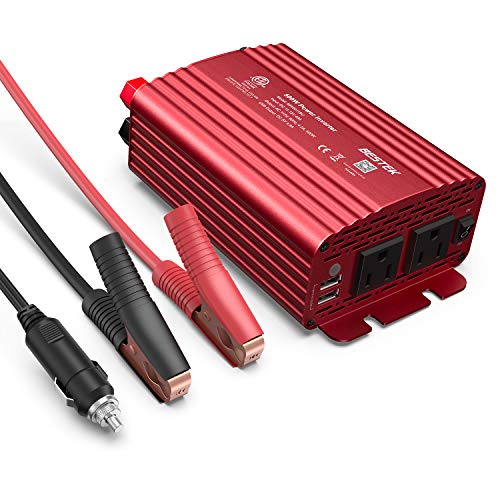
Bestek 500W pure sine inverter, PD 30W and 4.2A USB-A
500W continuousPure sine wave30W USB-C PD4.2A USB-A
Check price on Amazon
Best for: People who run a laptop, small TV and chargers together and want clean power.

Clean power at household quality is what this Bestek sells, and at 500W continuous it has the headroom to run a laptop, a small LED television and a charger together. The listing describes the output as identical to a wall outlet, a claim only a pure sine design can make. That matters for TVs and laptops, whose power supplies run cooler and more quietly on a smooth waveform.

A 30W USB-C PD port and a 4.2A USB-A port handle phones and tablets without wasting AC capacity. Dual AC outlets cover the rest. The cost is a position near the top of the price tiers, which is the price of a sine wave and a better circuit.

To reach the full 500W you need to connect to the battery with clamps, since a lighter socket is fused at 10 to 15A and supports only about 120 to 180W. Plan for that before you buy, and keep the cable short. After a season of use, check the clamp teeth for corrosion and the fan intake for dust. For a camper or a mobile office, this is the cleanest answer in the group, and it stays quiet at light loads.

What works

  • Pure sine output suits televisions and laptops
  • PD 30W USB-C keeps AC capacity free for other loads
  • 4.2A USB-A port charges phones and tablets
  • 500W continuous gives real headroom on a battery hookup

Watch out for

  • Upper tier for the price among 500W units
  • Needs battery clamps for full output
  • 30W USB-C will not charge a large laptop quickly

Spec sheet

Continuous output
500W
Waveform
Pure sine
USB-C
PD 30W
USB-A
4.2A
AC outlets
Dual
02
EFFORTWAY 500W inverter, alligator clamps, 2 AC, 2.1A USB
500W continuous1000W peakAlligator clamps2.1A USB
Check price on Amazon
Best for: Budget buyers who need to switch between the lighter plug and a real battery hookup.

EFFORTWAY states the truth about this class plainly: plug into the lighter socket to charge devices under 150W, or use the alligator clamps on the battery to reach 500W. That dual connection is the right design, because it matches the real limit of each path. Few listings in this category are as candid.

The specifications list 500W continuous and 1000W peak, with two AC outlets and a 2.1A USB port. The listing mentions a safety system that watches for overloads and the usual protections. A low tier in the price ordering makes it the strongest value in the group, though you give up pure sine and fast USB-C.

The clamps are the wear point. Alligator clamps can loosen, so look for heat and discoloration on them after the first few uses. If you use it often, upgrade to ring terminals on a short cable. The 2.1A USB port is slow by modern standards, so bring a separate car charger if you need to charge tablets quickly. For a tool battery charger or a laptop at a roadside job, it is a sound and honest tool.

What works

  • Lighter plug for small loads and clamps for 500W
  • Lists both 500W continuous and 1000W peak
  • Built-in overload and short-circuit protection
  • Low tier in the price ordering

Watch out for

  • No pure sine claim
  • 2.1A USB is slow compared with PD ports
  • Alligator clamps can loosen under vibration

Spec sheet

Continuous output
500W
Peak rating
1000W
Connection
Lighter plug or clamps
AC outlets
2
USB
2.1A
03
500W LCD car inverter, 36W USB-C, fault codes
500W continuous1000W peak36W USB-CLCD fault codes
Check price on Amazon
Best for: Owners who want to know why a shutdown happened and who charge devices over USB-C.

Here the LCD does the explaining. It shows input and output voltage and battery status, and it displays fault codes OL for overload, HI for high voltage and LO for low voltage. Most small inverters just stop, leaving you to guess which of three things went wrong. This one tells you.

The 36W USB-C port is the strongest charging port among the 500W units, and a 5V/3A USB-A port serves a phone. With two AC outlets the layout is conventional, and the listing gives 500W continuous with 1000W peak surge. It does not state a waveform, so treat it as modified sine for planning.

In a daily commute the display pays off over time. If LO appears when the engine is off, the battery is the problem, and starting the car fixes it. If HI appears, check the alternator. The tier is upper-middle, between the EFFORTWAY and the Bestek pure sine.

What works

  • LCD shows voltage and OL, HI and LO fault codes
  • 36W USB-C is the strongest in the group
  • Lists 500W continuous and 1000W peak
  • Dual AC outlets cover a laptop and a charger

Watch out for

  • Waveform is not stated
  • Upper-middle price tier
  • No clamps are described for full-power use

Spec sheet

Continuous output
500W
Peak surge
1000W
USB-C
36W
USB-A
5V/3A
Display
LCD with OL, HI, LO codes
04
Bestek 500W inverter, 1000W surge, dual 40A fuses
500W continuous1000W surge2x 40A fuses4.8A dual USB
Check price on Amazon
Best for: Buyers who want serviceable fuse protection and basic charging from a known brand.

This older Bestek design leans on proven basics: 500W continuous, 1000W of surge, dual AC outlets and 4.8A of dual USB charging. The standout is a pair of 40A fuses built in to protect the device and the battery. Replaceable fuses are the correct protection at this size, and they let you swap a blown fuse in seconds.

Its USB side is older than the newer units, with no PD port, so it charges phones and tablets but not a laptop over USB-C. Waveform is not stated, so assume modified sine. It sits at a middle tier among the five.

Use it with battery clamps for any load above the lighter socket's limit, and keep the cable short. At full load it draws about 45A, well under the 80A its two fuses combine to carry, so the fuses are ample. Inspect the fuse holders for corrosion annually, and carry spares of the exact rating. For a mechanic who wants a tool with a simple, serviceable protection scheme, this is a good pick.

What works

  • Two built-in 40A fuses are easy to replace
  • Lists 500W continuous and 1000W surge
  • 4.8A dual USB charges phones quickly
  • Dual AC outlets for a laptop and a lamp

Watch out for

  • No PD USB-C port
  • Waveform not stated
  • Older design with fewer modern comforts

Spec sheet

Continuous output
500W
Surge rating
1000W
Fuses
Two 40A
USB
4.8A dual
AC outlets
Dual 110V
05
RUTNRIXA 500W modified sine inverter, 25W PD, dual 50A fuses
500W continuous1000W peak25W USB-C PD2x 50A fuses
Check price on Amazon
Best for: Buyers with simple loads who want clear protection and honest labeling.

RUTNRIXA is upfront about the waveform: this is a modified sine design delivering 500W continuous and 1000W peak. Two built-in 50A fuses and six listed protections cover overload, short circuit, over-temperature and other faults. That honesty and protection scheme make it a rational budget choice for resistive loads and chargers.

A 25W PD USB-C port charges a phone at speed but not a laptop. The listing also mentions dual AC outlets with a surge allowance, though the exact text is garbled, so confirm the surge figure on the box. In the price tiers it lands in the lower-middle.

The modified sine output means a CPAP or a sensitive power supply is not a good match. For lights, a heater element or a phone charger, it is fine. The fuses are the key to ownership: carry spares and use short, thick cable to the battery. Next to the pure sine Bestek, you save money and lose the clean waveform, and that is a fair trade for many buyers.

What works

  • States modified sine honestly
  • Two built-in 50A fuses and six protections
  • PD 25W USB-C charges phones quickly
  • Lower-middle price tier

Watch out for

  • Modified sine suits only simple loads
  • 25W USB-C is too slow for a laptop
  • Surge text in the listing is unclear

Spec sheet

Continuous output
500W
Peak rating
1000W
Waveform
Modified sine
USB-C
PD 25W
Fuses
Two 50A built in

Spec sheet decoder

What the numbers on the box really mean

The specs manufacturers lead with, translated into what they tell you about real-world performance.

Continuous watts

The load an inverter can carry for hours. It decides what you can run.

Watch forAll five say 500W, but only the clamp-capable units can deliver it.

Peak watts

A startup allowance, usually lasting a second or two.

Watch for1000W peak on the EFFORTWAY is double the continuous rating.

Built-in fuse

A replaceable protection that blows before damage occurs. The rating should exceed the full-load draw.

Watch forThe older Bestek lists two 40A fuses and the RUTNRIXA lists two 50A fuses.

Fault codes

Letters on a display that identify a shutdown cause. They save diagnostic time.

Watch forThe LCD 500W unit shows OL, HI and LO.

PD wattage

USB-C power delivery output. Higher means faster charging.

Watch forThe LCD unit offers 36W, the Bestek PD 30W and the RUTNRIXA 25W.

Methodology

How We Evaluated These 500W Car Power Inverters

Honesty about real output

We credited listings that say how the unit connects and what each path delivers. The EFFORTWAY is the clearest, naming 150W for the lighter plug and 500W for clamps. Vague listings scored lower.

Waveform and protection

We scored the Bestek PD unit highest for stating pure sine. The RUTNRIXA scored well for honest modified sine labeling and listed protections. Unstated waveforms were treated as modified.

Charging ports

We compared USB-C wattage across the lineup, from 25W to 36W, and noted which units have no PD port. The LCD unit led. Slow ports lost points.

Diagnostics and serviceability

A display with fault codes and replaceable fuses both shorten repairs. The LCD 500W and the older Bestek each gained points here. Hard-to-service units lost them.

Ownership over time

We considered clamp quality, fuse access and vent dust. Alligator clamps on the EFFORTWAY are the likeliest wear item. A unit with ring terminals and short cable ages better, because vibration is what loosens spring clips and slowly turns a good connection into a hot one. We also noted whether the fan intake faces a spot that stays clear.

Decision guide

How to Choose the Right 500W Car Power Inverters

By Connection

SituationPickWhy
Plug in and clamp onEFFORTWAY 500WSupports both paths
Clean power on battery clampsBestek 500W PD 30WPure sine at full rating
Serviceable fusesBestek 500W 40A fuse unitTwo replaceable fuses
Fault diagnosisLCD 500WOL, HI and LO codes
Simple resistive loadsRUTNRIXA 500WModified sine, dual 50A fuses

By Budget

SituationPickWhy
Lowest tierEFFORTWAY 500WHonest dual connection
Lower-middle with protectionRUTNRIXA 500WDual fuses and six protections
Middle with fusesBestek 500W 40A fuse unitReplaceable fuses
Upper-middle with displayLCD 500WFault codes and 36W USB-C
Upper with sine waveBestek 500W PD 30WClean power

Pure Sine vs Modified Sine

Pure sine

The Bestek 500W PD unit is the one to buy for a television, a CPAP or a laptop with a sensitive adapter. It runs cooler and quieter on a smooth waveform and costs more.

Modified sine

The RUTNRIXA and the EFFORTWAY handle lights, heaters and phone chargers. They cost less and can make motors hum, so match them to simple loads. If a charger brick runs too hot to hold after ten minutes, that is the waveform talking and a sine unit is the answer.

Choose pure sine for electronics and motors, and modified sine for lights and chargers.

Protection Style

SituationPickWhy
Replaceable fusesBestek 500W 40A fuse unitTwo 40A fuses
Higher fuse ratingRUTNRIXA 500WTwo 50A fuses
Visible fault codesLCD 500WScreen shows why it stopped
Overload watchEFFORTWAY 500WSafety system monitors overload
Thermal protectionBestek 500W PD 30WIntelligent protection in the listing

For a Small TV Specifically

Look for

A pure sine output and a continuous rating at least double the TV's draw. A small LED television uses 40 to 100W, so a 500W unit is ample. Run it from the battery clamps, not the lighter plug, if it draws above 150W.

In this comparison

The Bestek 500W PD unit is the match, since its listing names LED televisions among the loads it powers. The LCD 500W unit also works if you want a display.

When to Spend More

Spend more if

You run a television, CPAP or laptop daily. The Bestek 500W PD unit gives clean power and the LCD 500W gives diagnostics.

Save if

Your loads are lights and phone chargers. The EFFORTWAY 500W and RUTNRIXA 500W cover them at lower tiers.

Ownership

Maintenance schedule

The upkeep that decides whether this machine lasts two seasons or ten.

TaskIntervalWhy it matters
Check clamps and terminalsEvery 3 monthsLoose clamps heat at 45A. Re-tighten and look for discoloration.
Clear fan ventsEvery 3 monthsDust blocks airflow. Use compressed air from the outside.
Inspect fusesEvery 6 monthsCorroded holders add resistance. Replace with the exact rating.
Check the cableEvery 6 monthsChafed insulation near a battery is a fire risk. Replace cracked cable.
Switch off when parkedEvery stopIdle draw slowly flattens a battery. Switch off or unplug at the end of use. A forgotten inverter can flatten a starter battery over a long weekend, even with nothing connected to it.

FAQ

Frequently Asked Questions

Can a 500W inverter run from the lighter socket?

Only for small loads. The socket fuse of 10 to 15A limits real output to about 120 to 180W. For the full 500W use battery clamps.

Is pure sine worth it at this size?

Yes for televisions, laptops and CPAPs. For lights and phone chargers, modified sine works. The Bestek PD unit is the sine choice.

How much current does 500W draw?

About 45A at 12V once efficiency losses are counted. That requires a short, thick cable and a fuse near the battery. Every extra foot of cable adds resistance, and resistance means lost voltage, so mount the inverter as close to the battery as ventilation allows.

Why do the clamps get warm?

Resistance at a loose or corroded connection turns current into heat. Re-tighten them and clean the battery posts with a wire brush. If a clamp keeps overheating after that, replace it with a ring terminal bolted to the post, which makes a far better connection than a spring clip.

Can I run a microwave on it?

A small microwave draws about 1000W or more, so no. Choose an inverter rated for twice the microwave's input, and expect a big battery bank. Most small microwaves are labeled with their input watts on the back, which is higher than the cooking watts on the front.

How long will a battery last?

A 100Ah lithium battery holds about 1200Wh, so a 100W load lasts roughly ten hours after losses and a 500W load about two. Those figures ignore the inverter's own idle draw, so real runtime is a little shorter.

Bottom line

The short version

Browse more 500w car power inverterson Amazon →
James Miller, Lead Machine Editor

About the author

James Miller

Lead Machine Editor, MachineFanatic

James Miller leads MachineFanatic's buying guides, turning spec sheets, manuals and owner feedback into clear verdicts on power tools, outdoor power equipment, shop machines and kitchen machines.

More from James →

Keep reading

Related guides