
Amazon affiliate links - we earn a commission.Affiliate disclosure

Buying guide · 12 min read · Updated 2026-11-13

Best 12V Inverters for Camping (2026)

Five 12V inverters for camping, from a plug-in 200W unit to a 3000W remote-start box, compared on waveform, outlets, fuses and battery draw.

James MillerBy James MillerLead Machine Editor5 machines comparedSpec-sheet verified
Best 12V Inverters for Camping

At a glance

Our top picks

Side by side

Spec comparison

Camping changes what an inverter has to do. The battery is a deep-cycle bank or a car battery with the engine off, the loads are small and steady, and a quiet campsite makes fan noise and standby draw far more noticeable than they are on a road trip.

The best picks pair the right size with the right connection. A small unit in the lighter socket is perfect for phones, while anything running a fridge or a CPAP belongs on battery clamps with a fuse, and the waveform decides whether sensitive gear survives.

Before you buy

6 Criteria to Look For Before Buying a 12V Inverter for Camping

  1. 01

    Size the inverter to the loads

    Add up the continuous watts of everything you plan to run at once and add 20 percent. A phone and laptop total about 100W, which the PiSFAU 200W handles, while a CPAP and fan near 150W suit the Bestek 500W. A microwave near 1000W needs a unit like the BELTTT 2000W. Oversizing wastes battery, since bigger units idle higher.

  2. 02

    Lighter plug or battery clamps

    A lighter socket is fused at 10 to 15A, which limits it to about 120 to 180W at 12V. The PiSFAU 200W and similar plug-in units live inside that ceiling. Above about 150 to 200W, connect directly to the battery. The Bestek 500W, Vansoet 400W and everything larger in this guide are clamp or hardwire designs.

  3. 03

    Waveform for sensitive gear

    A CPAP, a drone charger and a laptop with an active power supply run best on a pure sine wave. The Bestek 500W and BELTTT 2000W state pure sine, while the Cantonape 3000W is modified sine. If the manual for your CPAP forbids modified sine, the choice is made for you.

  4. 04

    Battery draw at campsite scale

    Current at 12V is watts divided by 12 plus losses, so 500W draws about 45A and 2000W about 190A or more. A 100Ah lithium battery supplies roughly 1200Wh, which lasts about two hours at 500W. Efficiency of 85 to 92 percent and idle draw eat into that, so the Vansoet 400W with its separate AC switch saves real capacity overnight.

  5. 05

    Fuse, cable and ventilation

    Cable gauge and length decide how much voltage you lose before the inverter ever sees it. Keep runs short and fit a fuse near the battery. The BELTTT 2000W and Cantonape 3000W need heavy cable and a hardwire connection. Never cover the fan intake with a sleeping bag.

  6. 06

    Remote and display

    A remote switch or display is convenience, not capability. The BELTTT 2000W has a 23ft wired remote and the Cantonape 3000W has a wireless remote, which matter when the inverter lives in a battery box. For a plug-in unit like the PiSFAU, none of that applies.

Detailed reviews

The 5 best 12v inverters for camping, explained

01
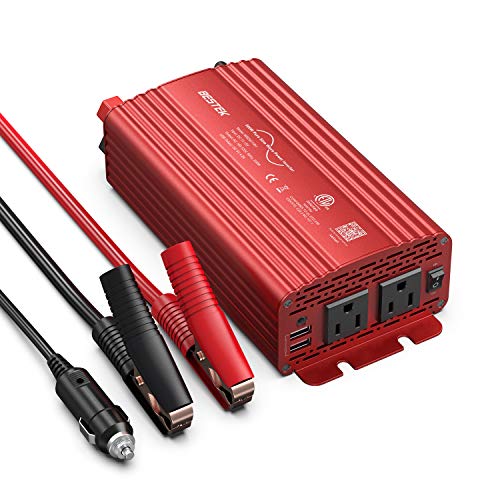
Bestek 500W pure sine inverter, 2 AC and USB
500W continuousPure sine wave2 AC outletsThermal sensors
Check price on Amazon
Best for: Campers running a CPAP, laptop and camera chargers from a car or deep-cycle battery.

A 500W pure sine inverter is the size that suits most tents and truck beds. It runs a laptop brick, a CPAP machine, a camera battery charger and a small fan without wasting the battery on an oversized unit. Bestek states that the output matches mains power, which is what a CPAP and a drone charger want, and the listing mentions thermal sensors inside an aluminum alloy case.

The metal case helps pull heat out of the electronics, and that matters because the unit sits in a cramped cargo area where airflow is poor. With two AC outlets and shared USB charging it covers a typical campsite desk. The limit is the ceiling: 500W will not start a drill with a big motor or run a kettle, so this is not the box for a power-tool weekend. A larger BELTTT 2000W unit in this guide handles that work, at a very different level of size and cost.

In use, connect it to the battery with the supplied clamps for anything above about 150W, and keep the cable as short as practical. Standby draw is small but not zero, so switch it off overnight if the battery is the only reserve. After a season, clean the clamp teeth and the fan vents, since pine needles and dust find their way into everything at a campsite.

What works

  • Pure sine output suits a CPAP and sensitive chargers
  • Aluminum case spreads heat in a cramped cargo area
  • Thermal sensors back up the internal protection
  • 500W size avoids wasting battery on a large unit

Watch out for

  • Will not run a kettle or a large power tool
  • USB output is shared across ports
  • Clamp connection means a short cable run is needed

Spec sheet

Continuous output
500W
Waveform
Pure sine
AC outlets
2
USB output
4.2A shared
Case
Aluminum alloy
02
BELTTT 2000W pure sine inverter, 4000W surge, 23ft remote
2000W continuous4000W surgePure sine wave23ft wired remote
Check price on Amazon
Best for: Van and trailer owners running a microwave, blender or power-tool chargers.

BELTTT builds a true 2000W pure sine unit with an LCD that shows input and output at once, a 23ft wired remote, and a 20A outlet beside the standard ones. The remote is the feature camp-van owners will notice, because the inverter can sit in a battery box while the switch lives by the bed. A pure sine waveform also means a microwave oven, a blender or a power-tool charger will run as designed.

The cost is bulk and battery draw. A full 2000W load pulls roughly 190A or more from a 12V bank, so this unit belongs to a van with a large lithium or AGM bank and cable sized for it. A small trailer battery will not last. Next to the Bestek 500W, this is a different tool: the 500W unit is for devices, this one is for appliances.

Ownership is mostly about cabling and ventilation. Hardwire it with heavy cable, fit a fuse near the battery, and keep the airflow path clear because the fan will cycle under load. The 4000W surge number is useful for the brief startup spike of a motor, but it is not a running rating. Expect to periodically clean the fan intake and retighten the terminals after the first few trips, when new connections settle.

What works

  • True 2000W continuous pure sine output
  • 23ft wired remote keeps the switch within reach
  • 20A outlet plus standard outlets covers larger plugs
  • Screen shows input and output at a glance

Watch out for

  • Needs a large battery bank and heavy cable
  • Too big and heavy for car-camping basics
  • Fan cycles audibly under load

Spec sheet

Continuous output
2000W
Surge rating
4000W
Waveform
Pure sine
Outlets
Dual AC and 20A
Remote
23ft wired
03
Vansoet 400W inverter, dedicated AC switch, 30W PD
400W continuousDedicated AC switch30W USB-C PDCooling fan
Check price on Amazon
Best for: Solo campers who want to leave USB charging on overnight without AC idle draw.

Vansoet's 400W inverter adds a dedicated AC switch, so the USB ports can charge phones all night while the AC side stays off. That removes the biggest nuisance of cheap inverters, which is idle draw from the transformer. A 30W USB-C PD port covers a phone or a tablet directly.

Output is described as clean and stable for small appliances, but the title does not say pure sine, so assume modified and keep it away from a CPAP unless you confirm the listing. At 400W it sits between the PiSFAU 200W and the Bestek 500W, which means it can run a laptop and a small speaker together with spare headroom.

The cooling fan is described as intelligent, meaning it ramps with load, which keeps a quiet campsite quiet at light loads. Check that the clamps seat firmly and that the cable stays short. If you leave the unit in a vehicle during winter, let it warm before using, since cold condensation in the vents is a real source of premature failure. Overall it is a sensible mid-size box for solo camping.

What works

  • Separate AC switch eliminates idle transformer draw
  • 30W USB-C PD charges a phone or tablet fast
  • 400W is enough for a laptop plus a small speaker
  • Fan ramps with load to stay quiet at light use

Watch out for

  • Waveform is not stated, so avoid a CPAP
  • Not enough for kitchen or tool loads
  • Fewer protections described than the larger units

Spec sheet

Continuous output
400W
AC control
Separate AC switch
USB-C
30W PD
Cooling
Intelligent fan
Input
12V DC
04
PiSFAU 200W plug-in inverter, 2 AC and 4 USB
200W continuousPlug-in design2 AC outlets4 USB ports
Check price on Amazon
Best for: Car campers who only charge phones, cameras and a laptop.

PiSFAU makes the smallest unit in this guide, about the size of a cellphone with a plug at one end. It slides into the lighter socket and gives you two AC outlets and four USB ports, which is all most campers need for phones, a camera charger and a headlamp. Cost sits at the bottom of the price tiers, the cheapest of the five.

The limits are physical. A lighter socket is fused near 10 to 15A, which caps real output near 120 to 180W regardless of the 200W label. That means a laptop works, but a hair dryer or a drill charger does not. Thin socket wiring can also brown out before the fuse blows, so listen for fan changes or a voltage drop.

Upkeep is minimal. Keep it out of the sun on the dash, because heat shortens the life of small electronics. Pull it out when the engine is off, since lighter sockets in many cars stay live and the inverter will drain the battery slowly. Compared with the Vansoet 400W, it is simpler, cheaper and quieter, but it cannot cover bigger gear, so choose by what you plug in.

What works

  • Plugs straight into a lighter socket with no cables
  • Four USB ports plus two AC outlets in a tiny body
  • Cheapest of the five on the price tiers
  • Phone-sized footprint stores in a door pocket

Watch out for

  • Real output is limited by the 10 to 15A socket fuse
  • No battery clamps for heavier loads
  • Waveform is not stated

Spec sheet

Continuous output
200W
Connection
Cigarette lighter
AC outlets
2
USB
4 ports, 4.8A and 24W
Size
Phone-sized
05
Cantonape 3000W modified sine inverter, LCD and remote
3000W continuousModified sine wave4 AC outletsLCD and remote
Check price on Amazon
Best for: Truck and cabin owners who need many outlets and heavy power for tools.

Cantonape sells the biggest unit in this lineup: 3000W continuous modified sine, four AC outlets, an LCD showing input and output voltage and a remote for switching it on and off. It is the box you buy for a work truck or an off-grid cabin, not for a weekend tent. At full load it would draw roughly 270A from a 12V battery, which only a very large bank and thick cable can support.

Modified sine is the cost. It runs resistive loads like heaters and incandescent lamps happily, but motors, a microwave and some chargers run warm or inefficiently. The BELTTT 2000W costs more per watt but gives clean output, and for most campers that is the better trade. If you only need power tools and lights, the Cantonape makes sense.

Plan the installation before buying. Use hardwire terminals with a proper fuse and heavy cable, ground the chassis lug where the manual says so, and keep the box ventilated. Idle draw is meaningful at this size, so use the remote to switch it off. Treat the 3000W as a ceiling you rarely reach rather than a daily target.

What works

  • 3000W continuous covers tools and heaters together
  • Four AC outlets reduce the need for power strips
  • LCD shows input and output voltage
  • Remote switch avoids reaching into the battery bay

Watch out for

  • Modified sine is poor for motors and sensitive gear
  • Full load needs a very large battery bank
  • Overkill and heavy for a weekend tent trip

Spec sheet

Continuous output
3000W
Waveform
Modified sine
AC outlets
4
Display
LCD input and output
Control
Wireless remote

Spec sheet decoder

What the numbers on the box really mean

The specs manufacturers lead with, translated into what they tell you about real-world performance.

Continuous watts

The load an inverter can carry for hours. Size to this number, not to the peak figure.

Watch forThe Vansoet 400W and Bestek 500W differ by only 100W, so the waveform decides between them.

Surge watts

A short allowance for startup spikes, often a fraction of a second to a few seconds. It is not a running limit.

Watch forThe BELTTT quotes 4000W surge against 2000W continuous.

Modified vs pure sine

Modified sine is a stepped approximation of grid power. Pure sine is smooth and suits motors and electronics.

Watch forThe Cantonape is modified sine, which limits what you can plug in.

Idle draw

The power an inverter burns with no load, because the transformer keeps running. Over a night it can drain a small battery noticeably.

Watch forThe Vansoet's separate AC switch lets the AC side sleep.

Low-voltage shutdown

A protection that cuts output near 10V to protect the battery. An alarm often sounds near 10.5V first.

Watch forRunning the Cantonape 3000W from a car battery will hit this limit fast.

Methodology

How We Evaluated These 12V Inverters for Camping

Fit to campsite loads

We matched each unit to the loads campers actually run: phones, a CPAP, a laptop, a fridge and a kettle. The PiSFAU 200W fits device charging while the BELTTT 2000W fits appliances. A unit that overshoots needs a bigger battery than most campers own.

Waveform and compatibility

We favored pure sine units for anything that touches sleep or computing gear. The Bestek 500W and BELTTT 2000W score best. Units that do not state a waveform are scored as modified sine until proven otherwise.

Connection method

We checked whether each unit plugs into a lighter socket or clamps to a battery, and whether the claim matches the 10 to 15A socket limit. The PiSFAU is honest about being a plug-in. The larger units require hardwire cables.

Battery friendliness

We looked for features that reduce waste: separate AC switches, remotes and efficient designs. The Vansoet's AC switch is the clearest example. Idle draw is the hidden cost at camp.

Ownership at the campsite

We considered dust, damp and vibration. An aluminum case like the Bestek 500W shrugs off heat in a cargo area. Fan intake design, clamp quality and fuse access are the daily realities.

Decision guide

How to Choose the Right 12V Inverters for Camping

By Load

SituationPickWhy
Phones and a camera onlyPiSFAU 200WPlugs in and charges four USB devices
Laptop plus a small fanVansoet 400WEnough headroom and a switchable AC side
CPAP machine overnightBestek 500WPure sine output
Microwave or blenderBELTTT 2000W2000W continuous pure sine
Power tools and heater togetherCantonape 3000W3000W and four outlets

By Budget

SituationPickWhy
Lowest costPiSFAU 200WCheapest tier of the five
Entry-level with USB-CVansoet 400WLow tier with PD charging
Mid tier with sine waveBestek 500WClean power at a moderate level
Upper tier for appliancesBELTTT 2000WPure sine at 2000W
Highest tier for heavy useCantonape 3000WLargest capacity and remote

Plug-in vs Battery Clamps

Plug-in

The PiSFAU 200W slides into the lighter socket. It is tidy and quick, but the socket fuse of 10 to 15A caps real output near 120 to 180W. It suits phones, cameras and a laptop.

Battery clamps

The Bestek 500W, Vansoet 400W and larger units connect to the battery. Cable and fuse decide how much of the rating you can use. They suit CPAPs, fridges and tools.

Choose plug-in for devices, clamps for anything above a laptop.

Battery Type

SituationPickWhy
Car battery, engine runningVansoet 400WFan ramps with load while the alternator helps
Small deep-cycle bankBestek 500WModest draw of about 45A at full load
Large lithium bank in a vanBELTTT 2000WCan sustain about 190A draws
Off-grid cabin bankCantonape 3000WDesigned for hardwire and heavy draw
Spare battery, phone use onlyPiSFAU 200WBarely taxes the battery

For a CPAP Specifically

Look for

A pure sine output, a continuous rating at least double your machine's draw, and a clamp connection to a deep-cycle battery. A CPAP draws about 30 to 60W with a heated humidifier, so a 500W unit is plenty. Switch off other AC loads at night.

In this comparison

The Bestek 500W is the match, with pure sine output and aluminum cooling. The BELTTT 2000W also works but wastes more standby power for such a small load.

When to Spend More

Spend more if

You run a CPAP or a laptop nightly, or you travel in a van with real appliances. The Bestek 500W or BELTTT 2000W protect sensitive gear and waste less power.

Save if

You camp occasionally and only charge phones and a camera. The PiSFAU 200W covers that for the lowest cost, and the Vansoet 400W adds more headroom for a little extra.

Ownership

Maintenance schedule

The upkeep that decides whether this machine lasts two seasons or ten.

TaskIntervalWhy it matters
Clean fan ventsEvery 3 monthsPine needles and dust block airflow. Use a soft brush or compressed air.
Check clamps and lugsEvery tripVibration loosens terminals. A hot clamp is the sign of resistance and wasted power.
Inspect cable insulationEvery 6 monthsChafed insulation near a battery is a fire risk. Replace any cable with cracked jacket.
Check fusesOnce a yearCorroded fuse holders add resistance. Replace with the same rating only.
Store dry and coolOff seasonMoisture corrodes terminals and boards. Store indoors with the vents covered.

FAQ

Frequently Asked Questions

What size inverter do I need for camping?

Most campers need 300 to 500W for a laptop, a CPAP and device chargers. A 2000W unit is only for appliances like a microwave. Add up your loads and add 20 percent.

Can I run a CPAP on a modified sine inverter?

Some machines accept it, but many manufacturers recommend pure sine. Check the manual, and choose the Bestek 500W or BELTTT 2000W if in doubt.

How long will a battery last with an inverter?

A 100Ah lithium battery holds about 1200Wh, so a 100W load runs roughly ten hours after losses. A 500W load lasts about two hours. Always leave reserve.

Can I leave the inverter on overnight?

Only if you accept idle draw. A unit with a separate AC switch like the Vansoet lets USB charging run while AC sleeps. Otherwise switch it off.

Is a cigarette lighter inverter enough?

For phones, a camera and a small laptop, yes. Real output is capped near 120 to 180W by the socket fuse, so heavier loads need battery clamps.

Do I need a fuse on the battery cable?

Yes for any clamp or hardwire unit. Place it near the battery on the positive lead and size it above the full-load draw, which is roughly 45A at 500W and 190A at 2000W.

Bottom line

The short version

Browse more 12v inverters for campingon Amazon →
James Miller, Lead Machine Editor

About the author

James Miller

Lead Machine Editor, MachineFanatic

James Miller leads MachineFanatic's buying guides, turning spec sheets, manuals and owner feedback into clear verdicts on power tools, outdoor power equipment, shop machines and kitchen machines.

More from James →

Keep reading

Related guides