
Amazon affiliate links - we earn a commission.Affiliate disclosure

Buying guide · 13 min read · Updated 2026-11-13

Best Inverters for RV Camping (2026)

Five 12V inverters for RV camping from 500W to 3500W, compared on pure sine output, efficiency, cable and fuse needs, and honest limits for a house battery.

James MillerBy James MillerLead Machine Editor5 machines comparedSpec-sheet verified
Best Inverters for RV Camping

At a glance

Our top picks

Side by side

Spec comparison

An RV adds a few wrinkles to the usual inverter question. The house battery is shared with lights, a water pump and a furnace fan, the outlets are wired into the coach, and the park or driveway often offers shore power that the inverter must never connect to by accident.

The best RV inverter is sized to the loads you really run on batteries, wired with proper cable and a fuse, and chosen for a clean waveform. Most owners need far less capacity than the catalog suggests, and the surplus only costs idle draw.

Before you buy

6 Criteria to Look For Before Buying an Inverter for RV Camping

  1. 01

    Size to what the battery can feed

    A house bank of two 100Ah batteries holds about 2400Wh, which supports a 1000W load for roughly two hours. The OYPSX 1000W and JARXIOKE 500W match that scale. The 2000W Ampeak and 3000W BELTTT need a large lithium bank. The inverter is only as useful as the battery behind it. Many owners buy a 3000W unit for a one-battery coach and then discover the battery cannot supply it for more than a few minutes.

  2. 02

    Battery current and cable

    Current is watts divided by 12 plus losses. The JARXIOKE 500W draws about 45A, the OYPSX 1000W about 90 to 100A, the Ampeak 2000W about 190A, the BELTTT 3000W about 280A and the FT feiteeng 3500W about 330A. Cable gauge and length decide how much arrives, so keep runs short. A cable that is too thin turns into a heater, and the inverter will shut down on low voltage even with a full battery.

  3. 03

    Pure sine for coach electronics

    A TV, a microwave, a residential fridge and a CPAP all run better on pure sine. The OYPSX, JARXIOKE, BELTTT and FT feiteeng state it. The Ampeak does not, so treat it as modified sine and keep sensitive gear on another circuit. A quick check on a charger brick after ten minutes tells you whether the waveform is a problem.

  4. 04

    Stated efficiency

    Efficiency decides how much battery is burned as heat. The Ampeak states 89 percent and the FT feiteeng 95 percent, a gap of six points. On a 2000W load that is roughly 120W of extra heat, which a house bank feels over hours. Efficiency numbers on listings are best-case, so read them as a ranking and not as a guarantee.

  5. 05

    Remote and mounting

    An RV inverter lives in a basement bay or a cabinet, so a remote matters. The BELTTT 3000W includes a 23ft wired remote. Small units like the JARXIOKE 500W can sit in reach with a simple switch. A remote also lets you check the unit without opening a hot, cramped bay.

  6. 06

    Shore power and backfeed

    Never connect an inverter's output to the RV's shore power inlet. That can energize the campground pedestal and endanger others. If you wire the inverter to the coach outlets, use a proper transfer switch or an inverter with an automatic one. This is the single most important safety rule in RV inverter wiring.

Detailed reviews

The 5 best inverters for rv camping, explained

01
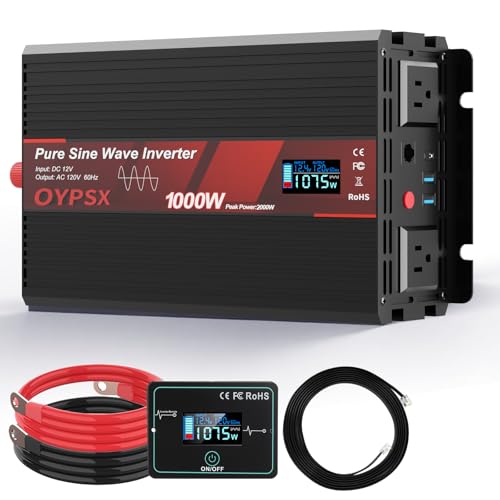
OYPSX 1000W pure sine inverter for RV and truck
1000W continuousPure sine waveChip-based protection12V input
Check price on Amazon
Best for: RV owners who want clean power for a TV, laptops and a small microwave.

Pure sine output at 1000W is the combination most RV owners actually need, and this OYPSX states it plainly. A built-in intelligent chip controls over-voltage, under-voltage, overload and short-circuit protection, which is the right set for a vehicle battery. It connects to a 12V battery and is pitched at RV, truck, camping and off-grid use.

At 1000W continuous, it runs a TV, a laptop, a coffee maker, a small microwave and a phone charger, one or two at a time. A 1000W draw is about 90 to 100A at 12V, which suits the typical house bank of one or two deep-cycle batteries with a short, thick cable.

The sweet spot for an RV is clear, because larger inverters idle higher and tempt owners to run appliances the battery cannot feed. This one sits at a lower-middle tier in the price ordering, so it is also easy to justify. Fuse it near the battery, keep the cable run short and mount it in a ventilated compartment rather than in a closed cabinet, because heat is the main enemy of a box this size. After a season, check lugs for heat and vents for dust.

What works

  • Pure sine output at 1000W continuous
  • Intelligent chip protection against faults
  • Size suits a one or two battery house bank
  • Lower-middle position in the price tiers

Watch out for

  • Too small for two heavy appliances at once
  • No remote or display is listed
  • Needs a short, thick cable and a fuse

Spec sheet

Continuous output
1000W
Waveform
Pure sine
Input
12V battery
Protections
Over/under voltage, overload, short
Use
RV, truck, camping, off-grid
02
JARXIOKE 500W pure sine inverter, lighter plug or clamps, Type-C
500W continuous1000W peakPure sine waveType-C port
Check price on Amazon
Best for: Small trailer and van owners with light loads and a CPAP or laptop.

Dual connection modes are the smart feature here. In a tow vehicle you can use the cigarette lighter plug for small loads, and in the RV you can clamp to the house battery for the full 500W. The listing states true 500W continuous with 1000W peak and a pure sine output, plus a Type-C port and two AC outlets.

Safety protections include over-voltage, low-voltage, overload, short-circuit, overheat and reverse polarity. Reverse polarity protection is a genuinely useful item for a first-time installer who might connect the clamps backwards. It is a small thing that saves an inverter, and a feature missing from many cheaper units.

The unit sits at the lowest tier among the five, the cheapest of the group. For lights, a laptop, a phone and a CPAP, 500W is enough, and the clean waveform helps. It will not run a microwave or a coffee maker with a heating element. For a small trailer, it is a very sensible choice.

What works

  • Lighter plug or clamp connection
  • Pure sine output at 500W continuous
  • Reverse polarity protection is listed
  • Lowest tier of the five

Watch out for

  • Cannot run a microwave or coffee maker
  • Lighter plug is limited by the socket fuse
  • Fewer outlets than larger units

Spec sheet

Continuous output
500W
Peak output
1000W
Waveform
Pure sine
Connection
Lighter plug or clamps
Protections
Includes reverse polarity
03
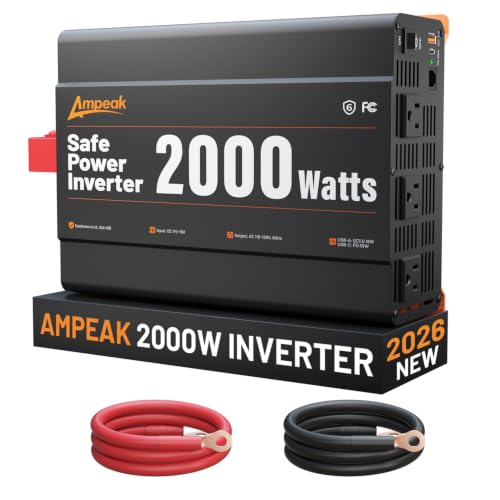
Ampeak 2000W inverter, 4000W surge, 3 AC, 30W PD, 18W QC
2000W continuous4000W surge3 AC outlets89% efficiency
Check price on Amazon
Best for: RV owners who run heating-element appliances and want plenty of outlets and USB ports.

Three AC outlets and fast USB ports distinguish this 2000W Ampeak. It offers a 30W PD USB-C port and an 18W QC 3.0 port, which handle phones and tablets in an RV without a charger brick. The listing states an 89 percent conversion efficiency, a candid figure that is lower than the 93 to 95 percent claimed by others.

Six protections cover overload, over-voltage, low voltage and other faults. The waveform is not stated, so treat it as modified sine. That makes it a better fit for a coffee maker, a hair dryer on low or a power tool than for a CPAP or a sensitive TV.

A 2000W draw is about 190A at 12V, so this needs a serious battery bank and heavy cable. It sits in the middle of the price tiers. The lower efficiency means more heat and more battery drain per watt, so it suits occasional heavy use and not constant load. If you want pure sine at 2000W, the options in the off-grid guide are better.

What works

  • Three AC outlets plus PD and QC USB ports
  • 2000W continuous with 4000W surge
  • Efficiency is stated openly at 89 percent
  • Six listed protections

Watch out for

  • Waveform not stated
  • Lower efficiency means more heat and drain
  • Needs a large bank and heavy cable

Spec sheet

Continuous output
2000W
Surge peak
4000W
AC outlets
3
USB
30W PD and 18W QC 3.0
Efficiency
Stated at 89 percent
04
BELTTT 3000W pure sine inverter, 6000W peak, 23ft remote
3000W continuous6000W peakPure sine wave23ft wired remote
Check price on Amazon
Best for: Full-time RV owners with a lithium bank who run a microwave and kitchen appliances.

A 23ft wired remote suits an RV, where the inverter often lives in a basement bay and the switch should be inside. This BELTTT provides 3000W continuous pure sine with 6000W of surge, a bright screen showing input and output and a 20A outlet beside the standard ones. The waveform matches grid power, which suits a microwave, a TV and a residential fridge.

Power of this size needs a serious battery bank. At 3000W, a 12V system draws about 280A, which is why most RV builders with this much inverter run lithium and very heavy cable. Many would prefer a 24V bank at this level to halve the current.

It sits in the upper-middle tier. For a full-time RV owner who wants a microwave, a coffee maker and a laptop, it is capable and well specified. For weekend use, it is more than you need, and the idle draw is a cost. Keep the remote cable routed away from heat and pinch points, and check the hardwire connections each season.

What works

  • Pure sine output at 3000W continuous
  • 23ft remote keeps the switch inside the coach
  • 20A outlet accepts larger plugs
  • Screen shows input and output

Watch out for

  • Full load draws about 280A at 12V
  • Upper-middle price tier
  • Idle draw is high for weekend use

Spec sheet

Continuous output
3000W
Peak surge
6000W
Waveform
Pure sine
Remote
23ft wired
Outlets
Dual AC and 20A
05
FT feiteeng 3500W pure sine inverter, 95% efficiency
3500W continuousPure sine wave95% efficiency claimReverse polarity guard
Check price on Amazon
Best for: RV owners with a very large bank who want a high-capacity pure sine reserve.

Efficiency is the headline for this FT feiteeng, which states 95 percent along with a cooling design to match. The listing also describes comprehensive safety protection that includes reverse polarity, short circuit, overload, over-voltage, under-voltage and overheat. A pure sine output at 3500W continuous makes it the highest-capacity clean unit in this group.

The physical reality at 3500W is a draw of about 330A from a 12V bank. That demands cable the thickness of a thumb, a very large lithium battery and a fuse built for the current. Most RV owners would be better served by a smaller unit, and anyone planning to run air conditioning should consider a 24V or 48V system.

It sits at the upper end of the price tiers. If you truly need a reserve for several loads at once, the stated efficiency helps. For everyone else, the OYPSX 1000W or the BELTTT 3000W is the more realistic choice. Mount it in a ventilated bay and plan the cable run before you buy, because the wiring costs real money at this current.

What works

  • Pure sine output at 3500W continuous
  • Efficiency stated at 95 percent
  • Reverse polarity and five other protections
  • Suits RV, truck and solar installs

Watch out for

  • Full load draws about 330A at 12V
  • Top price tier
  • Far more inverter than most RVs can feed

Spec sheet

Continuous output
3500W
Waveform
Pure sine
Efficiency
Stated at 95 percent
Protections
Reverse polarity, short, overload, over/under voltage, overheat
Use
RV, camping, home, truck, solar

Spec sheet decoder

What the numbers on the box really mean

The specs manufacturers lead with, translated into what they tell you about real-world performance.

Continuous watts

The load the inverter carries for hours. It limits the appliances you can run.

Watch forEven the 3500W FT feiteeng is limited by the bank behind it.

Surge watts

A brief startup allowance of a second or two.

Watch forThe Ampeak lists 4000W surge and the BELTTT 6000W peak.

Efficiency

The share of battery energy that becomes AC. Losses become heat.

Watch forThe Ampeak states 89 percent and the FT feiteeng 95 percent.

Reverse polarity guard

A guard against connecting the battery cables backwards.

Watch forThe JARXIOKE and FT feiteeng list it.

Pure sine

A smooth AC waveform equal to grid power.

Watch forThe Ampeak does not state it.

Methodology

How We Evaluated These Inverters for RV Camping

Fit to RV loads

We matched each unit to RV loads: a TV, a laptop, a CPAP, a microwave and a coffee maker. The JARXIOKE 500W suits light loads, the OYPSX 1000W suits a typical coach, and the BELTTT 3000W suits a full kitchen.

Waveform and efficiency

We credited stated pure sine and stated efficiency. The FT feiteeng leads with 95 percent, and the Ampeak states 89 percent honestly. Unstated waveforms were treated as modified, which matters for a coach with a TV, a CPAP and a residential refrigerator.

Battery realism

We computed full-load current for each unit, from about 45A to about 330A. A unit whose rating exceeds what an RV house bank can supply was marked down.

Installation features

We looked for remotes, reverse polarity protection and dual connection modes. The BELTTT includes a remote and the JARXIOKE has reverse polarity protection and a lighter-plug option.

Ownership

We considered idle draw, fan noise and terminal upkeep in a bay that sees vibration. A smaller unit wastes less. Larger units demand more cable checks, since a basement bay sees road vibration for hours every trip and loosens lugs faster than a home install ever would.

Decision guide

How to Choose the Right Inverters for RV Camping

By RV Size

SituationPickWhy
Small trailer or vanJARXIOKE 500WLight loads and CPAP
Typical travel trailerOYPSX 1000WTV, laptop and small microwave
Heating-element appliancesAmpeak 2000W2000W with three outlets
Large coach, lithium bankBELTTT 3000W3000W with remote
Very large bankFT feiteeng 3500W3500W with 95 percent efficiency

By Budget

SituationPickWhy
Lowest tierJARXIOKE 500WPure sine and honest
Lower-middleOYPSX 1000WPure sine at 1000W
MiddleAmpeak 2000WOutlets and USB
Upper-middleBELTTT 3000WRemote and 20A outlet
UpperFT feiteeng 3500WHighest capacity

Plug-In vs Hardwired

Plug-in

The JARXIOKE 500W, OYPSX 1000W and Ampeak 2000W power loads through their own outlets. It is simple and portable, but extension cords cross the coach.

Hardwired

The BELTTT 3000W and FT feiteeng 3500W suit permanent installs feeding coach outlets through a transfer switch. It is tidy and safe when done correctly.

Choose plug-in for light loads, and hardwire with a transfer switch for a coach.

Battery Bank

SituationPickWhy
One 100Ah batteryJARXIOKE 500WAbout 45A at full load
Two 100Ah batteriesOYPSX 1000WAbout 90 to 100A
300Ah lithiumAmpeak 2000WAbout 190A
400Ah lithiumBELTTT 3000WAbout 280A
Very large lithium bankFT feiteeng 3500WAbout 330A

For a Microwave Specifically

Look for

A pure sine output and a continuous rating at least 1.5 times the microwave's input watts. A small microwave listed at 700W cooking power draws about 1000W from the wall, so choose at least a 1000W inverter and a bank that can supply about 90 to 100A.

In this comparison

The OYPSX 1000W is the minimum for a small microwave. The BELTTT 3000W runs a larger one with headroom for another load.

When to Spend More

Spend more if

You live in the RV, run a microwave daily or want a remote. The BELTTT 3000W and the FT feiteeng 3500W bring clean power and reserve.

Save if

Your loads are a TV, laptops and lights. The JARXIOKE 500W and OYPSX 1000W cover those at lower tiers.

Ownership

Maintenance schedule

The upkeep that decides whether this machine lasts two seasons or ten.

TaskIntervalWhy it matters
Check terminals and lugsEvery 3 monthsVibration loosens connections. A hot lug at high current is a fire risk. Wipe each lug with a clean rag and look for green corrosion.
Clean the ventsEvery 3 monthsDust blocks airflow in a basement bay. Use compressed air, and check that nothing is stored against the intake.
Inspect fuse and cableEvery 6 monthsCorroded holders and chafed insulation add resistance. Replace as needed.
Test the transfer switchOnce a yearConfirm the switch isolates inverter output from shore power. This is a safety item. Walk through the wiring diagram once a year so you remember how it works.
Switch off when idleEvery dayIdle draw drains the house bank. Use the remote or the switch, and make it a habit at the end of each evening.

FAQ

Frequently Asked Questions

What size inverter do I need for an RV?

Most RVs need 1000 to 2000W for a TV, laptops and a small microwave. Add up your loads and size to the bank. A larger inverter idles higher, which matters when the sun is not available to refill the bank.

Can I run my RV air conditioner on a 12V inverter?

No. A rooftop air conditioner needs far more than these units can supply, and the 12V current would be enormous. Use shore power or a generator. A soft-start kit on the air conditioner can reduce the surge but does not change the running power.

Is pure sine worth it for an RV?

For a TV, microwave and CPAP, yes. For simple heating appliances, modified sine works. The OYPSX 1000W is a pure sine choice. Pure sine also tends to run quieter, which matters in a small coach.

Can I connect the inverter to my shore power inlet?

No. That can backfeed the pedestal and is dangerous. Use a transfer switch or an inverter with a built-in one. Check the wiring diagram in the manual before touching anything.

How long will my battery last?

Two 100Ah batteries hold about 2400Wh, which runs a 1000W load for about two hours. Smaller loads last proportionally longer, though idle draw and cable losses trim the real figure. Avoid draining lead-acid batteries below half.

Do I need a fuse?

Yes. Fit a fuse on the positive cable near the battery, sized above the full-load current and below the cable's rating. The fuse protects the wire, so never fit one larger than the cable can carry.

Bottom line

The short version

Browse more inverters for rv campingon Amazon →
James Miller, Lead Machine Editor

About the author

James Miller

Lead Machine Editor, MachineFanatic

James Miller leads MachineFanatic's buying guides, turning spec sheets, manuals and owner feedback into clear verdicts on power tools, outdoor power equipment, shop machines and kitchen machines.

More from James →

Keep reading

Related guides