
Amazon affiliate links - we earn a commission.Affiliate disclosure

Buying guide · 12 min read · Updated 2026-11-13

Best 300W Solar Generators (2026)

Five 300W solar generators compared on real watt-hours, panel pairing, chemistry and what they will actually run on a weekend trip or a short outage.

James MillerBy James MillerLead Machine Editor5 machines comparedSpec-sheet verified
Best 300W Solar Generators

At a glance

Our top picks

Side by side

Spec comparison

A 300 watt solar generator sits in the sweet spot between a glorified power bank and a real appliance battery. It will keep phones, laptops, a router, camera batteries, a CPAP and LED lighting alive through a night, and it will do it quietly, with no fuel and no exhaust. What it will not do is heat anything.

The label number only describes the inverter. How long the unit lasts is set by the watt-hour rating, and how fast the included panel refills it is set by the panel wattage and the sun. Most buying mistakes in this class come from reading the first number and ignoring the other two.

Before you buy

6 Criteria to Look For Before Buying a 300W Solar Generator

  1. 01

    Watt-hours decide runtime

    The 300W figure is the inverter limit, while runtime comes from the watt-hour pack. Multiply capacity by about 0.85 for inverter losses, then divide by the load. The EnginStar at 296Wh runs a 30W router for roughly 8 hours, while the ALLWEI at 256Wh gets closer to 7 hours. Buyers who compare only the 300W label often pick the smaller battery by accident.

  2. 02

    Chemistry and cycle life

    LiFePO4 cells commonly hold 2,000 or more cycles before dropping to 80 percent, while standard lithium-ion packs are often rated 500 to 800. The ALLWEI and yewpiny use LiFePO4; the ZeroKor and EnginStar use lithium-ion. If you will cycle the unit weekly, LiFePO4 saves a replacement. If it only sits as outage insurance, the lithium-ion price saving makes sense.

  3. 03

    Panel wattage in the bundle

    Panel labels are rated under lab conditions, and field output is usually 60 to 80 percent of the label. A 40W panel like the one bundled with the Jackery gives about 25 to 30W of real harvest, so a 292Wh pack needs several sunny days to fill. The ZeroKor's 60W panel is the best bundled option here. Never expect a single small panel to be your only recharge.

  4. 04

    USB-C power delivery

    Charging a laptop through the AC inverter wastes power, while a PD port feeds it directly. The yewpiny offers 65W, the Jackery 100W and the ALLWEI 60W. A 65W laptop charger on a 60W port will charge slowly or fall back to battery draw. Match the port to your charger wattage before choosing.

  5. 05

    Output wave and surge

    Pure sine output is the safe choice for CPAPs, laptop bricks and some chargers, and every unit here claims it. Surge ratings matter only for brief motor starts, such as a fan. The ALLWEI and yewpiny rate 600W peak, which covers a small compressor start, but none can run a kettle, toaster or hair dryer at 1,000W and above.

  6. 06

    Weight and carry reality

    The Jackery at 7.5 lb is a real backpack tool, while the 296Wh EnginStar lands closer to 6.5 lb plus its larger footprint. Over a mile of trail, an extra pound matters more than a 20Wh edge. Weigh the unit with its panel before assuming it fits your kit.

Detailed reviews

The 5 best 300w solar generators, explained

01
Jackery Solar Generator 300 with 40W panel, 292Wh
292Wh300W AC7.5 lb40W panel
Check price on Amazon
Best for: Campers and travelers who want the lightest, best supported 300W unit and mostly charge devices over USB-C.

Jackery's current 300 class unit leans on weight and port quality rather than headline capacity. At 7.5 lb it is the lightest station in this lineup that still carries two pure sine AC outlets, and the 100W USB-C PD port can charge most laptops directly without wasting energy through the inverter. That matters because every conversion from battery DC to AC and back to a laptop brick loses roughly 15 to 20 percent.

The catch is that 292Wh is ordinary for the class, and the 40W panel is the weak link of the bundle. In real sun a 40W panel delivers perhaps 25 to 30W, so refilling an empty battery is a multi-day job rather than a single afternoon. Treat the panel as a top-up for phones and lights, and plan on wall or car charging for a full refill. The ALLWEI below holds less energy but includes more usable panel area per kit in some listings.

Ownership is simple. There are no fans to clog with dust, the shell is compact enough for a backpack side pocket, and the brand's parts and warranty network is the deepest of anything at this size. Store it around half charge in a closet rather than a hot trunk, and run the inverter only when you actually need AC, because an idle inverter keeps drawing power.

What works

  • Lightest unit here at 7.5 lb with two AC outlets
  • 100W USB-C PD charges laptops without the inverter
  • Strong brand support and warranty reach
  • Compact shell fits a daypack or a car door pocket

Watch out for

  • 40W panel is slow for a full recharge
  • 292Wh is average, not a capacity leader
  • Pays a brand premium over similar LiFePO4 units

Spec sheet

Capacity
292Wh
AC output
300W continuous
Weight
7.5 lb station
Outputs
2 AC, 100W USB-C PD, 2 USB-A, car port
Included panel
40W foldable
02
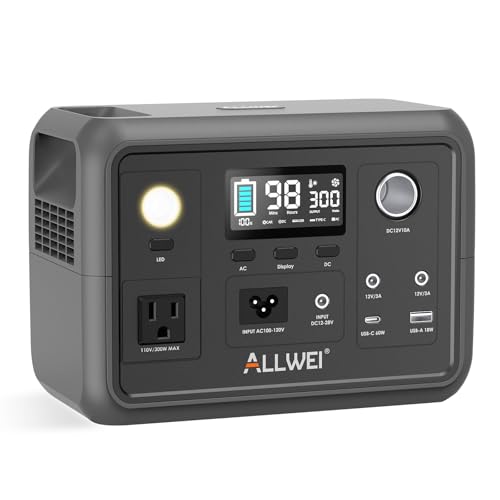
ALLWEI 300W 256Wh LiFePO4 power station
256Wh300W / 600W surgeLiFePO460W PD
Check price on Amazon
Best for: Buyers who cycle the unit often and want LiFePO4 longevity at a modest outlay.

ALLWEI builds this around lithium iron phosphate cells, which is the single most important durability decision in the class. LiFePO4 normally survives well over 2,000 charge cycles before dropping to 80 percent capacity, while the lithium-ion packs in several rivals are rated closer to 500 to 800. For a unit you cycle every camping weekend, that is the difference between a five year tool and a two year one.

The cost is energy density. At 256Wh it holds about 12 percent less than the Jackery Solar Generator 300, and the USB-C port tops out at 60W, so a 65W laptop charger will run it at the edge. The 600W surge rating helps with brief motor starts such as a small fan or a mini fridge compressor, but the continuous limit is still 300W and any load above that trips the inverter.

Upkeep is minimal. LiFePO4 tolerates heat better than lithium-ion, though you should still avoid charging below freezing, which can damage any lithium cell. Keep it between 40 and 60 percent for storage and top it up every few months. The unit ships without the big brand service network, so check return terms before you rely on it as your only backup.

What works

  • LiFePO4 cells rated for thousands of cycles
  • Pure sine AC output suits sensitive chargers
  • 600W surge covers small motor starts
  • Compact enough for a weekend kit bag

Watch out for

  • 60W USB-C is tight for 65W laptop bricks
  • 256Wh is the smallest battery among the 300W picks
  • Thinner service network than the big brands

Spec sheet

Capacity
256Wh
AC output
300W, 600W surge
Chemistry
LiFePO4
USB-C
60W PD
AC wave
Pure sine
03
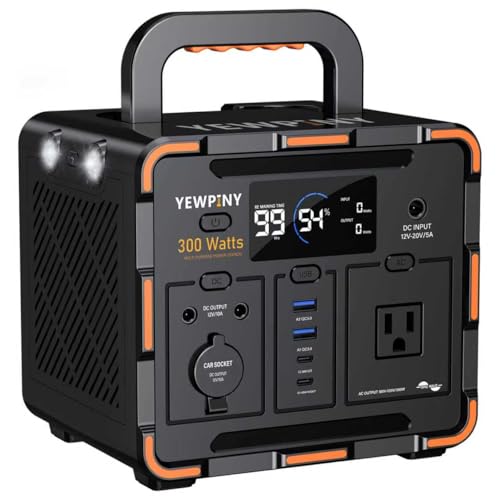
yewpiny EM300 300W 259Wh LiFePO4 station
259Wh300W / 600W peakLiFePO465W PD
Check price on Amazon
Best for: Remote workers who charge a laptop from the station and already own a compatible panel.

The EM300 is the cheapest way here to get LiFePO4 with a 65W USB-C port. That port is the practical highlight: 65W matches the charger of a typical ultrabook, so you can run a laptop from the station without ever touching the AC inverter and its idle drain. The maker claims more than 3,000 cycles, which is a vendor figure and not an independent result, but it is consistent with what LiFePO4 cells of this grade usually deliver.

The weak side is the ecosystem. At 259Wh it sits close to the ALLWEI, and it comes without a bundled panel in this listing, so you must buy and match a solar panel yourself. Check that the panel's open circuit voltage and connector fit the input before you order, because small stations often accept only 12 to 24V and use barrel connectors rather than MC4.

In ownership terms this is a lightweight appliance with few failure points. Leave the vents unobstructed, avoid sealing it inside a hot car, and expect to rely on the seller for warranty service. If you want a one box solution with a panel, the ZeroKor kit below is the easier start; if you already own a 60W to 100W panel, this unit's higher USB-C wattage makes it the better laptop companion.

What works

  • 65W USB-C PD runs an ultrabook without the inverter
  • LiFePO4 pack with a 3,000 cycle claim
  • Pure sine AC for sensitive electronics
  • Light and square, easy to pack

Watch out for

  • No bundled panel in this listing
  • Cycle life claim is a vendor figure
  • Limited track record versus larger brands

Spec sheet

Capacity
259Wh
AC output
300W, 600W peak
Chemistry
LiFePO4, 3000+ cycle claim
USB-C
65W PD
AC wave
Pure sine
04
ZeroKor 300W 280Wh kit with 60W solar panel
280Wh300W AC60W panelPure sine
Check price on Amazon
Best for: First time buyers who want panel and battery in one box and plan modest weekend use.

ZeroKor sells this as a complete kit, and the 60W panel is the reason to pick it. A 60W panel gives you roughly 40 to 50W of real harvest in clear midday sun, so an empty 280Wh pack refills in about two sunny days of use, which is half the time the Jackery's 40W panel would need. For anyone who actually wants to run solar and not just own the label, that is a real difference.

The compromise is build detail. This is a lithium-ion pack, not LiFePO4, so its cycle life will be lower than the ALLWEI or yewpiny, and the finish and software are basic. The built in SOS flashlight is a gimmick that can drain the pack if left on. You also get less safety margin on surge than the units with a 600W peak rating.

For ownership, fold the panel flat, wipe dust off the cells, and store the pack around half full. This works as a first kit for someone testing whether solar suits their weekends, and a poor choice for a unit you plan to cycle daily for years. If you outgrow it, the panel can usually be reused on a larger station with a matching connector.

What works

  • 60W panel refills noticeably faster than 40W kits
  • 280Wh sits above the class average
  • Two pure sine AC outlets
  • Complete kit, nothing extra to source

Watch out for

  • Lithium-ion pack has shorter cycle life than LiFePO4
  • Basic fit and finish
  • Brand has a short service history

Spec sheet

Capacity
280Wh
AC output
300W, 2 outlets
Included panel
60W foldable
Wave
Pure sine
Extras
SOS flashlight, DC port
05
EnginStar 300W 296Wh pure sine power station
296Wh300W AC2 AC outletsLithium
Check price on Amazon
Best for: Light users who want maximum watt-hours per unit of spend for outage insurance.

EnginStar's 296Wh unit packs the most stored energy of any station in this guide into a 9 x 5.5 x 7.5 inch body, and it sits at the cheapest end of the pricing ladder. If your goal is to cover a long night with a CPAP or keep a few devices alive in an outage and you have a wall outlet to recharge from, it delivers that capacity without paying for extras.

What you give up is ruggedness and refinement. There is no LiFePO4 option here, so cycle life is the lower lithium-ion figure, and the unit relies on the standard small station battery management system with little in the way of firmware or app control. It does not include a panel in this listing, so solar use means buying one that matches the input voltage and connector, and the usual advice about keeping Voc below the input limit applies.

Ownership is straightforward: keep it in a cool place, avoid leaving it fully drained for weeks, and give it a partial cycle every few months. Go with it if the budget is tight and the use is occasional, and the one to skip if you intend to cycle it heavily or want a manufacturer with a deep parts bench.

What works

  • 296Wh is the largest battery in this group
  • Two pure sine AC outlets at 300W
  • Compact 9 x 5.5 x 7.5 in body
  • Lowest cost of entry in the lineup

Watch out for

  • No LiFePO4 option, shorter cycle life
  • No panel in this listing
  • Minimal firmware and thin support

Spec sheet

Capacity
296Wh
AC output
300W, 2 outlets
Wave
Pure sine
Size
9 x 5.5 x 7.5 in
Chemistry
Lithium battery

Spec sheet decoder

What the numbers on the box really mean

The specs manufacturers lead with, translated into what they tell you about real-world performance.

300W continuous

The most the AC inverter can supply at once without shutting off. Add up the running watts of everything you plug in.

Watch forResistive heaters and kettles exceed it, so no pick here runs them.

Peak or surge 600W

A brief startup allowance for motors, lasting a second or two. It does not extend the continuous limit.

Watch forThe ALLWEI and yewpiny list 600W, but sustained loads above 300W still trip them.

Wh capacity

Stored energy. Usable runtime is about 85 percent of the number after conversion losses.

Watch forThe EnginStar 296Wh is the largest, the ALLWEI 256Wh the smallest in this guide.

PD wattage

The USB-C port's maximum output. It must meet or exceed what your laptop charger needs.

Watch forThe yewpiny 65W and Jackery 100W suit laptops; the ALLWEI 60W is borderline.

Cell chemistry

LiFePO4 offers longer life and better heat tolerance, while lithium-ion is lighter for the same energy.

Watch forOnly the ALLWEI and yewpiny use LiFePO4 here.

Methodology

How We Evaluated These 300W Solar Generators

Capacity against output

We compared stored watt-hours to the advertised 300W output to see which units give a usable runtime. The lineup spans 256Wh to 296Wh. A unit with high output and low capacity is little more than a surge buffer.

Chemistry and cycle life

We checked each listing's stated cell type and cycle claims. Lithium-ion and LiFePO4 packs trade weight for life, so we favored LiFePO4 in the picks that targeted frequent cycling. Vendor cycle numbers are treated as claims, not facts.

Solar pairing

We looked at the panel wattage in each kit and what the input will accept. The Jackery bundles 40W and the ZeroKor 60W, and the others require you to source a panel. Kits that leave the panel out were scored on the clarity of their input limits.

Port quality

We reviewed USB-C PD wattage, AC outlet count and pure sine claims. A laptop that needs 65W was matched against 60W, 65W and 100W ports across the lineup.

Ownership and support

We weighed brand service reach, warranty clarity and likelihood of parts availability. Big names scored higher where that affected the long term cost, but we did not invent track records for newer brands.

Decision guide

How to Choose the Right 300W Solar Generators

By Primary Use

SituationPickWhy
Weekend camping with phones and lightsJackery Solar Generator 300Lightest carry and strong USB-C ports
CPAP overnight in an outageEnginStar 300W 296WhLargest battery here for the longest night runtime
Remote work with a 65W laptopyewpiny EM30065W PD feeds the laptop directly
Frequent weekly cyclingALLWEI 300W LiFePO4LiFePO4 cells built for cycle life
First solar kit, panel includedZeroKor 300W with 60WLargest bundled panel in the group

By Budget

TierPickWhy
Lowest cost of entryEnginStar 300W 296WhMost watt-hours at the cheapest tier
Lower mid tier with LiFePO4ALLWEI 300W LiFePO4LiFePO4 at an accessible tier
Mid tier with panelZeroKor 300W with 60WPanel and station together
Upper tieryewpiny EM300Best USB-C wattage with LiFePO4
Highest tier in this guideJackery Solar Generator 300Premium for brand support and weight

LiFePO4 vs Lithium-Ion

LiFePO4

Offers far more cycles, usually above 2,000, and handles heat better, but weighs more per watt-hour. The ALLWEI and yewpiny use it. Choose it if the unit sees weekly use or lives in a hot garage or vehicle.

Lithium-ion

Lighter and denser, but typically rated 500 to 800 cycles. The ZeroKor and EnginStar use it. It suits outage insurance and rare trips where capacity and low weight matter more than longevity.

Heavy cyclists should pick the ALLWEI; occasional users can take the ZeroKor or EnginStar.

Panel Included vs Panel Separate

PreferencePickWhy
Everything in one boxZeroKor 300W with 60WStation and larger panel ship together
Smaller panel, brand safetyJackery Solar Generator 30040W panel with brand support
Already own a panelyewpiny EM300No panel needed, best USB-C power
Prefer to choose your ownEnginStar 300W 296WhLarge pack, bring your own panel
LiFePO4 with panel purchased laterALLWEI 300W LiFePO4Efficient pack, panel is separate

For CPAP and Medical Backup Specifically

Look for

Pure sine output, a pack sized to your device's draw times the hours needed, and low idle drain. A CPAP without a humidifier draws about 30 to 40W, so a 256Wh pack gives roughly 5 to 6 hours of use.

In this comparison

The EnginStar 296Wh offers the longest runtime, and the ALLWEI holds a LiFePO4 pack that handles repeated nightly cycling. Only the manufacturer of your device can approve a station for medical use, so check the unit against your device's manual.

When to Spend More

Spend more if

You need dependable service, travel often, or want the lightest pack. The Jackery Solar Generator 300 costs more but brings support and the best ports. Step up to a 500W unit if your gear draws over 250W.

Save if

You use the unit a few times a year. The EnginStar 296Wh and ZeroKor kit give workable capacity at a lower outlay, and the compromise is shorter cell life.

Ownership

Maintenance schedule

The upkeep that decides whether this machine lasts two seasons or ten.

TaskIntervalWhy it matters
Check state of chargeEvery 3 monthsLithium cells lose a few percent monthly in storage. Top up to about 50 to 60 percent to avoid deep discharge.
Wipe panel surfaceBefore each tripDust and pollen can cut output by 10 percent or more. Use a soft cloth, never abrasive cleaners.
Inspect cables and portsEvery 6 monthsLoose barrel connectors cause heat and drop charge current. Replace any frayed lead.
Run a full cycleOnce per yearA full discharge and recharge lets you confirm real capacity against the label.
Store cool and dryAlwaysHeat above 40 C accelerates cell wear, and freezing prevents safe charging. Avoid car trunks in summer.

FAQ

Frequently Asked Questions

Can a 300W solar generator run a mini fridge?

Many small compressor fridges draw about 40 to 60W while running with a short surge when the compressor starts, so a 300W unit can carry one for several hours. A 256Wh pack gives about 4 to 6 hours of fridge runtime depending on the thermostat cycle.

Is 300W enough for a laptop and phone?

Yes. A laptop usually draws 45 to 65W and a phone about 10W, so a 300W station powers both at once with room to spare. Use the USB-C PD port instead of the AC outlet for better efficiency.

Should I buy LiFePO4 or lithium-ion at this size?

Buy LiFePO4 if you will cycle the unit weekly, because it is rated for thousands of cycles rather than hundreds. If it is mainly outage insurance, a lithium-ion unit like the EnginStar saves money and gives more capacity.

How long does a 40W panel take to charge a 292Wh unit?

Real output from a 40W panel is often 25 to 30W, so a full recharge needs roughly 10 to 12 hours of solid sun, which usually means two or three days. A 60W panel cuts that nearly in half.

Does the 300W rating include the surge?

No. The 300W number is continuous. Surge ratings, such as 600W on the ALLWEI, cover only a short startup spike. If your continuous load is above 300W the inverter trips.

Can I use these units on a plane?

Not generally. Airlines limit carry-on lithium batteries to 100Wh, with 160Wh the maximum with approval, and every unit here exceeds that. Plan to drive them or ship them under cargo rules.

Bottom line

The short version

Browse more 300w solar generatorson Amazon →
James Miller, Lead Machine Editor

About the author

James Miller

Lead Machine Editor, MachineFanatic

James Miller leads MachineFanatic's buying guides, turning spec sheets, manuals and owner feedback into clear verdicts on power tools, outdoor power equipment, shop machines and kitchen machines.

More from James →

Keep reading

Related guides