

Amazon affiliate links - we earn a commission.Affiliate disclosure

Buying guide · 12 min read · Updated 2026-11-07

Best 2000W Solar Generators (2026)

Six 2000W class solar generators compared on inverter output, expandable capacity, charge speed, UPS switchover and solar input for home backup and RV use.

James MillerBy James MillerLead Machine Editor6 machines comparedSpec-sheet verified
Best 2000W Solar Generators

At a glance

Our top picks

Side by side

Spec comparison

Stations in this power class can finally run the loads people actually care about in an outage, such as a microwave, a coffee maker, a sump pump or power tools. The inverter, not the battery, is what changes at this tier.

The trap is that big inverters drain small batteries fast. A strong output paired with modest storage gives you power for minutes, so the useful question is how much energy sits behind the watts and whether you can add more later.

Before you buy

6 Criteria to Look For Before Buying a 2000W Solar Generator

  1. 01

    Inverter watts versus battery size

    Every unit here has a 2000 to 2400 watt inverter, but storage ranges from 1024Wh on the OUPES and Anker to 1843.2Wh on the EBL. At full 2000 watt load, 1024Wh lasts about 25 to 30 minutes after losses. Match the battery to your daily energy, not to the biggest appliance. Buyers often overpay for a huge inverter and then discover the battery empties before breakfast, so shop the watt-hours first and the watts second.

  2. 02

    Surge for motor loads

    Compressors and pumps draw several times running watts at startup. The OUPES Mega 1 lists 4500 watt surge, the Anker 3000 watt peak. If you run a fridge, sump pump or table saw, the surge number decides whether it trips, so compare it to the appliance's locked-rotor rating.

  3. 03

    Expansion path

    The Mega 1 expands to 5120Wh and the ABOK Ark2000 to 4608Wh with extra batteries. Expansion lets you start small and scale up, but buy only if you will actually expand. Check that the expansion batteries are currently sold, since proprietary connectors lock you in.

  4. 04

    Solar input and panels

    The ABOK accepts 1200W of solar input while the kits ship with only 100W to 200W panels. A 100W panel gives roughly 60 to 80 watts in real sun. To refill a 1024Wh station in a day you need 300W or more, so budget for extra panels. Also check the panel's open-circuit voltage against the station's input window, because an over-voltage panel can trip protection or damage the input.

  5. 05

    UPS switchover time

    For a desktop or router, a switchover under 20 milliseconds, as the OUPES Lite lists, can keep it running. The EBL's 0.1 seconds is 100 milliseconds and may cause a reboot. If you work from home, test your own equipment.

  6. 06

    Charge time from the wall

    The OUPES Mega 1 claims 0 to 80 percent in 36 minutes, while slower stations take hours. Faster charging matters in storm season, when grid power returns briefly. It also means the unit is ready sooner after a long outage. It is also worth confirming whether the station can charge from a gas generator, since that is the practical backup when solar is blocked by a week of cloud.

Detailed reviews

The 6 best 2000w solar generators, explained

01
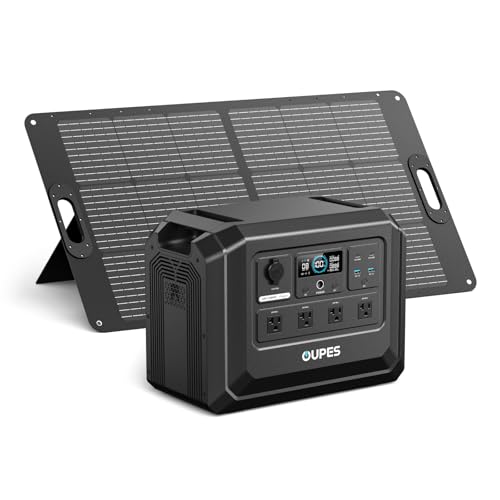
OUPES Mega 1 Solar Generator with 100W Panel
2000W AC4500W surge1024Wh LiFePO45kWh expandable
Check price on Amazon
Best for: Buyers who want expandable storage and a high surge rating.

The Mega 1 starts as a 1024 watt-hour LiFePO4 station with a 2000 watt pure sine inverter and a stated 4500 watt surge, which is a big allowance for motor loads. Its defining feature is that you can grow it, with listed expansion batteries that take the total to 5120 watt-hours.

That modularity changes the buying logic. A fixed 1024Wh pack running a microwave at 1000 watts lasts under an hour, but a five-battery system lasts several. The listing also claims 0 to 80 percent in 36 minutes from the wall, one of the fastest charge claims in this class.

The 100W panel in this kit is small for a unit this size, so plan to add more. Compared with the Anker C1000 Gen 2 at 3000 watt peak, the Mega 1 offers a far higher surge. It suits someone building a home backup in stages.

What works

  • 4500W surge handles motor startup
  • Expandable from 1024Wh to 5120Wh
  • Fast 36 minute wall charge to 80 percent
  • LiFePO4 cells for long cycle life

Watch out for

  • Included 100W panel is small for the station
  • Expansion batteries add to the total cost

Spec sheet

AC output
2000W, 4500W surge
Capacity
1024Wh LiFePO4
Expansion
Up to 5120Wh
AC charge
0 to 80% in 36 minutes
Panel included
100W
02
OUPES Mega 1 Lite Solar Generator with 100W Panel
2000W rated1024Wh LiFePO4<20 ms UPS100W panel
Check price on Amazon
Best for: Buyers who want a 2000W inverter and UPS switchover without expansion.

The Lite version keeps the 2000 watt inverter and the 1024 watt-hour LiFePO4 pack but trims the feature list, adding a listed under 20 millisecond UPS switchover. That makes it a candidate for a desktop computer or a router that should not drop during a blackout.

Its bi-directional inverter lets the wall charge it quickly, and the included 100W foldable panel converts up to 23 percent of sunlight. A 100W panel yields roughly 60 to 80 watts in real sun, so it is a trickle for a pack this size, but it is enough to keep a small load alive.

Where the full Mega 1 lists 4500 watt surge and a path to 5 kWh, the Lite is the simpler purchase for someone who just wants the 2000 watt class at a lower price. The tradeoff is the lack of listed expansion. It suits a camper or a small outage kit.

What works

  • 2000W inverter in a compact kit
  • Under 20 ms UPS switchover listed
  • Fast recharge from the wall
  • Panel included for first-day solar use

Watch out for

  • No stated expansion path
  • 100W panel refills only slowly

Spec sheet

AC output
2000W rated
Capacity
1024Wh LiFePO4
UPS
Under 20 ms switchover
Solar panel
100W, up to 23% efficient
Charge
Bi-directional inverter
03
Anker SOLIX C1000 Gen 2 with 200W Panel
2000W AC3000W peak1024Wh9 ports
Check price on Amazon
Best for: Buyers who want brand support and a bigger included panel.

Anker gives the C1000 Gen 2 a 2000 watt inverter with a 3000 watt peak and nine output ports from a 1024 watt-hour battery. The company calls it 14 percent smaller and 11 percent lighter than comparable units, which is a useful claim if you carry it often.

The 200W panel in this kit doubles the OUPES kits' panel size, so a sunny day refills noticeably more. The panel ships separately, a detail worth watching when it arrives. Its 3000 watt peak is below the Mega 1's 4500, so a fridge compressor or a well pump with heavy startup could trip it first.

Anker's strength is brand support and app polish. It is the safer pick for someone who wants clear warranty terms. It suits a home backup for a fridge, router and lights.

What works

  • 200W panel included for faster solar refill
  • Nine ports cover many devices
  • Smaller and lighter than comparable units
  • Strong brand support

Watch out for

  • 3000W peak is under the Mega 1
  • Panel ships separately from the station

Spec sheet

AC output
2000W, 3000W peak
Capacity
1024Wh
Ports
9 output ports
Size
14% smaller, 11% lighter than similar
Panel included
200W, shipped separately
04
ABOK Ark2000 with 200W Solar Panel
1536Wh2000W AC2400W A-Boost1200W solar in
Check price on Amazon
Best for: Buyers who want more stored energy in the base unit.

ABOK ships the Ark2000 with 1536 watt-hours, half again the OUPES and Anker base capacity, plus a 2000 watt inverter with a 2400 watt boost mode for resistive loads. The extra storage makes it better at running a microwave and fridge together.

Its solar input is 1200 watts, so with extra panels it recharges fast, though the included 200W panel uses a fraction of that. The listing also says you can add expansion batteries to reach 3072Wh or 4608Wh, a route to a real home backup system.

The brand is newer, so support and replacement paths deserve a check. Compared with the Anker at 1024Wh, you get 50 percent more energy in one box. It suits someone who wants more runtime on day one.

What works

  • 1536Wh is the largest base capacity here
  • Accepts up to 1200W of solar input
  • Expandable to 3072Wh or 4608Wh
  • 2400W boost mode for resistive loads

Watch out for

  • Newer brand with a thinner support record
  • Boost mode is for heating loads only

Spec sheet

Capacity
1536Wh
AC output
2000W continuous
Boost mode
2400W A-Boost
Expansion
Up to 4608Wh
Solar input
1200W
05
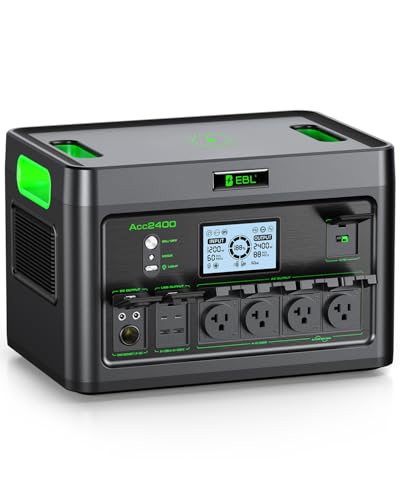
EBL 2400W 1843.2Wh Portable Power Station
1843.2Wh LiFePO42400W output0.1 s switchover12 devices
Check price on Amazon
Best for: Households that want a large battery with a 2400W inverter.

EBL's Acc2400 stores 1843.2 watt-hours in a LiFePO4 pack and outputs 2400 watts, a step above the 2000 watt class on both counts. It lists an intelligent emergency mode that switches to battery in 0.1 seconds during a blackout, which protects a desktop computer if the time claim holds.

It can charge 12 devices at once, so it works for group camping. At 1843Wh it holds almost twice what the OUPES Mega 1 base unit does, though at 2400 watts it will drain in under an hour at full load.

A 0.1 second switch is 100 milliseconds, so it is slower than the OUPES Lite's under 20 millisecond claim, and a desktop PC may still reboot. Keep that in mind if the UPS function matters. It suits a household backup of a fridge, router and lights.

What works

  • 1843.2Wh capacity is the largest listed
  • 2400W output beats the 2000W class
  • Lists a 0.1 second emergency switchover
  • Twelve ports for group use

Watch out for

  • 0.1 second switchover is slower than the OUPES Lite claim
  • Heavier than the 1024Wh units

Spec sheet

Capacity
1843.2Wh LiFePO4
AC output
2400W
Switchover
0.1 seconds
Ports
12 simultaneous devices
Use
Home backup and camping
06
2400W 1843.2Wh LiFePO4 Home Battery Backup Station
1843.2Wh LiFePO42400W outputTwo side handlesPanel optional
Check price on Amazon
Best for: Budget buyers who want a large LiFePO4 battery and will add panels later.

This unbranded station lists the same 1843.2 watt-hour LiFePO4 pack and 2400 watt output as the EBL, which suggests a shared design underneath. The listing stresses a compact body with a handle on each side, a small but real convenience when two people lift a heavy pack.

The solar panel is optional here, and the listing names a 200W panel as a possible input alongside the wall and a car charger. That means the headline price excludes a panel, so a fair comparison with the kits above needs an extra purchase. With one 200W panel, refilling 1843Wh takes the better part of two sunny days.

It is the route to a large battery at a lower cost, but the support path is the unknown. Keep the receipt, record the serial number and test the output with a known load on day one. It suits a buyer who wants the biggest battery in this class for the least money and will supply panels separately.

What works

  • 1843.2Wh matches the largest pack here
  • 2400W output exceeds the 2000W class
  • A handle on each side eases the two-person lift
  • LiFePO4 chemistry for long cycle life

Watch out for

  • Panel is optional and costs extra
  • Unbranded with an unclear support path

Spec sheet

Capacity
1843.2Wh LiFePO4
AC output
2400W
Handles
One on each side
Solar input
200W panel optional
Other inputs
AC wall and DC car charger

Spec sheet decoder

What the numbers on the box really mean

The specs manufacturers lead with, translated into what they tell you about real-world performance.

2000W continuous

The steady output the inverter can hold. It decides which appliances can run together.

Watch forThe EBL lists 2400W, above the others.

Surge watts

The allowance for motor startup lasting a moment. It is not a continuous rating.

Watch forThe Mega 1 lists 4500W and the Anker 3000W.

Wh capacity

Stored energy. Runtime equals Wh times about 0.85 divided by load watts.

Watch forBase units range from 1024Wh to 1843.2Wh.

A-Boost

A mode that raises output for resistive loads by lowering voltage.

Watch forThe ABOK lists 2400W in this mode, which is unsuitable for electronics.

Solar input

The most solar power the station can accept. It limits recharge speed.

Watch forThe ABOK accepts 1200W, far above the panels bundled in the kits.

Methodology

How We Evaluated These 2000W Solar Generators

Inverter and surge

We compared continuous and surge ratings from the spec sheets. The OUPES Mega 1 at 4500W surge led, and the EBL at 2400W continuous led output. Units with no surge rating lost points.

Capacity and expansion

We scored base capacity and listed expansion paths. The EBL at 1843.2Wh and the ABOK at 1536Wh led base capacity. The Mega 1 and ABOK both list expansion batteries.

Charging

We read AC and solar charging claims. The OUPES 36 minute wall claim and the ABOK 1200W solar input are the standouts. Slow wall charging was marked down.

UPS behavior

We credited stated switchover speeds. The OUPES Lite lists under 20 ms and the EBL lists 0.1 seconds. Units without a time were scored neutrally.

Support and brand

We weighed support using owner feedback patterns. Anker and OUPES sell through established channels. Newer labels carried more risk, so keep receipts.

Decision guide

How to Choose the Right 2000W Solar Generators

By Primary Use

SituationPickWhy
Home backup in stagesOUPES Mega 1Expands to 5120Wh with 4500W surge
Desktop and router UPSOUPES Mega 1 LiteUnder 20 ms switchover
Compact kit with a bigger panelAnker SOLIX C1000 Gen 2200W panel and nine ports
Longest runtime in one boxABOK Ark20001536Wh base capacity
Whole-day fridge and lightsEBL 2400W1843.2Wh capacity
RV microwave and coffeeABOK Ark20002400W A-Boost for resistive loads
Budget big battery2400W 1843.2Wh stationSame capacity class as the EBL

By Budget

TierPickWhy
LowerOUPES Mega 1 Lite2000W at a lower tier
Lower to middleAnker SOLIX C1000 Gen 2Brand support
MiddleABOK Ark2000Extra capacity
Middle to upperEBL 2400WLargest battery
UpperOUPES Mega 1Expansion and surge
HighestOUPES Mega 1 with extra batteriesScales to 5120Wh
Lower for capacity2400W 1843.2Wh stationBig battery without a bundled panel

Fixed Capacity vs Expandable

Fixed capacity

The Anker and EBL are single units. You buy the energy you need and carry nothing extra, which suits camping and short outages.

Expandable

The OUPES Mega 1 and ABOK Ark2000 accept extra batteries. You start small and grow, but the expansion batteries cost extra and need proprietary connectors.

Short-outage users should pick fixed units, and whole-house backup builders should pick expandable ones.

Solar Panel Needs

PreferencePickWhy
Bigger panel in the boxAnker SOLIX C1000 Gen 2200W panel included
Highest solar ceilingABOK Ark20001200W solar input
Panel for a light loadOUPES Mega 1 Lite100W panel included
Add panels laterOUPES Mega 1Expandable ecosystem
Large battery to refillEBL 2400WNeeds several panels for a day refill
Wall charge insteadOUPES Mega 136 minutes to 80 percent

For Home Outage Backup Specifically

Look for

A fast switchover, enough surge for the fridge compressor and enough watt-hours for the night. A fridge uses roughly 1 to 2 kWh a day, so a 1024Wh unit alone covers only half a day.

In this comparison

The EBL 2400W with 1843.2Wh or the ABOK Ark2000 with 1536Wh give the most overnight energy, while the OUPES Mega 1 offers the best growth path.

When to Spend More

Spend more if

You want a system that grows or a high surge. The OUPES Mega 1 with expansion batteries gives the best long-term path.

Save if

You only need a few hours of backup. The OUPES Mega 1 Lite or Anker C1000 Gen 2 cover short outages.

Ownership

Maintenance schedule

The upkeep that decides whether this machine lasts two seasons or ten.

TaskIntervalWhy it matters
Store at partial chargeWhen idle over a monthHalf charge reduces stress on cells. A full or empty pack ages faster.
Cycle the batteryEvery 3 monthsA light discharge and recharge keeps the management system calibrated. It also finds problems before an outage. It also gives a chance to run the fans and confirm they spin freely.
Check connectorsEach seasonCorroded solar plugs and loose expansion ports lose power. Clean them and recheck seating.
Keep vents clearEvery useA 2000W inverter makes heat. Blocked vents cut output and shorten fan life.
Test the UPS modeTwice a yearUnplug the wall input with a test load. It confirms the switchover works with your gear.

FAQ

Frequently Asked Questions

Can a 2000W solar generator run a refrigerator?

Yes, easily, and most can run it for many hours. A fridge averages about 100 watts but needs a surge at startup that the 3000W to 4500W peaks cover. For a typical 20 cubic foot fridge, plan on 1 to 2 kWh per day, so check that your battery size covers the night and not just the startup moment.

How long will it run a microwave?

A 1000 watt microwave on a 1024Wh station runs roughly 50 minutes after losses. The 1843.2Wh EBL roughly doubles that. Remember that heavy loads also drain the pack faster than the simple math suggests because the inverter wastes some energy as heat, so the real runtime is a little shorter.

Is LiFePO4 important at this size?

Yes. These units cycle often and LFP cells tolerate more cycles and heat than standard lithium-ion. That is what makes the OUPES, ABOK and EBL last.

How many panels do I need?

A 1024Wh station needs 300W to 400W of panels for a good day refill. The 100W kits only trickle charge, so budget for more. A larger array also shortens the time your generator spends in the low-charge range, which is gentler on the cells.

Does the UPS function protect a desktop computer?

Only if it switches fast enough. The OUPES Lite lists under 20 milliseconds, which most computers tolerate. The EBL lists 0.1 seconds, so test it with your own machine.

Is the 2400W boost mode safe for everything?

No. Boost modes lower voltage to raise watts and suit heating loads like kettles. Do not use them for computers or medical gear.

Bottom line

The short version

Browse more 2000w solar generatorson Amazon →
James Miller, Lead Machine Editor

About the author

James Miller

Lead Machine Editor, MachineFanatic

James Miller leads MachineFanatic's buying guides, turning spec sheets, manuals and owner feedback into clear verdicts on power tools, outdoor power equipment, shop machines and kitchen machines.

More from James →

Keep reading

Related guides