
Amazon affiliate links - we earn a commission.Affiliate disclosure

Buying guide · 12 min read · Updated 2026-11-13

Best 600W Solar Generators (2026)

Five 600W solar generators compared on tank size, LiFePO4 life, UPS speed and bundled panels, so you can match one to a real night of loads.

James MillerBy James MillerLead Machine Editor5 machines comparedSpec-sheet verified
Best 600W Solar Generators

At a glance

Our top picks

Side by side

Spec comparison

The 600 watt class is where portable stations stop being camping toys and start behaving like small appliance batteries. They can carry a television, a laptop setup, a fridge compressor and lighting together, and several include the fast switchover needed to bridge a short power cut.

Units in this class share a nominal inverter size but differ widely in tank size, which can range from small packs to double the energy. That spread, plus chemistry and bundled panels, is what separates a unit that lasts a night from one that lasts a late afternoon.

Before you buy

6 Criteria to Look For Before Buying a 600W Solar Generator

  1. 01

    Tank size versus inverter size

    All five picks carry roughly a 600W inverter, but tanks range from 288Wh to 640Wh. At a 100W load the LIBRIDS runs about 5.4 hours, while the Pecron, DaranEner and Bluetti run about 2.4. Always size to watt-hours first, then confirm the inverter covers your largest device.

  2. 02

    LiFePO4 versus standard lithium

    The LIBRIDS, Pecron, DaranEner and Bluetti use LiFePO4 or LFP chemistry, which is commonly rated for 2,000 or more cycles. The yewpiny does not advertise it and should be treated as a normal lithium pack. If you cycle weekly, the extra cycles save a replacement within five years.

  3. 03

    Panel size and real harvest

    Panel labels overstate output because real sunlight and temperature cut it to 60 to 80 percent of rating. The Pecron's 100W panel gives about 60 to 80W, the DaranEner's 80W about 50 to 60W. A 288Wh pack therefore refills in 4 to 6 hours of strong sun, which sets whether you can cycle it daily.

  4. 04

    UPS and switchover

    Only the LIBRIDS and Bluetti list a 10ms UPS. That is fast enough to avoid a desktop reboot or router blink when the grid drops. Without it, a plugged in router may restart, and a computer will shut off. For a home office backup, this feature matters more than the extra watts.

  5. 05

    Recharge from the wall

    The Bluetti reaches 80 percent in 45 minutes, while the DaranEner takes about 2 hours via a 120W input. After an outage, a quick turnaround lets you reuse the unit if power fails again. If your area suffers repeated brief outages, recharge speed becomes critical.

  6. 06

    Resistive loads

    Kettles, toasters and hair dryers commonly draw 1,000W to 1,800W, well over a 600W inverter. Only the Bluetti's Power Lifting mode can run some of them, at reduced output voltage, and only for minutes. Check the appliance label wattage; if it exceeds the continuous rating the unit trips.

Detailed reviews

The 5 best 600w solar generators, explained

01
LIBRIDS C600 640Wh 600W LiFePO4 power station
640Wh LiFePO4600W / 1200W peak4 AC outlets10ms UPS
Check price on Amazon
Best for: Home outage backup for a router, lights, fan and small fridge with real overnight runtime.

LIBRIDS pairs the largest tank of the group with a LiFePO4 cell and a 10ms UPS, which is why it leads. Its 640Wh gives about 540Wh of usable AC energy, enough to run a 60W load for roughly nine hours or a 100W setup of router, lights and a fan overnight. Four AC outlets with a 1200W peak also mean you can plug in a surge-prone fridge without needing an adapter strip.

The cost of that capacity is carry weight and price. Compared with the 288Wh Bluetti Elite 30 V2, which has the same 600W inverter, it holds more than twice the energy but weighs correspondingly more, so you would not hike with it. And as a newer brand, its long term service record is unproven, so keep your proof of purchase and look at the warranty terms before relying on it for medical loads.

Upkeep is minimal. The LiFePO4 pack tolerates both heat and cycles, so a monthly top up and a cool shelf are enough. Switch off the AC inverter when idle, give the vents a few centimeters of clearance and avoid charging in freezing temperatures. It is the best pick for a home essentials backup of this size.

What works

  • 640Wh is the largest tank in the lineup
  • LiFePO4 cells for long cycle life
  • 10ms UPS keeps desktops and routers alive
  • Four AC outlets handle several appliances

Watch out for

  • Heavier than the 288Wh units
  • Newer brand with an unproven service record
  • No panel in the listing

Spec sheet

Capacity
640Wh LiFePO4
AC output
600W, 1200W peak
AC outlets
4
Output ports
8 total
UPS
10ms switchover
02
yewpiny 600W 599Wh station with 100W USB-C PD
599Wh600W AC100W USB-C PDLCD screen
Check price on Amazon
Best for: Budget shoppers who want nearly 600Wh and a 100W laptop port for occasional use.

This yewpiny station is the capacity bargain of the lineup, sitting about 40Wh below the LIBRIDS but costing less in the pricing tiers. Its 100W PD USB-C port is the standout detail: it can feed a modern laptop directly at full speed, avoiding the 15 percent or so lost through the AC inverter. The LCD shows live input and output watts, which is more useful than a bar of LEDs when you are budgeting a night.

What it gives up is certainty. Cell chemistry is not highlighted as LiFePO4 in the listing, so treat it as a standard lithium pack with the lower cycle life that implies, and the brand has little service history compared with a Bluetti. The unit is also a plain box, so no app control, no UPS switchover claim and no fast charging record are listed.

For ownership, plan on gentle use: charge it to about 60 percent for storage, avoid extreme heat, and do not stack heavy loads near the 600W limit for long stretches. It is the right pick if you need the biggest tank per unit of spend for occasional trips or outage insurance, and the wrong one if you cycle it weekly.

What works

  • 599Wh tank at a lower price tier than the LiFePO4 leader
  • 100W USB-C PD charges laptops directly
  • LCD shows live watt flow
  • Pure sine AC output

Watch out for

  • No LiFePO4 claim, so expect shorter cell life
  • No UPS or app control listed
  • Thin support history

Spec sheet

Capacity
599.4Wh
AC output
600W pure sine
USB-C
100W PD
Display
LCD with live watts
BMS
Upgraded battery management
03
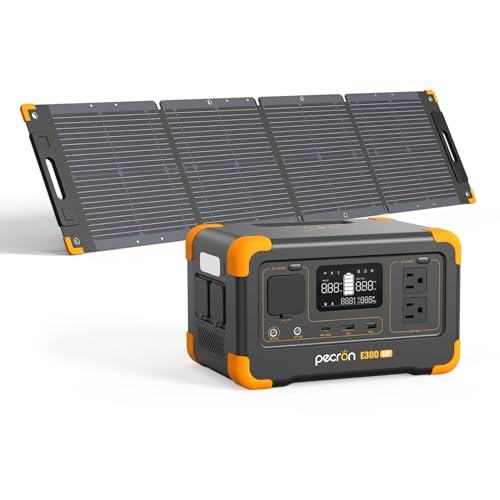
Pecron E300LFP 288Wh 600W with 100W panel
288Wh LiFePO4600W100W panelCamping kit
Check price on Amazon
Best for: Campers who want the station plus a 100W panel that refills in a day.

Pecron's E300LFP kit is aimed at buyers who want the panel in the box. The 100W panel is the largest bundled in this guide and gives roughly 60 to 80W in real sun, so the 288Wh LiFePO4 pack can fill in a single long afternoon, which none of the 40W bundled kits elsewhere can match. For a campsite where you leave the unit in the sun all day, that is a practical advantage.

The weakness is tank size. 288Wh gives about 245Wh usable, which is about 4 hours of a 60W load, and the 600W inverter can empty it in under 25 minutes if you push it. Against the LIBRIDS it has less than half the energy, so treat the 600W as a surge capability, not a sustained draw.

Pecron has a growing service presence and the LiFePO4 pack is a good long term bet. Keep the panel cable coiled loosely to avoid cracking the insulation, wipe the panel before each outing and check the connector for dirt. Because solar fills it quickly, you can cycle it daily on a long trip with confidence. In practice a three day camp with a laptop, phones, lights and a small fan draws roughly 150 to 200Wh per day, which the panel replaces each afternoon, so the small tank never becomes the limit.

What works

  • 100W panel is the largest bundled here
  • LiFePO4 cells with solid cycle life
  • 600W inverter at a compact size
  • Complete kit, nothing extra to buy

Watch out for

  • 288Wh tank runs heavy loads for minutes
  • Less capacity than the 640Wh LIBRIDS
  • Panel adds bulk to the pack list

Spec sheet

Capacity
288Wh LiFePO4
AC output
600W
Included panel
100W
Chemistry
LiFePO4
Positioning
Camping and backup
04
DaranEner 600W 288Wh LiFePO4 with 80W panel
288Wh LiFePO4600W / 1200W80W panel120W AC input
Check price on Amazon
Best for: Beginners who want a low cost LiFePO4 kit with an 80W panel and laptop-ready USB-C.

DaranEner's 600W kit is the starter pick because it combines an 80W panel with a LiFePO4 pack in a small box at a low tier. The 1200W surge allowance lets it start a small compressor such as a mini fridge, and the 100W USB-C PD port handles laptops without the inverter. The 80W panel will deliver 50 to 60W in sun, so the pack refills in about 5 to 6 hours of strong light.

It shares the 288Wh capacity of the Pecron and Bluetti and thus the same runtime ceiling, but the 120W AC input is slower than either rival. A full wall recharge takes about 2 hours to reach 80 percent, whereas the Bluetti gets there in 45 minutes. If you will be recharging between multiple outages, that slower refill is the main downside.

Care is simple: keep the unit out of hot vehicles, store at around half charge, and do not leave it unplugged in a drawer for a year, since lithium cells slowly self discharge. For a tight budget and an introduction to solar, this kit gives workable runtime and enough ports without requiring a second purchase.

What works

  • 80W panel included at a low tier
  • LiFePO4 pack with 1200W surge
  • 100W USB-C PD for laptops
  • Small footprint for the power class

Watch out for

  • 120W AC input recharges slowly
  • 288Wh limits heavy load runtime
  • Lesser known brand

Spec sheet

Capacity
288Wh LiFePO4
AC output
600W, 1200W surge
AC recharge
80% in about 2 hours, 120W
Included panel
80W
USB-C
100W PD
05
BLUETTI Elite 30 V2 288Wh 600W, 1500W lifting
288Wh LFP600W / 1500W lift10ms UPS45 min to 80%
Check price on Amazon
Best for: Buyers who want fast recharge, UPS reliability and a brand with support.

The Elite 30 V2 is the quick and tough option: LFP cells, a 10ms UPS and a 45 minute charge to 80 percent from the wall. Its Power Lifting mode takes a resistive load up to 1500W at reduced voltage, which gives it a trick none of the other 600W units can match, such as a short coffee maker or hair dryer run.

The flip side is tank size and price. At 288Wh it is the same size as the Pecron and DaranEner and sits at a higher tier, so you are paying for recharge speed, firmware and brand support rather than extra runtime. Lifting a 1000W load drains the pack in about 15 minutes, so keep that mode for brief jobs.

Ownership is where Bluetti earns its premium. The app lets you cap charge and update firmware, parts and warranty are easier to reach, and the 9.4 lb body is light enough to move room to room. Check vents for dust, avoid pushing continuous heavy loads, and store at about half charge when idle. Against the 640Wh LIBRIDS it is the better choice for a laptop desk or a tent, since you get the same UPS speed in a lighter shell, and the worse choice for an overnight outage where the larger tank simply outlasts it.

What works

  • 0 to 80% in about 45 minutes
  • 10ms UPS for desktops and routers
  • Power Lifting mode reaches 1500W on resistive loads
  • App control and firmware updates

Watch out for

  • Only 288Wh of energy at a premium tier
  • Lifting mode drains the pack in minutes
  • No panel bundled

Spec sheet

Capacity
288Wh LFP
AC output
600W, Power Lifting to 1500W
UPS
10ms
Fast charge
0 to 80% in 45 min
Weight
9.4 lb

Spec sheet decoder

What the numbers on the box really mean

The specs manufacturers lead with, translated into what they tell you about real-world performance.

600W AC

Continuous inverter limit. Add up running wattage of everything plugged in.

Watch forAll five picks claim it, so tank size differentiates them.

1200W peak

Startup allowance for motors and compressors lasting a second or two.

Watch forLIBRIDS and DaranEner list 1200W; the Bluetti's 1500W figure is a separate lifting mode.

Watt-hours

Stored energy, about 85 percent usable as AC.

Watch forLIBRIDS 640Wh, yewpiny 599Wh, three units at 288Wh.

10ms UPS

Switchover time when wall power fails while the unit is plugged in.

Watch forListed on the LIBRIDS and Bluetti only.

PD 100W

USB-C port output that can power a laptop directly without the AC inverter.

Watch foryewpiny and DaranEner list 100W.

Methodology

How We Evaluated These 600W Solar Generators

Runtime at fixed loads

We computed usable energy at 85 percent efficiency and ran it against 60W and 100W loads. That separates the LIBRIDS at around 540Wh usable from the three 288Wh units near 245Wh. This is the first filter.

Chemistry and longevity

We noted which units list LiFePO4 or LFP and treated vendor cycle claims as claims. Weekly cyclists were pointed toward the LiFePO4 units.

Charging flexibility

We compared AC input, solar input and bundled panels, from the Pecron's 100W to the DaranEner's 80W. Recharge from the wall was ranked using the 45 minute and two hour figures.

Backup behavior

We checked UPS claims and idle draw. Units with a 10ms UPS were rated as suitable for desktops and routers, while others were framed as camping tools.

Weight and support

We weighed the 9.4 lb Bluetti and other stations against their tank size and judged brand support by how easy warranty and parts service is to reach, relying on spec sheets and owner feedback patterns for every claim.

Decision guide

How to Choose the Right 600W Solar Generators

By Runtime Needed

SituationPickWhy
Overnight home essentialsLIBRIDS C600640Wh covers a full night at 60 to 80W
A day of laptop plus phone useyewpiny 600W 599Wh100W PD runs the laptop efficiently
Two hour dinner or movie outdoorsDaranEner 600W kit288Wh and panel ready
Quick top ups between short outagesBLUETTI Elite 30 V245 minute fast charge
All day camping with a panelPecron E300LFP100W panel refills in a day

By Budget

TierPickWhy
Lowest starter tierDaranEner 600W kitPanel and LiFePO4 included
Low midyewpiny 600W 599WhLargest tank for the cost
Mid with panelPecron E300LFP100W panel in the box
Upper tierLIBRIDS C600640Wh LiFePO4 and UPS
Highest tierBLUETTI Elite 30 V2Fast charge and support

Big Tank vs Small Tank

640Wh or 599Wh class

The LIBRIDS and yewpiny hold more than twice the energy of the 288Wh units, so they cover an overnight outage. They weigh more and take longer to recharge from small panels.

288Wh class

The Pecron, DaranEner and Bluetti are light and fill quickly from a panel or wall. They suit day trips and short backups, but a 100W load drains them in under 2.5 hours.

Choose the big tank for home backup and the small tank for camping and travel.

Recharge Priority

PreferencePickWhy
Fastest wall rechargeBLUETTI Elite 30 V20 to 80% in about 45 minutes
Solar refill in one afternoonPecron E300LFP100W panel on a 288Wh pack
Moderate speed, low costDaranEner 600W kit80W panel and 120W AC input
Large pack, slower refillLIBRIDS C600Large tank takes longer to fill
Laptop top up on the goyewpiny 600W 599Wh100W USB-C PD input and output

For Home Office Backup Specifically

Look for

A 10ms UPS, pure sine wave and at least 500Wh for a night of router, monitor and laptop. A desktop plus monitor draws 100 to 150W, so size the tank for hours of that.

In this comparison

The LIBRIDS C600 combines 640Wh with a 10ms UPS and is the most complete. The Bluetti Elite 30 V2 has the UPS but only 288Wh, so it fits a laptop office rather than a desktop.

When to Spend More

Spend more if

You want fast refills, UPS and an app. The Bluetti Elite 30 V2 gives all three, and the LIBRIDS adds capacity. Both are better for medical or office loads that cannot fail.

Save if

You camp occasionally. The DaranEner kit and yewpiny station cover phones, lights and a laptop at a lower tier, and their compromises are slower charging or no UPS.

Ownership

Maintenance schedule

The upkeep that decides whether this machine lasts two seasons or ten.

TaskIntervalWhy it matters
Top up the packEvery 3 monthsIdle lithium packs self discharge. Keep the charge between 40 and 60 percent for long storage.
Turn off the inverterAfter every sessionThe AC section draws power even with no load. Leaving it on can drain a 288Wh unit in under two days.
Clean the panelBefore each tripDust can cut harvest by around 10 percent. Wipe with a damp soft cloth only.
Inspect connectorsEvery 6 monthsCorroded or loose barrel plugs overheat and limit charge current.
Run a full cycleOnce a yearReveals capacity loss and recalibrates the gauge.

FAQ

Frequently Asked Questions

Is a 600W unit enough to run a mini fridge?

Yes for most compact compressor fridges, which draw 40 to 80W running and surge briefly at startup. A 288Wh pack gives roughly 4 to 6 hours of duty cycled runtime, while the LIBRIDS 640Wh stretches that to about 10 to 14 hours.

Should I pick 640Wh or 288Wh?

Pick the larger tank if you want overnight backup, and the smaller if weight and quick solar refills matter more. Capacity beats inverter size for deciding how long you last.

Can it run a coffee maker?

Small drip coffee makers draw 600 to 1,000W while heating. Only the Bluetti's Power Lifting mode can handle many of them, and then briefly. The other picks would trip.

Does LiFePO4 matter at this size?

Yes if you cycle weekly. LiFePO4 offers roughly 2,000 or more cycles versus 500 to 800 for ordinary lithium. For rare use it matters less.

What is the difference between 600W and 1200W peak?

Continuous 600W is what the inverter can sustain. The 1200W peak is a short allowance for motor start surges, lasting about a second, and must not be treated as usable capacity.

Can I use a larger solar panel with it?

Only within the input voltage and wattage limit on the label. A panel above the voltage limit can damage the controller, and extra wattage beyond the limit is simply ignored.

Bottom line

The short version

Browse more 600w solar generatorson Amazon →
James Miller, Lead Machine Editor

About the author

James Miller

Lead Machine Editor, MachineFanatic

James Miller leads MachineFanatic's buying guides, turning spec sheets, manuals and owner feedback into clear verdicts on power tools, outdoor power equipment, shop machines and kitchen machines.

More from James →

Keep reading

Related guides